A modern waste compactor for businesses can reduce your total waste volume by up to 80 percent according to 2026 data from The Mark-Costello Co. Stop paying to haul air in loose bags and start reclaiming your loading dock today. You've likely seen your hauling fees climb while unauthorized dumping and pest issues create a constant logistical headache. It's a drain on your time and your bottom line that you can't afford to ignore.
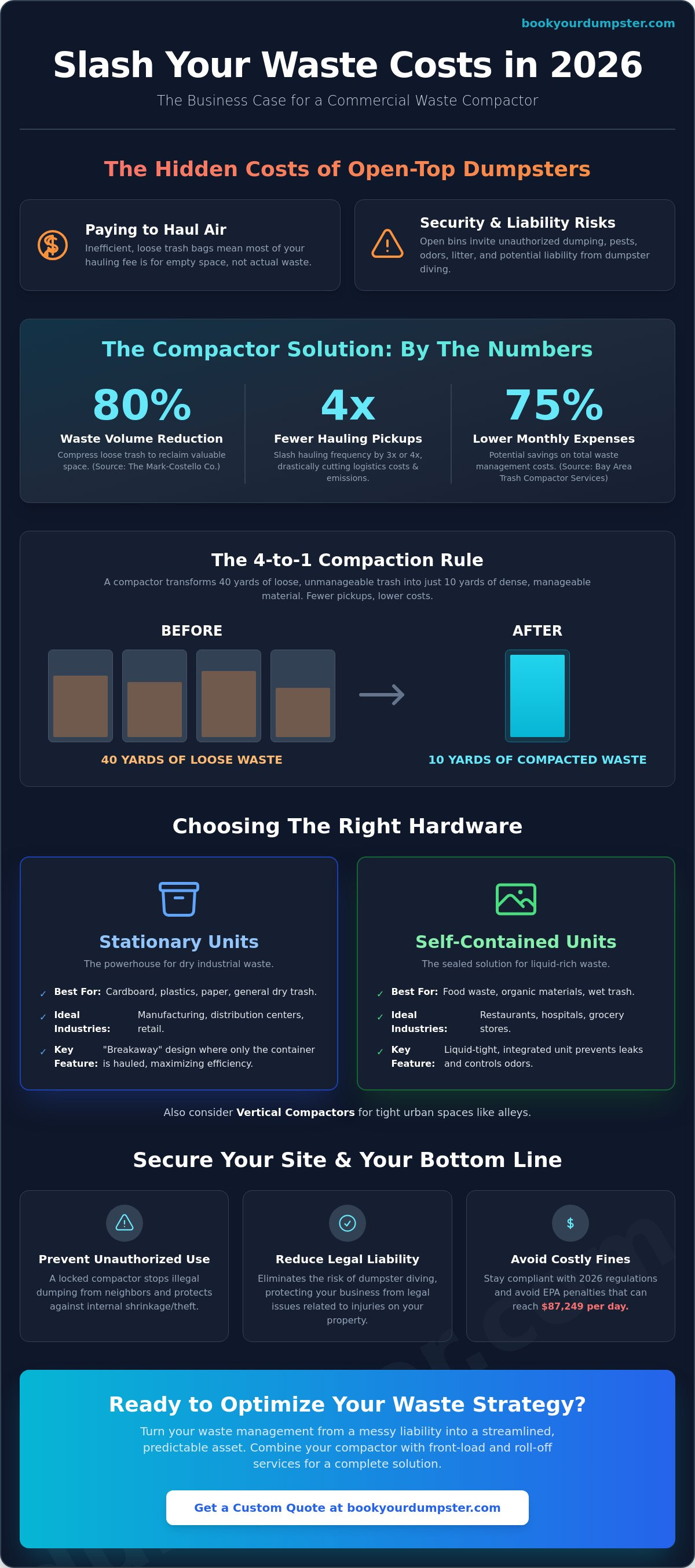
This guide shows you how a commercial compactor can slash your hauling frequency by 3x or 4x. You'll learn to secure your site and lower your monthly expenses by up to 75 percent based on reports from Bay Area Trash Compactor Services. We'll examine the 2026 regulatory landscape, including how to avoid EPA penalties that now reach $87,249 per day. We also compare stationary and self-contained units so you can choose the right tool for your specific waste stream. Use this information to turn a messy liability into a streamlined, predictable asset for your business operations.
Key Takeaways
- Understand the 4:1 compaction ratio and learn how it slashes your hauling frequency.
- Pick the right hardware by comparing stationary units for dry waste and self-contained models for wet materials.
- Identify the ROI tipping point to determine when a waste compactor for businesses becomes more cost-effective than standard dumpsters.
- Prepare your site for installation by meeting specific electrical and space requirements for heavy-duty hauling equipment.
- Combine your compactor with front load commercial waste pickup and roll-off rentals to manage surge volume and specialized debris.
Why Your Business Needs a Waste Compactor in 2026
A waste compactor for businesses is a motorized engine that crushes material into a high-density container. It's a high-functioning tool designed to replace the inefficiency of traditional open-top bins. In 2026, logistics costs are too high to ignore. If you're still using standard dumpsters, you're likely paying to haul air. A compactor changes the math. It takes 40 yards of loose, unmanageable trash and compresses it into just 10 yards of dense material. This shift alone can transform your overhead by reducing the number of times a truck needs to visit your site.
Open dumpsters come with hidden costs that eat into your profits every month. They attract pests, allow wind to blow litter across your site, and invite neighbors to dump their own waste in your containers. For retail and hospitality businesses, a messy loading dock is a liability. A sealed compactor keeps your site looking professional and keeps odors contained. It’s about maintaining control over your facility's environment and your budget. Consider these common issues with open containers:
- Unauthorized dumping: Third parties filling your bins with their debris.
- Litter management: Wind-blown trash requiring manual labor to clean up.
- Pest attraction: Open food waste inviting rodents and insects.
- Odor control: Uncompacted wet waste creating smells that drive away customers.
The 4-to-1 Rule: Visualizing Waste Density
The physical process is straightforward. A hydraulic ram moves through the charging chamber, compressing waste against a reinforced container wall. This action eliminates the air pockets found in loose trash bags. By understanding waste compaction, you can see why hauling uncompacted waste is a major profit leak. Densification allows you to fit significantly more material into every load. This doesn't just save money; it reduces the carbon footprint of your operations. Fewer truck arrivals mean less traffic congestion and lower overall emissions for your facility.
Security and Liability Benefits
A compactor provides a level of security that open bins can't match. It prevents dumpster diving, which protects you from the legal liabilities associated with injuries on your property. It also serves as a deterrent for internal shrinkage. Some employees hide valuable merchandise in loose trash to pick it up later from an open bin. A compactor makes this impossible by crushing everything immediately. Additionally, a locked unit stops neighbors from using your commercial containers for their personal waste. You should only pay for the trash your business produces. Secure your perimeter and stop subsidizing the neighborhood's disposal needs.
Choosing the Right Hardware: Stationary vs. Self-Contained
Selecting the wrong equipment leads to maintenance nightmares and environmental fines. Your choice of a waste compactor for businesses depends entirely on what you throw away. Dry materials like cardboard and plastic behave differently than wet, organic waste. Matching the machine to your specific waste stream is the first step toward reclaiming your budget and your floor space.
Stationary Units for Dry Industrial Waste
Stationary units are the standard for distribution centers and manufacturing plants in industrial hubs like New Jersey or Illinois. In a stationary setup, the motorized power unit remains bolted to the concrete. Only the receiving container is detached and hauled away when full. This "breakaway" design ensures the truck isn't wasting fuel hauling heavy machinery back and forth. It maximizes the legal weight limit for actual waste. Following industrial waste management guidelines helps ensure these units stay compliant with local environmental standards and disposal regulations.
Self-Contained Units for Liquid-Rich Waste
If you run a restaurant, hospital, or grocery store, you deal with "wet" waste. Self-contained compactors are the industry standard for these environments. The compactor and container are integrated into a single, liquid-tight unit. This design prevents leachate, or "trash juice," from leaking onto your pavement and into storm drains. In 2026, stricter organic waste diversion laws in states like New York and California make these units essential for high-volume food generators. Modern models include ozone generators and high-pressure seals to neutralize odors before they reach your customers or neighbors.
Beyond the two main types, consider these specialized tools for specific logistical challenges:
- Vertical Compactors: These are the space-saving heroes for tight alleys in cities like San Francisco or Queens. They take up little more room than a standard dumpster.
- Pre-Crushers: Choose these if your business deals with bulky items like pallets, crates, or furniture. They destroy the material's structural integrity before it even enters the container.
Choosing the right hardware prevents the logistical stress of leaks and equipment failure. If you're unsure which unit fits your daily volume, look into our front load commercial waste pickup options to see how different containers handle various waste streams. Get the right tool now to avoid paying for "hauling air" later this year.
The ROI Calculation: Is a Compactor Worth the Investment?
You don't need a compactor if your facility only fills a single cart. However, if your business requires more than two 8-yard dumpster pickups every week, you've reached the financial tipping point. At this volume, the cost of "hauling air" in loose bags begins to outweigh the cost of compaction equipment. A waste compactor for businesses turns your waste stream into a densified asset, allowing you to pay for actual weight rather than empty container space.
Standard waste contracts often rely on a "cost per pull" model. You pay a flat fee every time a truck visits your site, regardless of how much material is inside the bin. Switching to a compaction strategy moves your focus to "cost per ton." By packing four times as much material into a single container, you eliminate three out of every four truck visits. This change delivers immediate savings to your monthly waste management budget. Beyond the hauling fees, consider the labor savings. Employees spend less time walking to the loading dock and more time on core business tasks. In 2026, efficiency is your best defense against rising operational costs.
Reducing Hauling Frequency
Imagine moving from twelve pickups a month down to just three. This reduction does more than lower your hauling invoice. It protects your property. Heavy waste trucks cause significant pavement wear and tear over time, eventually leading to expensive asphalt repairs. By densifying your waste, you limit these heavy-duty visits and extend the life of your parking lot. Review our 2026 guide on Understanding Dumpster Rental Prices to see how these hauling fees vary across regions like New York and Illinois.
Rental vs. Purchase: Which Model Fits Your Cash Flow?
Deciding between leasing and buying depends on your long-term capital strategy. A rental agreement usually provides a fixed monthly fee that includes all preventative maintenance and emergency repairs. This is a popular choice for high-growth businesses in Massachusetts that prefer predictable expenses over large capital outlays. Purchasing the equipment outright builds long-term equity for established facilities. While the initial investment is higher, a high-quality machine typically pays for itself through hauling savings within two to four years. Many states now offer 2026 tax incentives for "green" waste technology, making energy-efficient units even more attractive for businesses looking to upgrade their infrastructure.
Installation Requirements and Local Compliance
Installing a waste compactor for businesses requires more than just an open spot on your loading dock. This is a heavy industrial machine, not a standard bin. You must prepare your infrastructure to handle the electrical load and physical stress of hydraulic compaction. Failure to plan for these specs leads to expensive delays and potential code violations. Start by verifying your power supply. Most commercial units require 3-phase power and a dedicated disconnect switch located within sight of the machine. This ensures your maintenance team can safely cut power during service or emergencies.
The physical footprint is another critical factor. You need a reinforced concrete pad at least 6 inches thick. The hydraulic ram exerts thousands of pounds of pressure against the container wall; standard asphalt or thin concrete will crack and sink under these forces. Beyond the pad itself, consider the logistics of the haul-off truck. These vehicles require a 50-60 foot straight-line approach to safely back into and pull the container. If your site has tight turns or steep inclines, you may need to reconsider your placement or choose a smaller unit. Navigating zoning laws in cities like Chicago or NYC also requires attention to permanent waste fixture regulations. Check your local building codes before you bolt anything to the ground.
Urban Constraints: Queens and San Francisco
Space is a premium in dense areas like Queens or San Francisco. Managing compactor placement in shared alleys or tight loading docks requires precision. You must also account for local noise ordinances. Some municipalities restrict the use of heavy machinery during late-night or early-morning hours, meaning you can only run your compaction cycles during the day. Local fire codes are equally strict regarding the storage of combustible waste. Ensure your unit is placed away from building air intakes and emergency exits to stay compliant with safety regulations. If space is too tight for a permanent installation, look at our front load commercial waste pickup options for a more flexible solution.
Safety and Employee Training
Safety is your primary liability concern. All equipment must meet ANSI Z245 standards for waste technology. Your managers should verify that every unit has accessible emergency stop buttons and safety interlocks on all loading doors. These interlocks prevent the ram from moving while a door is open. Training your staff is the final step in a successful installation. Operators must ensure the charging chamber is completely clear of obstructions and people before initiating the compaction cycle. Proper training reduces the risk of equipment damage and keeps your workers safe on the job.
Optimizing Your Waste Strategy with Book Your Dumpster USA
A waste compactor for businesses is a powerful tool, but it doesn't solve every disposal challenge. Most facilities generate multiple waste streams that require different handling methods. Integrating your compactor with a reliable front load commercial waste pickup service ensures your daily trash is managed efficiently while specialized materials are diverted correctly. Our digital booking system allows you to manage these diverse needs across New York, New Jersey, and Illinois from a single interface. This centralized approach removes the logistical stress of coordinating with multiple vendors and keeps your loading dock clear.
The Hybrid Approach: Compactor + Roll-Off
Some materials simply don't belong in a compactor. Construction debris, heavy pallets, and bulky surge waste can damage hydraulic rams or create jams that halt your operations. A hybrid strategy uses a permanent compactor for high-volume daily waste and temporary roll-off rentals for project-specific needs. If you're managing a renovation or clearing out old inventory, consult The Ultimate Guide to Construction Debris Removal to determine the best container for your project. This prevents your primary equipment from being misused and extends its service life.
A small 10 yard dumpster rental serves as the perfect overflow companion for these specialized materials. For example, a large retail warehouse might use a stationary compactor for high-volume cardboard recycling while keeping a 30 yard dumpster on-site for pallet disposal and broken fixtures. This setup prevents your primary machine from being overwhelmed by materials it wasn't designed to crush. It keeps your waste streams segregated and your costs predictable. You won't have to worry about "hauling air" or damaging your expensive compaction hardware.
Streamlined Logistics and Transparent Pricing
Reliability is the foundation of a successful waste strategy. You can't afford to have a full compactor sitting idle while your facility continues to produce trash. We focus on punctuality and pricing integrity to ensure your equipment is emptied before it reaches 100 percent capacity. Our direct-to-consumer model eliminates the opaque fees and hidden surcharges that are common elsewhere in the industry. You get clear terms and dependable scheduling every time you book through our platform.
Stop letting waste logistics drain your time and capital. Move your business from a state of clutter to a state of resolution with a strategy built for the demands of 2026. Book your next commercial waste solution today and take control of your facility's efficiency. We provide the tools and the service needed to keep your loading dock professional and your budget on track.
Secure Your Competitive Edge in 2026
Transitioning to a waste compactor for businesses is a strategic move that addresses rising hauling costs and site security. You've seen how densifying your trash by up to 80 percent eliminates the waste of "hauling air." By matching the right hardware to your specific waste stream and preparing your site for installation, you reclaim control over your loading dock. This shift doesn't just lower your monthly expenses; it protects your facility from unauthorized dumping and reduces pavement wear.
Whether you need a permanent solution or a 10 to 40 yard roll-off for seasonal surges, we provide the tools to keep your operations running smoothly. We serve major markets across NY, NJ, IL, MA, and SF with transparent, no-nonsense pricing that respects your bottom line. Stop letting messy logistics complicate your workday. Streamline your business waste—Book Your Dumpster now. Take the final step toward a cleaner, more efficient, and more profitable facility today.
Frequently Asked Questions
How much space does a commercial waste compactor actually require?
A typical stationary unit requires a physical footprint of roughly 10 by 20 feet for the machine and container. However, the most critical space requirement is the 50 to 60 foot straight-line approach needed for the collection truck to safely pull the container. Always verify your site dimensions to ensure the vehicle has enough overhead clearance and a sufficient turning radius to navigate your loading dock.
Can I put recyclables and regular trash in the same compactor?
Don't mix recyclables and regular trash in the same waste compactor for businesses. Doing so contaminates the recycling stream and often leads to rejected loads at the disposal facility. Use separate units or a dedicated baler for cardboard and plastic. Keeping these streams distinct ensures you meet local diversion mandates and avoid the financial penalties associated with contaminated loads.
What is the typical lifespan of a business waste compactor with regular maintenance?
A high-quality commercial compactor typically lasts between 10 and 15 years when you follow a strict preventative maintenance schedule. Regular hydraulic seal inspections, oil changes, and structural repairs extend the machine's service life significantly. Neglecting these tasks leads to premature pump failure and expensive downtime. Invest in a routine service plan to protect your long-term capital investment and ensure operational reliability.
Is it better to rent or buy a compactor for a new business location?
Renting is often the better choice for a new business location because it preserves your cash flow while providing a modern waste compactor for businesses. This model allows you to scale or change equipment as your volume grows without being locked into a specific machine. If you have a stable, long-term facility with predictable waste streams, purchasing the equipment outright builds equity and lowers your total cost of ownership over a decade.
Do I need a special permit to install a compactor in New York or Chicago?
Yes, you usually need a permit to install a permanent waste fixture in cities like New York or Chicago. These regulations ensure your equipment doesn't block public right-of-ways or violate local fire codes. Check with your local building department or zoning board early in the planning phase. Permit costs and requirements vary by borough and neighborhood, so verify the specifics for your exact address before bolting equipment to the ground.
How often does a compactor container need to be hauled away compared to a dumpster?
A compactor container typically needs to be hauled away three to four times less often than a standard open-top dumpster. Because the machine densifies the material, a container that would normally be full in two days can often last over a week. This reduction in truck visits is the primary driver of cost savings for your facility. Monitor your container's fullness levels to schedule pickups precisely when they're needed.
What happens if the compactor breaks down? How do we manage trash in the meantime?
If your unit fails, immediately switch to a temporary roll-off dumpster to manage your daily trash. This prevents waste from piling up on your loading dock while you wait for repairs. We recommend having a quick-deployment rental agreement in place for a 10 or 20 yard dumpster. This backup plan ensures your facility stays operational and compliant with health codes during equipment downtime.
Can a waste compactor handle bulky items like wooden pallets or furniture?
Standard compactors aren't designed to handle wooden pallets, large furniture, or heavy construction debris. These items can jam the hydraulic ram or puncture the container walls. Use a specialized pre-crusher if you must process bulky wood or metal. For occasional large items, it's safer and more efficient to use a 30 or 40 yard roll-off dumpster to avoid damaging your expensive compaction hardware.