Your open-top dumpster is likely the most expensive storage unit your business owns. If your facility in New York, Illinois, or Massachusetts handles high volumes of dry waste, you have probably noticed the costs of frequent hauls spiraling out of control. It's frustrating to watch employees spend hours breaking down cardboard or managing a cluttered loading dock that attracts pests. You need a logistics strategy that turns massive waste volume into a predictable, low-frequency hauling schedule. A professional stationary compactor service provides exactly that by compressing your trash into a fraction of its original size.
You'll learn how to optimize your high-volume waste streams and reduce your hauling costs. We'll show you how to select the right equipment for your facility while ensuring you stay compliant with the latest regulations, such as the New York Commercial Waste Zones program or the ANSI Z245.2-2026 safety standards. This guide covers everything from equipment selection to streamlining your logistics. Stop overpaying for air and start managing your waste with professional precision.
Key Takeaways
- Reduce hauling frequency by compressing dry waste at a 4:1 ratio to cut unnecessary operational costs.
- Select a professional stationary compactor service specifically for dry, bulky materials to keep your power unit permanently on-site.
- Identify the critical differences between stationary and self-contained units to avoid equipment damage from wet waste streams.
- Prepare your facility with a reinforced six-inch concrete pad and 3-phase power to meet industrial installation standards.
- Streamline your logistics in New York, Illinois, or Massachusetts by matching your waste volume to the right equipment size.
What is a Stationary Compactor Service and Why Does Your Business Need One?
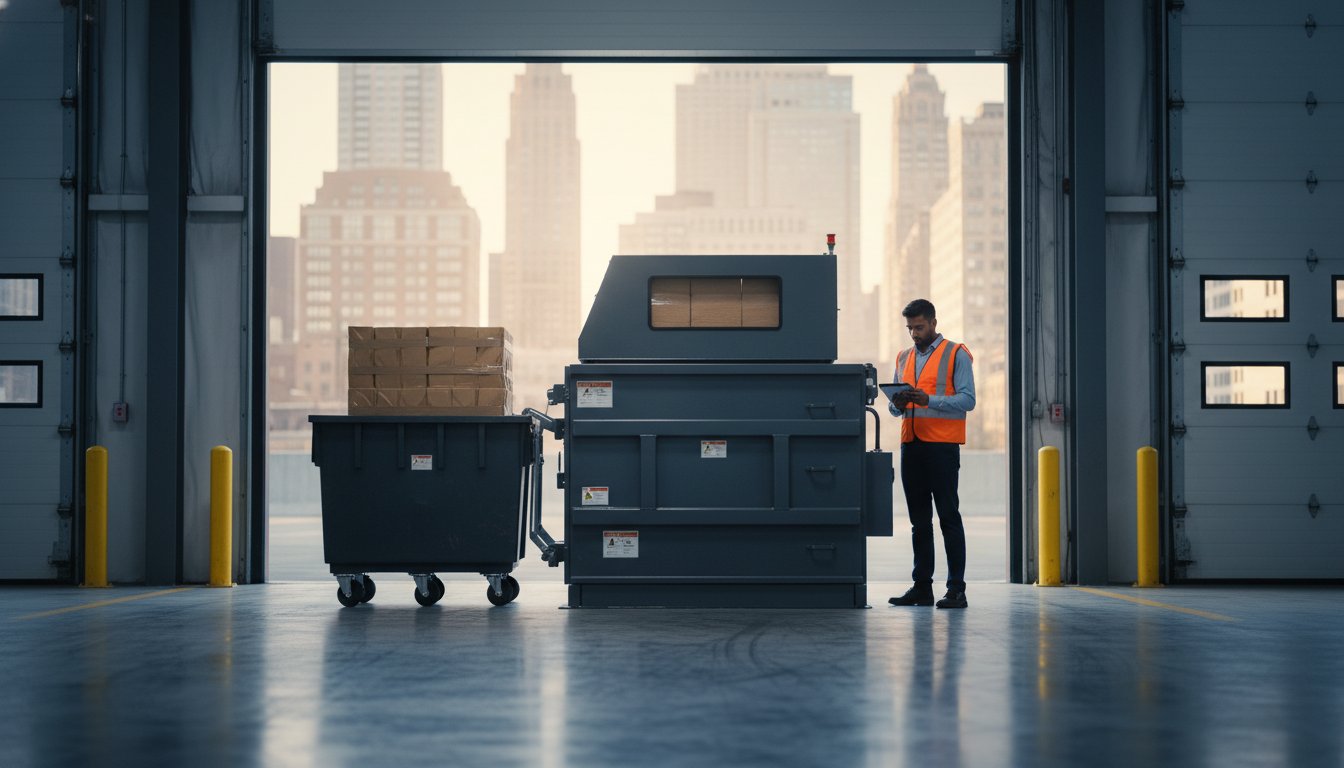
A stationary compactor is a heavy-duty machine bolted to a reinforced concrete pad. It uses a powerful hydraulic ram to crush dry waste into a detachable receiver box. This setup is the backbone of a reliable stationary compactor service. Unlike standard dumpsters, the power unit remains on your property while only the container is hauled away for emptying. This system is specifically designed for facilities that handle massive amounts of cardboard, paper, and dry trash, including:
- Distribution centers and warehouses
- Large-scale manufacturing plants
- Retail department stores and malls
- Printing facilities and paper recyclers
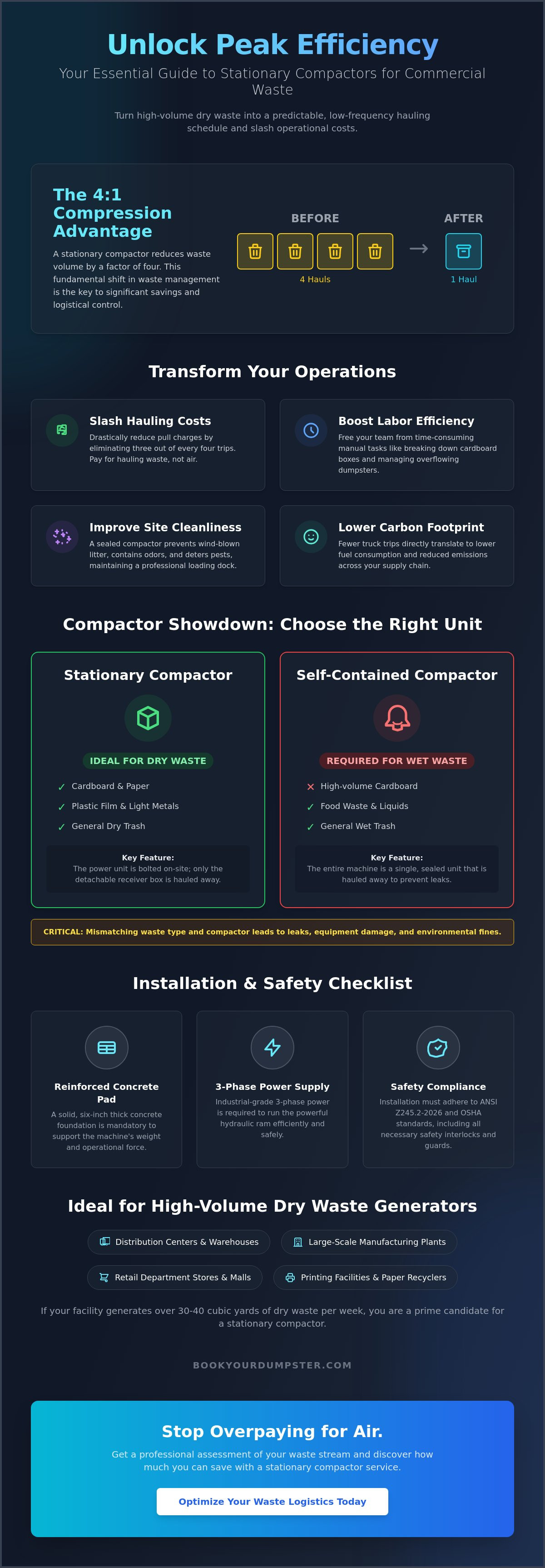
A Compactor works by exerting thousands of pounds of pressure to reduce waste volume significantly. In most industrial settings, you can expect a 4:1 compression ratio. This means you fit four times as much trash into a single container compared to a standard open-top roll-off. You effectively turn four expensive hauls into one, instantly streamlining your logistics and reducing the footprint of your waste area.
The ROI of Switching from Standard Roll-Offs
The primary financial benefit is the drastic reduction in pull charges. Every time a truck arrives to haul a dumpster, you pay a fee. By consolidating your waste into denser loads, you eliminate three out of every four trips. Labor efficiency also improves. Your employees won't spend their shifts manually breaking down boxes or trying to stomp trash down to make room. If your facility generates more than 30 to 40 cubic yards of dry waste per week, the volume likely justifies the transition to a stationary unit. Visit Book Your Dumpster USA to evaluate your current waste volume and see if a compaction strategy fits your needs. You gain total control over your hauling schedule rather than being at the mercy of frequent, unpredictable pickups.
Environmental and Aesthetic Benefits
Reducing the number of waste trucks entering your facility lowers your carbon footprint. Fewer trips mean lower fuel consumption and reduced emissions across your supply chain. Beyond the environment, a stationary compactor service transforms your loading dock. Standard open-top containers often overflow, leading to wind-blown litter and a cluttered appearance. A compactor keeps waste sealed and pressurized. This prevents debris from escaping and removes the food sources and nesting areas that attract pests like rodents and birds. Your facility stays clean, professional, and compliant with local sanitation standards in New York, Illinois, and Massachusetts.
How Stationary Compactors Work: From Loading to Hauling
Understanding the mechanical process of a stationary unit helps you maximize its efficiency. At its core, a stationary compactor uses a heavy-duty hydraulic ram to exert thousands of pounds of pressure against your waste. As you load material into the charging chamber, the ram cycles forward, pushing the trash into the attached receiver box. This constant pressure crushes bulky items like cardboard and plastic into a dense mass. The hallmark of a professional stationary compactor service is the breakaway design. This allows the receiver container to detach completely from the stationary power unit when it is time for transport.
Material compatibility is a vital factor in operational success. These machines are engineered specifically for dry waste streams. Cardboard, paper, plastic film, and light metals are ideal. Avoid liquids or food waste in these units; because the power unit and container separate, liquids can leak from the seal during the breakaway process. To prevent overflows, modern units use pressure-based monitoring systems. These sensors track the resistance the ram meets and alert the service provider when the container reaches 80% capacity. This data-driven approach ensures you never pay for a "pull" on a half-empty container.
The Loading Lifecycle
Your facility layout determines how you interact with the machine. Many businesses choose manual loading from a dock level, while others install through-the-wall chute systems. Chutes allow employees to dispose of waste from inside the building, which improves security and climate control. Regardless of the method, safety is the priority. All units must feature safety interlocks that cut power if the loading gate is open. Following OSHA safety requirements for machine guarding is essential to protect your team. High-velocity environments benefit most from these automated systems because they keep the loading area clear of debris in real-time.
Scheduled vs. On-Call Hauling Services
Logistics management is where you see the most significant cost savings. You can choose between a fixed hauling schedule or an on-call service based on your sensor data. In high-volume regions like New York, Illinois, and Massachusetts, coordinating these swaps is a precision task. The service provider arrives with an empty receiver box, detaches your full one, and swaps them in minutes. This minimizes downtime for your loading dock. If you are unsure which schedule fits your production cycle, you can evaluate commercial waste options to find a balance between hauling frequency and equipment capacity. Efficient scheduling reduces the total number of "pull" charges, which are the primary drivers of your monthly waste expenses.
Comparing Stationary vs. Self-Contained Compactors
Choosing between a stationary and a self-contained unit depends entirely on your waste profile. A stationary compactor service is the standard choice for dry, bulky materials. Since the power unit is bolted to the ground, only the receiver box moves during the haul. This setup reduces wear and tear on the hydraulic components, often leading to lower long-term maintenance costs. In contrast, self-contained units are built for wet waste. They are sealed systems where the entire machine is hauled away to prevent leaks. If your facility produces food waste or liquids, a stationary unit isn't for you.
Space is another critical factor. Stationary units require more linear clearance because the truck needs room to back in, hitch the receiver box, and pull it away from the power unit. Before you commit, measure your loading dock carefully. You don't want to realize too late that your breakaway container blocks essential traffic lanes. Because the power unit stays put, you don't have to worry about reconnecting complex electrical leads every time the container returns from the dump site.
When to Choose a Stationary Unit
Use the 70% rule as your guide. If at least 70% of your waste stream consists of dry recyclables or trash, a stationary unit is your most cost-effective option. Distribution centers in Massachusetts often prefer these units because they handle massive amounts of packaging material. Aligning your equipment with the waste management hierarchy helps you focus on volume reduction and recovery. From a budget perspective, these units offer the best ROI because they maximize the weight of every load, directly slashing your monthly hauling expenses.
The Hybrid Approach: Compactors and Roll-Offs
One machine rarely solves every waste problem. Many high-volume facilities use a hybrid strategy. You might use a stationary unit for your primary cardboard stream while keeping a 10 yard dumpster on-site for miscellaneous office trash or construction debris. This prevents your compactor from getting clogged with non-compressible items that could damage the ram.
During peak seasons, such as the Q4 retail rush, your volume might outpace even a high-capacity compactor. In these cases, adding a temporary roll off dumpster rental ensures your dock stays clear during 24-hour operations. Integrating these different tools into a total waste management plan allows you to scale your capacity up or down based on your facility's real-time needs. This multi-layered approach keeps your logistics flexible and your costs predictable.
Planning Your Installation: Site Requirements and Safety Standards
Installing a stationary compactor requires more than just clear space. You are anchoring a high-pressure machine to your property. This requires precise infrastructure to ensure your stationary compactor service runs without mechanical failure. Start with the foundation. A reinforced 6-inch concrete pad is non-negotiable. Standard asphalt will crumble under the thousands of pounds of hydraulic force exerted during the compaction cycle. If the pad isn't level, the ram will misalign. This leads to hydraulic leaks and frame warping over time.
Electrical infrastructure is the next hurdle. Most industrial units require 3-phase power, typically 208, 230, or 460 volts. You'll need a certified electrician to install a dedicated fused disconnect within sight of the machine. This ensures operators can cut power immediately during an emergency. Don't forget about truck access. The hauling vehicle needs a straight approach and enough linear space to pull the receiver box away from the power unit. In tight urban areas of New York or Chicago, this clearance is often the deciding factor in equipment sizing.
Compliance is about more than avoiding fines. Following the latest ANSI Z245.2-2026 standards ensures your equipment meets current manufacturing and installation safety requirements. OSHA regulations, specifically 29 CFR 570.63 as amended in April 2026, mandate strict guidelines for machine guarding and operation. Ignoring these details puts your staff at risk and opens your business to significant liability in Massachusetts and beyond. Professional installation ensures every safety interlock is functional before the first cycle begins.
The Pre-Installation Checklist
Verify the pad is completely level before the installers arrive. Even a slight slope can cause fluid to pool or the breakaway system to jam. Install heavy-duty steel bollards around the power unit. These protect your investment from accidental impact when the hauling truck backs in for a swap. Finally, place the power disconnect in a secure but reachable location. This prevents unauthorized use while keeping the operator safe during daily tasks.
Employee Training and Operational Safety
Develop a clear standard operating procedure (SOP) for all employees. Every operator must know the location of the emergency stop button and understand lockout/tagout procedures. Regular maintenance checks are the key to longevity. A well-maintained unit can last 15 to 20 years. If you're ready to upgrade your facility's infrastructure, schedule a commercial waste consultation to confirm your site meets these technical requirements. Taking these steps now prevents costly delays during the equipment rollout.
Streamlining Your Commercial Waste with Book Your Dumpster USA
Managing a high-volume facility requires more than just heavy machinery. It demands a logistics partner who understands the specific rhythm of your production floor. At Book Your Dumpster USA, we provide a stationary compactor service designed to eliminate the stress of waste management. Our team doesn't just deliver equipment. We act as consultants to help you determine if your volume justifies a stationary unit or if your needs are better met by our standard front-load options. By analyzing your waste streams, we ensure you never pay for capacity you don't use.
Our footprint spans the major industrial hubs of New York, Illinois, and Massachusetts. We provide localized support that accounts for regional specificities, such as the New York City Commercial Waste Zones program. You get a single point of contact for all your hauling needs, ensuring your loading dock stays clear and your operations remain uninterrupted. Check our latest dumpster rental prices to see how our transparent rates compare to your current overhead. We offer scalable solutions that grow with your business, moving you from basic dumpster rental prices to comprehensive industrial compactor management.
Why Commercial Clients Trust Our Logistics
Reliability is our primary product. Our 2026 commitment to pricing integrity means the quote you receive is the price you pay. We have extensive experience managing waste for high-density areas, from the busy commercial corridors of Queens to the industrial sectors of San Francisco. This experience allows us to navigate tight delivery windows and complex municipal regulations with ease. If your project grows unexpectedly, use our simplified online booking system to add supplemental services. Whether you need an extra 30 yard dumpster for a cleanout or a temporary roll-off, we scale our response to match your urgency.
Getting Started with Your Custom Waste Audit
Savings begin with a data-driven audit. We examine your current dumpster rental expenses to identify exactly where compaction can reduce your "pull" charges. Our experts then schedule a site visit to verify your electrical readiness and concrete pad specifications. We don't leave your installation to chance. Book Your Dumpster USA is ready to modernize your waste management and turn your trash into a streamlined, low-cost asset. Contact us today to secure your equipment and stabilize your 2026 stationary compactor service budget.
Modernize Your Facility Logistics
Transitioning to a professional stationary compactor service is a decisive move for any high-volume business. You've seen how compressing dry waste at a 4:1 ratio slashes hauling frequency and clears your loading dock of persistent clutter. By following strict site requirements and adhering to current safety standards, you protect your team and your investment for the long term. These logistics upgrades turn a messy operational burden into a predictable, cost-controlled asset.
Book Your Dumpster USA has served commercial clients in NY, NJ, IL, MA, and SF since 2018. We provide the industrial-grade equipment and hauling reliability you need to maintain a high-functioning facility. You'll benefit from transparent pricing with no hidden fees, ensuring your waste budget remains stable throughout the year. Don't let inefficient trash management slow down your production or inflate your overhead. Our team is ready to help you transition from standard roll-off containers to a high-efficiency compaction strategy.
Optimize Your Commercial Waste Logistics with Book Your Dumpster USA and take control of your facility waste stream. It's time to stop paying for air and start maximizing your operational efficiency.
Frequently Asked Questions
How much space is required for a stationary compactor installation?
You need approximately 40 to 50 feet of linear clearance to accommodate the machine and the hauling truck. This space allows the vehicle to back in, hitch the receiver box, and pull it away from the power unit. Always measure your loading dock width and height to ensure the truck has a clear path without obstructing traffic or neighboring businesses.
What is the difference between a stationary and self-contained compactor?
A stationary unit is bolted to the ground and handles dry waste, while a self-contained unit is a sealed machine designed for wet waste. In a stationary compactor service, the power unit stays on your site during the haul. Self-contained units are entirely removed and replaced to prevent leaks from food or liquid waste during transport.
Can I put cardboard and plastic in the same stationary compactor?
You can mix cardboard and plastic if they're part of a single-stream dry waste load. However, if your facility in Massachusetts or Illinois requires separated recycling to meet local diversion goals, you must keep these materials in dedicated units. Mixing materials is efficient for volume reduction but may impact your recycling rebates or compliance status.
How often does a stationary compactor container need to be hauled?
Hauling frequency depends on your specific waste volume and the capacity of your receiver box. Most businesses schedule a haul when their internal sensors reach 80 percent capacity to avoid overflows. High-volume distribution centers may require weekly swaps, while smaller manufacturing plants might only need a pull once every few weeks.
What are the electrical requirements for a commercial trash compactor?
Most industrial compactors require a dedicated 3-phase electrical circuit with 208, 230, or 460 volts. You must install a fused disconnect box within reach of the machine for emergency shutdowns. Consult with a certified electrician to ensure your facility's power grid can handle the startup current of a high-pressure hydraulic motor.
Does a stationary compactor reduce my total waste management costs?
Yes, compaction reduces costs by consolidating waste into fewer loads, which slashes your total number of pull charges. By achieving a 4:1 compression ratio, you effectively replace four standard dumpster hauls with one high-density trip. These savings often offset the equipment lease or purchase costs within the first year of operation.
What happens if the compactor breaks down or gets jammed?
You must immediately follow lockout/tagout procedures to cut all power before inspecting the machine. Never attempt to clear a jam while the hydraulic system is pressurized or active. Contact your service provider to dispatch a technician who can safely clear the obstruction and recalibrate the ram to prevent future mechanical failures.
Are there specific regulations for compactors in New York City or San Francisco?
New York City is currently implementing the Commercial Waste Zones (CWZ) program, which mandates specific carters for different zones through 2026. In San Francisco, businesses must comply with mandatory recycling and composting ordinances that require specific waste separation. Always check with your local municipality to ensure your compactor setup meets regional noise ordinances and waste diversion requirements.