
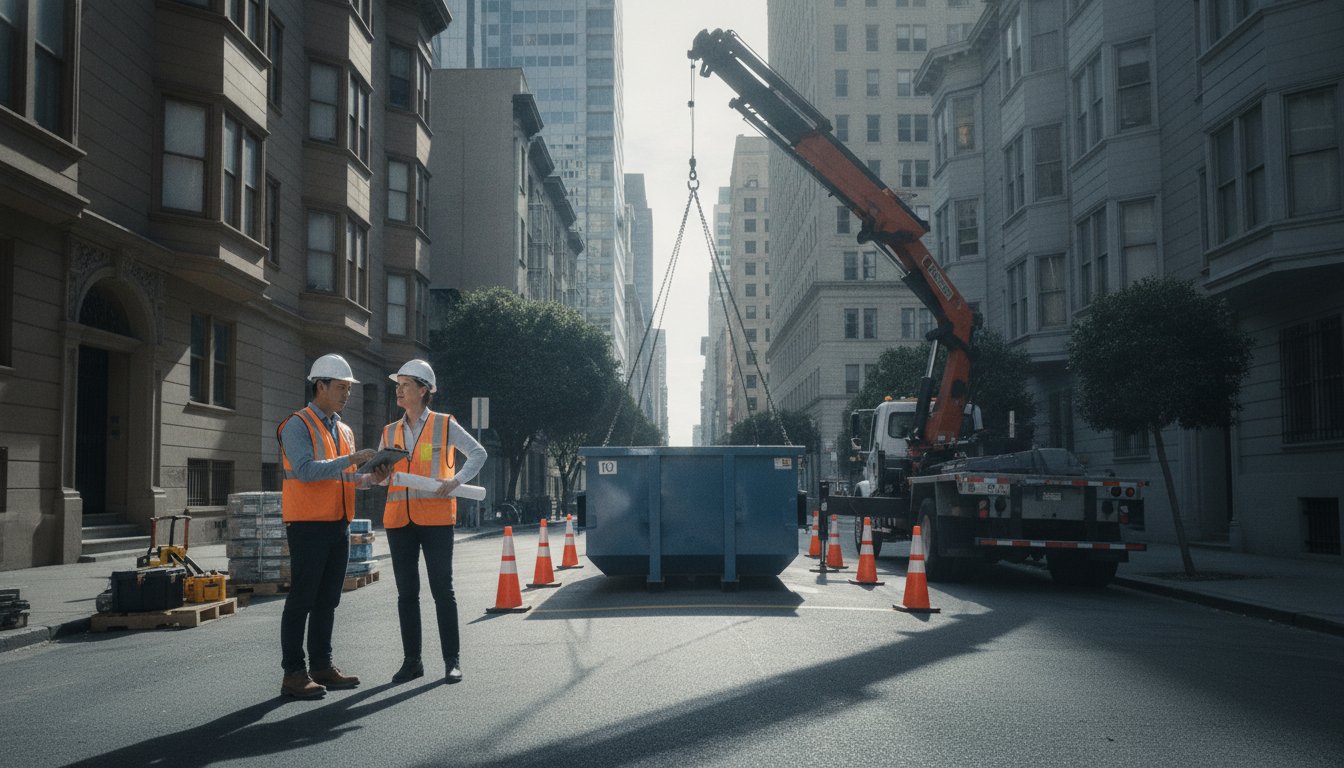
Did you know that construction and demolition debris accounts for 30% of all solid waste produced in the United States? When you're gutting multiple units in a crowded urban center, that waste doesn't just disappear; it becomes a logistical hurdle that can stall your entire project. You're likely dealing with zero street clearance for dumpsters and local inspectors who are ready to fine you for the slightest permit oversight. Effective waste management for apartment building renovations isn't just about hauling trash. It's about maintaining total control over a volatile job site.
We understand that you need a clean, compliant site without the constant stress of tenant complaints or safety hazards. This guide helps you master the logistics of multi-family renovation waste by providing a professional roadmap for planning, permitting, and equipment selection. You'll learn how to secure predictable costs and seamless scheduling for every pickup. We'll walk through the 2026 regulatory landscape, explain how to handle high volumes of debris, and show you how to keep your project moving toward a successful finish.
Key Takeaways
- Learn how to navigate the high-density constraints of waste management for apartment building renovations by mastering the logistics of tight urban spaces.
- Understand the specific Right-of-Way (ROW) permit requirements for major cities to avoid costly fines and project delays.
- Match your renovation scope to the ideal container size, utilizing 10-yard dumpsters for narrow alleys and limited street footprints.
- Implement "Clean Zone" protocols and safety measures to protect residents and maintain positive tenant relations during heavy debris removal.
- Discover how to simplify your project timeline through a modernized, digital-first approach to waste scheduling and logistics.
The Logistics of Waste Management for Apartment Building Renovations
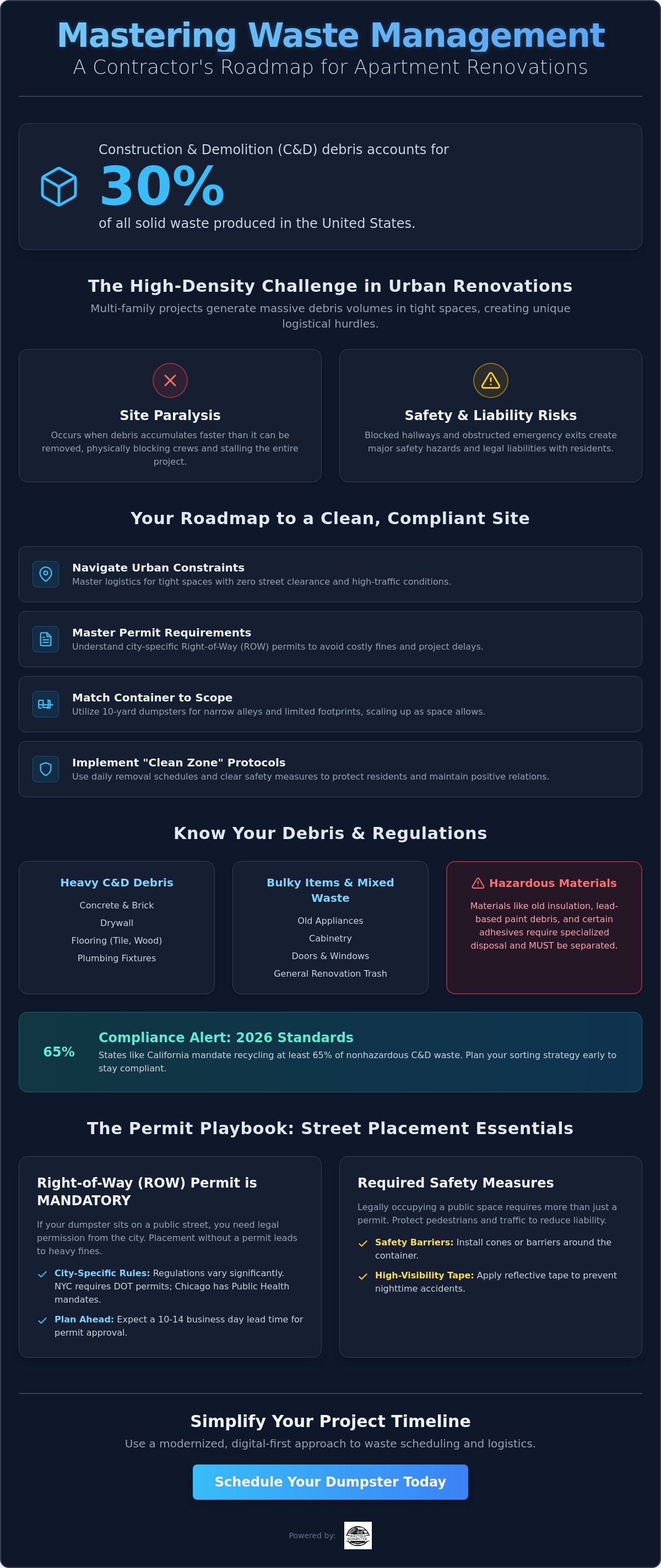
Effective waste management for apartment building renovations is a specialized logistics operation. It is not a simple matter of hauling trash; it is the strategic movement of tons of material through narrow corridors and onto high-traffic streets. We define this challenge as the High-Density Constraint. In a multi-family environment, you lack the luxury of a staging area or a wide driveway. Every square foot of the property is either a tenant's living space or a critical thoroughfare. Without a centralized waste plan, your project will suffer from site paralysis. This occurs when debris accumulates faster than it can be removed, physically blocking your crew from completing their work.
Your waste plan must account for the primary streams generated during a gut-reno. This includes heavy construction and demolition (C&D) debris, old appliances, and layers of flooring. Managing these materials requires a high-velocity approach. You must coordinate the flow of waste to ensure the job site remains productive and safe. Relying on a "fill it as we go" mentality leads to overflowing bins and municipal fines. Instead, treat waste removal as a scheduled phase of the construction cycle.
Why Multi-Family Projects Require Specialized Planning
Multi-family renovations often involve simultaneous work across multiple units. This creates a massive volume of debris in a very short window. If you renovate five units at once, you're looking at five kitchens and five bathrooms worth of cabinets and tile hitting the hallways on the same day. This volume quickly overwhelms common areas. You must prioritize the safety of residents who still live in the building. Blocked hallways or obstructed emergency exits are major safety risks and legal liabilities. Maintain a clear path at all times. Use a daily removal schedule to transfer debris from the units directly to your 10 or 20 yard dumpster rather than letting it sit in the corridors.
Identifying Your Primary Waste Categories
Categorize your waste before the first sledgehammer swings. You will deal with heavy materials like concrete and brick alongside bulky items like cabinetry and dry wall. Understanding Demolition waste composition and recycling helps you determine which materials can be commingled. Mixed-load dumpsters are the standard for apartment renovations because they accommodate the diverse materials found in a gut-reno. However, you must separate hazardous materials. Old insulation, lead-based paint debris, and certain adhesives require specialized disposal under strict municipal laws. In states like California, you are also mandated to recycle at least 65% of your nonhazardous C&D waste. Plan your sorting strategy early to stay compliant with these 2026 standards.
Navigating Permits and Regulations in Major Urban Centers
Securing a Right-of-Way (ROW) permit is the first critical step in waste management for apartment building renovations. If your building lacks a private loading dock or a spacious parking lot, your dumpster must sit on the public street. This requires legal permission from the city. Municipalities view a dumpster as a temporary obstruction of the public way, and they will fine you heavily for placement without a verified permit. In high-density areas, these permits often dictate the exact dimensions of the container allowed and the specific duration it can remain on-site.
Regulations vary significantly by city. In New York City, you deal with the Department of Transportation (DOT) for street occupancy permits. By June 2026, NYC has implemented mandatory containerization for buildings with up to nine units, which increases the pressure to keep renovation sites free of loose debris. In Chicago, contractors must navigate the Department of Public Health's recycling mandates while securing public way permits. These cities require specific lead times, often 10 to 14 business days, before you can drop a container. Never start demolition until your permit is physically on-site. A reliable rental partner can help you understand these local haulage laws and ensure your project stays compliant with EPA guidelines for C&D materials regarding source reduction and recycling.
Street Placement vs. Private Property Logistics
Legally occupying a parking lane requires more than just a permit. You must install safety barriers and apply high-visibility reflective tape to the container. This prevents nighttime accidents and reduces your liability. Avoid the "Blocking the Sidewalk" trap. Even a few inches of overhang can result in an immediate stop-work order or a fine ranging from $25 to $200 depending on the jurisdiction. If space is tight, schedule a smaller container that fits within the designated parking stall without encroaching on pedestrian paths.
Compliance with Local Noise and Timing Ordinances
Residential zones have strict work-hour restrictions. Most cities prohibit waste hauling and dumpster swaps before 7:00 AM or after 7:00 PM on weekdays. Swapping a bin at 6:00 AM might seem efficient, but the resulting noise complaints from tenants and neighbors can trigger municipal inspections. Check your local idling laws too. Many urban centers now penalize haulers who keep engines running for more than three minutes. Ensure your waste management plan aligns with these local timing ordinances to maintain a clean record with the city and your residents.
Choosing the Right Dumpster Sizes for Apartment Debris
Selecting the correct container size is a financial and logistical necessity. In the context of waste management for apartment building renovations, an oversized bin wastes expensive street space, while an undersized one leads to project delays. Use a strict framework to match your project scope to container volume. For renovations involving heavy masonry, such as concrete or brick, prioritize smaller, reinforced containers. These materials reach weight limits long before they fill the physical volume of a larger bin. Overloading a 30 or 40-yard dumpster with stone can make it impossible for a truck to lift, resulting in failed haul fees and immediate site paralysis.
Adopt a 'Small Footprint' strategy for tight urban alleys. When street space is at a premium, a 10 yard dumpster rental provides the necessary capacity without violating municipal permit boundaries. Effective Sustainable Management of C&D Materials starts with choosing the right tool for the specific waste stream. By matching the bin to the material density, you ensure safer transport and more predictable disposal costs. Avoid the common mistake of ordering the largest bin available for every phase; instead, rotate sizes based on the specific material your crew is removing that week.
10 Yard vs. 20 Yard: The Sweet Spot for Unit Renovations
Individual unit renovations typically generate a predictable volume of debris. A 10-yard dumpster holds approximately three to four pickup truck loads of material, making it ideal for bathroom gut-outs or small kitchen updates. If your project involves extensive flooring and drywall removal, scale up to a 20-yard bin. These containers offer double the capacity while maintaining a footprint that fits within a standard parking spot. Always verify the physical dimensions of the bin against your permitted street area. Most 20-yard containers are 20 feet long; ensure you have at least 22 feet of clearance for the delivery truck's rails to operate safely.
Bulk Debris: When to Scale Up to 30 or 40 Yards
Full-building overhauls or roof replacements require a heavy-duty roll off dumpster rental. Use 30 and 40-yard options for high-volume, low-density materials like wood framing, carpeting, and insulation. For these large-scale projects, implement a 'Swap-and-Drop' schedule. This logistics tactic involves the hauler dropping an empty bin and immediately removing the full one, keeping your crew working without interruption. Be aware of height constraints if you're using a covered loading dock. A 40-yard dumpster stands roughly 8 feet tall; ensure your facility has the overhead clearance for the truck to tilt the bin during the offloading process. Don't guess on dimensions; measure your clearance before you book.
Site Management: Maintaining Safety and Tenant Relations
Successful waste management for apartment building renovations requires balancing heavy logistics with the daily lives of residents. You aren't just moving debris; you're doing it in someone's home. Prioritize resident safety above all else. A messy site invites accidents, municipal fines, and tenant friction. Maintain a "Clean Zone" around your equipment to prevent the site from becoming a liability. Site management is about more than just trash; it's about maintaining a professional environment that respects the property's value.
Install clear signage around every dumpster area. State clearly that the container is for authorized construction debris only. This discourages neighbors from using your bin for their household trash. Unauthorized dumping can quickly lead to overweight charges or prohibited item fines that eat into your budget. If you notice local trash appearing in your roll-off, consider using a temporary fence to secure the perimeter. Keeping your site professional and secure builds trust with the community and local inspectors alike. Don't let a lack of oversight turn your waste solution into a neighborhood nuisance.
Tenant Communication Strategies
Notify residents at least 72 hours before a dumpster arrives. Your notification should be direct: "A 20-yard dumpster will occupy parking spaces 14 through 16 from Monday to Friday for building renovations." Managing expectations regarding noise is vital. Tell tenants exactly when the hydraulic swaps will occur. If the container takes up street parking, offer alternative parking solutions or directions to nearby lots. This proactive approach reduces complaints and keeps your project on schedule. To ensure your logistics are handled by a team that respects your timeline, schedule your next delivery with Book Your Dumpster USA today.
Debris Containment and Dust Control
Use debris chutes for any work above the first floor. This keeps dust contained and prevents falling hazards. Never throw loose material from a balcony or window. Tarp your dumpsters every night. This stops trash from blowing into the street and prevents "flyaway" debris from becoming a municipal nuisance. Establish a daily "sweep-down" routine. Assign one crew member to clean the five-foot radius around the roll-off every afternoon. This prevents dust from tracking into the lobby and keeps the building looking managed even during a gut-reno. Total site control is the only way to avoid project-stalling complaints.
Streamlining Your Project with Book Your Dumpster USA
Book Your Dumpster USA is your pragmatic partner for high-stakes urban projects. We don't just provide containers; we remove the logistical stress that often paralyzes multi-family job sites. Our service is built for the professional who values reliability and pricing integrity. When you're managing waste management for apartment building renovations, you need a hauler that understands the urgency of a tight timeline. We prioritize punctuality and transparent communication so you can focus on the construction, not the clutter.
Our streamlined online booking system allows for immediate scheduling. You can select your container, set your delivery date, and manage your swaps in minutes. This digital-first approach mirrors the efficiency of a modern job site. We eliminate the opaque communication structures common in the industry. Instead, we offer a verbal handshake through reliable service and honest pricing. You get the equipment you need without the administrative headache.
Local Expertise in Complex Markets
Managing the regulatory landscape of major hubs requires more than just a truck. We maintain deep local knowledge in high-density markets to reduce your risk of permitting errors. Refer to our 2026 guide for New York, Illinois, and Massachusetts to see how we handle specific municipal requirements. Whether you're working in a narrow Boston alley or a Chicago high-rise, we provide the right equipment for the environment. Our inventory includes 10, 20, 30, and 40-yard dumpsters to match any project scope. We ensure your container fits your permitted space and meets all local safety standards, including the evolving 2026 containerization mandates in cities like New York.
Next Steps: Securing Your Renovation Dumpster
Property managers and contractors need a waste partner who works as hard as their crew. Don't let debris accumulation stall your progress or trigger tenant complaints. Take control of your site logistics today. Our booking process is designed to reduce friction and move you from a state of clutter to a state of resolution with minimal cognitive load. Visit Book Your Dumpster now to get a real-time quote and secure your delivery. We offer the precision and control necessary for successful waste management for apartment building renovations in 2026. Choose the size that fits your site, schedule your drop-off, and let us handle the heavy lifting.
Master Your Renovation Site Logistics
Successful multi-family projects rely on more than just skilled labor; they require a disciplined approach to debris. You've learned how to navigate complex urban permits and select the ideal container size for high-density environments. By prioritizing resident safety and maintaining a clean site, you reduce the risk of municipal fines and tenant friction. Implementing a professional strategy for waste management for apartment building renovations ensures your project stays on schedule and avoids the hidden costs of site paralysis. Every square foot counts in an urban renovation, and a clean site is a productive one.
We provide the specific tools you need to manage these logistical challenges across major hubs including NY, NJ, IL, MA, and SF. With 10, 20, 30, and 40-yard sizes available, we match the equipment to your specific project scope every time. Our streamlined online booking for contractors removes the administrative friction that slows down your day. Take control of your debris removal and secure your timeline with a partner who values punctuality and pricing integrity. Book Your Renovation Dumpster Now and experience the reliability of a digital-first waste partner. Your next renovation is ready for a cleaner, more efficient start.
Frequently Asked Questions
Do I need a permit for a dumpster at an apartment building?
You must secure a permit if the dumpster occupies any public space, such as a street or parking lane. Most cities require a Right-of-Way (ROW) permit before the container can be delivered. Effective waste management for apartment building renovations requires these legal clearances to avoid immediate stop-work orders. If the dumpster sits entirely on private property, like a building's loading dock, you generally don't need a municipal permit.
What size dumpster is best for a multi-unit kitchen renovation?
A 20-yard dumpster is the most efficient choice for multi-unit kitchen renovations. It provides enough capacity for cabinets, countertops, and appliances without taking up excessive street space. If you're only updating a single bathroom, a 10-yard dumpster is usually sufficient. Scale your container choice based on the density of the material; heavy tile and masonry may require smaller bins to stay within legal weight limits.
Can I put a dumpster on the sidewalk for an apartment gut-reno?
You cannot legally place a dumpster on a public sidewalk in most major urban centers. Sidewalks must remain clear for pedestrian traffic and ADA compliance. Blocking the sidewalk can result in heavy municipal fines and an immediate stop-work order. If street space is unavailable, you must secure a permit for a parking lane or find a private staging area on the property that doesn't obstruct foot traffic.
How do I prevent neighbors from using my renovation dumpster?
Use high-visibility signage and physical barriers to discourage unauthorized use of your bin. Clearly mark the container for construction debris only and use a heavy-duty tarp to cover the opening every night. If the site is in a high-traffic area, consider a temporary fence around the dumpster. These steps prevent neighbors from filling your container with household trash, which can lead to overweight fees and project delays.
What happens if the dumpster exceeds the weight limit with heavy debris?
Exceeding the weight limit results in additional tonnage fees and may prevent the hauler from safely lifting the container. Most rental agreements include a specific weight allowance; going over this limit typically costs between $40 and $100 per extra ton. If a bin is dangerously heavy, you'll have to remove material manually before the truck can pull it. Always monitor the volume of heavy masonry like concrete or brick.
How much lead time is needed to rent a roll-off dumpster in NYC or Chicago?
Plan for at least 10 to 14 business days of lead time for waste management for apartment building renovations in cities like NYC or Chicago. This window allows for the processing of street occupancy permits and ensures equipment availability. Booking early is essential during the peak renovation season in 2026. Last-minute requests often fail due to the strict administrative requirements and high demand in urban centers.
Are there items I cannot put in an apartment renovation dumpster?
You cannot put hazardous materials, liquid waste, or certain chemicals in a standard renovation dumpster. Prohibited items include lead-based paint debris, asbestos, old tires, and large appliances containing freon. Local regulations in 2026 also require the separation of certain recyclable construction materials to meet diversion mandates. Check with your rental partner for a specific list of banned items to avoid contamination fees at the disposal site.
How do I manage waste if the building has no private parking lot?
Secure a street occupancy permit to place the dumpster in a designated parking lane if the building lacks a private lot. This process requires coordination with the city's department of transportation to ensure the container doesn't block fire hydrants or bus stops. Using a "swap-and-drop" strategy helps manage high volumes of debris when you only have space for one container at a time. This keeps the project moving without cluttering the site.


