

Your job site is your most visible business card, but a pile of debris tells your client you've lost control of the project. You already know that managing a major renovation is hard enough without worrying about overflowing bins or safety hazards. Logistical headaches like slow dumpster swaps and the threat of local fines for improper disposal can eat into your margins and your reputation. In an industry where the global construction waste market reached $123.5 billion in 2026, efficient waste management for general contractors is no longer just a utility; it's a competitive advantage.
Learn how professional strategies enhance your job site safety, ensure regulatory compliance with updated 2026 standards, and build lasting trust with your clients. We will show you how to achieve a clean, professional-looking site and establish seamless logistics that don't require constant supervision. This guide provides a clear path to full compliance with local regulations, including the latest LEED v5 requirements, so you can focus on the build instead of the trash. Follow these steps to transform your site from a cluttered liability into a high-functioning tool for project success.
Key Takeaways
- Master the systematic control of debris to improve site safety and maintain high professional standards throughout every project phase.
- Discover how to navigate complex permit requirements and logistical challenges in high-density areas like New York, Queens, and San Francisco.
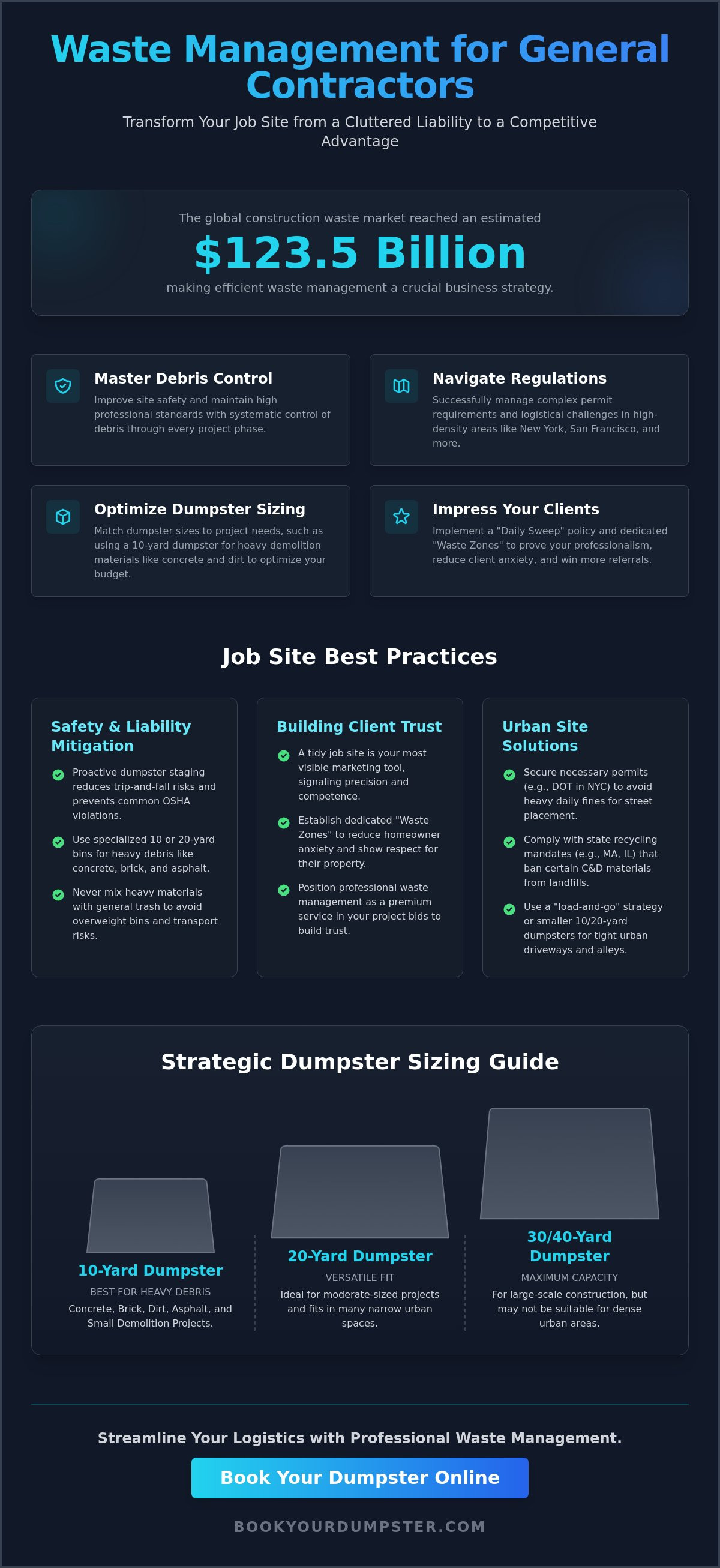
- Optimize your budget by matching dumpster sizes to specific needs, such as using a 10-yard dumpster for heavy demolition materials like concrete and dirt.
- Implement a "Daily Sweep" policy and dedicated "Waste Zones" to impress clients and keep subcontractors accountable.
- Learn how professional waste management for general contractors leverages streamlined online booking to eliminate scheduling delays and logistical stress.
The Role of Waste Management for General Contractors
Effective waste management for general contractors is the systematic control of all debris produced on a job site. It isn't a secondary task you handle only when the site gets messy. It's a core operational strategy that ensures safety, protects your crew, and maintains professional standards. When you treat waste as a logistical priority, you maintain a predictable workflow. This approach involves more than just hauling away trash. It requires a deliberate plan for every phase of the build, from initial teardown to the final punch list.
Think beyond simple disposal. Strategic dumpster placement and a strict haul-away schedule are essential components of a profitable project. If your dumpster is blocked or overflowing, your demolition phase stops. If it's placed too far from the work zone, you lose valuable man-hours to transit. A managed site is an efficient site. You must coordinate with your waste provider to ensure bins are swapped before they become a bottleneck. This level of control prevents the logistical headaches that often ruin project timelines and eat into your margins.
Safety and Liability Mitigation
Clutter kills productivity and creates unnecessary hazards. Proactive dumpster staging reduces trip-and-fall risks for your crew and subcontractors. This is a critical step for preventing common OSHA violations that lead to costly fines and project shutdowns. Managing demolition waste like concrete, brick, and asphalt requires specialized containers to prevent equipment strain and site damage. Use 10-yard or 20-yard bins for heavy debris to keep the site stable and compliant. Don't mix heavy materials with general trash. It complicates disposal and increases your liability if a bin becomes overweight or unbalanced during transport.
Building Client Trust Through Site Cleanliness
Your job site is your most visible marketing tool. Neighbors and passersby judge your work by the state of the curb before they ever see the finished interior. A tidy site signals precision, competence, and respect. For homeowners, a renovation is a high-stress event. Seeing an organized "Waste Zone" significantly reduces their anxiety. It proves you respect their property and their investment. You should position your waste strategy as a premium service in your project bids. It demonstrates that you aren't just a builder; you're a professional manager of the entire environment. This builds immediate trust and often leads to more referrals from impressed neighbors who see your clean operation every day.
Reliable waste management for general contractors removes the stress of site cleanup. It allows you to focus on the technical aspects of the build while maintaining a professional image. Use a system that offers transparent scheduling and clear communication. This ensures your site remains a high-functioning tool rather than a cluttered liability.
Navigating Local Regulations in Major Metro Areas
Operating in major metro areas requires a deep understanding of municipal bureaucracy. In New York and Queens, placing a dumpster on the street isn't just about finding a spot; it's about securing a Department of Transportation (DOT) permit. Fail to display this permit, and you'll face heavy daily fines that can derail your project's budget. San Francisco presents different challenges, where high-density neighborhoods and steep grades make container delivery a precision operation. Effective waste management for general contractors hinges on anticipating these local hurdles before the first sledgehammer swings.
Massachusetts and Illinois have pioneered aggressive recycling mandates that impact how you handle debris. Massachusetts, for instance, bans materials like asphalt, brick, and concrete from landfills entirely. Following EPA guidelines on C&D materials helps you establish a baseline for these requirements, but you must still meet specific city diversion rates. Street use permits are your first line of defense against municipal citations. Always verify the duration and weight limits of your permit to avoid overnight penalties or forced removals.
Urban Site Constraints and Solutions
Tight driveways in urban hubs often won't accommodate a standard 30-yard or 40-yard bin. Opt for a 10-yard or 20-yard dumpster to fit into narrow alleys or residential side-lots. If street placement is prohibited by local ordinance, use a "load-and-go" strategy where the truck remains on-site while your crew fills it. Coordinate with local traffic authorities if you need to block a lane for delivery. This proactive communication prevents the gridlock that leads to angry neighbors and police intervention.
Compliance with Local Waste Diversion Goals
Many cities now mandate that you divert a specific percentage of debris from landfills to meet green building codes. Documentation is mandatory. Keep every tipping receipt and diversion report to prove compliance during final inspections. Educate your crew on prohibited items to avoid surcharges at the transfer station. Items like mattresses, tires, or appliances often require separate handling and different disposal routes. If you're unsure about the specific rules in your area, check local dumpster availability to see how regional regulations impact your project requirements.
Strategic Dumpster Sizing for Professional Job Sites
Choosing the right bin size is a critical decision for effective waste management for general contractors. It isn't just about volume; it's about weight and site footprint. If you underestimate the weight of your debris, you'll hit overage fees or face "heavy load" rejections at the scale. Conversely, over-ordering a massive bin for a finishing phase wastes money and valuable site space. Match your container to the specific phase of the build to keep costs low and site flow high. Professional site management requires a calculated approach to every cubic yard of waste you produce.
- 10-Yard Dumpster: Use this for your heaviest materials. Dirt, rock, asphalt, and concrete are extremely dense. A larger bin filled with these materials will exceed legal road weight limits and may damage the pavement.
- 20 and 30-Yard Dumpsters: These are the workhorses of residential remodels and roofing. A 20-yard bin is perfect for small kitchen guts. Move up to a 30-yard container for whole-home renovations or larger additions where you have a mix of framing scraps and drywall.
- 40-Yard Dumpster: This is the industry standard for large-scale commercial demolition. It handles massive volumes of light-to-medium weight materials like wood framing, carpeting, and ceiling tiles.
Calculating Capacity Needs
Estimate your debris weight before you book your service. Use EPA best practices for construction waste to understand how different materials impact your total tonnage. For example, concrete weighs roughly 4,000 pounds per cubic yard, while wood is closer to 300 pounds. Check the physical footprint of each size. A 40-yard bin requires significantly more clearance for the truck to drop and pick up. If your staging area is tight, consider two smaller bins instead of one giant roll-off to maintain access for other subcontractors.
Maximizing ROI on Waste Logistics
Consolidate your waste to minimize delivery fees and logistical downtime. Every swap costs time and money. Renting a slightly larger size than your initial estimate often pays for itself by preventing a second delivery. It's cheaper to pay for a 30-yard bin once than a 20-yard bin twice. Efficient roll off dumpster rental keeps your project moving without the delays caused by overflowing bins. Analyze your waste stream early. If you know you'll generate high volumes of recyclable metal or clean wood, separate them. This reduces your total tonnage and helps you meet the diversion goals required by many modern building codes. Smart waste management for general contractors is about more than just trash; it's about protecting your bottom line.
Best Practices for Impressing Clients with Site Management
A messy site is a liability. It suggests a lack of discipline. Professional waste management for general contractors starts with visibility and order. Designate a specific "Waste Zone" on the first day of the project. This area must be easily accessible for delivery trucks but positioned so it doesn't block the client’s primary view of the construction progress. An organized zone keeps debris contained and prevents loose scraps from migrating across the property or into the street.
Implement a strict "Daily Sweep" policy. Require every subcontractor and crew member to spend the final 15 minutes of their shift clearing their specific debris. This prevents the massive end-of-week mountain of trash that makes a site look chaotic and unsafe. Use professional-grade containers. A rusted, leaking dumpster parked in a residential driveway ruins the professional image you've worked hard to build. Schedule your swaps when the bin is roughly 80% full. Don't wait for an overflow that forces your crew to pile trash on the ground. This proactive approach keeps the workflow moving and the site looking sharp.
Managing Subcontractor Waste Habits
Subcontractors are an extension of your brand. Write debris disposal requirements directly into your sub-contracts to ensure everyone is on the same page. Specify that failure to use the designated bins results in back-charges for cleanup time. This creates immediate accountability. Provide separate, clearly labeled bins for recyclables or hazardous materials to simplify the sorting process. Conduct a weekly site audit. Walk the entire perimeter to ensure no scraps are left in the landscaping, crawl spaces, or neighboring yards.
Communication as a Professional Tool
Proactive communication prevents neighborhood friction. Inform neighbors ahead of time when a dumpster is being delivered or picked up. It shows respect for their space and minimizes complaints about noise or blocked access. Include "clean site" updates in your regular client progress reports. Send a photo of the cleared Waste Zone alongside your construction updates. This reinforces the idea that you are a meticulous manager who values their property. You can even use your commitment to construction debris removal as a selling point in your project portfolio. When you master waste management for general contractors, you prove you handle the "messy" parts of the job with as much care as the finishing touches.
Ready to upgrade your site's professional image? Order your dumpster online today to ensure your next project stays clean and compliant.
Streamlining Logistics with Book Your Dumpster USA
Efficiency is the foundation of a profitable project. Book Your Dumpster USA provides a streamlined waste management for general contractors through a digital-first booking system. You need a partner who understands that every hour of site downtime costs money. We offer reliable delivery and precise placement across New York, New Jersey, Illinois, Massachusetts, and San Francisco. Our transparent pricing models eliminate the guesswork, allowing you to quote your clients with confidence. You get direct access to expert support for complex urban site logistics, ensuring that narrow streets or strict city permits don't stop your progress.
We handle the heavy lifting of logistics so you can focus on the build. Our system is designed for the modern contractor who values speed and simplicity. You can schedule your delivery, manage your swaps, and track your disposal costs from any device. This level of control is essential for maintaining the professional standards your clients expect. By removing the friction of waste disposal, we help you maintain a high-velocity workflow across all your active job sites.
Our Fleet of Professional Containers
We offer 10, 20, 30, and 40-yard roll-off options to cover every project phase. Our maintenance standards are a point of pride. We know that a clean, well-maintained dumpster reflects well on your brand. We don't drop off rusted or damaged bins that ruin your client's property value. Our fleet is ready for heavy-duty demolition or light finishing work. We focus on fast turnaround times. When you call for a swap, we execute the order quickly to prevent job site bottlenecks. This reliability ensures your crew never has to stop work because of an overflowing bin.
Partnering for Long-Term Success
We act as a high-functioning tool for contractors with recurring needs across multiple active sites. Our platform allows you to manage several rentals through one interface. We provide customized scheduling that adapts to your project’s specific timeline. If your demolition phase finishes early or your framing takes longer, we adjust the haul-away schedule to match. This flexible approach removes the logistical stress of waste disposal. Book your next dumpster online and experience professional waste management for general contractors that keeps your sites optimized and your clients impressed.
Build a Reputation for Precision and Order
Professional waste management for general contractors is the difference between a chaotic job site and a high-functioning operation. By right-sizing your containers and establishing a dedicated Waste Zone, you protect your margins and your professional reputation. You've seen how navigating local regulations in hubs like New York or San Francisco requires precision. Now it's time to put these strategies into practice. A clean site doesn't just prevent safety hazards; it serves as a silent testimonial to your competence for every neighbor and potential client who passes by.
Don't let logistical bottlenecks slow your project momentum. Whether you need a 10-yard bin for heavy concrete or a 40-yard container for a major commercial teardown, we have the fleet to support your timeline. We serve contractors across NY, NJ, IL, MA, and SF with a full range of 10 to 40 yard containers. You can complete our easy online booking in under 5 minutes, allowing you to get back to the build immediately. Streamline your job site today with Book Your Dumpster USA and experience the reliability of a partner who values your time. Your next successful project starts with a clear plan and a clean site.
Frequently Asked Questions
How do I determine the right dumpster size for a kitchen remodel?
A 20-yard dumpster is the standard choice for a mid-sized kitchen remodel. It handles cabinets, flooring, and basic drywall easily. If you're tearing out heavy concrete subflooring or thick granite counters, consider a 10-yard bin instead. This prevents exceeding weight limits on residential driveways. Always estimate your debris volume before booking to avoid the cost of a second delivery.
Are there specific items that general contractors are prohibited from putting in roll-offs?
You cannot dispose of hazardous materials, wet paint, tires, or lithium-ion batteries in a standard roll-off. These items pose fire risks and environmental hazards at the landfill. Electronics and appliances with Freon also require separate handling. Educate your crew on these restrictions to avoid significant surcharges or load rejections at the transfer station. Check with your provider before loading any questionable items to ensure compliance.
Do I need a permit for a dumpster if it is placed on a private driveway in Queens?
You don't need a permit if the container sits entirely on a private driveway in Queens. Permits are only mandatory when the dumpster occupies a public street or sidewalk. If you must use the street, you'll need a DOT permit. Check the current local requirements as municipal fees for street placement usually range from $20 to $150.
How much space is required for a 30-yard dumpster delivery?
A 30-yard dumpster requires approximately 60 feet of linear space for the delivery truck to maneuver and drop the bin. You also need at least 23 feet of vertical clearance to avoid hitting overhead power lines or tree branches. Ensure the staging area is clear of vehicles and equipment before the driver arrives. This prevents delays and dry-run fees.
Can I use one dumpster for both heavy concrete and general construction debris?
Do not mix heavy concrete with general construction debris in large containers. Heavy materials like dirt, rock, and concrete should stay in a 10-yard dumpster to remain within legal road weight limits. Mixing these into a 30 or 40-yard bin often makes the load too heavy for the truck to lift safely. Proper waste management for general contractors requires separating dense materials from lighter trash.
What happens if my dumpster exceeds the weight limit?
Exceeding the specified weight limit triggers overage fees that typically range from $40 to $200 per extra ton. If the load is too heavy for the truck's hydraulic system to lift, the driver will leave the bin on-site. You'll then have to manually remove debris until it reaches a safe weight. Always monitor your fill level and material density to avoid these costly site bottlenecks.
How quickly can I get a replacement dumpster if mine is full?
Most replacement swaps are completed within 24 to 48 hours of your request. Plan your schedule ahead of time and call for a swap once the bin is 80% full. This ensures your crew never stops working due to an overflowing container. Reliable waste management for general contractors relies on this proactive scheduling to maintain project momentum and site cleanliness.
Does professional waste management help with LEED certification?
Professional services support LEED v5 certification by providing detailed diversion reports and disposal documentation. Under the current standards launched in April 2025, you must use third-party certified recycling facilities to earn credits. Letters from facilities are no longer sufficient. Accurate tracking of salvaged materials is essential since they now count for 200% toward your diversion calculations.


