
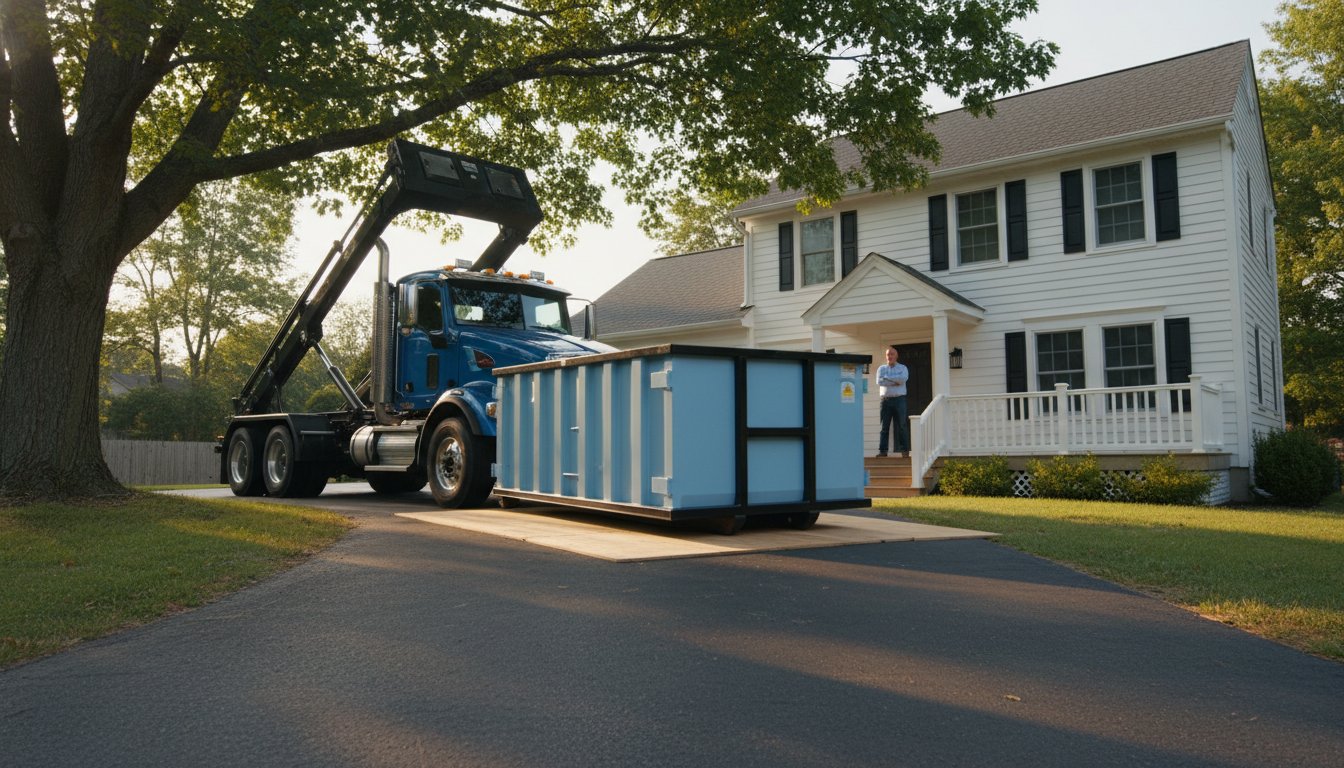
Most delivery failures don't happen because the bin is too big, but because the truck lacks the room to maneuver. Before you start your project, you're likely asking, will a 20 yard dumpster fit in my driveway? While a standard 20-yard container measures 22 feet long and 8 feet wide, the footprint is only half the battle. You must account for the 60 to 100 feet of straight clearance and 14 feet of vertical space required for the roll-off truck to safely drop the load without hitting low-hanging branches or power lines.
It's natural to feel anxious about cracked pavement or unexpected fines from the city. You want the debris gone without damaging your property or dealing with local inspectors. This guide from Book Your Dumpster USA provides the exact 2026 delivery requirements and state-specific permit rules, with detailed insights relevant to regions like New York, Illinois, and Massachusetts, and practical advice applicable to any area we serve, including New Jersey and Michigan. We'll show you how to protect your driveway surface and explain the local regulations that keep your project on schedule. Follow these steps to ensure your 20-yard bin fits perfectly the first time you schedule your delivery.
Key Takeaways
- Compare the 22-foot bin length to your driveway's footprint to avoid blocking sidewalks or streets.
- Account for the 60 to 100 feet of linear space and 14-foot vertical clearance required for a safe delivery.
- Navigate specific permit rules for New York, Illinois, and Massachusetts to ensure your placement is legal.
- Protect your driveway surface from weight and rollers by using the 3/4-inch plywood method.
- Confirm will a 20 yard dumpster fit in my driveway by measuring for the approach path and overhead obstacles.
20-Yard Dumpster Dimensions: Will It Fit Your Driveway Footprint?
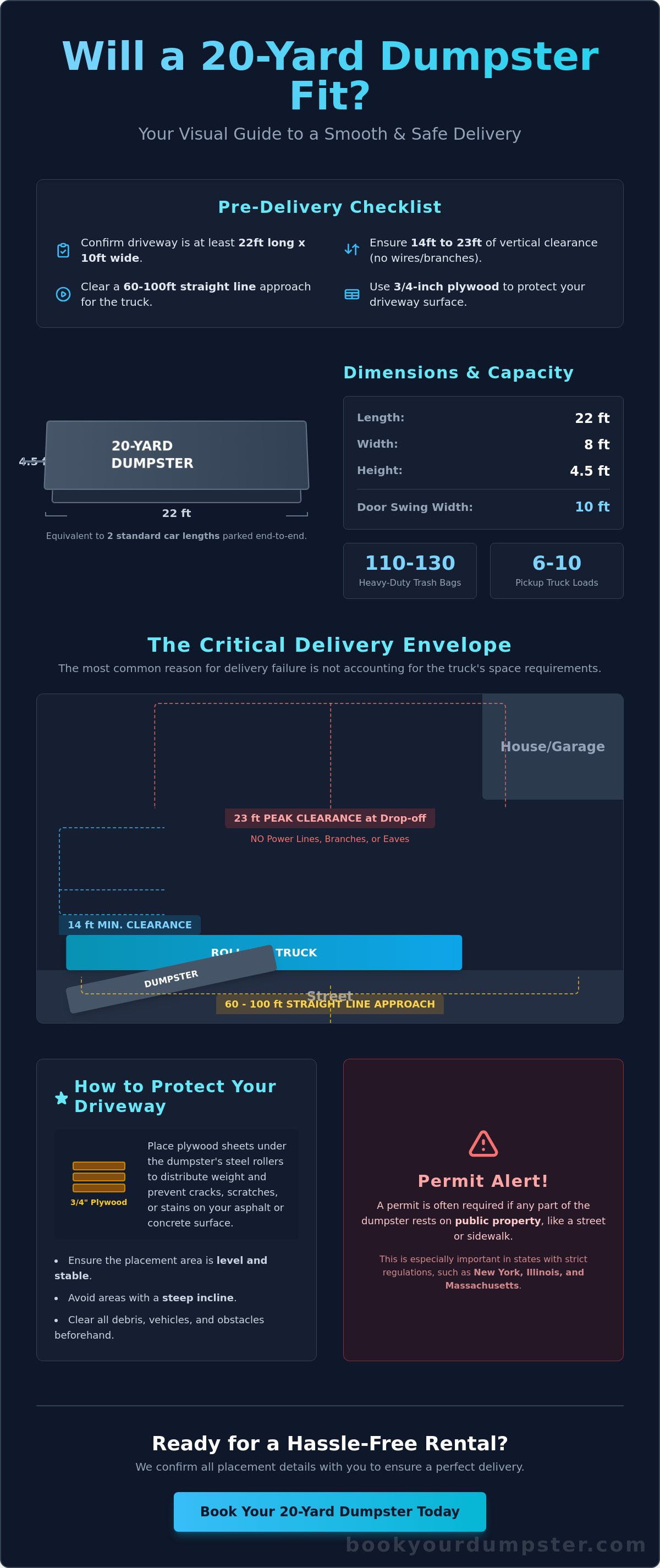
To determine if a bin works for your project, you need the hard numbers. The standard 20-yard dumpster dimensions are 22 feet long, 8 feet wide, and 4.5 feet high. These measurements represent the external footprint of the steel container. While the width seems manageable, you must plan for a 10-foot total width to allow the rear door to swing open. If you don't have this extra space, you'll find yourself lifting heavy debris over the 4.5-foot side walls. This leads to unnecessary physical strain and slows down your cleanup.
Visualize the bin as a large SUV or a heavy-duty pickup truck parked in your driveway. It's a substantial piece of equipment that takes up significant real estate. In terms of capacity, a 20-yarder holds roughly 110 to 130 heavy-duty trash bags. For those moving loose debris like shingles or drywall, imagine 6 to 10 pickup truck loads. This size is the industry standard for residential renovations and commercial cleanouts because it balances high volume with a footprint that fits most suburban properties.
Measuring Your Driveway for a 20-Yard Bin
Don't guess the available space. Use a tape measure to mark a 25-foot by 10-foot rectangle on your pavement. This provides a three-foot buffer at the end and one foot on each side for the rollers. Check for dead space during this process. Ensure you aren't blocking garage doors or active walkways that you'll need to access during the rental period. Confirm the slope of your driveway as well. Dumpsters require a relatively level surface. If the incline is too steep, the bin could slide or the weight could shift, making it dangerous for the driver to pick up the load. Book your dumpster only after you've confirmed the ground is stable and flat.
The 'Car Length' Rule of Thumb
If you don't have a tape measure handy, use the car length rule to estimate space. A 20-yard bin occupies approximately two standard car lengths. If you can park two sedans end-to-end in your driveway, you have the base footprint covered. However, the footprint of the bin is only one part of the equation. You must still account for the delivery truck's entry path. Confirming will a 20 yard dumpster fit in my driveway requires looking at the total space from the street to the final drop point. If your driveway is shorter than 22 feet, the bin will overhang onto the sidewalk or street, which often triggers the need for local permits.
The Delivery Envelope: Why Approach Room and Height Matter
Confirming the physical footprint of the bin is just the first step. To truly answer if a 20 yard dumpster will fit in my driveway, you must evaluate the delivery envelope. This is the total volume of space the truck requires to maneuver, tilt its hoist, and slide the container into position. A roll-off truck needs approximately 60 feet of straight-line space to drop the bin. If your driveway is only 30 feet long, the truck must use the street for its approach. This requires a clear path free of parked cars or narrow neighborhood bottlenecks.
Vertical clearance is the most common reason for delivery failure. While the dumpster itself is only 4.5 feet high, the truck's hoist reaches a peak of 23 feet during the offloading process. You must look up before the driver arrives. Low-hanging power lines, communication cables, or large oak branches will stop a delivery immediately. Drivers cannot risk snagging utility lines or damaging their equipment on your property. Check your roofline too. Gutters and eaves can be clipped if the bin is placed too close to the structure.
Avoiding Overhead Obstructions
Identify all potential hazards above the drop zone. Communication wires often sag over time, dipping below the required 23-foot safety margin. If you see branches hanging over the driveway, trim them back at least 15 feet from the ground. This ensures the truck can tilt without resistance. If you have a narrow entrance, remember that New York vehicle width limits allow for trucks up to 8.5 feet wide, but with mirrors and equipment, they often need 10 feet of operating width. Ensure gate posts are at least 12 feet apart to prevent scraping.
The Straight-Line Approach Requirement
Roll-off trucks cannot drop containers on sharp curves or 90-degree bends. The truck and the bin must be perfectly aligned in a straight line during the roll-off phase. If your driveway has a significant curve, the driver might have to place the bin closer to the street than you originally planned. Calculate your street width before the truck arrives. A standard residential street is 20 to 30 feet wide. If your street is narrower, the truck may not have the turning radius to enter your drive at the correct angle. If you suspect your layout is too tight, schedule your delivery with specific notes about your property's layout to avoid dry-run fees.
Finally, consider the weight. A 20-yard bin filled with construction debris can exceed 10 tons. Standard residential asphalt is often only 2 to 3 inches thick. Without proper preparation, this weight can cause ruts or cracks. Always have a plan for surface protection if you're worried about the integrity of your pavement.
Local Driveway Challenges in New York, Illinois, and Massachusetts
Geography dictates whether will a 20 yard dumpster fit in my driveway just as much as the physical measurements do. In New York, residents on Long Island typically have the 25-foot clearance required for a standard roll-off. However, in boroughs like Brooklyn or Queens, driveways are often shorter than the 22-foot bin length. If any part of the container hangs over the sidewalk, you'll face heavy municipal fines. In these urban zones, you must often secure a New York City DOT permit to place the bin on the street, a process usually handled by the carting company for a fee ranging from $50 to $200.
Illinois presents a different set of hurdles, specifically within Chicago's dense neighborhoods. Most Chicago alleys are approximately 16 feet wide. A 20-yard bin is generally the largest size allowed in these shared lanes because it must leave enough room for the city's "Blue Cart" recycling trucks to pass. If your placement blocks a neighbor's garage or the sanitation route, the city will order an immediate, expensive removal. Always measure the total width of the alley before you schedule your delivery to ensure the truck can maneuver at a 90-degree angle into your private space.
Massachusetts homeowners, particularly in Boston and surrounding historic towns, deal with narrow tandem driveways. These "triple-decker" layouts mean one bin can trap three or four vehicles. If you live in a historic district, check with your local Board of Health or Department of Public Works. In Worcester, for example, a $25 permit from the Fire Prevention Office is required even for private property placement. For more details on regional specifics, read our Dumpster Rental in New York, Illinois, and Massachusetts: The 2026 Complete Guide.
Urban vs. Suburban Placement Strategies
In urban centers like Chicago or Boston, street placement is frequently your only option. If you must use the "public way," apply for your permit at least five business days in advance. Suburban owners should focus on "dead space" management. Position the bin on the edge of the pavement to keep your garage accessible. In New York, state laws are strict about sidewalk obstruction; never allow the bin to creep into the pedestrian right-of-way.
Weather Impacts on Driveway Integrity
Winter weather in Illinois and Massachusetts creates hidden risks for your pavement. Never place a heavy 20-yard bin on a driveway covered in active ice or deep snow. The weight can cause the bin to slide or freeze to the surface, making pickup impossible. The "Spring Thaw" is equally dangerous in New York. As the ground softens in April and May, the 10-ton weight of a loaded bin can cause it to sink into unpaved or thin asphalt drives. Use heavy-duty boards to distribute the weight and prevent permanent ruts.
How to Prep Your Driveway and Protect Your Property
Preparation is the difference between a successful cleanup and a ruined driveway. Once you've confirmed will a 20 yard dumpster fit in my driveway based on the 22-foot length, you must focus on weight distribution. A loaded bin often exceeds 20,000 pounds. To prevent the steel rollers from gouging your pavement, use the plywood method. Lay down two 4'x8' sheets of 3/4-inch plywood exactly where the dumpster's rear wheels will land. This simple step spreads the pressure across a wider surface area, protecting the integrity of your asphalt or concrete. It's a small investment that prevents thousands of dollars in property damage.
Clear the path before the truck arrives to avoid dry-run fees. Move all vehicles, basketball hoops, and trash cans at least 15 feet away from the drop zone. The driver needs a wide berth to align the truck. Marking the spot with orange cones or a simple chalk outline shows the driver exactly where you want the bin centered. If you won't be home during the delivery, leave a visible note or specific instructions during the booking process. Clear communication ensures the bin is placed exactly where you need it for efficient loading. For more complex projects, check The Ultimate Guide to Construction Debris Removal in 2026.
Protecting Asphalt vs. Concrete
Different surfaces require different levels of care. Asphalt is particularly vulnerable to scarring during the high 2026 summer heat. When temperatures rise, the pavement softens, and the heavy steel feet of the dumpster can sink into the surface. Protective boards are non-negotiable for asphalt drives. Concrete is more rigid but prone to cracking at the edges. Ensure the driver centers the bin away from the driveway lip where the slab is thinnest. If you have high-end pavers or decorative stone, the risk of shifting or cracking is high. In these cases, we recommend street placement to keep your masonry pristine.
Pre-Delivery Checklist for Homeowners
Run through a final check 24 hours before your scheduled drop-off. Verify that no cars will be trapped in the garage once the 22-foot bin is placed; once that bin is down, you won't be moving it until the project is over. Check for underground utilities or septic tanks. Roll-off trucks are heavy, and driving over a septic lid or a shallow utility line can cause an immediate collapse. If you have any doubts about your driveway's strength, schedule your delivery on the street or at the very edge of the curb where the ground is most stable.
Book Your 20-Yard Dumpster with Book Your Dumpster USA
Deciding will a 20 yard dumpster fit in my driveway is the final hurdle before your project begins. Once you've confirmed the 60-foot approach and 23-foot vertical clearance, the logistical stress ends. Our booking process is built for efficiency. Choose your size, select your delivery date, and get back to your renovation. We remove the guesswork from waste management by providing a reliable tool for homeowners and contractors across New York, Illinois, and Massachusetts.
Transparency is our verbal handshake. While the national average for a 20-yard rental sits between $350 and $550, urban centers like New York City or Chicago often see higher rates due to landfill tipping fees and local regulations. We provide clear, upfront pricing with no hidden delivery or fuel surcharges. You'll know exactly what you're paying before the truck ever leaves the yard. This direct approach has made the 20-yard bin our most requested container for kitchen remodels and whole-home cleanouts.
Our drivers are trained to handle the unique challenges of the Northeast and Midwest. They understand that a 20-yard bin, which carries a weight limit of 3 to 4 tons, requires precise placement to avoid property damage. Whether you are dealing with a tight suburban drive in Long Island or a narrow street in Boston, we have the experience to drop your bin safely. We prioritize on-time delivery because we know your project timeline depends on it.
Why Choose Our 20-Yard Roll-Off?
Reliability is the core of our business model. We understand that a delayed dumpster stops your entire crew. Our drivers are local experts who navigate the historic streets of Massachusetts and the narrow alleys of Chicago daily. They understand the nuances of local municipal rules, from Worcester's fire prevention permits to the Chicago Department of Transportation's public way requirements. For a deeper look at maximizing your rental, see our Roll Off Dumpster Rental: The Complete Guide to Efficient Waste Management.
Ready to Start? Book Your Dumpster Now
The 20-yard bin remains the "Goldilocks" size for residential work. It holds roughly 6 to 10 pickup truck loads of debris without overwhelming a standard suburban footprint. If you've verified will a 20 yard dumpster fit in my driveway, don't wait for your trash to pile up. Use our online system to enter your zip code and receive an instant quote. We handle the logistics so you can focus on the build. Book your dumpster today at bookyourdumpster.com and experience a hassle-free cleanup.
Finalize Your Site Prep and Start Your Project
You now have the blueprint for a successful delivery. Remember that confirming will a 20 yard dumpster fit in my driveway is about more than just the 22-foot bin length. You must verify the 60-foot approach path and ensure your vertical clearance is at least 23 feet to avoid utility line damage. Use 3/4-inch plywood to protect your asphalt or concrete from the 10-ton weight of a loaded container. These steps prevent property damage and costly dry-run fees. Whether you're navigating a tight Chicago alley or a historic Boston driveway, local regulations are manageable when you prepare in advance.
We serve homeowners and contractors across New York, Illinois, and Massachusetts with pragmatic, on-time delivery. Our no hidden fees policy ensures you stay on budget from drop-off to pickup. Don't let debris stall your renovation or cleanout. Use our streamlined online system to secure your container and keep your project moving forward. Book your 20-yard dumpster rental in seconds and clear your site today. You've done the measurements. Now, let us handle the heavy lifting.
Frequently Asked Questions
Will a 20-yard dumpster damage my asphalt driveway?
Yes, the weight of a loaded bin can cause damage if you don't take precautions. A 20-yard container filled with debris can weigh over 10 tons, which puts extreme point pressure on your pavement. During the 2026 summer heat, asphalt softens and becomes prone to "scarring" from the steel rollers. Always use the plywood method to distribute this weight across a larger surface area and prevent permanent ruts or cracks.
How much space do I need behind the dumpster to open the door?
You need at least 8 feet of clear space behind the bin to fully swing the rear door open. Since the container is 8 feet wide, the door requires that same distance to clear the frame. If your driveway doesn't provide this "swing room," you'll be forced to lift every piece of debris over the 4.5-foot side walls. This increases the risk of injury and slows down your project significantly.
Can I put a 20-yard dumpster on the street if my driveway is too small?
Yes, street placement is a common solution in urban centers like Brooklyn or Chicago. However, you must obtain a "Right of Way" or DOT permit before the truck arrives. In New York City, these permits cost between $50 and $200 and are usually secured by the carting company. If you place a bin on the street without a permit, local inspectors will issue heavy fines and may order an immediate removal.
What happens if the delivery truck can't fit in my driveway?
If the driver determines the space is unsafe or too tight, they'll leave without dropping the bin. This results in a "dry-run" fee to cover the driver's time and fuel. This usually happens when homeowners underestimate the 60-foot straight-line clearance or fail to trim branches below the 23-foot hoist height. To avoid this, confirm will a 20 yard dumpster fit in my driveway by measuring the entire delivery envelope beforehand.
Do I need to be home when the 20-yard dumpster is delivered?
You don't need to be present as long as the delivery path is completely clear. Move all vehicles, basketball hoops, and trash cans at least 15 feet away from the drop zone. Mark the exact spot where you want the bin with orange cones or chalk. If you have specific instructions regarding gate codes or property hazards, provide them during the booking process to ensure a successful, hassle-free delivery.
How many tons can I safely put in a 20-yard driveway dumpster?
The standard weight limit for a 20-yard bin is 3 to 4 tons, which equals roughly 6,000 to 8,000 pounds. While the bin can physically hold more, exceeding this limit triggers overage fees that range from $40 to $100 per extra ton. If you're disposing of heavy materials like concrete, brick, or dirt, you must notify us in advance. These materials are much heavier than standard household debris and require special loading protocols.
Is a 20-yard dumpster bigger than a standard parking space?
Yes, a 20-yard dumpster is significantly longer than a standard parking spot. A typical parking space measures 18 feet long by 9 feet wide. Since a 20-yard container is 22 feet long, it will overhang a standard spot by at least 4 feet. If you're planning to use a parking area, ensure you have the extra length to avoid blocking traffic lanes or violating local fire codes in your municipality.
Can I park my car next to the dumpster in my driveway?
You can only park next to the bin if your driveway is at least 18 feet wide. The dumpster itself takes up 8 feet of width, and a standard car needs about 6 feet plus door clearance. Parking too close makes it impossible to open the dumpster's side door or your car doors. Additionally, you must move all vehicles on the day of pickup to give the roll-off truck a clear 60-foot path for removal.


