
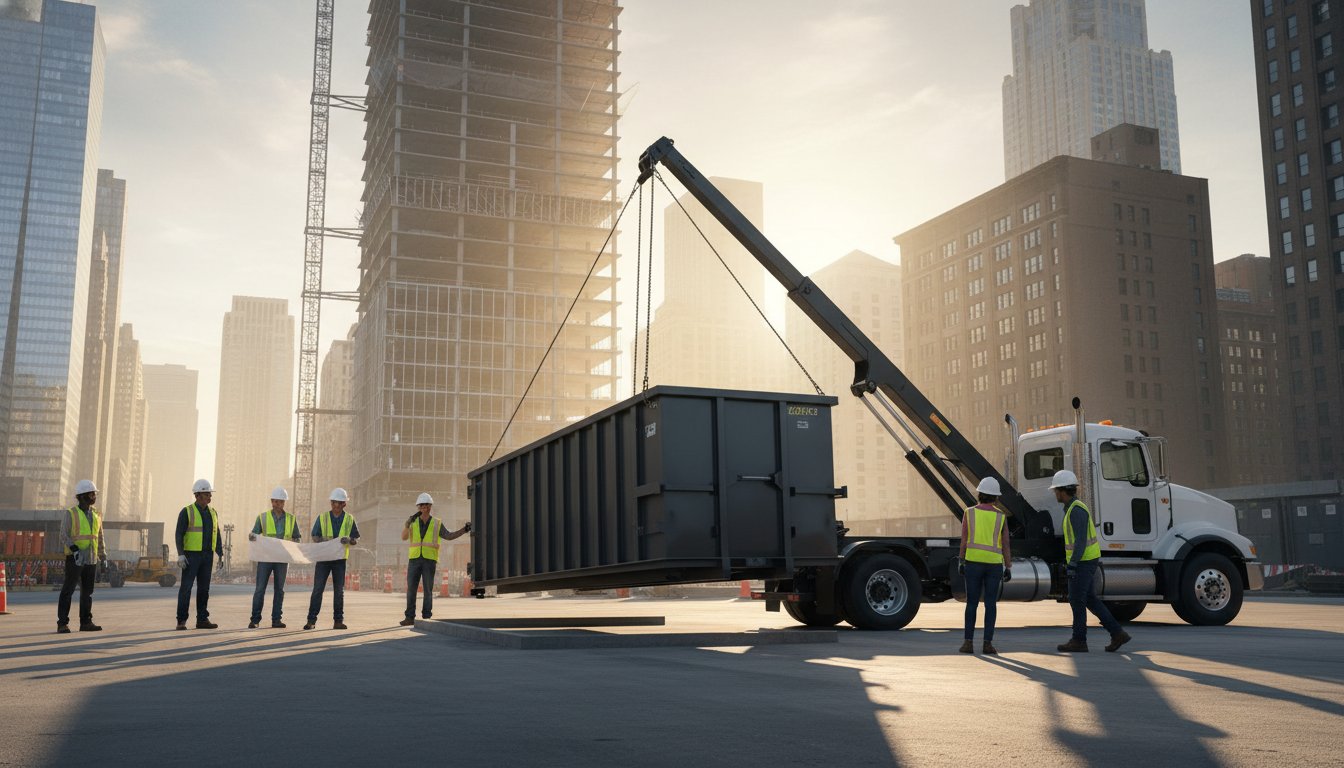
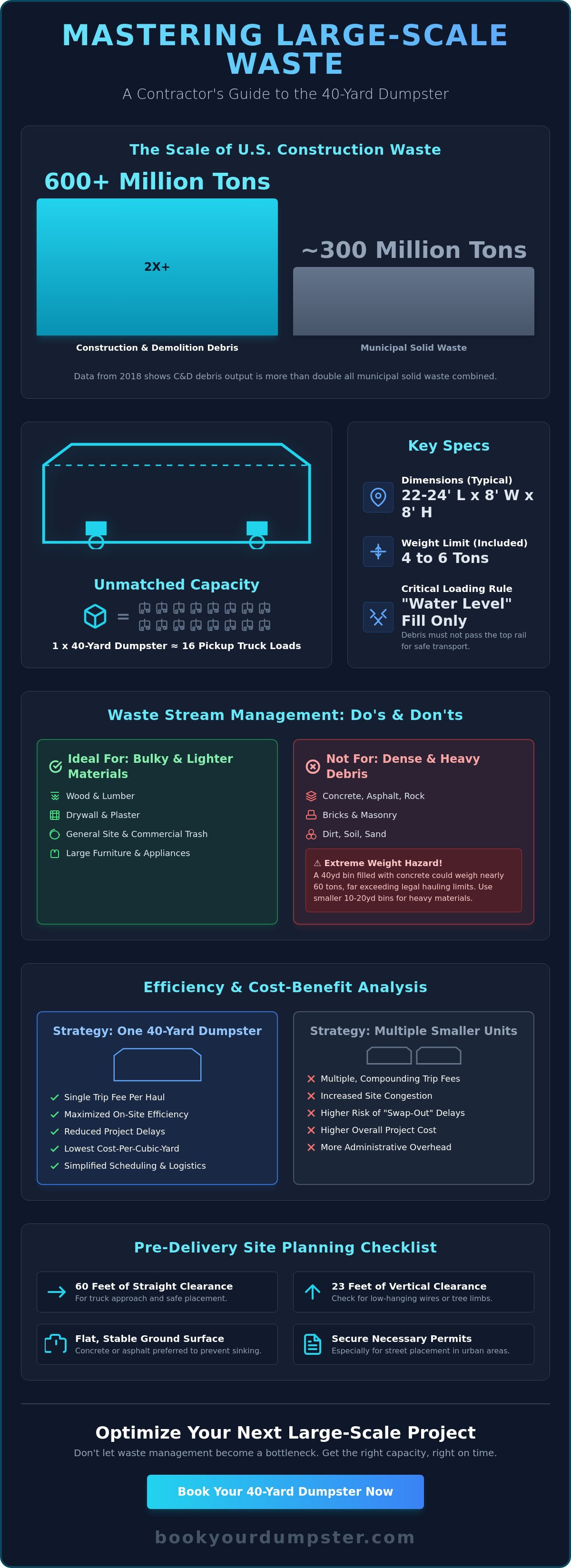
The United States generated over 600 million tons of construction and demolition debris in 2018, more than double the country's municipal solid waste output. On a high-volume job site, managing this waste isn't just a cleanup task; it's a critical logistics operation. Selecting a 40 yard dumpster for large construction is the most effective way to minimize trip fees and maximize site efficiency. Don't let a full bin or a delayed swap-out stall your crew and kill your margin.
Master the logistics of large-scale waste management with this professional guide to dumpster specs, site planning, and cost optimization. We'll show you how to handle site constraints in dense urban areas like Queens or Chicago and ensure compliance with city regulations. Learn to manage weight limits effectively and schedule reliable swaps to keep your project moving without interruptions.
Key Takeaways
- Understand the dimensions and weight limits of the industry's largest roll-off container to prevent logistical delays.
- Discover how a 40 yard dumpster for large construction saves money by reducing total trip fees and streamlining site operations.
- Identify when and where street permits are required in dense urban areas like Queens or Chicago to ensure full compliance.
- Compare the footprint and cost-efficiency of high-capacity bins against using multiple smaller units.
- Learn how professional coordination ensures reliable swap-outs and keeps your large-scale project on schedule.
The Role of 40-Yard Dumpsters in Large-Scale Construction Projects
The 40-yard dumpster is the industry's heavy hitter. It's the largest standard container in the fleet, usually measuring about 22 to 24 feet long. On an active site, a roll-off dumpster of this magnitude is the gold standard for high-volume debris management. Using a 40 yard dumpster for large construction projects ensures that you aren't wasting time on logistics when you should be focused on the build. It eliminates the need for constant haul-offs, which directly cuts down on trip fees and project delays. Think of it as a high-capacity tool designed specifically for the rigors of commercial demolition and new builds.
Physical scale matters when planning your site layout. These units are roughly the size of a standard city bus. They occupy significant real estate but offer unmatched utility in return. By consolidating waste into one massive bin, you keep the job site organized and reduce the risk of debris piles interfering with heavy machinery or crew movement. Efficiency starts with having the right equipment for the volume you generate.
Capacity Breakdown: What 40 Cubic Yards Actually Means
Visualization is key for effective site planning. Think of 40 cubic yards as the equivalent of 16 pickup truck loads. That's a massive amount of volume packed into a single footprint. When loading, strictly follow the "water level" rule. Debris must never crest above the top rail of the container. This ensures safe transport and compliance with road safety laws during the haul-off. This capacity is essential for gutting high-rises, managing large-scale residential additions, or handling commercial roof replacements where material volume is high but weight is manageable.
Why Large Construction Sites Prioritize This Size
Efficiency drives profitability in the construction sector. Large sites prioritize the 40-yard unit because it offers the best cost-per-cubic-yard value compared to 20 or 30-yard units. Instead of paying for two separate hauls of a 20-yard bin, you pay for one. This simple math saves hundreds in trip fees over the life of a multi-month project. It's a pragmatic choice for any project manager looking to optimize their budget. It reduces the administrative burden of scheduling multiple swaps and keeps the site clear for longer periods.
Beyond the numbers, the physical size provides a larger target for your crew. It makes disposing of bulky items like long timber, commercial piping, and industrial appliances much easier. You won't need to spend extra labor hours breaking down large components just to make them fit. Keeping the ground clear and the workflow steady is easier when you have a bin that can handle the reality of a messy job site.
Technical Specifications and Weight Limit Management
A 40 yard dumpster for large construction projects isn't just about volume; it's about managing physical footprint and legal hauling limits. These units typically measure 22 to 24 feet long, 8 feet wide, and 8 feet tall. While the volume is massive, the weight limit is where most contractors run into trouble. Most rentals include a tonnage cap between 4 and 6 tons. It's technically possible to fit over 10 tons of material into a bin this size, but doing so creates a legal and mechanical hazard. Hauling trucks have strict gross vehicle weight ratings. If you overload the bin, the driver will likely refuse the pickup, leading to costly dry-run fees and project delays.
Responsible management of waste requires understanding material density. Never use a 40-yard container for "heavy debris" like concrete, brick, or dirt. These materials are far too dense for a high-volume bin. A 40-yarder filled with concrete would weigh nearly 60 tons, far exceeding what any roll-off truck can lift. For heavy materials, stick to smaller 10 or 20-yard units. Reserve the 40-yarder for bulky, lighter materials like wood, drywall, and general site trash to keep your project compliant and your costs fixed.
Dimensions and Site Footprint Requirements
Placement is critical for a container of this size. You need at least 60 feet of straight approach for the truck to drop or swap the container successfully. Check for vertical obstructions before the truck arrives. Low-hanging power lines or tree limbs must be cleared to at least 23 feet to allow the truck's hoist to operate. Always place the bin on a flat, stable surface. Concrete or asphalt is preferred to prevent the unit from sinking into the ground under its own weight. If you're unsure about your site's layout, talk to a logistics expert to confirm your clearance before the delivery date.
Navigating Weight Limits for Specific Materials
Drywall and lumber are the ideal candidates for a 40 yard dumpster for large construction. They take up significant space but rarely exceed weight limits before the bin is physically full. If you're disposing of mixed debris, place the heaviest items at the bottom and keep them centered. This lowers the center of gravity for safer transport. Pay close attention to the tonnage caps in your commercial contract. Every ton over the included limit results in overage fees that can quickly erode your budget. Track your loads to keep your costs predictable and your crew working.
40-Yard Dumpster vs. Multiple Smaller Units: A Cost-Benefit Analysis
Space and budget are the two biggest constraints on any job site. Choosing a 40 yard dumpster for large construction projects allows you to maximize both. A single 40-yard unit occupies about 190 square feet of ground space. Placing two 20-yard units side-by-side doubles that footprint, often blocking access for other equipment. The financial advantage is even clearer. Every haul-off involves a trip fee. By consolidating your waste into one massive container, you eliminate the second trip fee. This typically saves $150 to $300 per haul. If your project runs for several months, those savings add up to thousands of dollars back in your budget.
Efficiency and Trip Fee Optimization
Calculating the ROI of a 40-yard rental depends on your waste volume. If your site generates 120 cubic yards of debris, a 40-yard unit requires three hauls. A 20-yard unit requires six. Reducing your hauls by half significantly lowers your operational overhead. Don't wait until the bin is overflowing to call for a swap. Schedule your swap-out at least 24 hours in advance to keep your crew productive. For more advanced strategies on site logistics, read our Construction Debris Removal Guide. Reliable timing ensures your site stays clear and your timeline remains intact.
Managing Mixed Waste Streams on Industrial Sites
High-capacity bins are essential for managing mixed Construction and Demolition (C&D) waste. If you're pursuing LEED certification, having a centralized collection point for mixed materials simplifies waste diversion reporting. Maintaining a clean site isn't just about aesthetics; it's about safety. Following OSHA regulations for waste disposal prevents accidents and keeps inspectors happy. The swinging rear door on these units is a major labor-saver. It allows your team to walk heavy items directly into the container. This is far safer than trying to hoist bulky debris over the eight-foot side walls, reducing the risk of back injuries and worker compensation claims.
Logistical Planning and Local Permitting in Major Metro Areas
Placing a 24-foot container in dense urban environments like Queens or Chicago requires precision. A 40 yard dumpster for large construction is an efficient tool, but its size makes it a logistical challenge in tight quarters. You can't just drop it anywhere. Most major metros require a street permit if the bin sits on public property. Depending on your city, the responsibility for pulling these permits falls on either the general contractor or the hauling company. Check your local building codes early to avoid work-stoppage orders or heavy fines. Local expertise in New York, New Jersey, and Massachusetts is vital because regulations often vary block by block.
Protecting the city infrastructure is your next priority. A fully loaded 40-yarder can crack sidewalks or damage asphalt under high pressure. Use "street pads" or heavy-duty plywood to distribute the weight across the surface. This simple step prevents thousands of dollars in surface damage fees from the municipality. Ensure your site plan accounts for both the container's weight and the truck's entry path before the delivery window opens. Keeping the site compliant keeps the project on schedule.
Site Preparation and Delivery Logistics
Use the "Cone Method" to secure your drop zone. Mark off the delivery area with traffic cones at least 24 hours in advance. This prevents unauthorized parking from blocking the truck's approach. Clear all vehicles and debris from the path by 6:00 AM to ensure no delays. A roll-off is a gravity-based delivery system that requires specific incline clearance to slide the bin off the hoist safely. If the approach is too steep or narrow, the driver cannot complete the delivery. This results in a dry-run fee and a stalled crew.
City-Specific Regulations (NYC, NJ, Chicago, SF)
In NYC and Queens, you must navigate Department of Transportation (DOT) permits and strict nighttime delivery windows. Many commercial zones only allow drop-offs during off-peak hours to minimize traffic congestion. In Chicago, alleyway placements are common but often too narrow for a 40-yard unit. You'll likely need a Class B street permit for anything over 30 cubic yards. San Francisco presents a different challenge: steep inclines. Weight distribution is critical for hill safety to prevent the bin from shifting or sliding. Always coordinate with a local expert who understands these regional nuances before you book your next haul.
Securing Your 40-Yard Dumpster with Book Your Dumpster USA
An idle crew is a drain on your project's profitability. Book Your Dumpster USA acts as a high-functioning tool in your logistical arsenal, ensuring that waste management never becomes a bottleneck. We specialize in high-capacity construction logistics, providing the heavy-duty equipment needed for the most demanding sites. Selecting a 40 yard dumpster for large construction through our platform means choosing a partner that understands the urgency of a professional job site. We focus on reliability and the removal of logistical stress, allowing you to maintain control over your project's timeline and budget.
Punctuality is our recurring rhythmic promise. According to our internal delivery data, we have successfully managed over 1.8 million dumpster deliveries with a 98% on-time rate. We don't just drop off a bin; we integrate into your workflow. Our team coordinates with a network of licensed haulers to ensure that your swaps happen exactly when scheduled. This level of precision keeps your site clear and your workers productive from the first day of demolition to the final inspection.
Our Streamlined Professional Booking Process
Efficiency is built into our digital-first platform. You can select the 40-yard size, set your delivery date, and finalize your order in under two minutes. This streamlined approach respects your time and eliminates the friction of traditional rental services. We maintain a strong local presence in New York, Illinois, and Massachusetts, providing localized expertise that national providers often lack. Before you schedule, review our Dumpster Rental Prices Guide to understand the regional factors impacting your site. We move you quickly through the decision-making process so you can get back to the build.
Reliability and Transparent Pricing for Contractors
Trust is built on pricing integrity. Our "No Hidden Fees" promise ensures that your 40 yard dumpster for large construction comes with clear tonnage limits and firm rental periods. We avoid the opaque communication structures common in the waste industry. For sites requiring long-term maintenance, we also offer Front load Commercial Waste Pickup and Private Curbside Trash Pickup. These options provide a total waste solution for diverse project needs. We position ourselves as a dependable expert that understands the messy reality of large-scale construction. Book your 40-yard dumpster today and experience a service designed for the modern contractor.
Optimize Your Site Logistics Today
Successful project management depends on making the right equipment choices before the first load of debris hits the ground. Utilizing a 40 yard dumpster for large construction is the most effective way to consolidate waste, minimize expensive trip fees, and maintain a safe, organized workspace. You now have the blueprint for navigating technical weight limits and managing complex city permits in major hubs like NYC, NJ, Chicago, and San Francisco. Don't let logistical oversights or hidden fees stall your crew's progress.
Take control of your waste management strategy with a partner that understands the high stakes of commercial development. Rely on our Punctual Delivery Guarantee and Transparent Contractor Pricing to keep your project moving forward without interruptions. Our digital-first platform makes it easy to schedule your rental and secure your site's efficiency in just a few clicks. Rent Your 40 Yard Construction Dumpster Online Now. Clear the path for your next phase of construction with confidence and precision.
Frequently Asked Questions
How much weight can a 40 yard dumpster actually hold?
A 40-yard unit can physically hold over 10 tons of material, but hauling trucks have strict legal limits. Most trucks cannot safely lift or transport more than 12 tons of debris. Overfilling a 40 yard dumpster for large construction creates a significant safety risk for the driver and other motorists. Stick to the tonnage limits specified in your contract to avoid failed pick-up attempts and additional dry-run fees.
What are the exact dimensions of a 40 yard roll-off dumpster?
Standard dimensions for this high-capacity unit are 22 to 24 feet long, 8 feet wide, and 8 feet tall. These measurements represent the external footprint of the container. Ensure your site has enough flat surface area to accommodate these specs plus the necessary clearance for the truck's approach. This size is roughly comparable to a standard city bus, making it the largest option available for commercial waste management.
Can I put concrete or brick in a 40 yard dumpster?
No, you should never put heavy debris like concrete, brick, or dirt in a 40-yard unit. These materials are extremely dense and will exceed the truck's hauling capacity long before the bin is half full. If you load a 40-yarder with masonry, the truck won't be able to lift it safely. Use smaller 10 or 20-yard dumpsters for heavy materials to stay within legal weight limits and avoid project delays.
Do I need a permit to put a 40 yard dumpster on the street in NYC or Chicago?
Yes, placing a container on a public street or sidewalk in NYC or Chicago requires a specific permit. In New York, the carting company or contractor must obtain a permit from the Department of Transportation. Chicago requires a Class B permit for units larger than 30 cubic yards. Always secure these documents before delivery. Failure to do so leads to immediate fines and the potential removal of the dumpster by city authorities.
How much space does the truck need to deliver a 40 yard container?
Your site needs at least 60 feet of straight-line approach for the delivery truck to drop the bin. The driver also requires 23 feet of vertical clearance to raise the hoist and slide the container into position. Check for low-hanging power lines, tree branches, or building overhangs that might obstruct the delivery. Clear all vehicles and obstructions from the path at least 24 hours before the scheduled drop-off window to ensure success.
What happens if I exceed the weight limit on my 40 yard dumpster?
Exceeding the weight limit results in two primary consequences: overage fees and hauling refusal. If the bin is overweight but still safe to haul, you'll be charged per ton for the excess weight based on local landfill rates. If the bin is too heavy for the truck to lift, the driver will leave it on-site. You'll then have to remove the excess material yourself and pay a dry-run fee for the failed pickup.
Is a 40 yard dumpster too big for a residential driveway?
Most residential driveways are not suitable for a 40-yard container. At 22 to 24 feet long, the bin will likely block your garage or extend into the sidewalk and street. The extreme weight of a loaded 40-yarder can also crack standard residential concrete or asphalt. For home cleanups or smaller renovations, consider a 10 or 20-yard unit instead. These smaller sizes offer a more manageable footprint and lower risk of property damage.
How many tons are typically included in a 40 yard dumpster rental?
Most rental agreements for a 40 yard dumpster for large construction include a tonnage cap of 4 to 6 tons. This included weight covers the disposal of standard debris like wood, drywall, and general site trash. If your project generates high-density waste, track your load weights carefully. Any weight beyond the included limit will trigger additional fees. Review your contract terms to understand the specific tonnage allowance and overage rates for your service area.


