

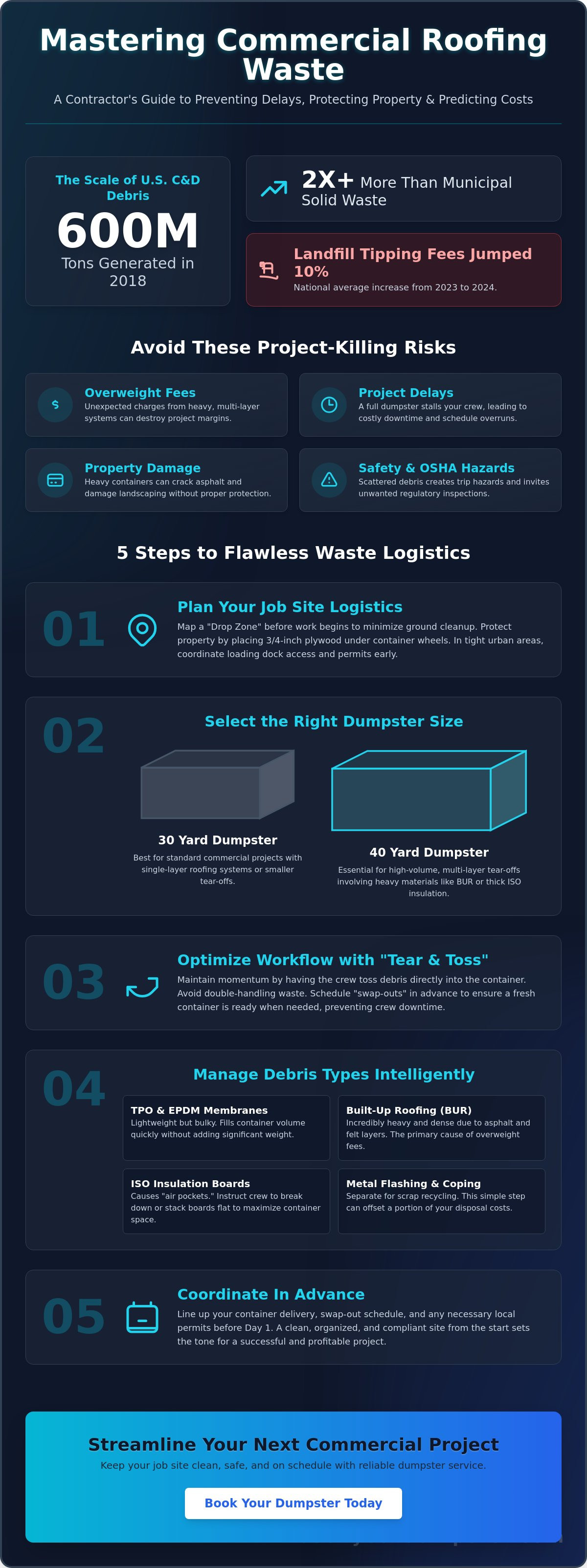
Did you know the U.S. generated 600 million tons of construction and demolition debris in 2018? That's more than twice the amount of standard municipal waste. For a professional contractor, efficient commercial roofing tear-off waste management is the difference between a profitable project and a logistical nightmare. You already know that a single overweight dumpster fee or a blocked access point can stall an entire crew. It's frustrating to watch margins shrink because of rising landfill tipping fees, which jumped 10% nationally between 2023 and 2024. One mistake with container placement can lead to property damage or costly delays that you can't afford.
This guide helps you master the logistics of roofing debris to prevent delays, protect the property, and keep your costs predictable. You'll learn how to select the right container sizes, such as a 30 yard or 40 yard dumpster, and how to map weight limits before the first shingle hits the ground. We'll also look at site layout strategies that eliminate bottlenecks on even the tightest urban job sites. Follow these steps to ensure your next tear-off remains clean, safe, and on schedule.
Key Takeaways
- Map your "Drop Zone" before the project begins to protect the property and reduce ground-crew labor in crowded urban environments.
- Calculate "Roofing Squares" accurately to choose between 30 yard and 40 yard containers for optimal commercial roofing tear-off waste management.
- Adopt the "Tear and Toss" method to keep your crew moving and prevent costly downtime waiting for container swaps.
- Account for the high waste volume of multi-layer commercial systems to avoid unexpected overweight fees or site overflows.
- Coordinate your container delivery and local permits early to ensure a clean, safe job site from the first day of demolition.
The Scope of Commercial Roofing Tear-Off Waste Management
Commercial roofing tear-off waste management is the systematic collection, containment, and disposal of complex, multi-layer roofing systems. It is a high-stakes logistics process that dictates your daily production rate. Unlike residential jobs, commercial projects often generate three times more waste per square foot. This massive volume comes from thick layers of polyisocyanurate (ISO) insulation, heavy stone ballast, and multiple historical roofing membranes hidden beneath the surface. Managing this output requires a disciplined approach to construction and demolition waste to keep the site safe and profitable.
Your waste strategy directly impacts OSHA compliance. A roof covered in loose TPO scraps or old ISO boards is a hazard. In 2018, the U.S. generated 600 million tons of C&D debris, and commercial roofing contributed a significant portion of that weight. Effective commercial roofing tear-off waste management ensures you account for every pound of TPO, EPDM, and metal flashing before the first crew member arrives. Plan for the weight of each material to avoid surprising fees at the scale.
Common Materials and Their Disposal Requirements
Single-ply membranes like TPO and EPDM are lightweight but bulky. They fill containers quickly without adding much weight. Conversely, old built-up roofing (BUR) with asphalt and felt is incredibly heavy and messy. ISO insulation boards are the primary cause of "air pockets" in your dumpster. Instruct your crew to stack or break these boards down. This simple step maximizes the capacity of your 30 yard or 40 yard dumpster. Don't throw away money by tossing metal flashing and coping into the trash. Separate these components early to recover costs through scrap recycling. It's a simple way to offset your disposal expenses.
The Risks of Poorly Managed Debris
Scattered debris is a major liability. It creates trip hazards that slow down your crew and invite unwanted OSHA inspections. If your containers aren't positioned correctly, you'll pay for "re-handling" debris. This happens when workers move trash from the roof to a staging area and then finally to the container. You're paying for the same labor twice. Beyond the crew, a cluttered job site destroys public perception. Building tenants and owners judge your competence by the cleanliness of the perimeter. Use Book Your Dumpster to coordinate precise drop-offs and swaps. This keeps the workflow moving and ensures that waste never accumulates where it shouldn't.
Planning Job Site Logistics for Commercial Projects
Efficient commercial roofing tear-off waste management requires a mapped site plan before the first crew member arrives. Establish a "Drop Zone" to dictate exactly where debris falls. This strategy minimizes ground-level cleanup and keeps laborers focused on the roof. In tight urban environments like New York or San Francisco, space is a luxury. You must coordinate with building management to secure loading dock access or specific parking stalls. Neglecting these details leads to blocked fire lanes and costly municipal fines.
Schedule your "Swap-Outs" in advance to maintain a continuous workflow. A full dumpster is a project bottleneck. If your crew stops to wait for a fresh bin, you're losing money on labor. Align your schedule with the Sustainable Management of C&D Materials guidelines to ensure you're handling waste responsibly and efficiently. For high-volume projects, ordering a 40 yard dumpster ensures you have the capacity to handle heavy multi-layer tear-offs without interruption.
Strategic Dumpster Placement for Roofers
Place containers as close to the roof edge or chute system as possible. Every foot of travel distance adds minutes to your cycle time. Check for overhead clearance before delivery. Roll-off trucks need significant vertical space to hoist and drop bins. Ensure the placement doesn't interfere with building exits or pedestrian walkways. If you're working in a high-traffic area, use safety cones and tape to mark the perimeter. This protects your equipment and the public.
Protecting the Building and Grounds
Heavy bins can easily crack asphalt or damage landscaping. Use 3/4-inch plywood or steel street plates to distribute the weight of the dumpster. This simple precaution prevents expensive property damage claims at the end of the job. Set up debris chutes to contain dust and small particles during the descent. This is critical for maintaining tenant relations in occupied buildings. Finally, run a magnetic nail sweep across the entire site at the end of every shift. Protecting tenant vehicles from flat tires is just as important as the roof itself. It builds your reputation as a professional who respects the property.
Selecting the Right Dumpster Size for Roofing Debris
Selecting the wrong container size kills your profit margins. Commercial roofing tear-off waste management depends on matching your dumpster volume to the specific material layers you're removing. Most commercial contractors rely on 30 and 40-yard bins because they accommodate the sheer bulk of multi-layer systems and insulation boards. If you underestimate the volume, your crew will sit idle while waiting for a swap. If you overestimate, you're paying for air. Calculate your roofing squares to avoid guessing. One roofing square equals 100 square feet. For a commercial tear-off, factor in the thickness of the insulation. A single layer of 2-inch ISO board takes up more room than standard shingles. If you're removing three layers of old roofing, triple your volume estimate immediately.
Don't ignore the footprint of your equipment. While a 40-yard bin holds more, it shares the same 22-foot length as a 30 yard dumpster. The difference is the height of the side walls. If your crew is loading by hand over the side, the taller 40-yard walls might slow them down. However, for bulky materials like loose insulation or large membrane rolls, that extra height is essential. Use multiple 20-yard bins only when ground space is extremely limited or when you're dealing with exceptionally heavy materials like concrete tiles or thick masonry debris. This keeps each load within legal hauling limits.
The 30 and 40-Yard Advantage
Large containers offer the best cost-per-yard value for massive commercial projects. These sizes are the industry standard because they handle the awkward dimensions of EPDM rolls and stackable ISO boards without constant overflow. According to the Construction & Demolition Recycling Association, efficient material sorting at the source can significantly reduce your total disposal volume. Larger bins give your crew the space to organize materials, such as stacking insulation flat to maximize every cubic inch. This efficiency reduces the total number of trips the truck makes to the landfill, saving you money on transportation fees.
Weight Considerations for Heavy Materials
Weight is the silent budget killer in roofing. Gravel ballast is the heaviest material you'll encounter. You'll hit the weight limit of a 40-yard container long before you fill the volume. For ballasted roofs, stick to 20-yard bins to ensure the truck can safely lift the load. Water is another factor. Saturated insulation weighs significantly more than dry material. If you're tearing off a roof after a heavy rain, expect your disposal weight to double. Proactive load monitoring prevents "overweight" fines. Instruct your foreman to stop filling if the material is particularly dense or wet. It's cheaper to order an extra bin than to pay a massive penalty at the scale.
Step-by-Step Guide to Managing the Tear-Off Sequence
Secure your local permits at least two weeks before the project start date. Every city has different rules for street placement. In some jurisdictions, you may need a "right-of-way" permit if the dumpster occupies a public parking space. Schedule your first 30 or 40 yard dumpster for delivery the afternoon before demolition begins. This proactive scheduling ensures your crew starts work immediately at sunrise without waiting for a truck to arrive. It's the first step in maintaining a professional, high-velocity job site.
Implement the "Tear and Toss" method for efficient commercial roofing tear-off waste management. In this workflow, debris moves directly from the roof to the container without ever touching the ground. This eliminates the need for a secondary cleanup crew and keeps your labor costs low. If your crew is moving material twice, you're losing money. Focus on a continuous flow of material from the roof edge to the bin to keep production rates high.
Monitor your fill levels constantly. Don't wait until the bin is overflowing to call for a pickup. Trigger a swap-out request when the bin is 75% full. This 24-hour lead time prevents your crew from standing around a full dumpster while the meter runs on their hourly wages. A swap-out is the timed replacement of a full container with an empty one to ensure zero downtime for the roofing crew. If you're working on a massive 50,000 square foot roof, you might need multiple swaps per day. Coordinate these times with the driver to avoid peak traffic hours in urban areas.
Coordinating the Tear-Off and Disposal
Assign one dedicated "ground man" to the drop zone. This person monitors fill levels, manages pedestrian safety, and guides the roll-off truck during swaps. For high-rise projects, prioritize debris chutes to contain dust and small particles. If space is too tight for a chute, use crane-loaded skips to move material to a street-level 40 yard dumpster. This level of coordination keeps the site organized and prevents the buildup of dangerous debris piles that could lead to OSHA citations or property damage.
Managing Hazardous Materials and Recycling
Stop work immediately if you suspect asbestos-containing materials (ACM). In California, for example, you must have a survey for ACMs before any demolition regardless of the building's age. For LEED-certified projects, separate your waste streams into distinct piles. Keep clean wood, metal, and membranes separate to maximize your recycling credits. This organization pays off in lower tipping fees and better client reporting. Consult our guide on construction debris removal for more on handling specialized waste.
Run a magnetic sweep twice daily. Do this once at lunch and once before the crew leaves for the day. This protects the property owner from liability and keeps the site professional. It's a small task that prevents flat tires and pedestrian injuries. Ready to start your next project? Book your dumpster today to lock in your schedule and ensure your waste management remains a tool for efficiency, not a bottleneck.
Streamline Your Commercial Project with Book Your Dumpster USA
Success in commercial roofing tear-off waste management depends on a partner who respects your timeline. We provide professional roll-off solutions across NY, NJ, IL, MA, and San Francisco. When you're managing a 40,000 square foot project, you can't afford a bin that's stuck in traffic or delayed by poor communication. Our team specializes in roll off dumpster rental for high-volume needs. We handle the logistical heavy lifting so you can focus on the installation. You get transparent pricing with no hidden fees. This clarity ensures your project budget stays intact from the first tear-off to the final inspection.
Local Expertise for Major Metro Job Sites
Navigating the permit requirements in Queens, the narrow streets of Boston, or the strict scheduling in Chicago is a major hurdle. We understand these local regulations and work within them to keep your site compliant and operational. Punctuality is our core promise. We deliver and pick up on your schedule to maintain the momentum of your crew. You have direct access to 10, 20, 30, and 40-yard containers. This variety allows you to scale your waste management strategy to the specific demands of each building. Whether it's a small retail strip or a massive industrial warehouse, we have the right bin for the weight and volume of your debris. Our drivers are experienced in tight urban placements, ensuring your container is exactly where you need it to minimize labor travel time.
Simplified Waste Management for Contractors
Busy contractors need tools that save time, not add to the workload. Our streamlined online system allows for one-click ordering and easy scheduling across multiple job sites. You can manage your entire fleet of dumpsters from a single dashboard. If you aren't sure which size fits your next tear-off, our expert support team helps you calculate the right capacity. We look at your roofing squares and material types, such as heavy gravel ballast or bulky ISO board, to prevent overweight fines. We remove the stress of coordination and the uncertainty of disposal costs. This digital-first approach modernizes a traditional industry, giving you more control over your project's profitability. Book your commercial dumpster online today to experience a waste management process built for modern construction speed. We are the dependable partner you need for every square foot of the job.
Master Your Next Commercial Tear-Off
Efficiency on a commercial job site isn't accidental. It's the result of precise planning and reliable logistics. You've learned how to map your "Drop Zones" to protect property and how to calculate roofing squares to choose the right container. Mastering commercial roofing tear-off waste management ensures your crew stays on the roof and your project stays on budget. Don't let a full dumpster or a missed delivery stall your progress. Every hour spent waiting for a swap-out is an hour of lost profit. We provide a full range of 10, 20, 30, and 40 yard containers across NY, NJ, IL, MA, and San Francisco to keep your workflow moving. Our streamlined digital platform is built specifically for busy contractors who need results without the fluff. Take control of your site logistics today and eliminate the stress of debris removal. Use our online tools to schedule deliveries and manage multiple sites with a single click. Order Your Commercial Roofing Dumpster Online Now. Your next profitable project starts with a clean site and a dependable partner.
Frequently Asked Questions
What size dumpster is best for a commercial roofing tear-off?
The 30 and 40-yard dumpsters are the industry standard for commercial projects. These sizes provide the necessary volume for bulky items like ISO insulation boards and large membrane rolls. For smaller maintenance tasks or job sites with extreme space constraints, a 20-yard dumpster is often used. Always match the container size to the total cubic yardage of your debris to prevent site overflows and project delays.
How much does a commercial roofing dumpster rental cost in 2026?
Costs in 2026 vary based on your geographic location and the weight of the materials being disposed of. Landfill tipping fees rose by 10% nationally between 2023 and 2024, reaching an average of $62.28 per ton. You should check the current rates in your specific city, as regional fees in the Northeast are significantly higher than in the South Central United States. Weight limits and rental duration also influence the final price.
Can I put asbestos roofing materials in a standard roll-off dumpster?
No, you cannot put asbestos-containing materials (ACM) into a standard roll-off container. Federal and state laws require hazardous materials like asbestos to be disposed of in specialized, leak-proof containers at certified facilities. Following the EPA's 2024 ban on chrysotile asbestos, regulations for demolition and renovation have become even stricter. If you encounter ACM during a project, stop work and hire a licensed abatement professional for legal disposal.
How many squares of roofing fit into a 40-yard dumpster?
A 40-yard container typically holds about 50 to 60 squares of single-layer roofing material. However, efficient commercial roofing tear-off waste management requires accounting for insulation and multiple layers. If you're removing a ballasted system or thick ISO boards, you might only fit 15 to 20 squares per bin. Bulky materials create air pockets that fill the volume quickly, even if the total weight remains below the hauling limit.
Do I need a permit to place a dumpster on the street in New York or Chicago?
Yes, both New York and Chicago require permits for any container placed in the public right-of-way. In New York, you must obtain a permit from the Department of Transportation (DOT) before delivery. Chicago requires a similar Right-of-Way permit. Fines for placing a dumpster without proper documentation are steep and can lead to immediate project shutdowns. Always secure your permits at least 10 business days before the project start date.
What happens if my roofing dumpster is overweight?
If a dumpster exceeds its weight capacity, the driver may be unable to safely lift the bin onto the truck. You will be charged overweight fees for every ton over the limit. In some cases, you'll have to manually remove debris from the container until it reaches a legal hauling weight. This creates expensive labor delays and stalls your workflow. Monitor heavy materials like gravel and wet insulation to avoid these penalties.
How do I protect the parking lot from damage during a commercial roof project?
Protect the asphalt or concrete by placing 3/4-inch plywood or steel plates under the dumpster's landing points. This distributes the pressure and prevents the heavy bin from cracking the surface or leaving deep ruts. Ensure the delivery area is clear of loose debris and nails before the truck arrives. These simple steps prevent expensive property damage claims and help maintain a professional relationship with the building owner or manager.
Can commercial roofing membranes like TPO be recycled?
Yes, TPO and EPDM membranes are recyclable if they are kept clean and separated from other debris. Many manufacturers offer take-back programs for old membranes to support sustainable commercial roofing tear-off waste management. You must remove all fasteners, adhesives, and insulation scraps before the material is accepted for recycling. Check with local processing centers or the material manufacturer to confirm their specific requirements for recycling clean roofing scraps.


