

The smallest dumpster might actually cost you twice as much if you underestimate your junk density. You've spent years stacking boxes, broken tools, and old furniture in your two-car garage, and now you're finally ready to reclaim that square footage. It's natural to worry about overpaying for empty space or facing the nightmare of a second delivery fee because your first bin overflowed before the job was done.
We'll help you determine the exact dumpster size for a two-car garage cleanout so you can book with confidence. Whether you're navigating a $135 permit in New York City or avoiding $90 per ton overage fees in Chicago, we have the logistical details you need. This guide compares 10-yard and 20-yard capacities against real-world clutter levels to ensure your project stays on budget. You'll learn how to choose the right container, navigate specific landfill bans in Massachusetts, and get your waste removed without the typical industry headaches. We provide a clear path from a cluttered floor to a clean driveway with transparent pricing and fast delivery.
Key Takeaways
- Compare the capacity of 10, 20, and 30-yard roll-offs to find the perfect fit for your 400 to 600-square-foot garage space.
- Master the "clutter density" method to choose the right dumpster size for a two-car garage cleanout and prevent costly overage charges.
- Review city-specific permit costs and regulations for placing dumpsters on public streets in Chicago, Boston, and New York City.
- Identify hazardous and prohibited materials like E-waste and chemicals that require specialized disposal under current state laws.
- Simplify your project logistics with a direct, online booking process that guarantees transparent pricing and no hidden fees.
Choosing the Right Dumpster Size for a Two-Car Garage Cleanout
A standard two-car garage typically measures between 400 and 600 square feet. When this space is used for long-term storage rather than vehicles, it accumulates a massive volume of debris. Selecting the correct dumpster size for a two-car garage cleanout is the difference between a one-day project and a multi-week logistical nightmare. Many homeowners gravitate toward a 10-yard bin to save money, but these containers often reach capacity before the garage is even half empty. If your cleanout includes bulky items like old appliances, wooden shelving, or heavy workbenches, you'll likely need to step up to a 15-yard or 20-yard roll-off.
These common dumpster sizes are designed to handle the diverse weight and volume found in residential settings. When you book your dumpster, prioritize a model with a rear walk-in door. This feature is a game-changer for garage projects. It allows you to carry heavy items directly into the container rather than lifting them over high side walls. It also helps you maximize space by allowing you to stack items tightly from front to back. This ensures you get every cubic inch of value from your rental and avoid paying for air pockets in the middle of your load.
The Pickup Truck Load Comparison
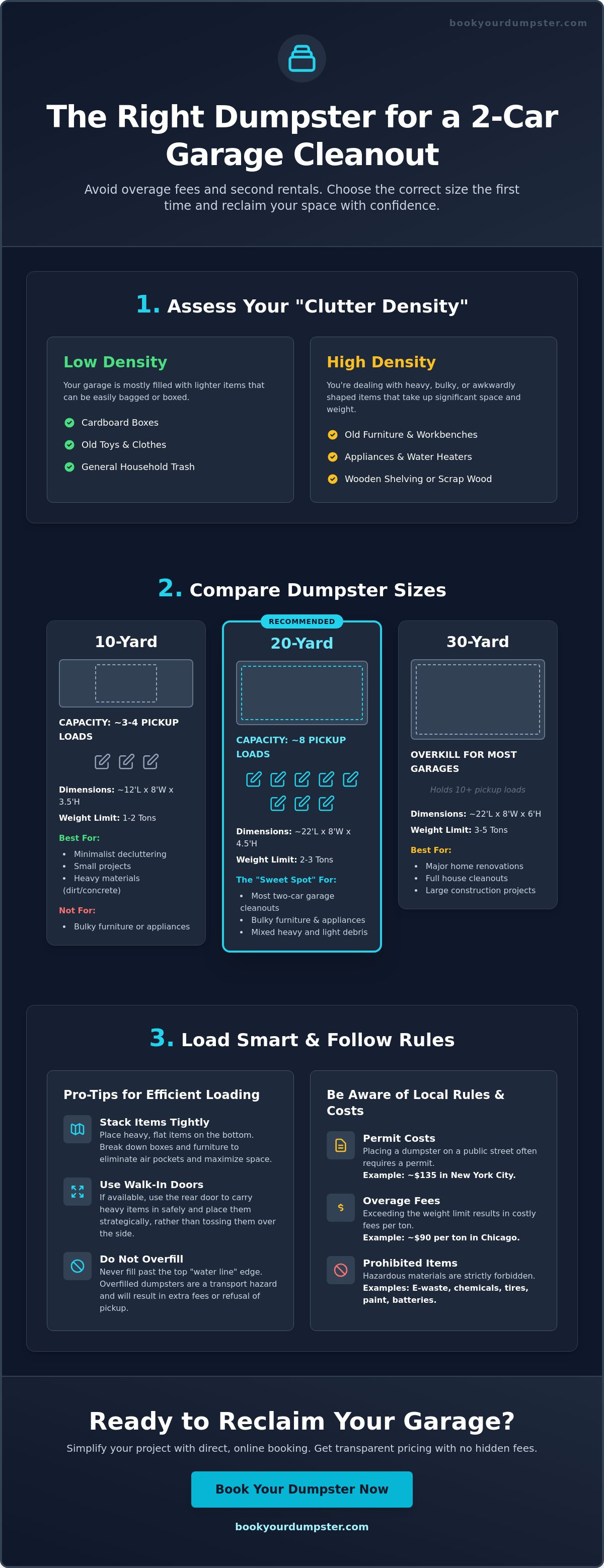
Visualizing cubic yards is difficult if you don't work in waste management. Think of it in terms of a standard pickup truck bed. A 10-yard dumpster holds about 3 to 4 full truckloads of junk. This works for a light decluttering project where you're only tossing old toys and clothes. However, a 20-yard dumpster accommodates approximately 8 full pickup truck loads. If your garage has piles of junk that would take you a full weekend of driving to a local landfill, the 20-yard container is your best bet. It provides the breathing room needed for large furniture and unexpected debris that always surfaces once you start digging.
Why "Cubic Yards" Matter More Than Dimensions
A cubic yard is a measurement of volume equal to a 3x3x3 foot cube. While the length and width of a dumpster determine if it fits in your driveway, the height provides the actual capacity. Use the vertical space wisely. Place heavy, flat items on the bottom and stack lighter debris on top. You must never fill the container past the "water line," which is the top edge of the steel walls. Overfilled dumpsters are a safety hazard during transport. Drivers will often refuse to pick up a bin if items are protruding above the rim, which can lead to dry-run fees and project delays.
Comparing 10, 20, and 30-Yard Dumpsters for Garage Junk
Choosing the right dumpster size for a two-car garage cleanout ensures you don't stall your project halfway through because of an overflowing bin. You need a container that balances floor space in your driveway with the actual volume of your junk. Most two-car garages require more capacity than homeowners expect. Before you book, review the standard dimensions and capacities to avoid the stress of a second rental fee.
| Dumpster Size | Typical Dimensions (L x W x H) | Weight Limit (Average) |
|---|---|---|
| 10-Yard | 12' x 8' x 3.5' | 1 to 2 Tons |
| 20-Yard | 22' x 8' x 4.5' | 2 to 3 Tons |
| 30-Yard | 22' x 8' x 6.0' | 3 to 5 Tons |
The 10-Yard Dumpster: For the Minimalist
This size is best for light decluttering. If your garage mostly contains cardboard boxes, small plastic toys, and general household trash, this compact bin works well. It doesn't take up much space, making it easy to place in tight driveways. However, a 10 yard dumpster rental is specifically useful if you're disposing of heavy debris like concrete or dirt from a small garage floor repair. Don't choose this size if you have large furniture like old workbenches or sofas; they'll consume the entire volume instantly.
The 20-Yard Dumpster: The Industry Standard
The 20-yard dumpster is the "sweet spot" for most suburban two-car garages. It's roughly 22 feet long, which fits comfortably in a standard driveway while leaving room for your vehicle. This size accommodates bulky appliances, old water heaters, and large sports equipment without reaching the fill line too quickly. It typically handles 2 to 3 tons of waste. Before you start loading, remember to check the EPA guidelines on hazardous waste to ensure you aren't tossing prohibited chemicals or old paints that could lead to fines.
The 30-Yard Dumpster: For Major Hoards
If your garage is packed floor-to-ceiling with large items, or if you're gutting the space entirely, go with the 30-yard option. This size is essential for projects that include tearing out old wooden shelving, drywall, or heavy cabinetry. It provides the depth needed for long pieces of lumber and high-volume debris. This size is also ideal for construction debris removal if your cleanout is part of a larger renovation. Schedule your dumpster delivery now to clear out a major hoard in one go.
Estimating Your Waste Volume: The 'Clutter Density' Factor
Determining the correct dumpster size for a two-car garage cleanout requires looking past the square footage. You must evaluate the density of your debris. A garage filled with empty cardboard boxes has a very different volume requirement than one packed with old engine parts and decades of magazines. We categorize garages into three distinct levels to help you choose the right roll-off: Low (Organized), Medium (Standard), and High (Pack-Rat). High-density garages often look smaller than they are because the items are packed tightly, hiding the true volume of waste.
Use this checklist to estimate your volume before you book your dumpster:
- Are the rafters or overhead storage racks completely full?
- Do you have heavy construction materials like old roof shingles or floor tiles tucked in corners?
- Is there significant scrap metal, such as old lawnmowers or automotive machinery?
- Are there large stacks of paper, such as old files, books, or magazines?
- Do you have bulky wooden workbenches that cannot be disassembled?
The "Pack-Rat" Test
If you cannot see the floor of your garage, you're in the High Density category. This status almost always requires a 20-yard or 30-yard dumpster. Look up. Hidden volume in the rafters often accounts for an extra 5 to 10 cubic yards of debris that homeowners forget to count. When loading your bin, efficiency is your priority. Break down every cardboard box and disassemble furniture to eliminate air pockets. Air pockets are a waste of money. You want to fill the container with actual junk, not empty space that could have been avoided with a few minutes of prep work.
Weight Limit Considerations for Garage Debris
Understand the difference between volume and mass. Volume is the space your junk takes up; mass is how much it weighs. A 10-yard dumpster might physically fit your pile of old roof shingles, but it will likely exceed the weight limit instantly. Heavy items like shingles, tiles, or stacks of paper are deceptive. According to verified 2026 data, overweight fees in regions like New York can reach $250 per ton. Review how dumpster rental prices are tied to these weight limits. Choosing a larger bin with a higher weight allowance is often cheaper than paying overage fees on a smaller, overloaded container. Be realistic about what you're tossing to avoid unexpected costs at the landfill.
Local Disposal Rules for New York, Illinois, and Massachusetts Residents
Identifying the right dumpster size for a two-car garage cleanout is only half the battle. You must also account for local laws and logistical constraints. In states like New York, Illinois, and Massachusetts, waste management is highly regulated. Failing to secure a permit or tossing a banned item can result in fines that exceed the cost of the rental itself. Choosing a dumpster rental provider with regional expertise ensures you don't get caught off guard by city-specific ordinances.
Navigating Permits in Chicago and NYC
Street placement is a common necessity in dense urban areas where driveways are narrow or non-existent. In New York City, a permit for placing a container on public property is mandatory and currently costs between $135 and $385. Chicago residents face daily fees ranging from $25 to $60 for street access. You should apply for these at least 72 hours before your project starts. If you have a driveway, ensure it is clear of low-hanging branches or power lines. Book Your Dumpster USA helps you determine if your specific address requires additional paperwork, removing the stress of city hall bureaucracy.
State-Specific Prohibited Items
Massachusetts has some of the nation's strictest landfill bans as of April 2026. You cannot toss asphalt, brick, concrete, metal, wood, or gypsum wallboard into a standard bin there. These materials must be separated for recycling. New York and Illinois focus heavily on electronic waste. The Electronic Equipment Recycling and Reuse Act in New York makes it illegal to dispose of computers, monitors, and printers in landfills. In Illinois, the Consumer Electronics Recycling Act (CERA) carries similar weight. If your garage cleanout includes old TVs or desktop PCs, you must find a dedicated recycling center. These debris removal standards are non-negotiable and strictly enforced at the scale house.
Cleanouts in the Northeast and Midwest often collide with harsh winter weather. Snow and ice make driveways slick, which can prevent a roll-off truck from safely dropping or picking up a container. In Chicago or Boston, a single overnight storm can delay your project if the path isn't salted and cleared. Clear a space at least 10 feet wide and 22 feet long to ensure the driver has enough room to maneuver. Selecting a local provider who understands these regional nuances is essential for a smooth project. Avoid the headache of local regulations and book your dumpster rental today for a guaranteed, compliant cleanout experience.
Simplify Your Cleanout with Book Your Dumpster USA
Stop guessing and start clearing. You've evaluated your clutter density and reviewed the local permit requirements for Chicago or NYC. Now, it's time to execute. Choosing the right dumpster size for a two-car garage cleanout shouldn't be a source of anxiety. We've modernized the waste management industry to provide a digital-first experience that respects your schedule. At Book Your Dumpster USA, we remove the logistical stress so you can focus on reclaiming your home. Our process is designed for speed, moving you from a state of clutter to a state of resolution with minimal cognitive load.
Instant Online Booking
Our Book Your Dumpster homepage offers an instant booking interface that eliminates the need for frustrating phone tag or waiting for a callback. Follow these four steps to secure your container:
- Enter your location: Provide your service address in NY, IL, or MA to see local availability.
- Select your size: Choose the 10, 20, or 30-yard roll-off that fits your specific project needs.
- Pick your dates: Schedule your delivery and pickup to match your project timeline.
- Confirm your price: Review your transparent quote and finalize your booking instantly.
This pricing structure is fundamentally honest. We promise no hidden fees. You won't find surprise fuel surcharges or "environmental fees" tacked onto your final bill. The price you see during the booking process is the price you pay for the agreed-upon weight and rental duration. This focus on transparency acts as a verbal handshake, ensuring you stay on budget from start to finish.
Reliable Support for Homeowners
We understand that garage cleanouts are messy and labor-intensive. Our team acts as a professional partner to ensure the delivery process is the easiest part of your project. We prioritize on-time delivery because we know you've likely scheduled help or cleared your weekend for this task. Our drivers are experts who understand how to place a roll-off container safely on your driveway without damaging the surface. Whether you're navigating a tight street in Boston or a suburban driveway in Illinois, we have this under control.
Don't let the clutter sit for another season. Book your dumpster today and clear the clutter. Reclaiming your 400 to 600 square feet of garage space starts with a single click. Schedule your delivery now and experience a pragmatic, no-nonsense approach to waste removal that puts you back in charge of your home.
Start Reclaiming Your Garage Space Today
Clearing out a 400 to 600-square-foot space requires a realistic look at your junk density. Most homeowners find the 20-yard bin to be the ideal dumpster size for a two-car garage cleanout because it handles bulky furniture and heavy debris without reaching the weight limit too early. You've learned how density affects your choice and why local street permit requirements in cities like NYC or Chicago are critical. It's the difference between a smooth project and a costly delay at the landfill.
Don't let the logistics of waste removal stall your home improvement project. Our instant online booking system allows you to secure a roll-off container in minutes. We provide a no hidden fees guarantee and prioritize on-time delivery across New York, Illinois, and Massachusetts. Book your dumpster for your garage cleanout today and transform your cluttered storage area back into a functional garage. You have the plan and the right dimensions; now take the final step to reclaim your driveway. It's time to get your project across the finish line with confidence.
Frequently Asked Questions
What is the best dumpster size for a two-car garage cleanout?
A 20-yard container is generally the best dumpster size for a two-car garage cleanout because it accommodates bulky items like sofas, old workbenches, and appliances. If you're doing a light decluttering of small boxes and toys, a 10-yard bin might suffice. Most 400 to 600-square-foot garages contain enough hidden volume in rafters to fill a 20-yard unit quickly. Choose the larger size to avoid the high cost of a second rental.
How much weight can a 20-yard dumpster hold?
A standard 20-yard dumpster typically holds between 2 and 3 tons of waste. This capacity is perfect for general household debris and furniture. If you're disposing of heavy materials like concrete or roof shingles, you'll reach this weight limit before the bin is physically full. Exceeding this limit in New York can result in fees of $200 to $250 per extra ton. Monitor your load density carefully to stay within your limit.
Do I need a permit to put a dumpster in my driveway in Chicago?
You don't need a permit if the dumpster stays entirely on your private driveway in Chicago. Permits are only required for placement on public property like streets or alleys. City street permits in Chicago range from $25 to $60 per day as of April 2026. Always ensure the delivery truck has a clear path that is at least 10 feet wide to avoid property damage or frustrating delivery delays.
Can I put old tires or car batteries in my garage cleanout dumpster?
No, tires and car batteries are prohibited in standard roll-off containers across New York, Illinois, and Massachusetts. Disposing of these items can result in fines ranging from $50 to $250 per item in New York. State laws like the Illinois Portable Battery Stewardship Act require these to be handled through specialized recycling programs. Separate these hazardous materials from your general garage junk before your scheduled delivery to avoid extra charges or fines.
How long can I keep the dumpster for my garage project?
Standard rental periods usually last 7 days. This timeline provides enough flexibility to sort through years of garage storage without feeling rushed. If you need more time, extended rental fees in Chicago typically cost between $10 and $25 per additional day. In Massachusetts, extra days cost around $10 to $15. Schedule your pickup online as soon as you've finished loading to keep your driveway clear and avoid unnecessary daily charges.
What happens if I overfill the dumpster past the top edge?
Overfilling a dumpster past the top edge creates a safety hazard for the driver and other motorists. Drivers will refuse to pick up a container if debris is piled above the "water line" or rim. You'll likely face a dry-run fee for the failed pickup attempt. Level out your load and ensure nothing is hanging over the sides. This guarantees a smooth and safe removal process without the need for a return trip.
How do I estimate the weight of my garage junk?
Estimate weight by identifying high-density materials first. A cubic yard of general household junk weighs about 250 pounds, but a cubic yard of concrete weighs 4,000 pounds. Stacks of old magazines or books are heavy and can push you toward your weight limit quickly. If your two-car garage contains heavy machinery or construction debris, opt for a higher weight allowance. This prevents expensive overage fees at the scale when the job is done.
Does Book Your Dumpster USA deliver to New York City and its suburbs?
Yes, Book Your Dumpster USA provides reliable delivery to all five boroughs of New York City and surrounding suburbs like Yonkers. We understand the logistical challenges of NYC, including strict DSNY regulations and permit requirements. Our team ensures on-time delivery even in high-traffic areas. Use our instant online booking system to check availability for your specific zip code and get a transparent quote with no hidden fees for your project today.


