
Dumpster sizing is a precise calculation of volume, weight, and site geometry. Ignore any of these factors and you risk paying double. Most project managers and homeowners struggle to visualize cubic yards, leading to the common mistake of choosing the right dumpster size based on visual space alone while ignoring landfill weight limits. You want a clean site without the sting of a $200 overweight fee or a permit violation in a crowded Queens neighborhood.
It's stressful to manage waste logistics when you're already balancing a renovation or a commercial cleanout. We understand you need a high-functioning tool, not a guessing game. This guide provides the essential 2026 checklist to help you master sizing logistics, avoid hidden fees, and ensure your project stays on schedule. You'll gain a clear understanding of the critical difference between volume and weight, learn how to navigate street permit requirements, and get the exact steps to confirm your size before you book. Follow this breakdown to move from a state of clutter to a state of resolution with total confidence.
Key Takeaways
- Visualize debris volume using the "pickup truck" rule to ensure you don't rent a container that's too small for your project.
- Master the process of choosing the right dumpster size by matching your specific waste materials and room dimensions to 10, 20, 30, or 40-yard options.
- Avoid costly overweight fees by distinguishing between standard household junk and heavy debris like concrete or brick before you load.
- Verify your site's delivery logistics by applying the "Double Length" rule to ensure there's enough straight clearance for container placement.
- Secure reliable service with a transparent, flat-rate pricing model that removes the stress of hidden fees from your cleanup schedule.
Understanding Dumpster Volume: What Is a Cubic Yard?
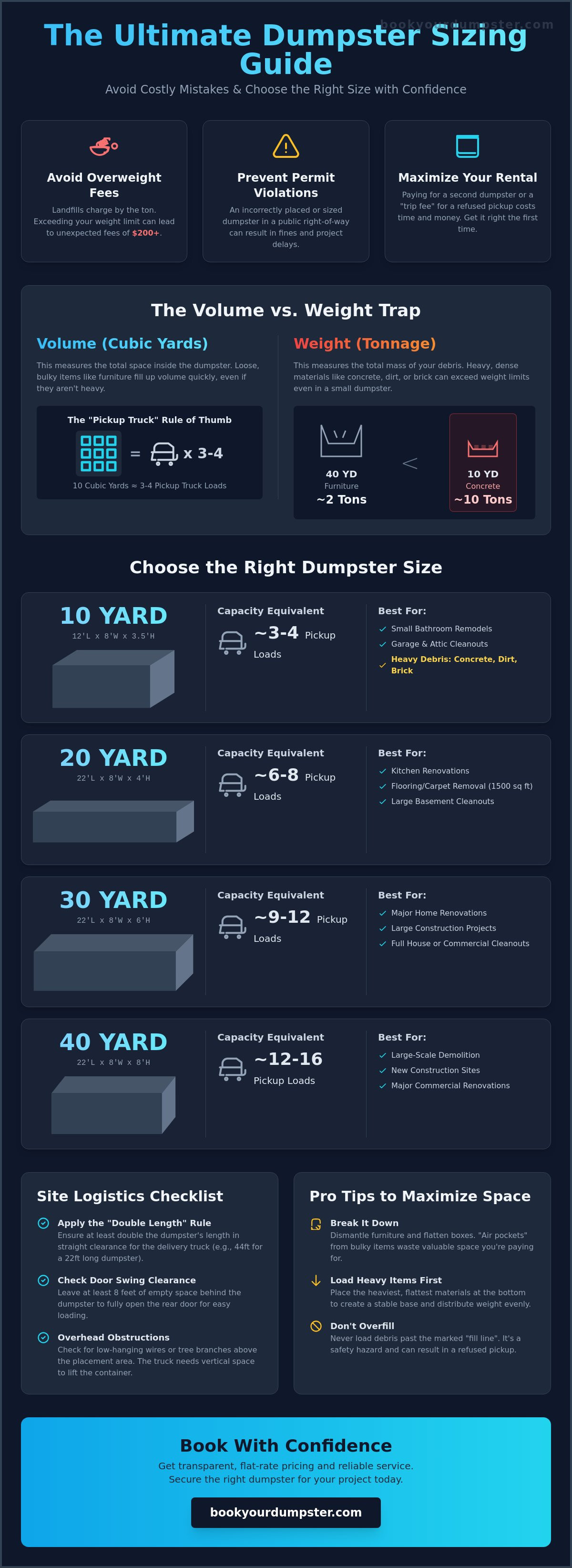
Visualizing waste is the most difficult part of the planning process. When you start choosing the right dumpster size, you'll see every container measured in cubic yards. A single cubic yard is a cube that measures three feet long, three feet wide, and three feet high. To get a better sense of scale, compare it to a standard pickup truck. One level truck bed holds approximately 2.5 cubic yards of debris. This means 10 cubic yards equals roughly 3-4 pickup truck loads.
Capacity refers strictly to the internal volume of the container. It's not the same as the external footprint on your driveway. The metal walls and floor take up physical space, so focus on the "fill line" marked on the side of the bin. Never load debris past this point. It creates a safety hazard for the driver and can lead to immediate fines or a refused pickup from the site. You must also account for air space. Loose, bulky items like tangled tree branches or un-broken furniture create pockets of empty space. These pockets fill your bin faster than you expect. Break down every box and dismantle large items to maximize the internal volume you're paying for.
To learn more about the mechanics and standard uses of these containers, you can research What is a Roll-Off Dumpster? and how they function in different project environments.
The Volume vs. Weight Trap
Volume and weight are two different metrics that dictate your final cost. You might have plenty of physical space left in a bin while already exceeding your tonnage limit. This is the "weight trap." For example, a 10-yard dumpster full of concrete or wet dirt weighs significantly more than a 40-yard dumpster full of household furniture. Every rental comes with a specific weight allowance. Landfills charge by the ton, so if you go over your limit, you'll pay an additional fee for every extra ton of waste. Heavy materials like asphalt shingles, brick, and stones lead to automatic weight overages if you don't plan ahead. Always disclose the type of debris you're disposing of to avoid these surcharges.
Visualizing Your Debris Pile
Estimate your project size before you book at Book Your Dumpster USA. If you have a pile of loose debris in your driveway, measure its length, width, and height in feet. Multiply those three numbers together and divide the total by 27 to find the total cubic yardage. If you're cleaning out a home, use the "Standard Room" rule. A 20-yard dumpster is usually the right fit for clearing out two to three standard-sized bedrooms. For larger construction projects or full-scale commercial renovations, you'll need to scale up to a 30 or 40-yard option to handle the bulk without requiring multiple trips.
Common Roll-Off Dumpster Sizes and Dimensions
Standardizing your project starts with matching your debris to a specific container footprint. Most homeowners and contractors find that choosing the right dumpster size depends as much on the physical dimensions of the bin as it does on the cubic yardage. At Book Your Dumpster USA, we provide four primary sizes to handle any waste stream. While all our containers share a standard width of 8 feet to fit in a typical driveway, their lengths and wall heights vary to accommodate different scales of work.
- 10-Yard: 12' L x 8' W x 3.5' H
- 20-Yard: 22' L x 8' W x 4' H
- 30-Yard: 22' L x 8' W x 6' H
- 40-Yard: 22' L x 8' W x 8' H
One critical detail often overlooked is the swinging door clearance. Every roll-off container features a rear door that swings open. You must ensure you have at least 8 feet of clear space behind the dumpster's final placement area to utilize this feature. Without this clearance, you'll be forced to lift every item over the side walls, which is inefficient and physically demanding.
10 and 20-Yard Dumpsters: Residential Favorites
The 10-yard bin is a low-profile powerhouse. Its 3.5-foot walls make it easy to toss heavy items over the side without straining your back. This is the ideal choice when disposing of common construction and demolition materials like concrete, dirt, or asphalt shingles. These materials are heavy, and the smaller volume helps you stay within weight limits. Our 10 yard dumpster rental is our most requested residential option for bathroom remodels and small garage cleanouts. If your project involves a kitchen renovation or 1,500 square feet of flooring, the 20-yard bin provides the necessary length for cabinets and long planks without taking up excessive space on your property.
30 and 40-Yard Dumpsters: Commercial Powerhouses
Large-scale projects require higher walls and greater volume. The 30-yard dumpster is the standard for whole-home decluttering or removing a large wooden deck. When you step up to the 40-yard bin, you encounter the "High-Wall" challenge. Because the walls are 8 feet tall, manual loading over the side is impossible for most people. You must use the walk-in entry door to carry debris inside. This size is specifically designed for construction debris removal and commercial roofing jobs where the volume of waste is massive. Walking your waste into the container allows you to stack items tightly, minimizing air pockets and maximizing the load. Before you begin your next big project, view current availability to ensure the right container is ready when you are.
The Ultimate Dumpster Sizing Checklist
Stop guessing and start measuring. Successful waste management depends on a systematic approach to choosing the right dumpster size. Use this checklist to verify your requirements before you place an order. This process eliminates the risk of hidden overage fees and ensures your project timeline remains intact. When managing larger projects, reviewing resources like the City of Del Mar C&D Recycling guidelines can help you understand how to categorize and separate specific materials for efficient disposal.
- Identify the primary waste material: Classify your debris as household junk, construction and demolition (C&D), or heavy debris.
- Estimate the scale: Calculate the total square footage of the area you're clearing or the number of rooms involved.
- Determine the weight of individual items: Identify heavy objects like appliances, pianos, or cast-iron tubs that significantly impact the total tonnage.
- Check for prohibited items: Confirm that your pile does not contain hazardous materials, paints, chemicals, tires, or batteries.
The "Heavy Debris" Rule
Heavy materials like dirt, brick, and concrete have strict limitations. These items are restricted to 10-yard or 20-yard bins because of their extreme density. If you fill a larger 40-yard container with concrete, the delivery truck will be unable to lift it. This situation "freezes" the dumpster on your property until you manually unload the excess material. It's a costly and labor-intensive mistake. For safety and transport compliance, heavy debris must never exceed the 10-yard volume for safety. Stick to smaller bins for these materials to maintain control over your project logistics.
Project-to-Size Matching Guide
Use these standard benchmarks to align your project with the correct container volume. While every job is unique, these pairings represent the most common successful applications for our inventory at Book Your Dumpster USA.
- Small Basement or Garage Cleanout: Select a 10-yard dumpster. This size handles roughly three pickup truck loads of loose debris.
- 2,000 sq. ft. Roof Tear-off: Opt for a 20-yard dumpster. This provides enough capacity for shingles and underlayment without exceeding weight limits.
- Whole Home Siding or Major Renovation: Step up to a 30-yard dumpster. These bins accommodate the bulky, long-form waste generated by exterior updates.
- New Home Construction or Large Demolition: Use a 40-yard dumpster. This is the only viable choice for high-volume commercial debris and major structural removals.
Review your pile one last time. If you're on the fence between two sizes, always choose the larger option. The cost of a slightly larger bin is always lower than the price of a second rental or an overweight penalty.
Logistics: Will the Dumpster Fit Your Site?
Logistics are the final hurdle in choosing the right dumpster size. You can calculate volume perfectly, but if the truck cannot safely drop the bin, your project stalls immediately. Most standard roll-off containers are 8 feet wide. Measure your driveway width to ensure you have at least 10 feet of clearance. This extra space accounts for the truck's mirrors and provides a safety buffer during the drop process.
Follow the "Double Length" rule for every delivery. A 22-foot long container requires 50 to 60 feet of straight-line clearance. The truck needs this room to back into position, tilt the hoist, and pull forward as the bin rolls off the rails. Look up before the truck arrives. You need at least 15 to 18 feet of vertical clearance to avoid snagging low-hanging tree branches or power lines. Finally, account for the rear swinging door. If you plan to walk heavy items into the bin, leave an additional 8 feet of space behind the unit to allow the door to open fully without hitting a garage door or fence.
Urban Siting: Queens, San Francisco, and Beyond
Narrow streets and tight corners in historic neighborhoods like Queens or San Francisco present unique challenges. If your driveway is too short or non-existent, you'll likely need to place the bin on a public street or sidewalk. This requires a local permit. Based on 2026 municipal data, these permits typically cost between $10 and $100 depending on your city. Failure to secure one can lead to immediate fines or a refused delivery. To prevent surface damage on asphalt or concrete, place plywood sheets or "street pads" on the ground before the bin arrives. This distributes the weight and prevents the metal rollers from gouging your property during the drop and pickup.
Placement and Accessibility
Check for "No Parking" zones and local HOA restrictions before scheduling your delivery. If the driver arrives and finds the space blocked by a neighbor's car or a low-clearance gate, you'll likely face a trip fee. Ensure the path is completely clear of vehicles, basketball hoops, and low-hanging wires. For specific regulations in your area, refer to our local guide for NY, IL, and MA. These regions often have strict containerization rules and permit timelines that you must follow to stay compliant. Once you've verified your site dimensions, reserve your bin online to lock in your delivery date and ensure your project stays on schedule.
Book Your Dumpster with Confidence
Planning your project shouldn't be derailed by logistical uncertainty. Once you've finished choosing the right dumpster size, the booking process should be the easiest part of your day. We've modernized the waste management experience by moving everything online. You don't need to spend hours on the phone negotiating with local haulers. Our digital platform allows you to select your container and schedule your drop-off in just a few clicks. This streamlined approach removes the friction from your cleanup or renovation project.
Transparency is the foundation of our service. We prioritize flat-rate pricing to ensure you aren't surprised by unexpected surcharges after your project is complete. This integrity in pricing acts as a verbal handshake between us and our customers. On delivery day, expect punctuality and professional placement. Our drivers are experts at navigating the site constraints we discussed in the previous section. They'll position your bin exactly where it needs to be to maximize your workflow efficiency.
Why Book Your Dumpster USA?
We provide a full range of containers to meet the demands of any project volume. Whether you need a 10, 20, 30, or 40-yard dumpster, we have the inventory ready for dispatch. Our team understands the specific regional regulations and permit requirements in New Jersey, Illinois, and Massachusetts. This local expertise ensures your rental is compliant with municipal rules, avoiding unnecessary fines or delays. Visit our homepage to view current availability and secure your container today.
Final Preparation Steps
Prepare your site before the truck arrives to ensure a seamless drop-off. A clear site prevents delays and protects your property from accidental damage. Follow these final steps to get ready:
- Clear the area: Move all cars, pets, and children away from the delivery zone to provide the driver with maximum clearance.
- Provide a contact: Ensure a designated point of contact is available via phone to answer any last-minute questions from the driver during the drop.
- Review the schedule: Confirm your pick-up date or call us for an early haul-away if you finish your project ahead of time.
Mastering the process of choosing the right dumpster size is only half the battle. Executing the logistics with a reliable partner ensures your project stays on track and within budget. Start your booking now to experience a no-nonsense waste management solution built for the modern contractor and homeowner.
Take Control of Your Project Waste
You now have the technical framework to manage your cleanup with precision. By applying the "Double Length" rule and the pickup truck volume comparison, you've eliminated the guesswork that leads to overage fees. You understand how to match your debris type to the specific footprints of our 10, 20, 30, and 40-yard containers. Mastering the process of choosing the right dumpster size is the most effective way to protect your project budget and timeline.
We provide a streamlined experience for homeowners and contractors across NY, NJ, IL, MA, and San Francisco. Our service relies on transparent flat-rate pricing to ensure you never face hidden costs at the landfill. Don't let waste logistics slow down your progress. Select the container that fits your site and schedule your delivery today. Use our digital platform to secure your bin and move from a state of clutter to a state of resolution.
Get started today and experience a waste management partner that respects your time and your bottom line.
Frequently Asked Questions
What happens if I overfill my dumpster?
You'll face additional fees or a refused pickup if debris extends past the rim. Drivers cannot legally or safely transport a container if waste is piled above the "fill line." You must remove the excess material before the truck returns for a second attempt. This situation usually results in a dry run fee and delays your project timeline.
Can I change my dumpster size after I have already booked it?
Yes, you can modify your order as long as the truck hasn't been dispatched for delivery. Contact us immediately if you realize your project requires more volume. We'll adjust your booking based on our current inventory. Getting the dimensions right during the initial stage of choosing the right dumpster size prevents these last-minute logistical shifts and potential trip fees.
Is there a weight limit for a 10-yard dumpster?
Every 10-yard dumpster has a specific tonnage limit mandated by landfill regulations. While the bin holds 10 cubic yards of volume, heavy materials like brick, dirt, or concrete reach weight capacities very quickly. If your load exceeds the agreed tonnage, you'll pay a per-ton overage fee. Always check your rental agreement for the exact weight allowance before loading heavy debris.
How much space do I need for a 20-yard dumpster delivery?
You need a clear, straight path approximately 10 feet wide and 60 feet long. This footprint accounts for the 22-foot length of the bin and the space required for the truck to maneuver. Ensure there are no low-hanging wires or branches within 20 feet of the ground. Clear all vehicles and equipment from the driveway before the driver arrives to avoid delivery delays.
Do I need a permit if the dumpster is on my own driveway?
No, you generally don't need a municipal permit for placement on private property. Permits are typically mandatory only when the container sits on a public street, sidewalk, or right-of-way. You should still check with your local Homeowners Association (HOA) for any community-specific rules. Some neighborhoods have restrictions regarding the duration a container can remain visible on a driveway.
What items are strictly prohibited in a roll-off dumpster?
Hazardous materials, tires, batteries, and electronics are strictly prohibited from all containers. You also cannot dispose of liquid paints, oils, chemicals, or appliances containing freon. These items require specialized handling at certified facilities. Placing them in your bin results in significant fines from the landfill and potential environmental penalties. Check our full prohibited items list before you start loading.
How long can I keep the dumpster on my property?
Standard rental periods typically last between 7 and 14 days depending on your agreement. You can schedule a pickup earlier if you finish your project ahead of schedule. If you need more time, contact us to extend your rental for a daily fee. Always confirm your specific pickup date during the booking process to ensure your site is cleared on time.
What is the difference between a roll-off dumpster and a front-load bin?
Roll-off dumpsters are temporary containers designed for construction or cleanup projects and are delivered by a hoist truck. Front-load bins are permanent containers used for scheduled commercial waste pickup at businesses. When choosing the right dumpster size for a home renovation or a one-time site clearing, a roll-off container is the correct tool for the job.