A single missing weight ticket can derail years of LEED planning and cost your project its certification. It's a frustrating reality for modern contractors. Managing waste on a high-stakes site is a logistical burden that goes far beyond just moving debris. You're likely dealing with the documentation headaches of diversion reports and the constant risk of losing points due to poor hauler reporting. Securing a reliable dumpster rental for LEED certified projects requires more than just a drop-off; it demands a partner who understands strict waste diversion mandates. Whether you're working in the tight streets of Queens or meeting California's 65 percent diversion requirements, you need precision and accountability.
We understand that your project's success depends on accurate, audit-ready data. This professional guide provides a clear roadmap for coordinating waste removal that meets strict LEED v4.1 requirements. You'll learn how to manage multiple material streams effectively, verify that your recycling facilities are RCI-certified, and streamline your reporting process. We'll show you how to maintain control over your waste management plan so you can focus on the build instead of the paperwork. Follow these steps to ensure your next project stays compliant and your diversion points stay secure.
Master the nuances of LEED v4.1 waste diversion thresholds to secure your project's certification points without last-minute documentation scrambles. You'll need to understand exactly how many material streams are required to hit your target diversion rates of 50 percent or 75 percent.
Conduct a thorough pre-project waste audit to decide if on-site source separation or commingled recycling is the most cost-effective path for your specific site. This decision impacts your container needs and the complexity of your final diversion reports.
Select the right equipment for the job, such as using 10-yard dumpsters for heavy, source-separated materials like brick or concrete to keep your logistics tight. Choosing the correct size reduces the carbon footprint of your hauls and prevents weight overage fees.
Build a comprehensive Construction Waste Management Plan (CWMP) that tracks every mandatory data point, from hauler dates and container sizes to final weight tickets. Accurate record-keeping is the only way to survive a LEED audit.
Simplify your dumpster rental for LEED certified projects by using a streamlined booking system that focuses on professional-grade reporting and audit-ready data. Don't let poor hauler communication put your project's certification at risk.
Ensure reliable delivery and pickup in challenging urban environments like Queens or San Francisco where site space is limited and timing is critical. Eliminate the risk of losing LEED points by partnering with a hauler that prioritizes transparency and precise waste diversion reporting from day one.
What Makes LEED Project Waste Management Different?
Standard waste disposal is a straightforward "load and go" process. You fill a bin, a driver hauls it away, and the debris ends up in a landfill. For projects pursuing Leadership in Energy and Environmental Design (LEED) certification, this traditional approach doesn't work. LEED is a global green building rating system that prioritizes sustainability, and its "Construction and Demolition Waste Management" credit is one of the most rigorous components of the certification process.
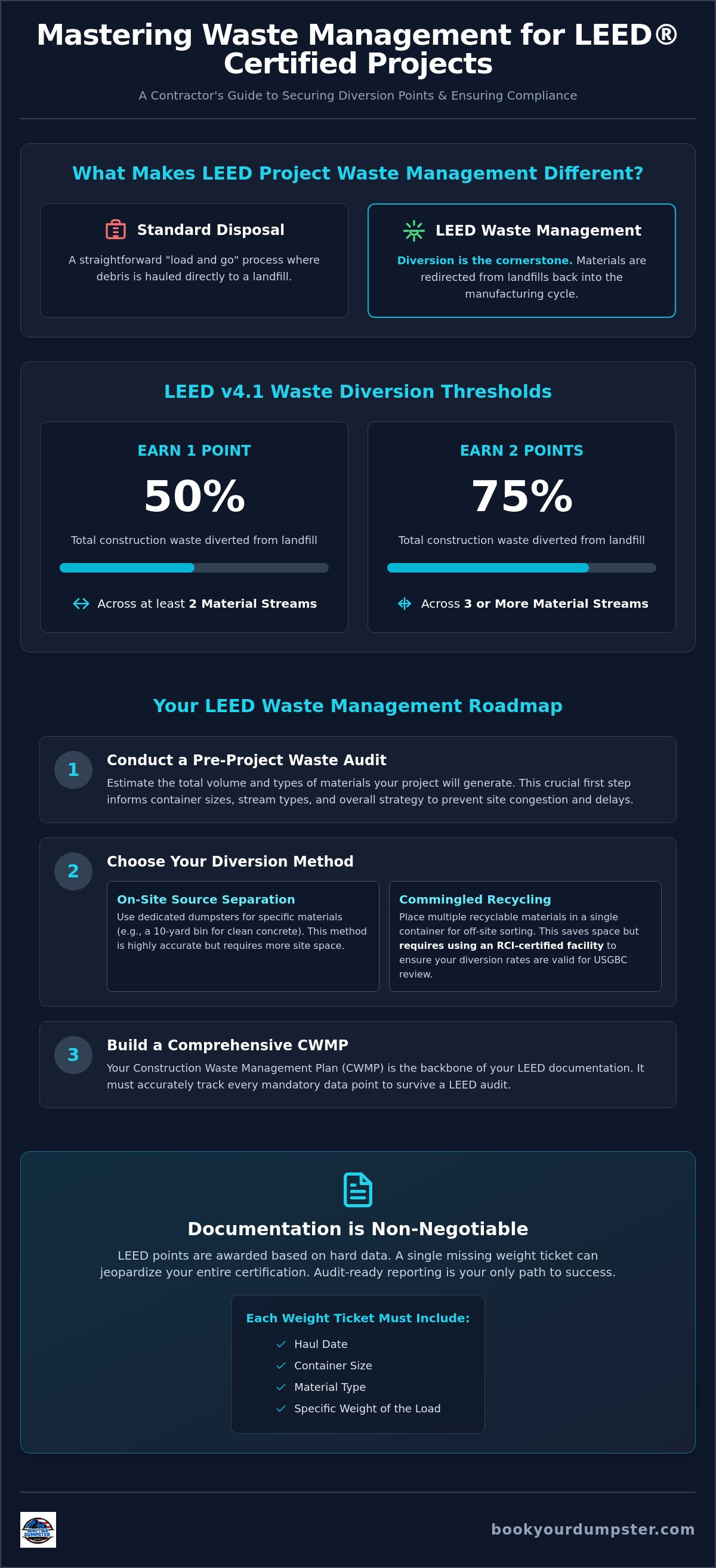
The primary difference lies in the concept of diversion. Instead of simply disposing of material, you must prove that a massive portion of your site debris never reached a landfill. Under the current LEED v4.1 standards, the requirements are specific. To earn one point, your project must divert at least 50 percent of total construction and demolition material through at least two material streams. To earn two points, you must reach a 75 percent diversion rate across three or more streams. Achieving these numbers requires a strategic dumpster rental for LEED certified projects that prioritizes data over just haul volume.
The Role of Waste Diversion in LEED Points
Diversion is the cornerstone of sustainable waste management. It involves redirecting materials like wood, metal, concrete, and drywall back into the manufacturing cycle. You have two primary ways to handle this on-site. Source-separated recycling involves using dedicated bins for specific materials, such as a 10-yard dumpster exclusively for clean concrete. This method is highly accurate but requires significant space. Commingled recycling allows you to put multiple recyclable materials into a single container, which is then sorted at an off-site facility. If you choose commingled sorting, ensure the facility is certified by the Recycling Certification Institute (RCI) to guarantee your diversion rates are valid for USGBC review.
Why Audit-Ready Documentation is Non-Negotiable
LEED points aren't awarded based on good intentions; they're awarded based on hard data. Every single load that leaves your site must have a corresponding weight ticket. These tickets are the building blocks of your final diversion report. Without them, you cannot prove your percentages, and you risk losing the credit entirely. This documentation must include the haul date, container size, material type, and the specific weight of the load. At Book Your Dumpster USA, we understand that these reports are just as important as the physical removal of the waste. We provide the transparent, audit-ready reporting you need to satisfy USGBC requirements. Our process removes the logistical stress of tracking down missing tickets, allowing you to maintain a seamless flow of data from the job site to your final certification application.
How to Plan Your LEED Waste Management Strategy
Planning for a dumpster rental for LEED certified projects starts long before the first bin arrives. You need a proactive strategy to ensure every ton of debris is accounted for. Begin with a pre-project waste audit. This step involves estimating the total volume of materials your project will generate. Identifying these volumes early allows you to select the right container sizes and stream types. Without an accurate estimate, you risk site congestion or unexpected delays.
Your next step is deciding between on-site sorting or commingled recycling. Once you choose a method, establish a designated dumpster placement area. This zone must be clearly defined to prevent cross-contamination between different waste streams. In dense urban environments like San Francisco or Queens, coordinate your pickup schedules carefully. Tight streets and limited staging areas mean you can't afford a dumpster sitting full for days. Finally, review the reporting process with your hauler. Confirm they can provide the specific weight tickets and diversion data required for your certification.
Choosing Between Commingled and Source-Separated
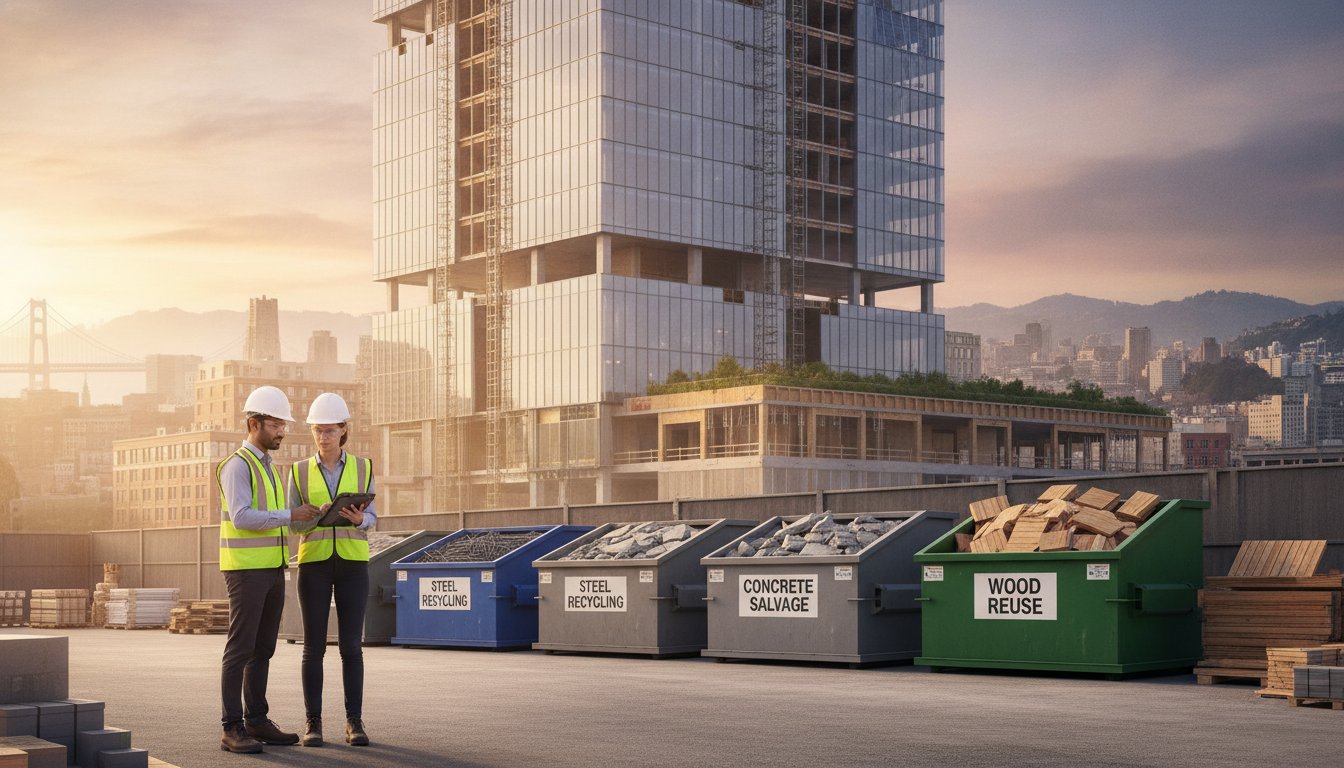
Site space usually dictates your dumpster strategy. In tight urban sites like Chicago or New York, commingled dumpsters are often the only practical choice. They allow you to throw all recyclables into one bin for off-site sorting. However, if you have the footprint, source-separating high-volume materials like metal or concrete is often more cost-effective. Dedicated metal bins can sometimes even generate revenue, offsetting your overall project costs. Evaluate your site plan to see if you can accommodate multiple 10-yard or 20-yard bins for specific materials.
Setting Up Your Jobsite for Success
Clear signage is mandatory for LEED-compliant sites. Use high-visibility labels on every bin to show exactly what goes inside. Don't assume your crew knows the difference. Train all subcontractors on proper debris disposal during their initial site orientation. Their compliance protects your diversion rate and keeps your project on track for certification. Contamination occurs when non-recyclable debris is mixed into a recycling stream, which often results in the entire load being rejected and sent to a landfill. To avoid these setbacks, you can schedule your LEED-ready bins through our simplified online platform to ensure your logistics are handled by experts who understand the Sustainable Management of C&D Materials.
Selecting the Right Dumpster Sizes for LEED Compliance
Selecting the right equipment for a dumpster rental for LEED certified projects is a calculation of volume, weight, and carbon impact. Every haul contributes to your project's total carbon footprint. Minimizing the number of trips by choosing the correct container size helps align your site with broader LEED construction waste management goals. If you choose bins that are too small, you increase transportation emissions. If they're too large for the material weight, you risk safety issues and site congestion. Efficient logistics are a core part of the "Construction and Demolition Waste Management" credit.
A 10 Yard Dumpster is the designated workhorse for heavy, source-separated materials. Use these for clean concrete, brick, or dirt. 20 Yard and 30 Yard Dumpsters are the standard choice for mixed C&D debris or large-scale interior renovations. They provide the capacity needed for bulky items like drywall and wood without overwhelming a staging area. For massive demolition phases or high-volume light debris, a 40 Yard Dumpster is essential. For more details on managing these phases, see The Ultimate Guide to Construction Debris Removal in 2026.
Matching Container Volume to Material Type
Don't overload your containers. Heavy debris like masonry or stone should never go into 30 or 40-yard bins because the weight will exceed legal hauling limits. In states like Massachusetts and New Jersey, 10-yard dumpsters are the preferred option for urban LEED projects because they fit into tight footprints while handling maximum weight. Calculating your haul frequency is also vital. By maximizing the volume of each load, you reduce total site traffic and can potentially earn LEED pilot credits for reduced transportation emissions. Plan your stream separation based on the density of the material to keep your diversion reporting accurate.
Logistical Considerations for Urban Project Sites
Urban sites present unique challenges for large equipment. Navigating the narrow streets of San Francisco or the tight corners of Queens requires precision. A 40-yard delivery in these zones often requires advanced planning and specific equipment. You must also account for local permitting. In New York and Illinois, street placement usually requires a specific permit and adherence to strict safety lighting codes. Book Your Dumpster USA specializes in these complex environments. We handle the precise placement needed in tight zones to ensure your project stays compliant with local laws and LEED standards. We move quickly so your site stays clear and your timeline remains intact.
Managing Documentation and Diversion Reports
Documentation is the backbone of any successful certification effort. For a dumpster rental for LEED certified projects, you cannot rely on verbal promises or casual estimates. Every project requires a formal Construction Waste Management Plan (CWMP) before the first bin arrives. This plan outlines which materials you will divert and which facilities will receive them. Without this blueprint, your project lacks the structure needed to survive a USGBC audit. You must track every ton of debris with clinical precision to ensure your diversion rate percentage meets the 50 percent or 75 percent thresholds required for points.
Mandatory data points for your reports include specific haul dates, container sizes, material types, and verified weights. Your final diversion report is a compilation of this data, showing exactly how much material was kept out of the landfill. Verify that your hauler uses authorized recycling facilities before you sign a contract. If you use commingled recycling, the facility must often be certified by the Recycling Certification Institute (RCI) to count toward your goals. Don't leave your certification to chance by using a hauler that doesn't understand these specific reporting standards.
The Anatomy of a LEED-Compliant Weight Ticket
A standard receipt isn't enough. Your weight tickets must clearly show the gross, tare, and net weights for every load. Check each ticket for a facility certification number or ID to prove the material went to a legitimate processor. The chain of custody for recycled construction debris is a documented record that tracks the material from its point of origin on your site to its final destination at a certified processing facility. If a ticket is missing this information, it's useless for your LEED coordinator. Demand clear, legible tickets for every haul to maintain your project's integrity.
Monthly Reporting vs. Final Project Summaries
Wait until the end of the project to check your numbers and you'll likely face a disaster. Track your diversion rates monthly to catch issues before they become permanent. If a subcontractor is contaminating bins, you need to know immediately so you can correct the behavior. Use digital logs to keep your LEED coordinator updated in real-time. This proactive approach prevents end-of-project surprises that could cost you a certification level. For more information on budgeting for these services, check our Dumpster Rental Prices in New York, Illinois, and Massachusetts: 2026 Guide.
Eliminate the paperwork stress and ensure your project stays on track for certification. Book your LEED-ready dumpster now and get the professional-grade reporting your project demands.
Booking Your LEED-Ready Dumpster with Book Your Dumpster USA
Managing high-stakes construction shouldn't involve chasing down weight tickets or wondering when your bin will arrive. We bring a pragmatic, professional approach to waste logistics in the nation's busiest metros. Our system removes the friction from your day. You get a streamlined online booking experience that allows for immediate scheduling. This digital-first model ensures your project stays on track without the back-and-forth phone calls typical of old-school haulers. We've modernized the process to respect your time and your project's urgency.
Budgeting for a dumpster rental for LEED certified projects requires absolute transparency. We provide direct pricing with no hidden fees or surprise surcharges. This clarity is essential for maintaining your project's financial integrity and preventing budget overruns. Punctuality is our core promise. We understand that a delayed pickup in a tight urban site can halt your entire workflow. We show up when we say we will, ensuring your site remains clear and your subcontractors stay productive. Our reliability is a verbal handshake you can count on.
Local Expertise in NY, NJ, IL, MA, and SF
We operate with deep local knowledge across NY, NJ, IL, MA, and SF. Whether you're working in Queens or San Francisco, regional regulations for waste diversion are strict. Our team understands the specific permitting requirements for street placement in major cities. This expertise prevents costly permit delays and site violations that can eat into your profit margins. For a deeper dive into regional logistics, read Dumpster Rental in New York, Illinois, and Massachusetts: The 2026 Complete Guide. We handle the local red tape so you can focus on meeting your sustainability targets.
Get Started on Your LEED Project Today
Secure your project's certification goals today. Select the container size that fits your current phase. We offer 10, 20, 30, and 40-yard dumpsters to handle everything from source-separated concrete to mixed C&D debris. Use our online portal to schedule your delivery in minutes. Our platform is designed to be a high-functioning tool that moves you quickly from clutter to resolution. If your project has specialized recycling reporting needs, contact our professional team directly. We're ready to provide the audit-ready data your LEED coordinator requires. Rent your LEED-ready dumpster now and experience a waste management service built for the modern contractor.
Streamline Your LEED Waste Logistics Now
Success on a high-performance jobsite requires more than just moving debris. It demands a rigorous commitment to data and diversion. You've seen how precise weight tickets and a clear Construction Waste Management Plan form the foundation of your certification efforts. By matching your material streams to the right container sizes, you reduce site congestion and transportation emissions. Managing a dumpster rental for LEED certified projects shouldn't be a source of stress. It should be a predictable, high-functioning part of your project's rhythm.
Our team brings deep local expertise to major markets including NY, NJ, IL, MA, and SF. We understand the specific regional mandates that can make or break your diversion reports. With 10, 20, 30, and 40-yard roll-off containers available, we have the right equipment for every phase of your build. Use our direct online booking system for immediate logistics resolution and transparent pricing. Secure Your LEED-Compliant Dumpster Today and keep your project moving toward its sustainability goals. You have the tools to build a greener future, and we have the reliability to help you get there.
Frequently Asked Questions
What is a waste diversion rate in LEED certification?
The waste diversion rate is the percentage of total construction debris redirected from landfills to recycling or reuse facilities. Under LEED v4.1, you must divert at least 50 percent of materials for one point or 75 percent for two points. These calculations are based on weight and require documentation of at least two or three distinct material streams depending on your target point level.
Can I use a single dumpster for all my LEED project waste?
You can use a single bin if you choose a commingled recycling strategy where debris is sorted off-site at a certified facility. This approach is ideal for tight urban sites with limited staging area. However, the sorting facility must be RCI-certified to guarantee that the diversion data counts toward your certification. If you have the space, source-separating materials on-site often provides more precise data.
How do I get the weight tickets needed for LEED documentation?
Your hauler provides these tickets after each container is weighed at a certified recycling or disposal facility. Every ticket must clearly show the gross, tare, and net weights along with the date and material type. We ensure these documents are delivered promptly to your team. These tickets are the only way to prove your diversion percentages during a USGBC audit.
Are there specific dumpsters for concrete and heavy debris?
Use a 10-yard dumpster for heavy materials like clean concrete, brick, asphalt, or dirt. Larger containers like 30 or 40-yard bins are not designed for these materials because the weight would exceed legal hauling limits. Choosing the correct 10-yard size ensures safe transport and allows for accurate reporting of source-separated heavy debris streams, which is critical for meeting LEED diversion thresholds.
Does LEED require a specific waste management plan before construction starts?
Yes, every project must have a formal Construction Waste Management Plan (CWMP) in place before any debris leaves the site. This plan identifies the specific materials you intend to divert and names the facilities that will receive them. It serves as your primary roadmap for the project. Without a pre-construction plan, you risk failing to track the data points required for final certification.
What cities do you provide LEED-compliant dumpster rentals in?
We provide a professional dumpster rental for LEED certified projects in major US metros including New York, Chicago, and San Francisco. Our local teams understand regional mandates like California’s 65 percent diversion requirement and the specific permitting needs of Queens or Manhattan. We also serve markets in Massachusetts and New Jersey with reliable, audit-ready reporting that simplifies your certification process.
How does commingled recycling affect my LEED points?
Commingled recycling simplifies site logistics but requires you to use an off-site sorting facility certified by the Recycling Certification Institute. The facility’s verified average diversion rate is applied to the weight of your load. This method typically counts as a single material stream unless the facility provides project-specific sorting data. It's a pragmatic solution for projects that lack the space for multiple source-separated bins.
Is it more expensive to rent a dumpster for a LEED project?
The container rental itself is usually standard, but tipping fees for recycling can differ from landfill fees. In California, mixed C&D processing fees range from $90 to $160 per ton, while landfill fees are often higher, ranging from $120 to $200 per ton. This price difference often makes recycling the more cost-effective choice. The real value is the specialized reporting that protects your project's certification investment.