
Your client likely views waste disposal as a hidden cost or a logistical nuisance, but for a professional contractor, it's a critical strategy for protecting profit margins. Mastering how to present a waste management plan to a client transforms you from a vendor into a strategic partner who manages complex logistics before they become a liability. It's frustrating when a client balks at disposal fees or fails to understand the legal risks of new 2026 organic waste mandates in states like New York or New Jersey. You know that a project can't stay on schedule if the site is buried in debris, yet getting a budget approved requires more than just a list of bins.
We understand that explaining why a 30 yard dumpster is necessary for the initial demo phase can be a tough sell. This guide promises to help you secure a signed contract by using data-driven logic and regulatory compliance to justify your waste budget. You'll learn how to navigate NYC’s 2026 composting fines, select the right container sizes for every project phase, and use transparency to build immediate trust. We'll show you how to move your client from a state of clutter to a state of resolution with a professional, compliant strategy.
Key Takeaways
- Define your strategy as a living document focused on the three pillars of cost control, safety, and regulatory compliance.
- Discover how to present a waste management plan to a client using site maps and historical data to prove logistical efficiency.
- Master the site-specific audit process to accurately predict waste volume and determine the best container placement for site access.
- Counter budget concerns by showing the direct link between a managed waste strategy and the avoidance of expensive project work stoppages.
- Align dumpster swaps with project milestones to minimize site clutter and maintain a reputation for professional management.
The Core Components of a Professional Waste Management Proposal
A Waste Management Plan (WMP) is much more than a list of trash bins. It's a living document that evolves alongside your project, ensuring maximum efficiency from groundbreaking to the final walkthrough. When you master how to present a waste management plan to a client, you stop being a simple hauler and start acting as a strategic partner. This distinction is vital because it builds trust and justifies your budget by focusing on risk mitigation and logistical control.
Your proposal must stand on three essential pillars: Environmental Impact, Regulatory Compliance, and Cost Control. Clients often view waste as an afterthought, but a professional presentation proves it's a core financial variable. For a comprehensive overview of waste management principles like the waste hierarchy, your document should reflect how you intend to reduce landfill reliance while keeping the site clean. Include specific equipment needs early in the draft, such as a roll off dumpster rental, to show you've already visualized the physical logistics of the job site.
Defining Project-Specific Waste Streams
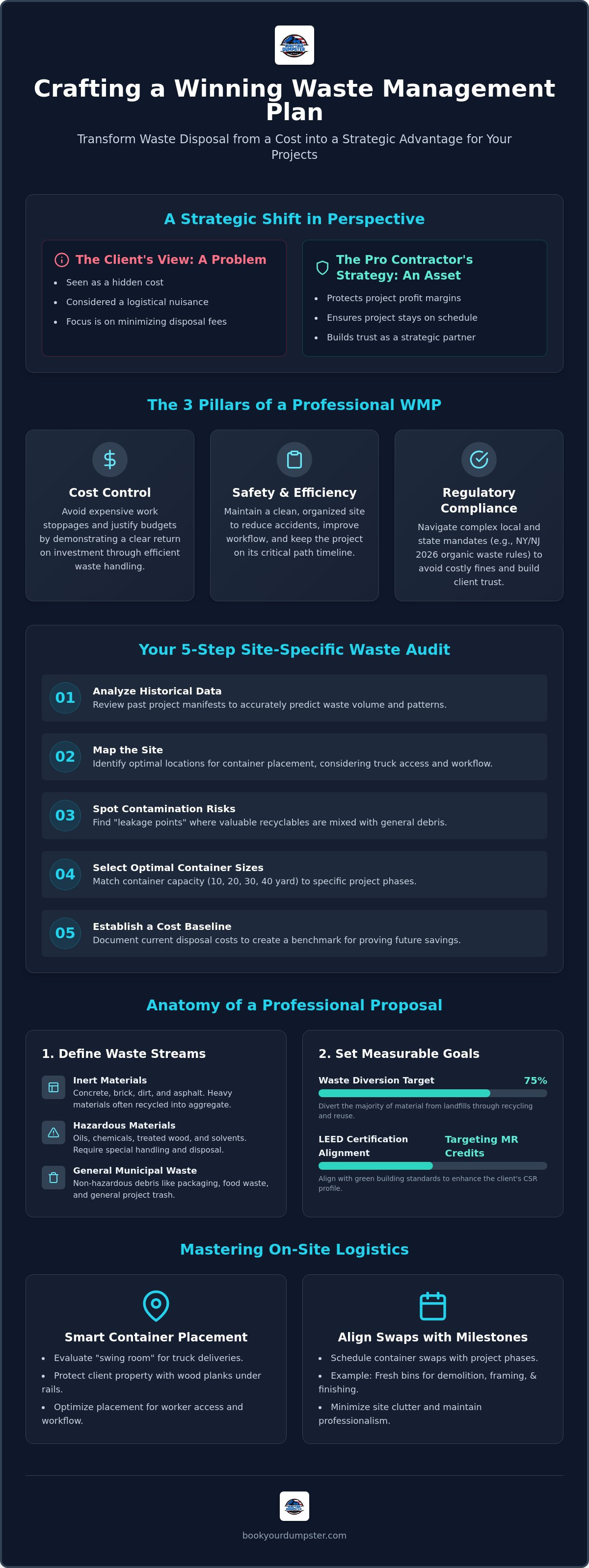
Break down the expected debris into clear categories. Group materials into Inert (concrete, brick, and dirt), Hazardous (oils, chemicals, or treated wood), and General Municipal Waste. Don't guess on the volume. Estimate your needs based on the project's square footage or historical data from similar renovations. Waste Stream Diversion is the specific percentage of total material that you successfully divert from landfills through recycling or reuse. Providing these categories shows the client you understand the specific disposal requirements of their site.
Setting Measurable Sustainability Goals
Define what success looks like for the project's footprint. Align your goals with LEED certification requirements or local green building standards to provide tangible value. Establish a clear "Zero Waste" target or a specific recycling percentage that the project will strive to meet. These goals do more than protect the environment; they significantly improve the client’s corporate social responsibility (CSR) profile. A client who can report high diversion rates to their stakeholders is a client who will value your expertise. Use these metrics to demonstrate that you aren't just moving junk; you're managing a professional, compliant operation.
Conducting a Site-Specific Waste Audit for Your Client
Before you can finalize how to present a waste management plan to a client, you must perform a rigorous site audit. Don't rely on guesswork. Start by analyzing historical waste data from similar past projects to predict volume accurately. A thorough audit allows you to identify "leakage" points where valuable recyclables are cross-contaminated with general debris. By documenting current disposal costs now, you create a baseline to prove future savings. Refer to the EPA's Guide to Waste Management for Commercial Buildings to ensure your assessment meets federal standards for tracking and reduction.
Follow these five steps to build a bulletproof audit:
- Analyze historical data: Review previous manifests to understand waste patterns.
- Map the site: Identify precise locations for container placement and truck access.
- Spot contamination: Find areas where workers mix inert materials with municipal waste.
- Select optimal sizes: Match specific project phases to container capacity.
- Establish a cost baseline: Track every dollar spent on hauling and tipping fees today.
The Logistics of Container Placement
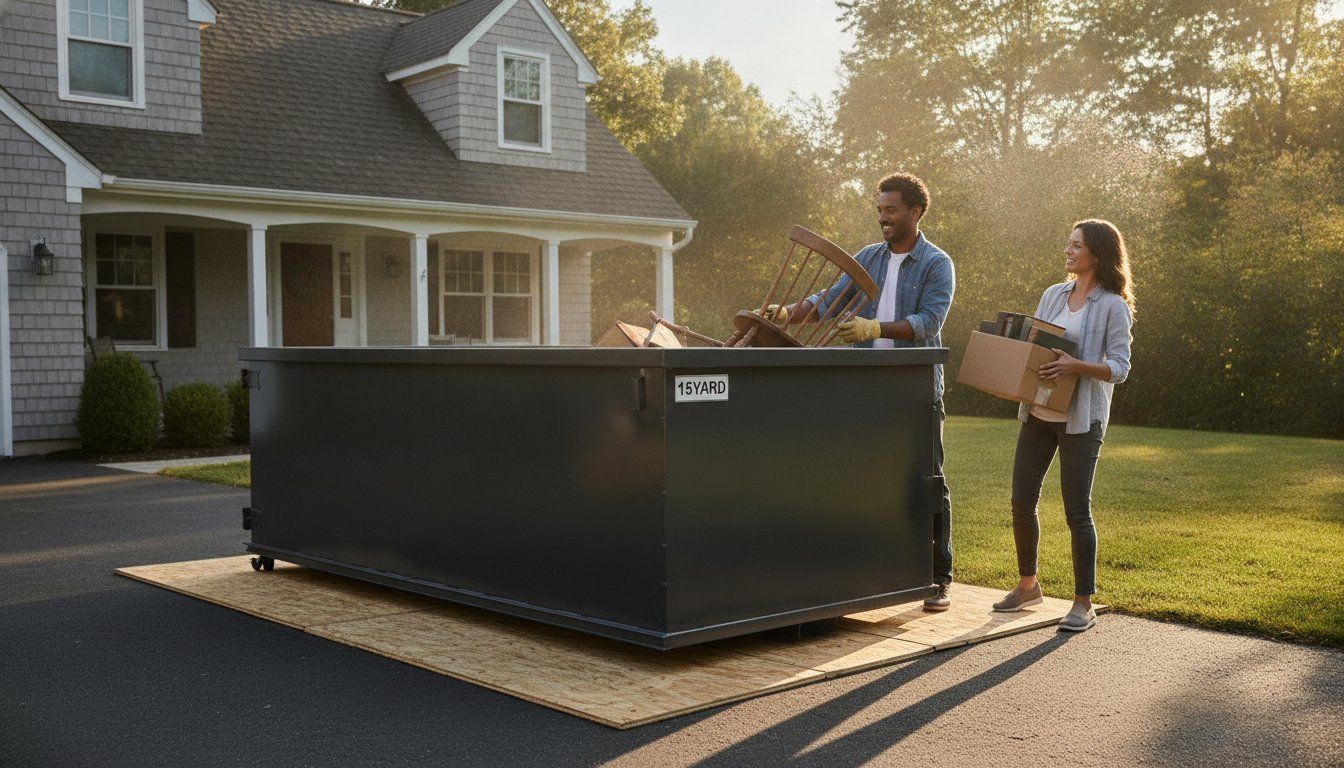
Physical constraints often dictate the success of your plan. Evaluate the "swing room" required for roll-off delivery trucks, especially in tight urban corridors like Queens or Boston. Improper placement leads to worker fatigue and slowed project speed. Protect the client's property by specifying the use of wood planks under the rails to prevent driveway or pavement damage. Efficient placement keeps the workflow moving and reduces the risk of onsite accidents. If you need to verify site dimensions for a specific project, check our sizing guides to ensure a smooth delivery.
Sizing the Solution: From 10 to 40 Yards
Choosing the wrong container size creates unnecessary "pull" fees or overflowing hazards. Recommend a 10 yard dumpster rental for heavy, dense materials like soil, asphalt, or concrete. These smaller bins prevent weight limit violations and are easier to place in restricted spaces. For large-scale commercial cleanouts or massive demolition phases, justify the use of 30 or 40-yard containers. These high-capacity options reduce the frequency of hauls, lowering the total carbon footprint and logistical noise on the job site. Always link your container selection directly to the project timeline to prevent site clutter during peak construction phases.
Structuring the Presentation: Data, Logistics, and ROI
Once you have gathered your audit data and selected your container sizes, you must package this information into a persuasive pitch. Most clients view waste as a nuisance rather than a strategic variable. Your goal is to shift their perspective by leading with safety and compliance. Establish urgency immediately. Explain how a failure to manage waste leads to site accidents, legal fines, and project delays. When you know how to present a waste management plan to a client effectively, you move beyond being a line item in their budget and become a partner in their project's success.
Structure your presentation to follow a logical flow that addresses the client's biggest fears: cost overruns and timeline slippage. Use the following framework to organize your pitch:
- The Hook: Lead with the regulatory risks of 2026, such as NYC's composting fines or regional tipping fee increases.
- The Visuals: Use site maps to show exactly where equipment will sit and how it will be accessed.
- The Logic: Compare the chaotic cost of reactive, "ad-hoc" disposal against a scheduled, managed strategy.
- The Close: Provide a clear, one-page approval document to trigger the initial delivery.
The "Executive Summary" Slide
Start with the bottom line. Your first slide should highlight three primary benefits: cost savings through volume control, risk mitigation via compliance, and timeline security. Include a brief project timeline that maps out exactly when dumpsters will arrive and when they will be swapped. The ROI of waste management is the measurable reduction in labor hours spent on debris handling. By keeping the site clear, your crew spends more time building and less time navigating piles of trash. This efficiency directly protects the client's profit margins.
Visualizing Logistical Flow
Show, don't just tell. Use a site diagram to define the "Clean Zone" for active construction and the "Waste Zone" for debris collection. This visual proof demonstrates that construction debris removal will occur seamlessly without interrupting other subcontractors or blocking delivery routes. High-resolution photos of professional roll-off containers set a high standard for site cleanliness. When a client sees a tidy, organized waste zone on paper, they feel a sense of control over the inherent mess of the project. This clarity reduces friction and makes the budget for frequent swaps much easier to justify.
Addressing Client Objections and Local Regulations
Expect pushback when you sit down to review the waste budget. Most clients see disposal as a drain on capital rather than a necessary infrastructure. Your success in how to present a waste management plan to a client depends on your ability to neutralize these objections with hard facts and regulatory data. Don't get defensive. Instead, frame your responses around risk management and the protection of their project timeline.
When a client claims the plan costs too much, pivot the conversation to the cost of non-compliance. As of January 2026, the NYC Department of Sanitation has reinstated fines for organic waste separation failures, starting at $25 and scaling to $300 for repeat offenses. In California, SB 1383 violations can trigger administrative penalties of up to $10,000 per day. Show them that your managed strategy is an insurance policy against these unpredictable hits to their bottom line. If they argue there's no room on-site for large equipment, propose a high-velocity swap schedule using 10 yard or 20 yard dumpsters. This keeps the footprint small while maintaining the same total disposal capacity.
Position permit management as a key value-add in your proposal. Street placements in dense urban areas require specific paperwork and coordination with local municipalities. Tell your client that you or your vendor will handle these logistics. This removes a significant administrative burden from their plate and ensures the project doesn't get shut down by a surprise inspection.
Navigating Local Compliance (NY, NJ, MA, IL)
Highly regulated markets require licensed haulers who understand regional nuances. In New York, you must navigate the Business Integrity Commission (BIC) rules, while New Jersey projects often fall under strict NJ DEP requirements. A professional plan prevents "Illegal Dumping" liabilities that can follow a property owner for years. Address city-specific needs directly, such as the mandatory street permits required in Chicago or San Francisco. Using a vetted partner ensures you stay on the right side of the law. To secure a compliant hauler for your next project, book your dumpster online and let us handle the logistics.
Handling Hidden Cost Concerns
Transparency builds immediate trust. Don't hide potential overage triggers. List them clearly in your presentation. Explain how weight limits work and identify prohibited items that cause "surprise fees" in unmanaged projects. By defining these boundaries upfront, you position your plan as a fixed-cost solution. This eliminates the financial "leakage" that occurs when waste is handled on an ad-hoc basis. Your client will appreciate the honesty, and you'll protect yourself from future budget disputes.
Implementing the Plan: Partnering with Reliable Logistics Providers
A waste management plan is a theoretical exercise until the first container arrives on-site. The success of your execution depends entirely on the reliability of your logistics partner. When you master how to present a waste management plan to a client, you must convince them that your chosen vendor is an extension of your own professional standards. Punctuality is not a luxury in this industry; it's a requirement. A missed swap or a late delivery doesn't just create a mess; it creates a site bottleneck that stalls every other subcontractor on the job. Your reputation hinges on your ability to keep the site moving without interruption.
Finalize your schedule by aligning every dumpster swap with specific project milestones. If the demolition phase is set to finish on a Tuesday, your 30 yard or 40 yard containers must be hauled away that evening to make room for the materials needed for the next phase. This level of coordination removes logistical stress and maintains a high-velocity workflow. Modern waste management also requires data. Provide your client with post-project diversion reports that show exactly how much waste was diverted from landfills. This transparency proves the ROI you promised during the initial pitch and builds long-term trust.
The Value of Modern Booking Systems
Efficiency starts with the booking process. Digital platforms allow for real-time scheduling and immediate confirmation, which prevents the communication gaps common with traditional haulers. This is especially critical for dumpster rental needs across multi-state projects in regions like New York, Illinois, or Massachusetts. Professional, well-maintained equipment also matters. Branded, clean roll-off containers on a client’s property project an image of competence and control. Use these tools to show your client that you've modernized a traditionally messy industry through digital convenience and straightforward honesty.
Post-Presentation: Turning Approval into Action
Move quickly once you have the green light. Your final task in how to present a waste management plan to a client is the seamless hand-off to the execution phase. Confirm your equipment needs based on the final approved budget and site constraints. Whether you need a compact 10 yard dumpster for heavy debris, a versatile 20 yard unit, or a massive 40 yard container for a commercial cleanout, ensure the sizes are locked in and the delivery windows are set. Establish a recurring reporting cadence for high-visibility projects to keep the client informed of progress. For a streamlined and professional experience that reflects the quality of your plan, visit BookYourDumpster.com to schedule your first delivery and resolve your logistical challenges today.
Elevate Your Project Standards
Professional waste management is a strategic advantage that protects your budget and your reputation. By conducting a site-specific audit and leading with data-driven ROI, you transform a logistical hurdle into a seamless part of the construction process. Mastering how to present a waste management plan to a client allows you to justify every dollar spent through the lens of safety and regulatory compliance. You aren't just renting bins; you're securing the project's timeline and ensuring that local mandates in 2026 don't lead to expensive work stoppages.
Ready to execute your plan with a dependable partner? We provide reliable 10, 20, 30, and 40-yard roll-off containers across NY, NJ, IL, MA, and San Francisco. Streamline your project logistics with professional dumpster rentals at BookYourDumpster.com. Our streamlined online booking system is designed for both commercial and residential projects, moving you from site clutter to resolution with total transparency. Take control of your site logistics and build a reputation for flawless project management today.
Frequently Asked Questions
What is the most important part of a waste management plan for a client?
The most critical component is demonstrating regulatory compliance and risk mitigation. Clients care about avoiding legal fines and project delays above all else. Your plan should clearly show how you'll handle debris safely while following specific local laws. This approach builds immediate trust and positions you as a strategic partner who manages liabilities rather than just a vendor who moves trash.
How do I calculate the waste volume for a construction project proposal?
Calculate volume by multiplying the project’s square footage by standard debris density factors for your specific project type. For example, demolition typically generates more bulk than a new build. Use historical data from your previous jobs to refine these estimates. Accurate projections ensure you order the right equipment and prevent site overflows or unnecessary haul fees that can eat into your profit margins.
Can I include recycling targets in my waste management plan presentation?
Yes, you should include specific recycling targets to boost the client’s Corporate Social Responsibility profile. Highlighting a "Zero Waste" goal or a specific diversion percentage adds value beyond simple disposal. This is particularly effective for commercial clients who need to report environmental metrics to stakeholders or those seeking LEED certification for their building projects. It shows you're committed to a modern, circular economy.
How much detail should I include about dumpster sizes in the pitch?
Include specific details for each container size you recommend, such as 10, 20, 30, or 40-yard options. Explain why a 10-yard bin is best for heavy materials while a 40-yard container suits bulkier debris. Providing this level of detail when learning how to present a waste management plan to a client proves you've visualized the project's physical logistics and site constraints before the first bin arrives.
What local regulations should I mention to a client in New York or New Jersey?
Mention NYC’s 2026 organic waste diversion mandates and the Business Integrity Commission (BIC) licensing requirements. For New Jersey, highlight specific NJ DEP regulations regarding debris separation. Notifying clients about these rules demonstrates your local expertise. It also protects them from potential fines that the NYC Department of Sanitation started enforcing in early 2026 for buildings that do not separate organic waste properly.
How do I justify the cost of a professional waste management plan to a skeptical client?
Justify the cost by comparing the plan's fixed price against the volatile expenses of ad-hoc disposal and potential legal fines. Explain that an organized site reduces labor hours spent moving debris, which directly lowers total project costs. Position the plan as a risk management tool that prevents work stoppages and keeps the project on its scheduled timeline. Efficiency is always the best argument for a budget.
Is it necessary to include a site map in the waste strategy presentation?
Including a site map is essential for proving logistical feasibility. It shows the client exactly where containers will sit and how delivery trucks will navigate the property without blocking access. A visual plan reduces anxiety about site clutter and demonstrates that you have a professional strategy for maintaining a "Clean Zone." This clarity helps the client visualize a successful, well-managed project from start to finish.
What happens if the project generates more waste than the plan anticipated?
If waste exceeds your initial estimates, adjust the schedule by increasing the frequency of dumpster swaps or adding a larger 40-yard container. Your plan should remain a living document that allows for these logistical shifts. When you master how to present a waste management plan to a client, you include a contingency clause that outlines how you'll handle unexpected debris without derailing the total project budget.