
A missed waste collection isn't just a nuisance; it's a direct threat to your business reputation and health code compliance. You shouldn't have to spend your mornings double-checking the curb or your afternoons disputing "environmental fees" that weren't in your contract. In high-stakes markets like New York, Illinois, and Massachusetts, your commercial trash pickup needs to be a silent, reliable utility rather than a source of logistical stress. You need a service that respects your schedule and your budget without the fluff.
We agree that transparency and punctuality are the foundations of a professional partnership. This guide helps you master the logistics of commercial waste disposal and find a reliable pickup service tailored to your specific business volume. You'll learn how to evaluate pricing structures, select the right equipment for your site, and manage your account online with ease. We will also provide the necessary framework for navigating regional mandates to ensure your business stays compliant and efficient.
Key Takeaways
- Identify the key differences between municipal services and private contracts to ensure your business meets its specific waste obligations.
- Match your business volume to the correct equipment, whether you need standard front-load containers or high-capacity roll-off dumpsters for larger projects.
- Navigate regional waste mandates in New York, Illinois, and Massachusetts to maintain compliance and avoid penalties for your commercial trash pickup.
- Protect your bottom line by learning how to spot and eliminate hidden fuel and environmental surcharges in service agreements.
- Simplify your logistics with a reliable, on-time pickup schedule and a transparent pricing structure that reflects your actual service usage.
What is Commercial Trash Pickup? Defining Modern Business Waste
Commercial trash pickup is the regularly scheduled collection of non-hazardous solid waste from business properties. While residents often rely on tax-funded municipal services, businesses must secure private contracts to manage their refuse. This distinction is critical for compliance and operational efficiency. In major hubs like New York and Chicago, local laws mandate that commercial entities hire private haulers. For example, the New York City Business Integrity Commission (BIC) regulates the private carters that service the city's businesses, as the municipal department focuses primarily on residential routes. Using a professional service for your Waste management needs ensures that high volumes of industrial and retail debris don't overwhelm public infrastructure.
Maintaining a clean site is about more than just aesthetics. Reliable waste removal protects your property value and keeps you in compliance with strict health department standards. A single missed pickup can lead to pest issues or odor complaints. These problems quickly escalate into costly fines or reputational damage. By partnering with a dependable hauler, you shift the logistical burden of waste from your daily to-do list to a professional schedule. This allows you to focus on running your business while we handle the heavy lifting.
Recurring Service vs. Temporary Project Disposal
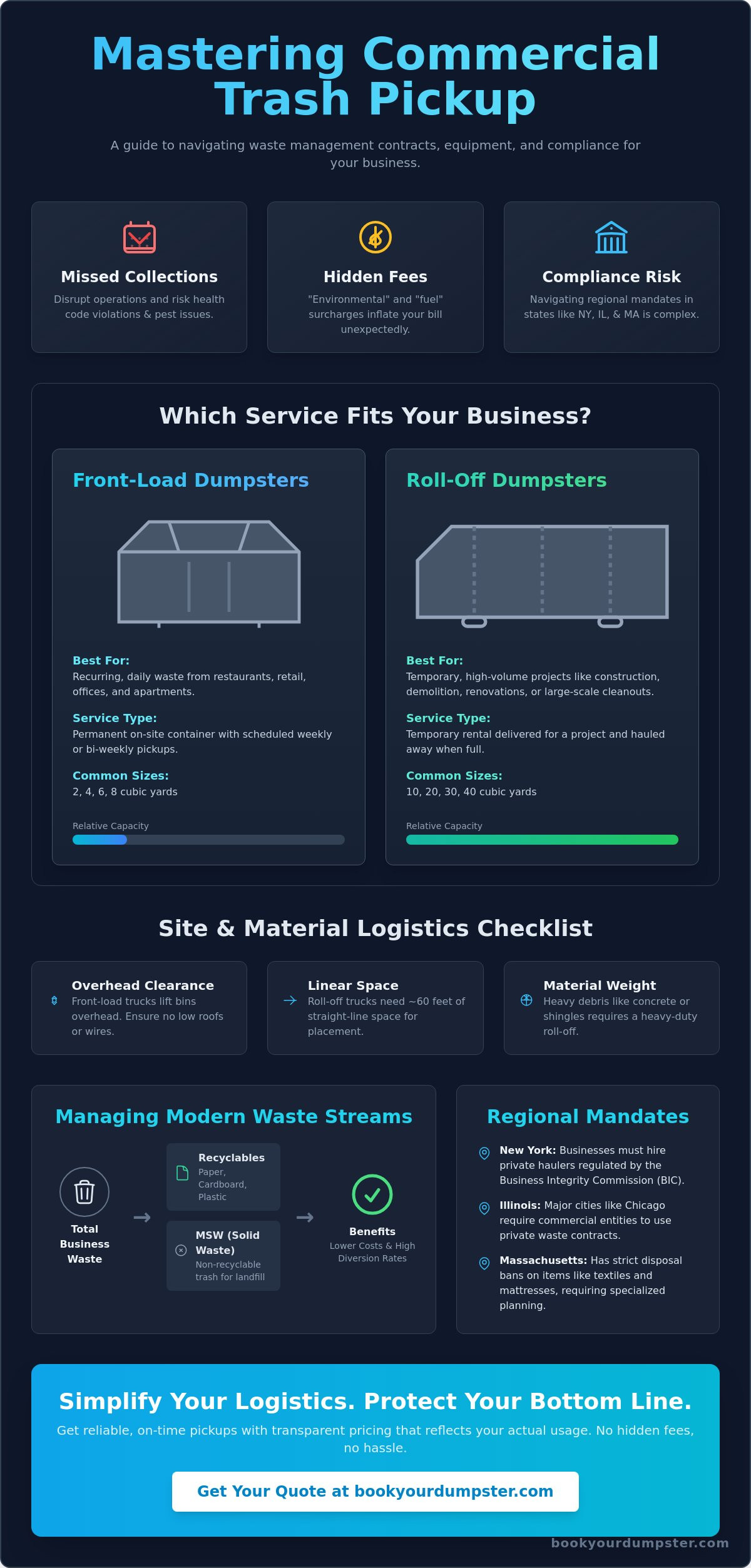
Most businesses require a permanent solution for their daily operations. Front load commercial waste pickup uses stationary containers, typically 2 to 8 cubic yards, which stay on-site and are emptied on a set weekly or bi-weekly schedule. These are ideal for restaurants, retail shops, and office complexes. However, your needs might change during a renovation or a warehouse cleanout. In these cases, you need temporary roll off dumpsters. We provide specific sizes like 10, 20, 30, or 40 yard dumpsters to handle these high-volume surges. You should determine if your business requires a hybrid approach. Many clients maintain a permanent front-load bin for daily trash while scheduling a temporary roll-off for seasonal projects or construction debris. Visit Book Your Dumpster to see which equipment fits your current project phase.
The Logistics of Waste Streams: Trash, Recycling, and Beyond
Modern waste logistics involve separating Municipal Solid Waste (MSW) from recyclables and specialized materials. Standard office or retail operations usually generate a mix of paper, plastic, and general trash. Implementing single-stream recycling or dedicated cardboard collection helps your business hit high diversion rates. These rates measure the amount of waste diverted from landfills, which is a key metric for corporate sustainability goals. In states like Massachusetts, strict bans on disposing of textiles and mattresses mean you must have a plan for every material type. Efficient sorting reduces your overall volume and can often lower your total disposal costs. Focus on a streamlined system that makes it easy for your staff to separate materials correctly at the source.
Front-Load vs. Roll-Off: Which Commercial Service Fits Your Business?
Choosing the right equipment for your commercial trash pickup prevents overspending on unused space or facing fines for overflowing bins. The EPA's Guide for Commercial Buildings emphasizes that right-sizing your containers is the first step toward efficient waste management. Front-load containers are the industry standard for restaurants, retail storefronts, and small offices. They stay in a fixed location, usually an alley or a parking lot corner, and serve as your daily waste hub. Roll-off dumpsters are different. These are heavy-duty, open-top containers designed for high-volume debris, construction sites, and large-scale cleanouts where a standard bin would be inadequate.
Analyze your physical constraints before you commit to a service type. A front-load truck lifts the bin over the cab, requiring significant overhead clearance. If your enclosure has a low roof or hanging wires, the truck won't be able to service the unit safely. Roll-off trucks need about 60 feet of linear space to drop and retrieve the container. Weight also dictates your choice. Dense materials like broken concrete or heavy roofing shingles can quickly exceed the mechanical limits of a front-load truck. For those materials, you'll need the reinforced structure of a roll-off. Matching the container to the material density ensures you don't pay overweight penalties or face service delays.
Front-Load Service: The Set-It-and-Forget-It Solution
Standard front-load bins range from 2 to 8 cubic yards. Small offices might only need a 2-yard bin picked up once a week, while high-volume restaurants often require an 8-yard container serviced daily to maintain hygiene. In dense urban environments like Queens, we recommend lockable lids. These prevent unauthorized use by passersby, which keeps your costs predictable and your site clean. You can easily manage these recurring schedules through a digital platform. This consistency allows you to focus on your operations while the waste logistics run in the background.
Roll-Off Rentals: When Your Waste Exceeds the Bin
Roll-off logistics are project-based rather than schedule-based. You call for a haul when the bin is full. For small renovations or tight job sites, 10 yard dumpster rentals provide a compact footprint without sacrificing capacity. If you're managing a major construction site or a full building gut-out, you'll need to scale up to 20, 30, or 40-yard containers. These larger units handle massive volumes of wood, metal, and bulky debris that would destroy a standard front-load bin. If you aren't sure which size fits your current project, check the dimensions at Book Your Dumpster to find the right match.
Industry-Specific Waste Needs in NY, NJ, IL, and MA
Every industry generates a unique waste profile that requires a specific logistical response. Retailers in New Jersey must navigate mandatory recycling laws for cardboard and plastic, while restaurants in Boston focus on high-frequency food waste removal. Aligning your commercial trash pickup with these sector-specific demands prevents health code violations and optimizes your operational costs. Property managers also rely on clean, on-time collections to maintain tenant satisfaction and property value. For professional offices, the focus shifts toward document security and efficient paper recycling. Use a service that understands these distinctions to ensure your site remains productive and compliant with all local commercial recycling requirements.
Managing waste streams effectively requires a proactive approach to sorting and scheduling. If your business produces high volumes of recyclables, you need a plan that separates these materials from your general refuse. This not only supports corporate sustainability goals but often reduces your total disposal fees. In states like Massachusetts, where landfill capacity is at a premium, diversion is not just a goal; it is a regulatory necessity. Choose a provider that offers the right container sizes and pickup frequencies to handle your specific volume without allowing waste to accumulate on-site. This keeps your facility safe and projects an image of professional competence to your clients and tenants.
Construction Debris Removal for Local Contractors
Contractors working in dense urban environments like San Francisco must maintain tight site flow. Effective construction debris removal involves more than just dropping a bin; it requires strategic dumpster swaps that align with your project phases. If you are pursuing LEED certification for a green building project, you need detailed reporting on your diversion rates. We provide the documentation necessary to prove that your wood, metal, and concrete are being processed correctly. Keep your site safe and compliant by scheduling hauls before debris piles up and creates a hazard for your crew. This prevents site bottlenecks and ensures your project stays on schedule.
Urban Logistics: Navigating New York and Chicago Regulations
Navigating the regulatory landscape in New York and Chicago requires precise planning and local knowledge. If your project requires placing a dumpster on a public street, you must obtain the necessary municipal permits to avoid costly citations. Chicago's dense commercial districts often have strict time-of-day restrictions that dictate when trucks can access your loading zone. You must also account for regional material bans, such as the Massachusetts rules regarding textiles and mattresses that went into effect on November 1, 2022. These regulations are designed to reduce landfill pressure but require businesses to have clear diversion plans in place. Partner with a hauler that stays current on these changes to keep your operations running smoothly. Visit Book Your Dumpster to verify the specific requirements for your zip code.
Navigating Commercial Waste Contracts and Pricing Integrity
Contracts for commercial trash pickup often contain complex clauses that obscure the actual cost of service. You must demand a clear breakdown that includes your base rate, estimated tonnage, and collection frequency. A professional agreement should be a tool for your business, not a trap for your budget. Always review the fine print for "environmental" or "fuel" surcharges. These variable fees can inflate your monthly bill by 20% or more without any change in your service level. Insist on a transparent pricing structure and reject any contract that allows for arbitrary fee hikes mid-term.
Beware of auto-renewal or "evergreen" clauses. These are common in the waste industry and can lock you into multi-year agreements that are notoriously difficult to exit. Set a calendar reminder for 90 days before your contract expires to evaluate your service and negotiate better terms. Right-sizing your equipment is another critical step in maintaining pricing integrity. If your front-load bin is consistently half-empty on pickup day, you're paying for air. Audit your waste volume every quarter. Adjust your container size or pickup frequency to match your actual needs. This simple adjustment can significantly reduce your annual waste spend.
Understanding Dumpster Rental Prices
Geography plays a major role in determining your final costs. In New York City, the Business Integrity Commission (BIC) sets maximum rates for private waste collection, providing a layer of regulatory protection. In Illinois and Massachusetts, prices are largely market-driven and vary by municipality. Consult our 2026 guide on dumpster rental prices to understand the regional variables in your area. Pricing models generally fall into flat-rate or variable categories. Flat-rate models provide predictability for project-based work, while variable models might suit businesses with fluctuating volumes. Tonnage limits protect businesses from overage fees by providing a clear weight allowance for every haul.
Avoiding Service Gaps and Missed Pickups
Unreliable commercial trash pickup is a liability. A missed pickup leads to overflowing bins, which create health hazards and attract city fines. Vet your hauler for punctuality before you sign. Ask for local references in your specific neighborhood to confirm their trucks can navigate your streets reliably. You need a direct point of contact who understands your site's specific logistics. Generic call centers often lack the local knowledge required to solve a routing issue or a missed collection quickly. Prioritize haulers who offer easy online management tools for real-time updates on your service status. To get started with a partner that values your time, request a service quote today.
Reliable Business Waste Solutions with Book Your Dumpster USA
Book Your Dumpster USA delivers pragmatic waste logistics designed for the modern business owner. We remove the logistical stress of commercial trash pickup by combining local expertise with a transparent, digital-first platform. Our service reaches across the complex regulatory environments of New York, Illinois, and Massachusetts. We don't hide behind opaque fee structures or automated phone trees. Instead, we offer direct solutions for your recurring front-load needs or temporary roll off dumpster rentals. You get the specific equipment you need, from 10 to 40 yard containers, exactly when you need it.
Pricing integrity is the foundation of our professional partnership. We provide straightforward quotes that reflect the actual work performed, ensuring your budget remains predictable. Our team understands that waste management is a high-functioning tool for your business, not a lifestyle choice. We prioritize punctuality and removal of clutter so you can focus on your primary operations. By modernizing a traditional industrial sector with digital convenience, we act as a dependable partner for contractors and property managers alike.
The Digital-First Approach to Waste Management
Managing waste across multiple locations shouldn't require a dedicated department. Our online system reduces your administrative burden by consolidating your scheduling and billing into one intuitive interface. View your delivery windows in real time and receive clear communication on every haul. This technology-driven approach ensures that your logistics stay on track even during high-volume periods or seasonal shifts. Stop chasing trucks and start managing your commercial trash pickup with confidence through our streamlined portal.
Your Partner in Clean, Efficient Operations
We act as your expert partner in maintaining clean, efficient job sites and storefronts. Our communication is direct and reassuring. We tell you what we can do and then we execute. By providing dependable, honest service, we support the local communities where your business operates. We understand the specific challenges of urban waste removal and high-density construction debris management. Ready to clear the clutter? Book Your Dumpster Today and experience a higher standard of reliability and control.
Secure Your Business Logistics Today
Efficient waste management is a strategic asset for any operation. It keeps your facility compliant with local health codes and ensures your overhead stays predictable month after month. By right-sizing your equipment and staying informed on regional mandates like New York's organic waste rules or Massachusetts' textile bans, you remove the risk of expensive fines and service gaps. Your commercial trash pickup should be a silent, high-functioning utility that supports your growth rather than hindering it.
We provide the professional tools and local expertise needed to manage your refuse with precision. Our service areas cover New York, New Jersey, Illinois, and Massachusetts, offering everything from permanent front-load bins to specialized roll-off sizes from 10 to 40 yards. Use our direct online booking system to gain immediate control over your schedule and pricing. Stop settling for unreliability and start working with a partner that values transparency and punctuality as much as you do. Clear the clutter and get back to focusing on what matters most for your bottom line.
Schedule Your Commercial Trash Pickup with Book Your Dumpster USA
Frequently Asked Questions
How often should a business have its trash picked up?
Frequency depends on your specific waste volume and local health codes. Food-based businesses like restaurants usually require daily or multi-weekly pickups to prevent pests and odors. Standard retail or office locations often find that a weekly schedule is sufficient. Monitor your bin levels over a two-week period to determine the most cost-effective frequency for your commercial trash pickup.
What is the difference between a commercial dumpster and a roll-off?
The primary difference lies in the mechanical lift and the type of waste handled. A commercial dumpster, or front-load bin, is a permanent fixture for recurring municipal solid waste. A roll-off dumpster is a temporary, heavy-duty container used for construction debris or large cleanouts. Roll-offs have open tops and are dropped off and retrieved by specialized trucks, whereas front-load bins are emptied on-site.
Can I share a commercial trash service with a neighboring business?
Most private waste contracts prohibit sharing containers because pricing is based on the specific volume and material type of a single entity. Sharing can lead to weight overages and disputes over billing or prohibited items. If you operate in a shared complex, consult your property manager about a master service agreement rather than attempting an informal split with a neighbor.
What items are prohibited in commercial trash containers?
You cannot dispose of hazardous materials, liquid waste, electronics, or large batteries in standard commercial bins. Specific regional bans also apply, such as the Massachusetts prohibition on mattresses and textiles in landfills. Always check with your provider before disposing of tires or appliances to avoid heavy fines and service rejections.
How do I know if I need a 10, 20, or 30-yard dumpster for my business renovation?
Choose your container size based on the density and total volume of your debris. A 10 yard dumpster is ideal for small bathroom remodels or heavy materials like dirt and concrete. Use a 20 yard unit for a standard office floor renovation, and scale up to a 30 yard container for major structural gut-outs or large-scale warehouse cleanouts.
Are there specific commercial waste regulations in New York City?
New York City businesses must hire private carters licensed by the Business Integrity Commission (BIC). As of January 1, 2026, many businesses generating at least one ton of organic waste per week must also comply with expanded diversion mandates. Ensure your carter follows the maximum rate caps set by the BIC to maintain pricing integrity.
What happens if my business generates more waste than my current bin size allows?
Excess waste leads to overflowing bins, which often result in city fines and missed pickups. If you consistently exceed your capacity, you must either increase your pickup frequency or upgrade to a larger container size. Contact your service provider immediately to adjust your schedule before a health code violation occurs.
Does Book Your Dumpster USA provide recycling services for businesses?
We focus on providing reliable front load commercial waste pickup and private curbside trash pickup for your primary waste streams. While our core services handle general municipal solid waste, we help businesses maintain high diversion rates through efficient logistics and proper container sizing. Check your local service agreement for specific material separation requirements in your region to ensure your commercial trash pickup stays compliant.


