

The biggest dumpster on the market might actually be the most expensive way to manage your waste in 2026. If you're operating in a high-volume commercial environment, simply increasing the size of your bin won't solve the problem of rising hauling fees or the 2026 expansion of municipal waste zones. Choosing between a compactor vs roll-off dumpster requires a cold look at your daily output and your available square footage. Stop paying for hauls that mostly move air and start looking at the density of your waste stream.
You already know that traditional open-top containers fill up fast, attract pests, and take up valuable real estate. This guide compares the efficiency, costs, and site requirements of both options to find the best fit for your commercial or large-scale project. We'll examine how compaction ratios of up to 5:1 can slash your weekly pickups and help you lower your total waste disposal spend. Use this data to optimize your site footprint and regain control over your logistics with a clear, ROI-driven strategy.
Key Takeaways
- Identify the mechanical differences between a compactor vs roll-off dumpster to match the right hardware to your specific waste stream density.
- Calculate how compaction ratios of up to 5:1 can reduce your hauling frequency and significantly lower total disposal costs.
- Compare the low upfront costs of temporary roll-off rentals against the long-term ROI of permanent mechanical compaction systems.
- Assess your site's infrastructure, including concrete pad stability and 3-phase power availability, before finalizing your waste management layout.
- Determine the best strategy based on your project duration and whether you are handling heavy construction debris or high-volume soft waste.
Understanding the Core Differences Between Compactors and Roll-Off Dumpsters
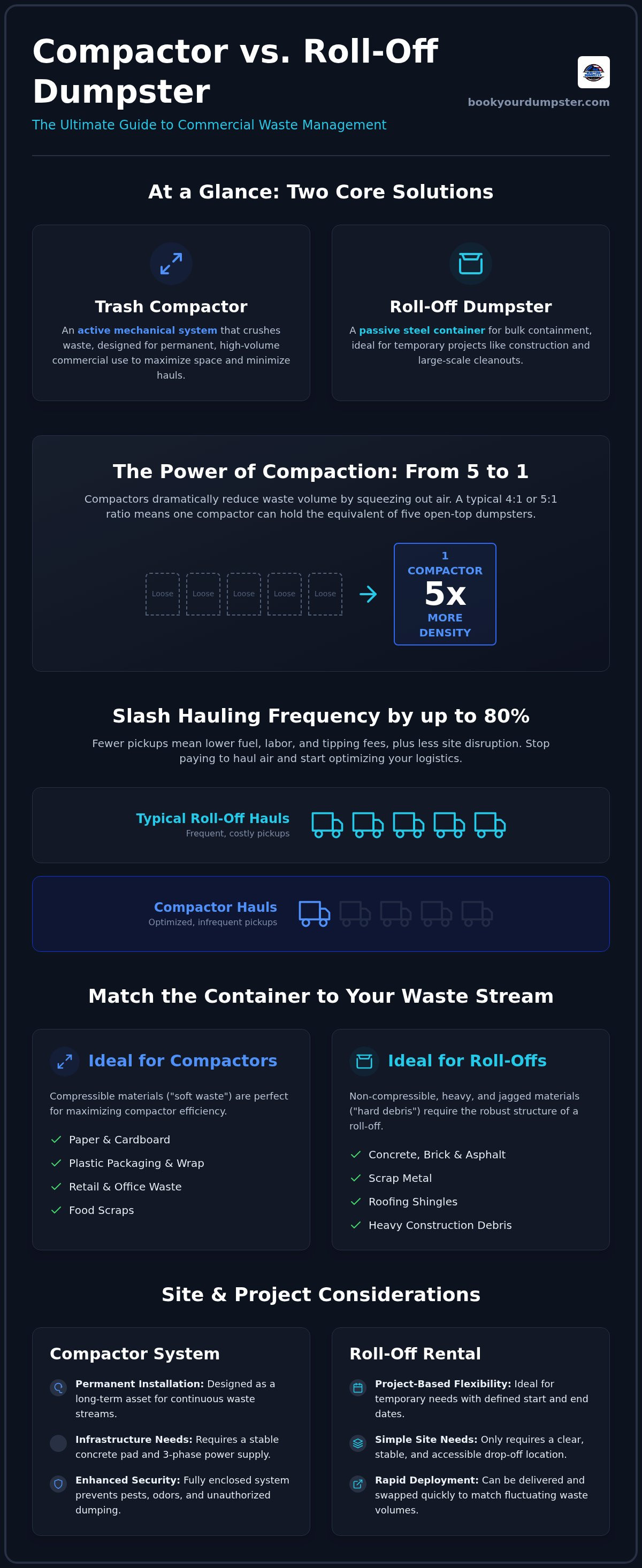
The choice between a compactor vs roll-off dumpster starts with a clear understanding of hardware. While both serve the same ultimate purpose—removing waste from your property—they function on opposite ends of the logistical spectrum. One is a passive steel container designed for bulk containment. The other is an active mechanical tool designed for volume reduction. Don't let the similar appearance of the receiver boxes fool you. The operational demands and long-term utility of these systems are distinct.
What is a Roll-Off Dumpster?
Roll-off dumpsters are open-top containers engineered for rapid deployment and easy loading. These units feature heavy-duty wheels that allow a specialized hoist truck to "roll" the container onto your designated site. They are the industry standard for construction, demolition, and large-scale cleanouts because they can handle jagged, heavy, and non-compressible debris. Book Your Dumpster USA provides these in 10, 20, 30, and 40-yard sizes to match the specific scale of your project. They are temporary solutions that we haul away as soon as they reach capacity.
What is a Trash Compactor?
A trash compactor is a fully enclosed mechanical unit that uses a hydraulic ram to crush soft waste into a smaller footprint. This system is designed for permanent or long-term placement at facilities with high-volume, daily trash output like retail centers and hospitals. Unlike a standard bin, a compactor is an integrated piece of equipment that often stays on-site while only the attached receiver box is hauled away for emptying. It requires specialized infrastructure, but it offers a level of control over waste density that a standard container cannot match.
The primary goal of a roll-off is debris containment. It's a versatile tool for projects with a defined start and end date. The primary goal of a compactor is volume reduction. It's a strategic asset for businesses that want to minimize truck traffic and maximize their site's footprint. By consolidating waste at the point of disposal, you reduce the number of times a hauler needs to visit your property. When evaluating a compactor vs roll-off dumpster, prioritize your waste stream's physical properties and your project's timeline over simple container volume.
Comparing Waste Volume and Compaction Ratios
The primary advantage of a compactor is its ability to eliminate wasted space. Most commercial trash consists of air trapped inside cardboard boxes, plastic packaging, and lightweight containers. When evaluating a compactor vs roll-off dumpster, you must look at your compaction ratio. Standard industrial compactors typically achieve a 4:1 or 5:1 ratio. This means you compress five yards of loose trash into a single yard of space. In practical terms, one 30-yard compactor can hold the same volume as four 30-yard open-top dumpsters.
Analyze your trash before it hits the bin. If your crew throws away empty pallets, plastic wrap, and office paper, you're paying to haul air. A density analysis shows that compacting these materials is the key to profit. Higher density means fewer hauls. For a business in a high-traffic area like Midtown South NYC, reducing truck traffic is also a matter of site safety and logistical compliance. Minimize your footprint by crushing what can be crushed.
Soft Waste vs. Hard Debris
Soft waste like paper, food scraps, and retail packaging is the ideal candidate for compaction. These materials yield easily to a hydraulic ram, allowing for maximum volume reduction. Hard debris is different. Materials like roofing shingles, scrap metal, brick, and concrete are non-compressible. Attempting to crush these items can damage the internal components of a compactor ram. This is why construction sites and demolition projects rely almost exclusively on roll off dumpster rentals. These open-top containers provide the structural integrity needed to hold heavy, jagged materials without the risk of mechanical failure.
The Impact on Pickup Frequency
Reducing the number of hauls is the fastest way to lower your waste management budget. Every time a truck enters your site, you pay for fuel, labor, and tipping fees. A compactor reduces these visits by up to 80%. This lower frequency also reduces site disruption and your project's overall carbon footprint. For permanent facilities, this efficiency is vital for long-term sustainability. However, project-based work often requires the flexibility of a "fill and swap" model. If your waste volume fluctuates or the project has a short timeline, a standard roll-off container is the superior tool. You can schedule a 10 to 40-yard dumpster online to handle these temporary surges without the long-term commitment of a compaction system.
Operational Costs and Pickup Frequency: The ROI Analysis
The financial structure of a compactor vs roll-off dumpster represents a choice between variable and fixed costs. Roll-off dumpsters operate on a pay-as-you-go model. You pay for the delivery, a daily or weekly rental fee, and the tonnage you dispose of at the landfill. This makes them ideal for projects with fluctuating budgets or tight timelines. Compactors require a significant upfront capital investment. Whether you purchase or lease the unit, you must account for high initial costs and professional installation. However, the return on investment comes from the massive reduction in hauling fees. If you currently pay for multiple weekly pickups in high-rate cities like Chicago or Boston, the compaction model can pay for itself by cutting your "hauls" by 70% or more.
Calculate your break-even point by looking at your monthly hauling statement. If you are hauling standard loose trash more than twice a week, you're likely overspending on logistics. Compactors consolidate that waste, meaning the truck visits your site once every two or three weeks instead of every other day. This shift from high-frequency hauling to high-density storage is where the ROI lives. But don't ignore the ongoing maintenance. Compactors are machines with moving parts. You'll need to budget for hydraulic fluid checks, seal replacements, and electrical repairs to avoid costly downtime.
Hidden Costs of Compactors
Infrastructure requirements often catch facility managers off guard. A stationary compactor isn't just dropped into a parking lot; it requires a reinforced concrete pad to support the weight of the hydraulic ram and the loaded receiver box. You also need a 3-phase electrical hookup, which may require a dedicated circuit from your building's main panel. In cold climates like Illinois or Massachusetts, "wet" waste can freeze to the interior walls of the unit during winter. This prevents the container from emptying completely at the landfill, leading to "short hauls" where you pay full price for a half-empty container. Factor in these utility and climate-driven expenses before committing to a permanent installation.
Cost Benefits of Roll-Off Rentals
Roll-off rentals offer total financial flexibility with zero maintenance responsibility. The provider owns the container and handles all structural repairs. This model allows you to scale your waste capacity up or down as project demands change. For instance, you might start a renovation with a 10 yard dumpster for heavy debris and then switch to a larger unit for finishing materials. There are no specialized power needs or concrete pad requirements. You simply provide a flat, stable surface. This transparency is especially valuable in states like Illinois, where the Junk Fee Ban Act of 2026 mandates upfront disclosure of all mandatory fees. You get a clear, predictable cost without the long-term liability of heavy machinery.
Site Requirements: Space, Power, and Accessibility
Before you commit to a compactor vs roll-off dumpster, you must walk your site with a tape measure. Physical constraints often dictate the choice more than your waste volume does. A roll-off dumpster requires a flat, stable surface like concrete or reinforced asphalt. Placing a heavy 40-yard bin on soft soil or thin asphalt can lead to property damage as the unit sinks. You also need significant vertical clearance. If your site has low-hanging power lines, tree branches, or building overhangs, the truck's hydraulic arm won't be able to lift or drop the container safely. Accessibility is the final hurdle; the hauling truck needs a clear, wide path for frequent swaps.
Stationary compactors have even stricter physical requirements. These are permanent installations that require a level, reinforced concrete pad to withstand the constant vibration and pressure of the hydraulic ram. If you're handling liquid-heavy waste, such as food scraps from a grocery store, a self-contained compactor is the better tool. These units are leak-proof because the ram and the container are one single body. However, they take up a larger footprint because the entire machine must be hauled away for emptying, requiring more maneuvering room for the driver.
Urban Logistics: Queens and San Francisco Constraints
Navigating narrow streets and overhead wires makes urban waste management a specialized challenge. In densely populated areas like Queens or San Francisco, you'll likely face strict permit requirements for placing any container on a public right-of-way. Street placement isn't just about finding a spot; it's about truck physics. A roll-off truck typically requires a 60-foot straight-line clearance to drop or pick up a container. If your alleyway or loading dock doesn't provide this runway, you'll be forced to use smaller 10 or 20-yard bins. Check your local municipal code for specific "set-back" rules before you book your dumpster online.
Power and Foundation for Compactors
Industrial compaction is power-hungry and heavy. A standard 110V outlet won't work for these systems; you must install a dedicated 3-phase electrical connection. This often requires an electrician to run a new line from your building's main panel. The foundation is equally critical. Use reinforced concrete pads to prevent the unit from shifting or sinking under hydraulic pressure. Safety is the final site requirement. Mark clear safety zones around the unit to keep employees away from moving mechanical parts during the compaction cycle. Proper site prep prevents mechanical failure and keeps your operations compliant with local safety standards.
Making the Right Choice for Your NY, NJ, or IL Business
Choosing between a compactor vs roll-off dumpster depends on your waste stream's consistency. If your volume fluctuates or you're managing a temporary job site, don't overcomplicate your logistics with heavy machinery. Choose a roll-off dumpster for projects involving heavy construction debris or short-term cleanouts. However, if your facility generates over 30 to 40 cubic yards of soft waste every week, a compactor is the more efficient tool. Large commercial hubs in New York and Illinois often benefit from a hybrid approach. Use a permanent compactor for daily office and retail waste; keep a 30 or 40-yard roll-off on standby for periodic renovations and bulky equipment disposal.
The decision between a compactor vs roll-off dumpster is a question of logistics versus machinery. Compactors solve the problem of overflowing trash and high hauling fees in metropolitan areas. Roll-offs solve the problem of immediate, heavy-duty debris removal. Segmenting your waste is the fastest way to find the right balance. Don't put metal or wood into a compactor. Use separate containers to maximize your density and avoid mechanical damage. This strategy ensures you aren't paying to haul air or risking expensive repairs on a hydraulic ram.
Decision Matrix: Project Duration vs. Waste Type
Evaluate your needs based on two factors: how long you'll need the container and what you're throwing away. Use this framework to decide:
- Short-term (1-30 days): Always use a roll-off. The delivery and pickup are fast, and there's no infrastructure to install on your site.
- Long-term (Permanent): Evaluate the ROI of a compactor against your recurring roll-off hauling fees. If you're paying for three or more hauls per week, the machine pays for itself.
- Mixed Waste: Use a hybrid model. Dedicate a compactor to compressible materials like cardboard and plastic while using 20 or 30-yard roll-offs for non-compressible construction waste.
How to Get Started with Book Your Dumpster USA
Managing waste doesn't have to be a manual process. Book Your Dumpster USA simplifies the entire cycle with a digital-first approach. You can view dumpster rental prices online to ensure your project stays within budget. Our service covers major hubs across New York, New Jersey, Illinois, and Massachusetts. We provide the hardware and the reliability you need to keep your site clean and compliant with 2026 local regulations.
Take control of your site logistics by following our streamlined booking process. Use the online system to select the right volume from our 10, 20, 30, or 40-yard inventory. Schedule your delivery date and specify the exact placement location to avoid site interference. Receive prompt service from a team that understands the urgency of your project. Rent your roll-off dumpster today and get your project moving without the stress of waste management delays.
Optimize Your 2026 Waste Strategy
Success in commercial waste management requires matching the right tool to your specific waste stream. Deciding on a compactor vs roll-off dumpster often comes down to your project's duration and the density of your debris. If you're managing a temporary construction site or a residential cleanout, the flexibility of a roll-off container is unmatched. For permanent facilities with high soft-waste volumes, the long-term ROI of compaction can significantly reduce your monthly hauling spend.
Site preparation is your final step. Ensure your location meets the space and power requirements discussed earlier to avoid logistical delays. We provide transparent pricing and reliable service across New York, New Jersey, Illinois, Massachusetts, and San Francisco. Whether you need a 10-yard bin for a small renovation or a 40-yard container for a major project, we have the inventory ready for your site. Stop overpaying for inefficient hauling and start streamlining your operations today.
Book Your Roll-Off Dumpster Online Now to lock in your delivery and eliminate the stress of waste disposal. We're ready to help you clear the way for your next big project.
Frequently Asked Questions
Can I put construction debris in a trash compactor?
Do not put construction debris in a trash compactor. Hard materials like concrete, brick, and heavy scrap metal will damage the hydraulic ram and internal seals. These units are built specifically for compressible soft waste. For heavy renovation materials, stick with a standard roll-off container. This ensures your project stays on schedule without the risk of mechanical failure or expensive repair bills for damaged equipment.
How much space do I need for a 40-yard roll-off dumpster?
A 40-yard roll-off dumpster typically measures 22 feet long and 8 feet wide. However, you need more than just the container's footprint. Plan for at least 60 feet of straight-line clearance so the truck can safely drop and retrieve the unit. Check for overhead wires and tree branches; the truck's arm requires significant vertical room to operate without striking obstacles during the lift.
Do trash compactors require a special electrical hookup?
Most industrial trash compactors require a 3-phase electrical hookup. A standard 110V or 220V outlet cannot provide the torque necessary for a high-powered hydraulic system to crush dense waste. You must hire a licensed electrician to run a dedicated power line to the installation site. Failure to provide the correct voltage can lead to motor burnout and immediate system failure.
Is it cheaper to rent a dumpster or buy a compactor?
The choice between a compactor vs roll-off dumpster depends on your long-term waste volume. Renting a dumpster is cheaper upfront because it requires no capital investment or infrastructure prep. Buying a compactor is a strategic move for facilities generating consistent high-volume trash. While the machine is expensive, it pays for itself by reducing hauling frequency and consolidated tipping fees over several years.
What happens if a roll-off dumpster is overloaded?
Never fill a roll-off dumpster past the top rail. An overloaded container is a safety hazard during transport and may exceed the truck's lifting capacity. If the load is too heavy or high, the driver will refuse the pickup. You'll be responsible for removing the excess debris and may face a "dry run" fee for the failed collection attempt. Always distribute weight evenly.
How often do compactors need to be serviced compared to dumpsters?
Compactors require more frequent technical service than dumpsters. While a dumpster only needs a visual inspection for structural integrity, a compactor has moving parts, hydraulic fluid, and electrical sensors that need regular checks. Plan for quarterly maintenance to prevent leaks and mechanical jams. In contrast, dumpsters are worry-free; your provider handles all repairs and container swaps as part of the rental agreement.
Are there weight limits for roll-off dumpsters in New Jersey?
New Jersey enforces strict weight limits based on the gross vehicle weight rating of the hauling truck. Additionally, tipping fees vary by county; for example, 2026 rates in Burlington County reach $127.55 per ton for construction and demolition waste. Exceeding weight limits results in heavy fines and safety violations. Always check your local county regulations before loading heavy materials like soil, sod, or concrete.
Can a compactor handle recyclable materials like cardboard?
Compactors are excellent for managing large volumes of recyclable cardboard and plastic film. By crushing these materials at ratios up to 5:1, you maximize your storage space and reduce the number of trips to the processing facility. This is a primary factor in the compactor vs roll-off dumpster debate for retail and warehouse operations. Consolidating recyclables lowers your carbon footprint and streamlines your back-of-house logistics.


