

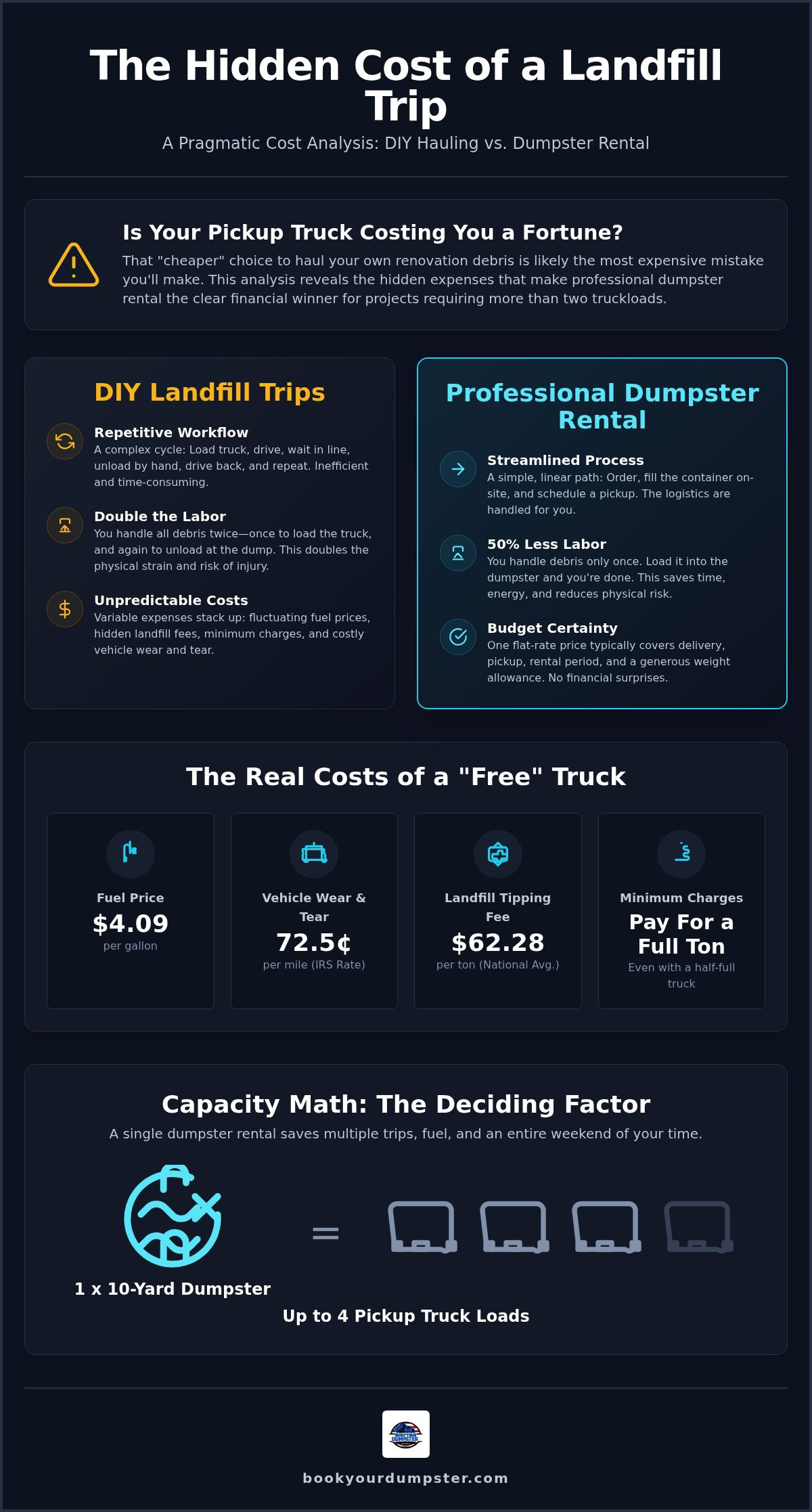
The "cheaper" choice of hauling your own renovation debris to the dump might actually be the most expensive mistake you make this weekend. You want to save money, and you likely believe your pickup truck and a few hours of driving will beat the cost of a professional service. However, a pragmatic cost analysis of dumpster rental vs landfill trips reveals that the math rarely favors the DIY approach in 2026. Between rising fuel prices at $4.09 per gallon and national average tipping fees climbing to $62.28 per ton, those "free" trips add up fast.
We understand the desire to stay in control of your project budget while avoiding logistical stress. This breakdown provides a clear financial winner by exposing the hidden expenses of self-hauling, from the 72.5 cents per mile IRS wear-and-tear rate to the physical exhaustion of loading and unloading your vehicle twice. You'll learn why a single 10-yard dumpster typically replaces three full pickup truck loads, effectively saving you a full weekend of labor. Stop wasting time in landfill traffic and start focusing on finishing your project instead.
Key Takeaways
- Account for hidden vehicle expenses. Factoring in $4.09 gasoline and the 72.5 cent IRS mileage rate reveals the high cost of every mile driven to the dump.
- Reduce your labor by 50%. Professional rentals require you to load debris once, while DIY hauling forces you to load and unload the same trash twice.
- Master the capacity math. A 10-yard dumpster holds as much as four or five full pickup truck loads, making it the most efficient tool for single-room renovations.
- Use a pragmatic cost analysis of dumpster rental vs landfill trips. You'll find that renting is the clear financial winner the moment your project exceeds two truckloads.
- Prioritize your time. Avoid landfill lines and traffic by using streamlined online booking to have a dumpster delivered directly to your project site.
The Logistics of Waste Disposal: Landfill Trips vs. Dumpster Rental
Understanding The Logistics of Waste Disposal is the first step in protecting your project budget and your schedule. When you perform a cost analysis of dumpster rental vs landfill trips, you'll quickly see that the two methods operate on entirely different efficiency scales. DIY hauling is a repetitive, multi-stage cycle that consumes your most valuable resource: time. A professional rental, however, is a linear process designed to remove logistical friction from your job site.
The DIY workflow is surprisingly complex. It starts with finding a suitable vehicle, followed by loading debris, driving to a facility, and waiting in often-long queues. Once you reach the tipping face, you must manually unload every heavy item you just loaded. Finally, you drive back to the site to start the process over. This "double handling" means you touch every piece of waste twice. It's an inefficient use of energy that slows down your actual renovation or cleanup work.
Professional rentals simplify this into a "single-load" system. You book your container, receive delivery at your preferred location, and load the waste once. When the bin is full, a professional driver handles the transport and disposal. This shift in workflow eliminates the "Opportunity Cost" that many homeowners and contractors overlook. Every hour you spend sitting in landfill traffic is an hour you aren't finishing your floors, installing cabinets, or managing your crew.
The DIY Hauling Workflow Reality
Hauling your own waste carries significant physical and unpredictable risks. Unloading heavy construction debris or old furniture by hand at a landfill is exhausting and increases the chance of injury. In major metropolitan areas like New York or Chicago, landfill wait times are notoriously volatile. You might lose three hours in a single trip. Additionally, without a commercial permit, you risk being turned away for carrying prohibited items, forcing you to drive the waste back home and start your search for a disposal site again.
The Streamlined Rental Alternative
Choosing a rental provides a stationary, organized hub for your project waste. Professional placement ensures the container sits exactly where you need it, which preserves driveway space and keeps your yard free of unsightly piles. This organization prevents project clutter from becoming a safety hazard. Visit Book Your Dumpster USA to view available sizes and secure a flat-rate container that fits your specific project footprint. Moving waste directly from the house to a dumpster keeps your site professional and your timeline on track.
Breaking Down the Direct Costs: Landfill Fees and Rental Prices
Pricing waste disposal isn't as simple as checking a single number. You must account for regional price hikes and facility-specific rules to get an accurate estimate. In 2026, the national average landfill tipping fee reached $62.28 per ton, which represents a 10% increase from previous cycles. This baseline fluctuates wildly by geography. If you're working in Illinois, you might see fees around $50 per ton. In Massachusetts, those costs jump to over $80 per ton due to limited capacity and stricter regional regulations.
A cost analysis of dumpster rental vs landfill trips reveals that DIY hauling often triggers "minimum charges." Many landfills charge a flat minimum for any vehicle, regardless of how little weight you carry. If you arrive with a half-full pickup truck, you still pay for a full ton. This makes small, frequent trips disproportionately expensive compared to a single bulk disposal solution. Every trip you make without a full load is essentially money left on the scale.
Landfill Tipping Fees and Minimums
Landfills calculate your final bill using a combination of weight and material type. Construction and demolition debris often carries higher rates than standard household trash. Additionally, states with waste-to-energy facilities see fees roughly 28% higher than those without. Before you drive, verify if your local facility requires a resident permit or a specific commercial account. Being turned away because you lack the right paperwork is a costly waste of fuel and time.
Dumpster Rental Flat-Rates
Professional rentals operate on a flat-rate structure that provides immediate budget certainty. This single price typically covers the delivery, a designated rental period, the final pickup, and a pre-set weight allowance. For large construction projects, this predictability is vital. It prevents the "death by a thousand cuts" scenario where fuel, tipping fees, and hourly labor costs bleed your budget dry. Review our Dumpster Rental Prices Guide to see how these rates compare across major metros.
Don't forget the hidden risk of penalties. Overweight fees at landfills are steep, but dumpster rentals also include weight limits. Exceeding your ton limit can result in additional charges ranging from $40 to $200 per extra ton. Cities like San Francisco and Boston also require specific street permits if the container isn't on private property. You can check local permit requirements and secure a flat-rate bin through our online system to avoid these surprises.
The Hidden Costs: Time, Fuel, and Vehicle Wear-and-Tear
Your "free" pickup truck isn't actually free once you load it with heavy construction debris. A comprehensive cost analysis of dumpster rental vs landfill trips must account for the mechanical and financial toll of self-hauling. With gasoline prices averaging $4.09 per gallon in July 2026, the cost of idling in landfill traffic becomes a significant line item. Heavy-duty trucks consume fuel rapidly when hauling weight, making every round trip more expensive than the last.
The IRS standard mileage rate for 2026 is 72.5 cents per mile. This figure represents the true cost of operating a vehicle, including fuel, insurance, and depreciation. If your local disposal site is 20 miles away, a single round trip costs you $29 before you even pay a tipping fee. Multiply that by the four or five trips required to match a small dumpster, and you've spent over $145 just on vehicle operation alone. This doesn't include the added cost of renting a trailer or a heavy-duty vehicle if you don't already own one.
The Time-Value Analysis
Time is your most finite resource. Hauling your own waste often turns a two-day project into a four-day ordeal. You must factor in the limited operating hours of municipal dumps, which often close early on weekends or have restricted holiday schedules. In high-traffic metros like Queens or San Francisco, wait times at the scale house can exceed two hours during peak morning shifts. Choosing a roll off dumpster rental recovers your schedule. You spend one hour loading the bin instead of ten hours staring at taillights on the highway. This allows you to focus on the actual renovation rather than the logistics of trash.
Vehicle Depreciation and Damage
Standard residential pickup trucks aren't designed for the concentrated weight of concrete, shingles, or wet drywall. Overloading your bed puts extreme strain on the suspension and transmission. Beyond mechanical wear, the dump site itself is a hazardous environment for your tires. Sharp metal, nails, and jagged wood debris are common on the tipping floor. A single puncture can cost you $200 to $300 to replace a heavy-duty tire. Messy household waste also leaves behind odors and stains that may require professional detailing to remove. When you add up the risk of suspension damage and tire replacement, the "savings" of DIY hauling quickly disappear.
Capacity Math: How Many Truckloads Fit in a 10-Yard Dumpster?
A standard pickup truck bed provides roughly 2.5 cubic yards of space when loaded level to the side rails. To match the capacity of a single 10-yard dumpster, you must complete four full round trips to the disposal site. This volume gap is the core reason why a cost analysis of dumpster rental vs landfill trips usually favors professional service for any project larger than a minor closet cleanout. If you're managing a larger project, such as a full-scale construction debris removal, the math becomes even more lopsided. A 40-yard container holds the equivalent of 16 pickup truck loads, a logistical feat that would take a DIY hauler several days of continuous driving to achieve.
Attempting to bypass these trips by "heaping" or overfilling a truck bed is a dangerous gamble. Unsecured loads are a leading cause of highway accidents and are illegal in every state. In high-traffic metros like Queens or Chicago, law enforcement frequently issues heavy fines for debris that isn't properly contained and covered. Beyond the legal risk, an overfilled truck is difficult to handle. It places uneven weight on your tires and suspension, which we previously identified as a major source of hidden vehicle depreciation. Using a roll-off container ensures your waste is contained within steel walls, keeping your project compliant and your local roads safe.
Volume Equivalency Guide
- 10-Yard Dumpster: Equivalent to 4 pickup truck loads. Use this for small basement cleanouts or single-room flooring projects.
- 20-Yard Dumpster: Equivalent to 8 pickup truck loads. This is the standard choice for medium kitchen remodels or large deck removals.
- 30-Yard Dumpster: Equivalent to 12 pickup truck loads. Choose this for whole-home cleanouts and commercial renovations.
Efficiency in Loading
Loading a dumpster is significantly faster than loading a truck. The low side walls of a roll-off container allow you to toss debris over the side without lifting it above your head. Most units also feature a heavy-duty swing-door. This allows you to walk heavy items like appliances, concrete chunks, or old cabinetry directly into the bin. This ergonomic advantage prevents the back strain associated with lifting heavy waste over a truck's tailgate. Professional hauling is simply the safer, more efficient choice for the community. Select your dumpster size online to streamline your next project today.
Conclusion: Making the Efficient Choice with Book Your Dumpster USA
The evidence presented in this cost analysis of dumpster rental vs landfill trips points to a single, pragmatic conclusion. DIY hauling is a false economy for almost every project beyond a simple trunk-load of trash. While driving your own waste might feel like a cost-saving measure, the reality of 2026 fuel prices, rising tipping fees, and vehicle depreciation creates a different financial picture. Once your debris exceeds two pickup truck loads, the efficiency and flat-rate predictability of a professional rental become unbeatable. You save money, protect your vehicle, and recover your most valuable asset: your time.
Choosing a professional service removes the logistical weight from your shoulders. You eliminate the physical exhaustion of double-handling waste and the frustration of landfill wait times. Instead of spending your weekend at a scale house, you can focus on the completion of your renovation or cleanup. Professional waste management is a high-functioning tool that ensures your project stays on schedule and under budget. Don't let the "hidden" costs of self-hauling derail your hard work.
Why Local Expertise Matters
Waste management is not a one-size-fits-all industry. Regulations in high-density areas like Queens or San Francisco require specific knowledge to avoid heavy fines and permit violations. We maintain deep expertise in the local requirements of New York, New Jersey, Illinois, Massachusetts, and San Francisco to ensure your project remains compliant. Our commitment to transparent pricing and punctuality acts as a verbal handshake with our customers. You get the bin you need, exactly when you need it. Visit Book Your Dumpster USA to see how we modernize traditional disposal through digital convenience and straightforward honesty.
Ready to Start Your Project?
Selecting the right tool for the job is essential for maintaining your budget. Use this checklist to match your project scale to our available inventory:
- 10-Yard Dumpster: Best for entry-level cleanups and small room remodels.
- 20-Yard Dumpster: The standard choice for large deck removals or kitchen renovations.
- 30-Yard Dumpster: Ideal for whole-home cleanouts and commercial waste.
- 40-Yard Dumpster: Reserved for major construction debris and industrial-scale projects.
Take Control of Your Project Logistics
DIY hauling is a false economy for most projects. Your cost analysis of dumpster rental vs landfill trips should prioritize the $4.09 per gallon fuel costs and the 72.5 cents per mile vehicle depreciation rate. A 10-yard dumpster replaces four full pickup truck loads, which saves you from hours of landfill traffic. You don't have to worry about unloading heavy debris by hand or risking suspension damage to your personal vehicle. It's a pragmatic shift that protects your budget and your physical health.
It's time to simplify your workflow and eliminate the stress of waste management. We offer flat-rate pricing with no hidden surprises across NY, NJ, IL, MA, and SF. Whether you need a 10-yard bin for a garage cleanout or a 40-yard container for a major construction site, we provide the reliability you need to stay on schedule. Book Your Reliable Roll-Off Dumpster Online Now. Secure your rental in minutes and focus on finishing your project. We're ready to help you clear the clutter and move forward.
Frequently Asked Questions
Is it cheaper to go to the dump or rent a dumpster in 2026?
Renting is the more cost-effective choice for any project exceeding two pickup truck loads. When you account for $4.09 per gallon fuel costs and the national average landfill tipping fee of $62.28 per ton, DIY hauling expenses rise quickly. A 10-yard dumpster replaces four round trips to the landfill, which eliminates hours of driving and the physical toll of unloading debris by hand.
How much can a 10-yard dumpster actually hold compared to my truck?
A 10-yard dumpster holds the equivalent of four full pickup truck loads. Most standard truck beds only provide about 2.5 cubic yards of space when loaded level. By choosing a 10-yard container, you consolidate your waste into a single professional pickup. This efficiency allows you to finish your project a full weekend faster than if you performed multiple hauling cycles yourself.
What are the hidden fees associated with landfill trips?
Hidden fees include minimum load charges, fuel surcharges, and vehicle depreciation calculated at the 2026 IRS rate of 72.5 cents per mile. A cost analysis of dumpster rental vs landfill trips also reveals the risk of fines for unsecured loads or flat tires from sharp debris. These variable expenses often exceed the predictable flat-rate pricing of a professional roll-off rental.
Do I need a permit to park a dumpster on the street in New York or Chicago?
Yes, placing a dumpster on a public street in New York or Chicago typically requires a permit from the local Department of Transportation. If you have space to place the container on a private driveway, you generally won't need a permit. Always verify local municipal codes before your delivery date to ensure your site is compliant and to avoid unexpected city fines.
Can I throw construction debris like concrete into a regular landfill trip?
Many municipal landfills restrict heavy construction debris or require you to use specialized disposal areas with higher fees. Concrete, brick, and asphalt are often diverted to recycling facilities rather than standard tipping faces. Check with your local facility before driving to ensure they accept your specific material type. Professional rentals provide a more reliable way to manage these heavy materials without the guesswork.
How do I calculate if my project is big enough for a 20-yard dumpster?
A 20-yard dumpster is the right choice if your project will produce approximately eight pickup truck loads of waste. This size is standard for medium-sized kitchen renovations or large deck removals. If your debris pile covers a standard parking space and stands four feet high, you likely have enough volume to justify the capacity and weight allowance of a 20-yard container.
What happens if I exceed the weight limit on my dumpster rental?
Exceeding the pre-set weight limit results in additional "overweight fees" calculated per ton. These charges typically range from $40 to $200 per extra ton depending on local disposal rates. Perform a cost analysis of dumpster rental vs landfill trips to estimate your debris weight accurately. Selecting a larger 30-yard or 40-yard bin upfront is often cheaper than paying overage penalties on a smaller unit.


