
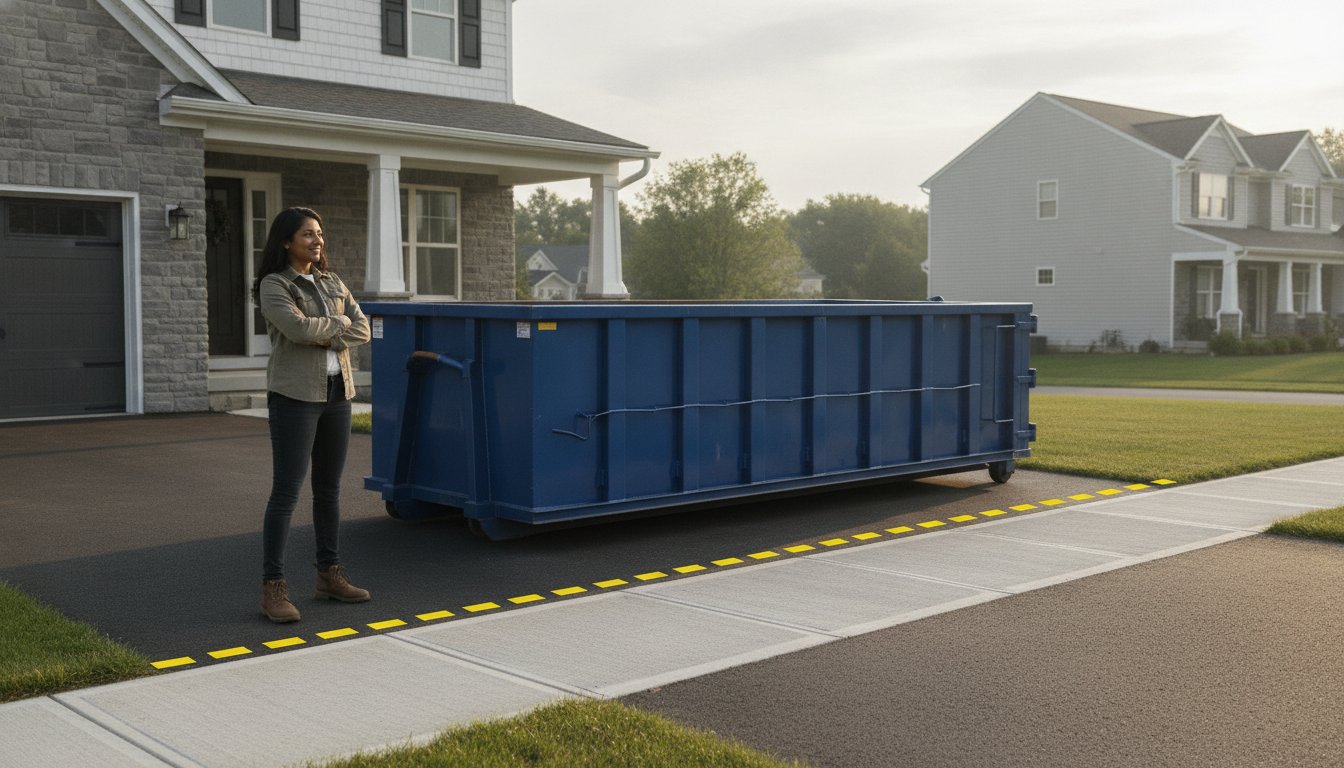
A single mistake in dumpster placement can cost you up to $500 per day in municipal fines. While your driveway is private property, the line between your land and the city's right-of-way is often thinner than you think. Most homeowners ask, "do I need a permit for a dumpster in my driveway" because they want to avoid the headache of unexpected legal delays or neighbor complaints. It's frustrating to deal with red tape when you just want to clear out your garage or start a renovation.
We understand you need clear, action-oriented answers to keep your project on schedule. This 2026 guide explains exactly when you can skip the permit and when city hall requires a signature. We'll cover the specific rules regarding public sidewalks, the hidden requirements of Homeowners Associations, and how to prep your driveway to avoid property damage. You'll finish this article with a solid plan for a stress-free delivery and a clear path to getting your project started without the fear of local penalties.
Key Takeaways
- Most municipalities do not require permits for containers placed entirely on private property.
- Identify how HOA rules and shared driveway legalities act as secondary permit layers for your project.
- Get a definitive answer to the question, "do I need a permit for a dumpster in my driveway" by checking your local right-of-way boundaries.
- Use our checklist to clear obstacles and confirm your driveway meets the 25 feet of vertical clearance required for delivery.
- Choose the right container size to stay compliant with local weight limits and property constraints.
The General Rule: Private Property vs. Public Right-of-Way
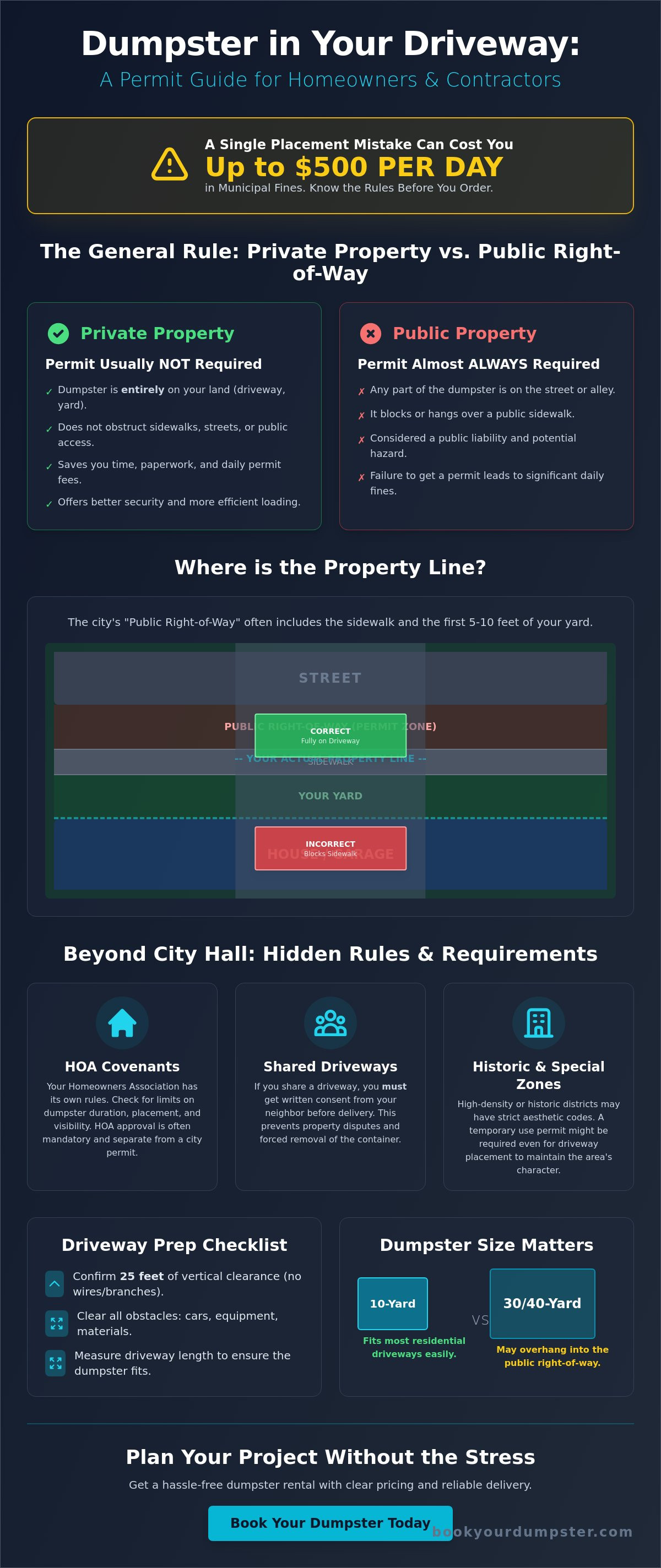
Most city ordinances distinguish between the land you own and the public right-of-way. If the container sits entirely on your concrete or asphalt, you are usually in the clear. Municipalities generally don't require permits for driveway placement because the equipment isn't obstructing public traffic, emergency vehicles, or utility access. It's your land, and you have the right to use it for temporary project logistics without city hall oversight.
Contrast this with street placement. Putting a bin on the road almost always requires a city permit. This is because a dumpster on a public street is a liability and a potential hazard. While specific roll off dumpster rental rules vary by city, the private property exemption is a standard industry baseline across the United States. If you can fit the container on your property, you save yourself time and administrative paperwork.
When Your Driveway is Considered Private
To qualify as "entirely on private property," the unit must sit behind the legal property line. This line isn't always the edge of the street. In many suburban neighborhoods, the city owns the first five to ten feet of grass or concrete adjacent to the road. If your dumpster blocks a sidewalk or hangs over the curb, it is no longer on private property in the eyes of the law. You'll need a permit to avoid fines that can reach $500 per day in some jurisdictions.
Size dictates how easily you can stay within these boundaries. Our 10-yard dumpster is the most maneuverable option for residential projects. It fits in short driveways where larger 30-yard or 40-yard units might hang over the sidewalk. Always measure your available space before ordering. If the truck can't drop the bin without crossing into the public zone, the question of "do I need a permit for a dumpster in my driveway" shifts from a "no" to a "yes."
The Benefits of Driveway Placement
Choosing the driveway over the street provides immediate financial and logistical advantages. You avoid the daily permit fees that cities like Chicago or Boston charge for street occupancy. These costs can quickly exceed the price of the rental if your project runs long. Driveway placement also offers better security. A dumpster on the street is an open invitation for neighbors or strangers to dump their own debris, which could push you over weight limits and trigger extra fees.
Loading is also more efficient when the container is on your property. You can position the bin closer to your garage or side door, reducing the distance you have to carry heavy materials. This setup keeps the project contained and professional. It also minimizes the risk of blocking your neighbors' view or interfering with their parking. Always verify your local "do I need a permit for a dumpster in my driveway" requirements if you plan on keeping the unit for more than two weeks, as some HOAs have specific time limits.
When a Permit is Required for Driveway Placement
Even if your city doesn't require a permit for private property, you aren't always in the clear. Private regulations and physical property boundaries create secondary legal layers that can complicate your project. If you share a driveway with a neighbor, for example, you must obtain their written consent before the truck arrives. Without it, you are technically encroaching on their property rights. This can lead to civil disputes or a forced removal of the container at your expense. Similarly, high-density zones or historic districts often have aesthetic codes. In places like Queens or parts of historic New England, these codes may require a temporary use permit even for driveway placement to ensure the equipment doesn't disrupt the local character.
Always verify the specific boundaries of your lot. The answer to "do I need a permit for a dumpster in my driveway" changes the moment a bin crosses onto city property. If your driveway is short and the container hangs over the curb, you are no longer on private property. This triggers the need for a municipal permit and can result in fines ranging from $50 to over $500 per day if you fail to register the placement with your local public works department.
HOA and Neighborhood Covenants
Your Homeowners Association (HOA) functions as a private government with its own set of rules. While the city might not care about your renovation, your HOA likely does. Most associations have strict covenants regarding dumpster duration and visibility. You might be limited to a 48 or 72-hour window, or you may be required to place the bin behind a fence or out of sight from the street. An HOA approval letter is not the same as a city permit, but it's just as mandatory. Violating these rules usually results in steep fines and strained relationships with your neighbors. Check your bylaws before you schedule your rental.
Sidewalk and Curb Encroachment
A private driveway ends where the public sidewalk begins. If any part of the roll-off container hangs over the pedestrian path, you are blocking the public right-of-way. In cities like San Francisco, this is a major safety violation. You must maintain at least 48 inches of clear path on the sidewalk to comply with ADA regulations. If your driveway can't accommodate the full length of the bin, you will need a right-of-way permit.
Measure your driveway depth carefully. A standard 10 yard dumpster is roughly 12 feet long. If your driveway is shallow, this smaller size is your best bet to avoid the curb. You can view container dimensions online to find a unit that fits your property without crossing into city-owned territory. This simple step prevents the legal headache of unexpected permit applications.
Navigating Public Property Permits (Street Placement)
Urban projects in high-density areas like Queens or Chicago often present a logistical challenge: the driveway is either non-existent or too small. If the answer to "do I need a permit for a dumpster in my driveway" is "no" simply because the bin won't fit, you must pivot to street placement. This move shifts the container from private land to the public right-of-way, making a municipal permit mandatory. Failure to secure this paperwork before the truck arrives will result in a "dry run" fee, as drivers cannot legally drop a container on a public road without authorization.
The application process requires specific documentation to protect the city from liability. You'll typically need to provide a Certificate of Insurance (COI) from the rental company, a basic site map showing the bin's position relative to fire hydrants and corners, and your exact rental dates. Local agencies like the NYC DOT or Chicago's CDOT oversee these approvals. Once granted, you are often required to set up "No Parking" signs 24 to 48 hours in advance. You must also use orange traffic cones or barricades with reflectors to ensure the container is visible to drivers at night.
Typical Permit Costs and Timelines
As of 2026, most major cities require at least 5 to 7 business days to process a residential street permit. Don't wait until the day before your project starts to apply. The type of permit you need depends on the waste. A standard residential cleanup permit is usually faster to obtain than a specific construction debris removal permit, which may involve additional environmental impact fees. Always check your city's online portal for the most current fee schedule, as prices can fluctuate based on the duration of the placement.
Permit Responsibilities: You vs. The Rental Company
The responsibility for obtaining a permit almost always falls on the property owner or the contractor. While some haulers offer permit assistance for an extra fee, you shouldn't assume it's included in the base price. Verify this during the booking process to avoid a last-minute scramble. Once you receive the physical permit, you must display it clearly. Some cities require you to tape a weather-proof copy to the side of the container or a nearby street sign. This visibility prevents local law enforcement from issuing citations during routine patrols. If you're still wondering "do I need a permit for a dumpster in my driveway" because your lot line is blurry, it's safer to apply for the street permit and avoid the risk of a $500 fine.
Preparing Your Driveway for a Roll-Off Dumpster Delivery
Once you confirm that you don't need a permit, shift your focus to the physical site. A delivery truck is heavy and requires significant space to operate safely. Neglecting site prep leads to property damage or "dry run" fees if the driver cannot drop the bin. Clear all vehicles from the driveway and the curb in front of your house. Trim low-hanging branches and check for overhead utility wires. A hoist needs vertical room to lift the dumpster off the bed. Even if the answer to "do I need a permit for a dumpster in my driveway" is a clear "no," your project can still stall if the truck can't access the drop zone.
- Clear the approach: Ensure at least 60 feet of straight-line space for the truck to back in.
- Measure the zone: A standard 20-yard dumpster is roughly 22 feet long; ensure your driveway accommodates this without overhanging the sidewalk.
- Mark the spot: Use traffic cones or chalk to show the driver exactly where to place the container wheels.
- Verify the line: Re-confirm your property line to ensure no part of the bin or the truck's tires cross onto your neighbor's land.
- Lay protection: Place boards or plywood down before the truck arrives to prevent surface scarring.
Protecting Your Pavement
A fully loaded 20-yard or 30-yard dumpster weighs several tons. That weight is concentrated on four small steel wheels that can easily crack standard residential asphalt or leave deep ruts in soft ground. Use the "Plywood Method" to create a buffer. Lay two sheets of 3/4-inch thick plywood exactly where the dumpster wheels will rest. This distributes the downward force across a wider surface area. This step is mandatory for decorative pavers or stamped concrete, which chip easily under heavy industrial loads. Taking ten minutes to lay boards saves you thousands in driveway repairs later.
Ensuring Driver Access
Accessibility is the primary reason for delivery delays. A roll-off truck requires about 60 feet of straight approach to back into a driveway safely. If your street is narrow or has cars parked on both sides, the driver may not have the turning radius needed to align the truck. Vertical clearance is also critical. The truck hoist needs 20 to 25 feet of overhead room to tilt the container into place. If you have low power lines or a dense tree canopy, the driver will refuse the drop for safety reasons. Address these obstacles before your scheduled delivery window to keep your project moving. Ready to book? Check availability for your location at Book Your Dumpster USA.
Hassle-Free Dumpster Rentals with Book Your Dumpster USA
Managing waste shouldn't be the most difficult part of your project. Book Your Dumpster USA provides a direct, no-nonsense online booking platform for residents across New York, New Jersey, Illinois, and Massachusetts. We've modernized the rental process to match your urgency. You can select your container, schedule delivery, and pay in one streamlined session. If you are still asking, "do I need a permit for a dumpster in my driveway" after checking your local lot lines, our team offers expert guidance based on the specific regulations in your city. We prioritize clarity so you can avoid the administrative friction that often slows down residential cleanouts.
Budgeting is straightforward with our transparent model. You can view current dumpster rental prices online without waiting for a callback or navigating hidden surcharges. We offer a full fleet of containers to handle any volume, including 10, 20, 30, and 40-yard options. Whether you're a homeowner tackling a basement or a contractor managing a multi-unit renovation, we provide the industrial-grade tools you need with the digital convenience you expect.
Why Our 10-Yard Dumpster is the Driveway Favorite
The 10-yard dumpster is our most requested size for residential driveways. Its compact footprint fits easily into standard parking spaces, making it the best defense against the question, "do I need a permit for a dumpster in my driveway." Since it stays well within private property lines, you usually won't need city intervention. This size is ideal for heavy debris like dirt or concrete, as well as general household junk from a garage or attic. Check out our 10 Yard Dumpster Rental page to see if these dimensions work for your specific drop zone.
Reliability and Punctuality Guaranteed
We view every delivery as a verbal handshake. Our commitment to punctuality ensures your project never stalls while waiting for a bin to arrive or an empty one to be hauled away. For contractors, this reliability is the difference between staying on schedule and losing billable hours. We manage the logistics so you can focus on the labor. Our drivers are professionals who respect your property and follow your placement instructions to the letter. Don't let waste pile up while you wait for a callback. Book Your Dumpster Online in Seconds and get back to work.
Secure Your Delivery and Start Your Project
Knowing the legal boundaries of your property is the most effective way to avoid municipal fines and project delays. Most homeowners find that as long as the container doesn't hang over a sidewalk or block a public road, they can skip the city permit process entirely. Always double check your HOA covenants and shared driveway agreements to ensure your neighbors are on the same page. Proper site preparation, including laying down plywood and clearing overhead obstacles, guarantees a smooth drop-off without property damage.
Getting a definitive answer to the question do I need a permit for a dumpster in my driveway removes the final hurdle between you and a successful renovation. Book Your Dumpster USA provides reliable 10, 20, 30, and 40-yard options across NY, NJ, IL, MA, and San Francisco. Use our streamlined online booking system to secure your equipment and maintain your project timeline.
Book Your Driveway-Friendly Dumpster Online Now to get your cleanup started. You've done the research; now it's time to clear the clutter and take control of your space.
Frequently Asked Questions
Do I need a permit if the dumpster is only half-on my driveway?
Yes, you must obtain a permit if any part of the container hangs over the sidewalk or curb. Municipalities view even a partial encroachment as a public right-of-way violation. To avoid daily fines that can exceed $500, ensure the entire unit sits behind your legal property line. Measure your driveway depth before booking to confirm a 20-yard or 30-yard unit fits safely.
How much does a dumpster permit cost in New Jersey or New York?
Permit fees typically range from $10 to $150 depending on your specific city or township. Major urban centers like New York City often sit at the higher end of this range due to high traffic and liability risks. These costs are separate from your rental fee. Contact your local Department of Transportation or Public Works office to verify the current 2026 rates for your zip code.
What happens if I put a dumpster on the street without a permit?
You risk immediate citations and the forced removal of the container at your expense. Fines for non-compliance range from $50 to over $500 per day in most jurisdictions. City inspectors routinely patrol residential areas for unpermitted equipment. If an unpermitted dumpster causes an accident or blocks emergency access, you may also face significant legal liability and insurance complications.
Can my HOA fine me for having a dumpster in my driveway?
Yes, your Homeowners Association can issue fines for violating neighborhood covenants. While you might not need a city permit for private property, HOAs often have strict rules regarding how long a bin can stay visible. Some associations limit placement to 72 hours or require specific "drop zone" protections. Always get written approval from your HOA board before the delivery truck arrives at your home.
How long can a dumpster stay in my driveway without a permit?
Most cities allow containers to stay on private property indefinitely, but local zoning laws or HOAs often impose limits. If you are asking, "do I need a permit for a dumpster in my driveway" for a project lasting over 30 days, check for "temporary structure" ordinances. Some municipalities require a permit for long-term placement even on private concrete to ensure the area remains sanitary and safe.
Do I need a permit for a 10-yard dumpster vs. a 40-yard dumpster?
Permit requirements depend on where the unit sits, not its total volume. A 10-yard dumpster is often easier to keep on private property because of its compact 12-foot length. A 40-yard dumpster is roughly 22 feet long and frequently overshoots residential driveways. If the larger size forces any part of the equipment onto the sidewalk or street, a municipal permit becomes mandatory for your project.
Is a permit required for a dumpster on a private gravel road?
No municipal permit is necessary if the gravel road is 100% privately owned and maintained. However, many gravel roads in semi-rural areas are still considered public rights-of-way by the county. If the local government plows or repairs the road, you likely need a permit for placement. Verify the road's legal status with your local land records office to avoid unexpected trespassing or obstruction charges.
Does Book Your Dumpster USA obtain the permit for me?
The property owner or contractor is responsible for securing all necessary municipal and HOA permits. We provide the equipment and reliable delivery, but the legal right to place that equipment on public land rests with you. We recommend applying for any required street permits at least 5 to 7 business days before your project begins. This ensures your delivery driver can drop the bin without legal delays.


