
That $500 fine for blocking a public curb isn't just a rumor. It's a reality for hundreds of homeowners and contractors every month who fail to check local ordinances. The question "do I need a permit for a dumpster" is the first thing you should ask before the delivery truck arrives at your job site. You're likely already stressed about your renovation or cleanout. The last thing you need is a city inspector halting your project because of a missing piece of paperwork or a DOT violation. We understand that bureaucratic red tape feels like an unnecessary hurdle when you're just trying to clear out debris.
This 2026 guide removes the guesswork by detailing exactly when you need a permit, how much it costs in major hubs like Chicago and NYC, and how to legally bypass fees altogether. We'll break down the "private property rule" and provide a simple checklist to keep your project on schedule and your budget intact. You'll learn the difference between Class A and Class B permits and discover why placement is the most important factor in your total project cost. From driveway rules to sidewalk clearances, we've got the answers you need to proceed with confidence.
Key Takeaways
- Identify the "Golden Rule" of placement to determine if your project qualifies for a permit-free driveway setup.
- Discover specific permit requirements for major cities like NYC and Chicago to avoid common DOT and CDOT filing errors.
- Protect your budget by learning how to avoid daily city fines and project-stopping "Stop Work Orders."
- Use our five-step checklist to answer the question, "do I need a permit for a dumpster" and secure the right paperwork for your specific address.
- Streamline your waste management logistics with professional guidance tailored for residential cleanups and commercial construction sites.
The Golden Rule: Private Property vs. Public Right-of-Way
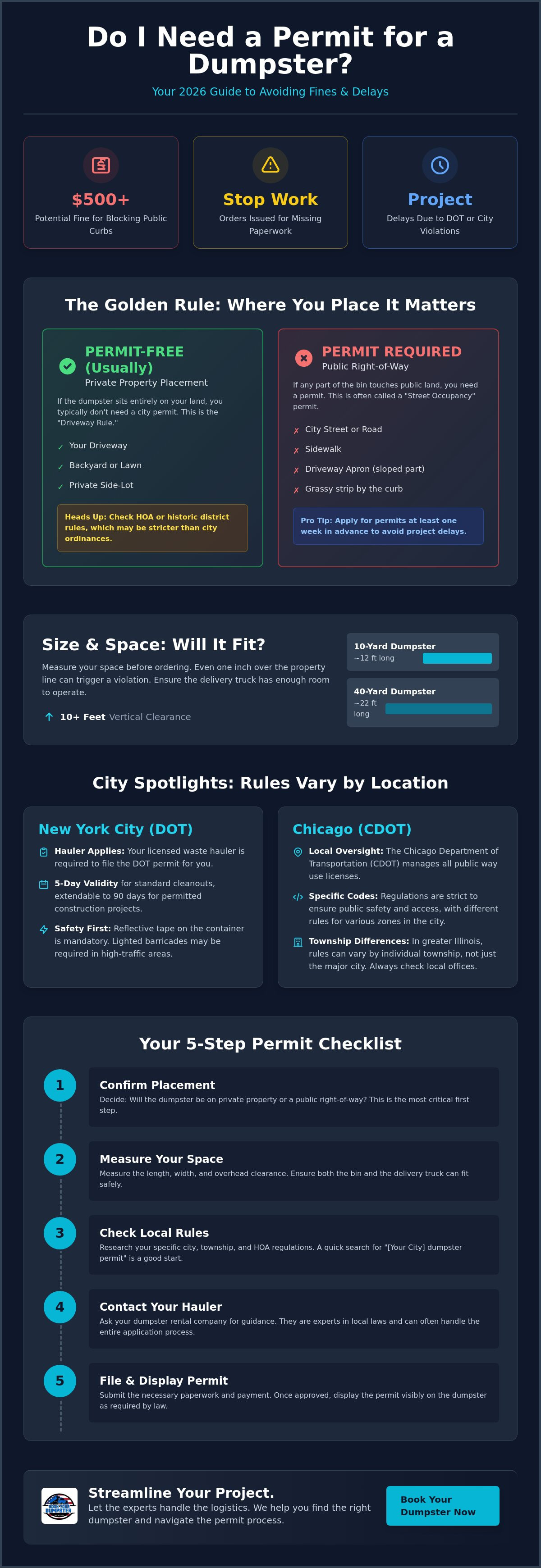
The location of your bin determines your legal obligations. If the container sits entirely on your land, you can usually skip the city paperwork. This is the "Driveway Rule." However, if any part of the unit touches a public right-of-way, you must file for a permit. This includes city-owned streets, sidewalks, and even the grassy strip between the sidewalk and the curb. Most municipal codes define these areas as public infrastructure that must remain clear for utility access and pedestrian safety.
You might wonder, do I need a permit for a dumpster if I have a large driveway? Usually, the answer is no. But check your local HOA or historic district guidelines first. These private organizations often have stricter aesthetic rules than the city. They might demand specific placement or limit how long the bin can stay on-site. Ignoring these private contracts can lead to liens or daily fines that the city doesn't even control.
Consider the footprint of your rental. A 10-yard dumpster is roughly 12 feet long and fits easily in a standard residential driveway. A 40-yard dumpster can reach 22 feet in length. Measure your space before the truck arrives. You need enough room for the bin and at least 10 feet of vertical clearance for the delivery truck's hoist. If the bin hangs over the sidewalk even an inch, you are technically in violation of city code.
What Qualifies as Private Property?
Your property line ends where the city's begins. Many homeowners mistake the "apron," which is the sloped part of the driveway connecting to the street, for their own land. It isn't. Placing a bin there is a public violation. Move the unit toward your garage or into a backyard to stay within your legal bounds. Using a roll off dumpster rental in a side-lot or backyard is a smart way to bypass city red tape. Just watch for overhead power lines or low-hanging branches. These obstructions can prevent the truck from operating safely.
When the Street is Your Only Option
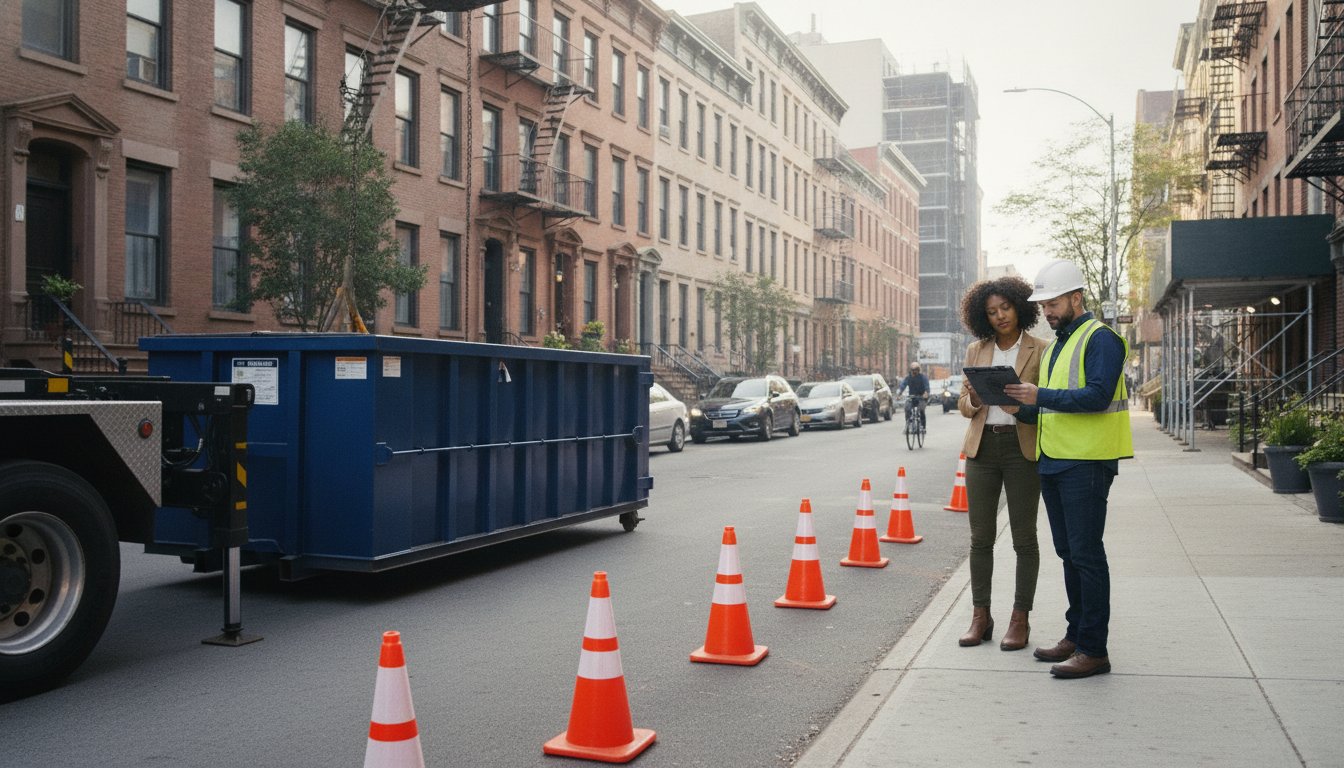
Urban density often makes driveway placement impossible. In neighborhoods like Queens or San Francisco, the street is your only choice. This setup always requires a "Street Occupancy" or "Encroachment" permit. Cities prioritize public safety above your project timeline. You cannot block fire hydrants, bus stops, or handicap ramps. If the city determines your dumpster creates a traffic hazard, they will deny the permit or tow the unit at your expense. Plan for these permits at least a week before your project starts to avoid delivery delays.
City-Specific Dumpster Rules: NYC, Chicago, and Beyond
The answer to "do I need a permit for a dumpster" changes the moment you cross city lines. Municipalities view public space as a high-value asset. In New York City, the Department of Transportation (DOT) maintains strict oversight of every square foot of pavement. Chicago uses its own Department of Transportation (CDOT) to manage "Public Way Use" licenses. If you're working in Massachusetts or New Jersey, you'll likely deal with individual township offices rather than a massive city agency. Each region has specific safety requirements that can stall your project if ignored. Review our local dumpster options to see which footprint fits your city's specific street requirements.
San Francisco is famously tight on space. Even a compact 10 yard dumpster rental requires a Public Works permit if it touches the street. The city prioritizes transit lanes and pedestrian access above all else. Before you book, verify your local setbacks and clearance rules. Ask your provider, "do I need a permit for a dumpster in this specific zip code?" to avoid surprise fines on delivery day.
New York City and Queens: The DOT Permit
In NYC, you don't apply for the permit yourself. The law requires your licensed hauler to handle the DOT paperwork. According to official New York City dumpster regulations, permits for non-construction cleanouts are usually valid for 5 days. Construction projects with a Department of Buildings (DOB) permit can extend this to 90 days. Safety is the primary focus. You must use reflective tape on the container. In high-traffic areas, the city may require "lighted" barricades to warn drivers at night. Failure to meet these visibility standards results in immediate violations and potential towing.
Chicago and Illinois: CDOT Regulations
Chicago's CDOT requires a Public Way Use license for any bin hitting the pavement. The city divides its fee structure by location. Expect higher costs if your project is inside the Central Business District (CBD). Outside the CBD, fees for a standard 30-yard bin are lower but still mandatory. Chicago permit applications include a strict "Indemnification" clause. This legal language protects the city from liability if your dumpster causes property damage or injury. Winter projects face extra scrutiny. You cannot place a dumpster on designated snow plowing routes during the snowy season. Check the city's snow map before choosing your drop-off point to ensure the truck can legally service your site.
The Risks of Skipping the Permit: Fines and Liabilities
Skipping the permit isn't a shortcut; it's a gamble with your project's budget. City inspectors don't just issue warnings. They issue citations. In many major metropolitan areas, fines for an unpermitted dumpster range from $250 to $1,000 per day. These penalties accumulate until you either move the bin or secure the proper paperwork. If you're still asking, do I need a permit for a dumpster, consider the "Stop Work Order." A single dumpster violation can freeze your entire renovation. City officials can halt all construction on your property until the waste management issue is resolved, costing you thousands in contractor downtime.
The legal risks extend beyond simple fines. If the city finds an unpermitted container on a public street, they may impound it. This means the city removes the bin immediately at your expense. You'll face towing fees, storage costs, and the loss of your rental deposit. Additionally, liability shifts heavily onto the property owner. If a vehicle strikes an unpermitted dumpster, you may be held legally responsible for damages and injuries. An unpermitted bin is considered an illegal obstruction, making it difficult to defend your position in civil court.
Financial Impact of Non-Compliance
A single fine can easily double the total cost of your dumpster rental. Municipal courts rarely accept "ignorance of the law" as a valid defense. Most cities post their ordinances online, placing the burden of research on the resident. Don't wait for an inspector to drive by. Neighbor complaints are the primary trigger for city inspections. If your bin blocks a parking spot or narrows a lane, a single phone call to 311 will bring an enforcement officer to your door.
Safety and Insurance Hazards
Insurance companies look for reasons to deny claims. If an accident involves an unpermitted structure on a public street, your provider may refuse to cover the damages. This leaves you personally liable for medical bills or vehicle repairs. When you ask yourself, do I need a permit for a dumpster, remember that permits exist to enforce the "Visibility Rule." This regulation requires specific safety markings, such as reflective tape or barricade lights, to protect pedestrians and drivers. Work with a professional service like Book Your Dumpster USA to ensure your placement meets every local safety standard. We help you identify potential hazards before the truck arrives, protecting your project from liability and loss.
How to Obtain Your Dumpster Permit in 5 Steps
Securing a permit doesn't have to be a bureaucratic nightmare. If you've determined that your project requires street placement, you must act before the delivery truck arrives. Follow this logical sequence to keep your project on schedule. If you are still asking, do I need a permit for a dumpster, these steps will help you finalize your logistics and avoid city interference.
- Step 1: Determine exact placement coordinates. Don't just give a general address. Identify the specific side of the street and the distance from the nearest intersection or fire hydrant. City officials use this data to ensure you aren't creating a blind spot for drivers.
- Step 2: Contact the governing department. Depending on your city, this is usually the Department of Transportation (DOT) or the Building Department. Verify if your specific street has "no parking" restrictions that require additional signage.
- Step 3: Gather required documentation. You'll likely need a site map showing the dumpster's footprint. Some cities also require proof of insurance or a copy of your contractor's license if the bin is for a major renovation.
- Step 4: Submit the application and pay the fee. Most municipalities now offer online portals for faster processing. Fees vary significantly based on your city's cost of living and the duration of the permit.
- Step 5: Post the permit. Once approved, print the permit and secure it to the dumpster or a visible spot on the job site. Inspectors look for this document first when responding to neighbor complaints.
Who Should Apply: You or the Rental Company?
The rules on who pulls the permit vary by region. In New York City, the law requires the hauler to file the paperwork. In other markets, the homeowner is responsible. Before you sign a contract, ask your dumpster rental company if they handle permit filings. If you're a homeowner, ask if you qualify for a "Residential Use" permit, which is often cheaper and easier to obtain than a professional "Contractor Permit." Verify these details early so you don't end up with a bin sitting at the curb without legal protection.
Timeline and Expiration Rules
Don't wait until the day before your project starts. Most cities require 2 to 5 business days to process a standard application. If your project hits a delay, check the renewal rules. Most permits expire after 30 days, and renewing after the expiration date often triggers a higher fee. If you're dealing with an emergency like flood or fire damage, ask about "Emergency Permits." These are processed faster but usually carry a premium price. Book your dumpster now to ensure you have enough time to clear the city's red tape.
Simplifying Your Project with Book Your Dumpster USA
Waste management shouldn't be a source of logistical stress. We've built our service to act as a high-functioning tool for both homeowners and contractors. We understand the specific regulatory hurdles in NY, NJ, IL, MA, and SF markets. When you ask, do I need a permit for a dumpster, you need a professional partner who understands local setbacks and street occupancy laws. Our team provides the reliable equipment and clear communication necessary to keep your project moving forward without city interference.
Our digital portal streamlines the entire rental process. You can select your bin size, schedule a delivery, and manage your service from a single interface. We prioritize pricing integrity. This means you won't face hidden surcharges or opaque communication regarding your delivery. We position ourselves as a dependable partner that respects your project's urgency and your budget's limits. Use our platform to secure the right waste solution for your specific zip code today.
The Right Size for Every Space
Choosing the correct bin size is your best defense against permit fees. A 10-yard dumpster often fits into tight residential driveways where a 30-yard or 40-yard unit would overflow onto the street. By selecting a smaller footprint, you can often bypass the need for a DOT permit entirely. Our roll-off delivery system is designed for precision. We place your container exactly where you need it while taking care to protect your pavement or driveway surface. For smaller projects that don't require a full roll-off unit, we offer Private Curbside Trash Pickup to keep your site clear and compliant.
Direct, Reliable Waste Management
Bypass the confusion of city bureaucracy by using our modernized waste management system. We focus on utility and speed. Our platform removes the cognitive load of coordinating debris removal, allowing you to focus on your renovation or cleanout. If you are still wondering, do I need a permit for a dumpster, our system helps you evaluate your site's physical constraints before you commit to a rental. We provide the transparency you need to make an informed decision regarding placement and local laws. Check dumpster availability and local permit requirements at Book Your Dumpster USA today.
Secure Your Site and Start Your Cleanout
Don't let city bureaucracy stall your progress. You now understand that placement is the deciding factor in your permit requirements. If you can keep the container entirely on your own land, you'll likely avoid the paperwork and the fees. For those working in dense urban environments, you know which city departments to contact and how to verify if your hauler handles the filing. The answer to do I need a permit for a dumpster depends on your specific footprint and local ordinances. Measure your space and check your property lines before the truck arrives to ensure a seamless delivery.
Book Your Dumpster USA provides the reliability and transparent pricing you need to manage your project with confidence. We serve major metros across NY, NJ, IL, MA, and SF with 10, 20, 30, and 40-yard containers sized for any job. Our no-nonsense logistics ensure your bin arrives on time and stays compliant with local safety standards. Ready to start your project? Book your dumpster online in minutes with Book Your Dumpster USA. We are here to help you clear the clutter and keep your job site running smoothly.
Frequently Asked Questions
Do I need a permit if the dumpster is on my driveway?
You generally don't need a city permit if the container sits entirely on your private driveway. Municipalities typically only regulate bins that occupy public space like streets or sidewalks. However, you must ensure the unit doesn't block the sidewalk or extend into the "apron" connecting your driveway to the street. If any part of the bin crosses your property line, you'll need to secure the proper paperwork.
How much does a typical dumpster permit cost in 2026?
Permit fees vary by city and project duration. In Chicago, permit fees for a 30-yard bin start at $50 for three days outside the Central Business District, while NYC fees typically range between $75 and $150. National averages usually fall between $10 and $150. Always verify current rates with your local Department of Transportation, as costs increase for larger containers or high-traffic metropolitan zones.
Can I put a dumpster on a sidewalk if I have a permit?
Placing a dumpster on a sidewalk is usually prohibited because it creates a safety hazard for pedestrians. Cities prioritize ADA compliance and clear walkways for public use. If your site has no other options, you might apply for a partial sidewalk closure, but this involves strict requirements for temporary walkways and safety barriers. Street placement remains the standard alternative for sites without driveways.
Who is responsible for getting the permit, me or the rental company?
Responsibility depends on your local municipal code. In New York City, the law requires the licensed hauler to apply for the permit on your behalf. In many other cities, the property owner or contractor must file the application directly with the city. When asking, "do I need a permit for a dumpster," always confirm with your provider who handles the filing before you schedule your delivery.
How long does it take to get a dumpster permit in NYC?
Standard processing for an NYC DOT permit takes between 2 and 5 business days. While many applications move through digital portals, you should plan your project at least one week in advance. This lead time ensures your hauler can secure the necessary approvals and prevents delivery delays. If you're working on a construction site, ensure your Department of Buildings permit is also current before applying.
What happens if I put a dumpster on the street without a permit?
Placing a bin on a public street without a permit triggers immediate financial and legal penalties. You'll likely face daily fines ranging from $50 to over $500 depending on your city's enforcement rules. In extreme cases, the city can impound the dumpster at your expense or issue a "Stop Work Order" that halts your entire renovation until the violation is corrected and all fines are paid.
Are there different permits for 10-yard vs 40-yard dumpsters?
Many cities categorize permits based on the container's footprint. For example, Chicago uses a Class A designation for bins 30 yards or smaller and Class B for larger units. Larger bins often carry higher application fees because they occupy more public space. Verify your bin's dimensions before you start asking, "do I need a permit for a dumpster," to ensure you select the correct permit class for your project size.
Does my HOA require a separate permit from the city?
Yes, Homeowners' Associations often have their own set of rules that are separate from city ordinances. Even if the city doesn't require a permit for your driveway, your HOA might require formal approval or a small fee. Failure to follow these private guidelines can result in community fines or legal action. Always check your bylaws before the truck arrives to ensure your project stays compliant with neighborhood standards.


