
What if your business is held legally responsible for trash long after it leaves your property? Most owners assume their liability ends at the curb, but federal cradle-to-grave laws mean you're on the hook until that waste is processed. Managing a growing enterprise is difficult enough without the constant threat of EPA or municipal fines. You already know that staying organized is the only way to protect your bottom line, yet overlapping state and federal laws often create a confusing paper trail.
When you secure a commercial dumpster rental for business waste removal, the hardware is only half the battle. This guide ensures you master the essential paperwork and permits required for legal commercial waste management to avoid costly fines and ensure seamless operations in 2026. You'll gain a clear list of required documents, a better understanding of your long-term legal obligations, and a strategy for streamlined digital record-keeping. Stop worrying about surprise audits and start building a verified audit trail today.
Key Takeaways
- Understand your cradle-to-grave liability under RCRA to ensure your business remains legally protected even after waste leaves your site.
- Learn how a professional commercial dumpster rental for business waste removal provides the essential haul-away tickets and manifests needed for a complete audit trail.
- Identify specific waste characterization reports and street permits required before your project begins to avoid immediate municipal citations.
- Implement a strict three-year document retention policy and transition to digital records to prevent the loss of critical compliance paperwork.
- Select the correct container size, from 10 to 40 yards, to ensure accurate waste classification and prevent overfilling penalties.
Understanding the Commercial Waste Regulatory Framework
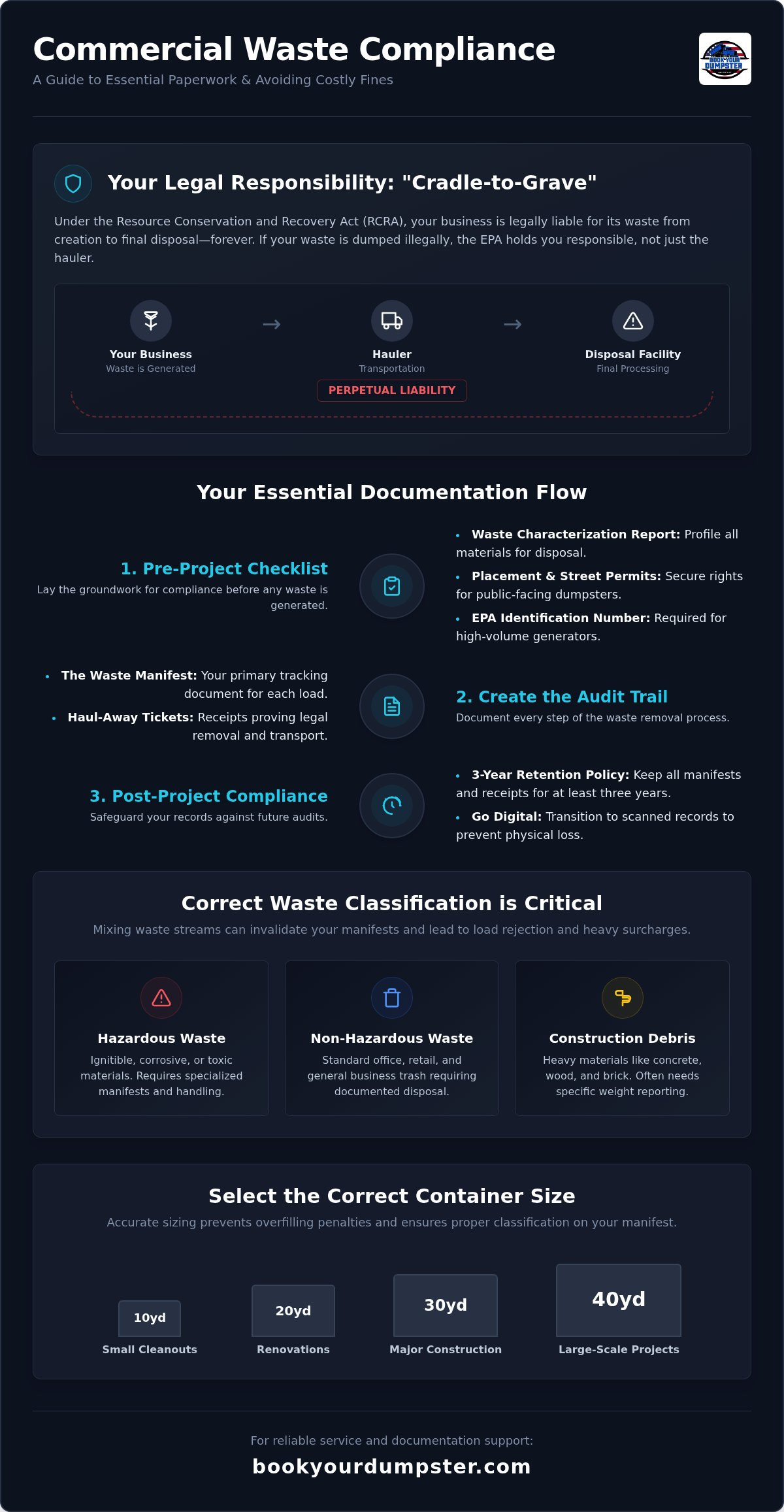
The commercial waste regulatory framework is built on the Resource Conservation and Recovery Act (RCRA). This federal law dictates how businesses manage solid and hazardous waste from the moment of creation to final disposal. By 2026, federal e-Manifest updates will require even more rigorous digital tracking, especially in states like Illinois where reporting standards are tightening. Your business holds cradle-to-grave responsibility. This means you're legally liable for your waste forever. If a hauler dumps your trash illegally, the EPA holds you accountable, not just the transportation company.
You must categorize your waste streams accurately to avoid legal friction. These generally fall into three categories:
- Hazardous Waste: Ignitible, corrosive, or toxic materials that require specialized manifests and strict handling.
- Non-Hazardous Waste: Standard office or retail trash that still requires documented disposal at approved facilities.
- Construction Debris: Heavy materials like concrete, brick, and wood that often require specific weight reporting and recycling documentation.
Agencies like the New York Department of Environmental Conservation (DEC) and the Illinois EPA enforce these rules through regular inspections. Using a professional commercial dumpster rental for business waste removal ensures you have the right infrastructure to manage these streams safely and legally.
Federal vs. Local Compliance Standards
EPA standards provide the baseline for every U.S. business. However, local municipal codes in cities like Queens or Boston add extra layers of reporting and permit requirements. You must understand your facility's waste stream, which is the total flow of materials from your back door to the landfill. Local laws often dictate where a container can sit and how long it can stay on a public right-of-way. Failure to respect these local boundaries results in immediate citations from city inspectors.
The True Cost of Non-Compliance
Documentation is your only shield during a surprise municipal audit. If you can't produce a manifest or a haul-away receipt, you can't prove compliance. Financial penalties for missing paperwork or improper classification can reach thousands of dollars per day. Beyond fines, businesses face significant reputational risks. Illegal dumping or fly-tipping is often publicized, leading to a permanent loss of community trust. A reliable commercial dumpster rental for business waste removal provides the paper trail necessary to prove you operate within the law. Protect your business by keeping every receipt and manifest for at least three years.
Pre-Project Checklist: Essential Permits and Classifications
Don't wait for a municipal audit to find out your waste strategy is illegal. Before you schedule a commercial dumpster rental for business waste removal, verify your specific site requirements. A Waste Characterization Report is your first step. This document profiles exactly what materials you intend to dispose of. It prevents hazardous items from slipping into standard bins and serves as proof of intent for inspectors. If your facility generates large volumes of specific materials, check if you need a federal EPA Identification Number. These numbers track high-volume generators and are central to EPA waste manifest and compliance requirements.
Securing Dumpster Placement Permits
If you plan to place a container on a public street in New York or Massachusetts, you usually need a Street Opening or Right-of-Way permit. Municipalities like Queens or Boston are aggressive about enforcing these rules. Check if your roll off dumpster rental requires a Department of Transportation (DOT) permit for curbside placement. For private commercial lots, the process is simpler. However, you should still review your property manager or HOA guidelines. Never block fire hydrants or emergency exits. A misplaced bin is an invitation for a municipal fine.
Classifying Your Waste Streams Correctly
Accuracy in classification keeps your records clean. Common commercial categories include construction and demolition (C&D) debris, office cleanout materials, and organic waste. Never mix these streams. Contaminating a load of clean wood with hazardous chemicals or food waste can invalidate your entire disposal manifest. This oversight leads to load rejection at the facility and heavy surcharges. For projects involving heavy renovation, review specific rules for construction debris removal to stay compliant with 2026 standards. Proper classification ensures your haul-away tickets match the actual contents of the bin.
Some cities require a pre-approved Commercial Waste Disposal Plan before a project begins. This strategy outlines your intended haulers and disposal sites to the city council or building department. You can simplify this entire preparation phase by choosing a partner that understands local permit nuances. If you're ready to start your project with the right documentation, view available container sizes and secure your digital record-keeping platform today. Staying organized from day one is the most effective way to protect your business from liability.
The Waste Manifest: Your Primary Tracking Document
The waste manifest is your primary legal defense. It tracks the movement of materials from your site to the final destination. For hazardous materials, you must use the Uniform Hazardous Waste Manifest. For standard debris, you use a non-hazardous waste manifest or a detailed haul-away ticket. Both documents serve the same purpose: documenting the transfer of liability. When you schedule a commercial dumpster rental for business waste removal, the manifest acts as the formal record of your compliance.
Compliance relies on a clear signature chain. It starts with you, the Generator. You sign to verify the contents and volume. Next, the Transporter signs when they pick up the bin. Finally, the Disposal Facility signs once the load is accepted. This three part verification creates a closed loop. If a Discrepancy Report occurs, meaning the landfill weight significantly differs from your estimate, you must investigate the reason. Document the resolution immediately to prevent red flags during future inspections.
Anatomy of a Compliant Waste Manifest
Every document must contain specific identifiers to be valid. Include your business name, the exact site address, and updated federal or state contact information. For 2026, ensure the transporter’s ID and the facility’s permit number are current. Accuracy is non-negotiable. If you are using a 30 yard dumpster for an office cleanout, the waste description on the manifest must reflect those specific materials. Vague labels invite scrutiny during audits and can lead to load rejections at the facility.
Cradle-to-Grave Tracking Procedures
Your responsibility doesn't end when the truck pulls away. You need the Return to Generator copy. This is the final version signed by the disposal facility. It serves as your absolute legal proof of final disposal. A signed disposal receipt holds significant legal weight in court. It's the only document that proves you fulfilled your environmental duty. If you don't receive this signed copy within 35 days of the haul, contact the transporter immediately. Under federal rules, you may need to file an exception report if the paperwork remains missing after 45 days. Maintain these records in a dedicated file to ensure they are accessible for any surprise municipal check.
Record-Keeping Best Practices for Business Compliance
Establish a three year minimum retention policy for every waste related document your business generates. This timeframe aligns with federal auditing standards and ensures you can answer municipal inquiries long after a project ends. Physical receipts fade and get lost; digitize all paper manifests immediately upon receipt. A missing document is treated as a compliance failure during an inspection. Using a professional commercial dumpster rental for business waste removal provides the initial data points you need to populate a comprehensive Log of Shipments.
Maintain this log as a central index for quick reference. It should include haul dates, container sizes, and final disposal locations. Conduct quarterly internal reviews to verify that every entry in your log has a corresponding signed manifest. This proactive habit identifies documentation gaps before an external auditor does. If you find a missing signature, resolve it with your hauler immediately. Staying organized is the only way to maintain control over your liability.
Digital vs. Physical Record Management
Transitioning to cloud based folders is the most efficient way to manage your waste history. Organize your files by project date, site location, or specific waste stream type. This structure allows remote facility managers or compliance officers to access critical data instantly from any location. Digital storage also makes it easier to track dumpster rental prices and service contracts across multiple fiscal years. Clear organization reduces the cognitive load during high pressure audits and ensures your business remains audit ready at all times.
Annual Reporting and Compliance Filings
Check your local municipal requirements for annual reporting. In 2026, many cities require a formal Waste Generation Report to track commercial output. Large hubs like Chicago and San Francisco have specific mandates regarding recycling tonnages and diversion rates. You must report these numbers accurately to meet local sustainability goals and avoid administrative penalties. Your documentation should clearly separate landfill waste from diverted recyclables to simplify these filings. Accurate record keeping isn't just about avoiding fines; it's about proving your business meets the environmental standards of the communities where you operate.
Streamline your compliance strategy by choosing a partner that prioritizes digital accuracy. Order your commercial dumpster online to start your digital audit trail with instant records and transparent documentation.
Streamlining Documentation with Book Your Dumpster USA
Book Your Dumpster USA eliminates the logistical friction of waste management. Our online booking system creates an instant digital audit trail for your business. Every time you schedule a commercial dumpster rental for business waste removal, the platform generates a searchable record of your haul. This automation removes the risk of lost paper manifests and disorganized files. Access historical rental data at any time for year-end compliance reviews or tax purposes. We provide local expertise in NY, NJ, IL, and MA to ensure you receive the correct guidance on municipal permits before your container arrives.
Selecting the right container size is the first step in accurate waste reporting. We offer 10, 20, 30, and 40-yard roll-off containers to match your specific waste stream. Proper sizing prevents overfilling citations and ensures your documentation reflects the actual volume of materials removed from your site. Use our digital platform to track these volumes across multiple locations or projects with a single login. A 10-yard dumpster is ideal for heavy debris like concrete, while a 40-yard container handles large-scale office cleanouts. Choosing the wrong size leads to secondary hauls or overage fees that complicate your digital paper trail. Our system helps you match the size to the job, keeping your records clean and your costs predictable.
Accessing historical data is critical for internal audits. Instead of digging through filing cabinets, export your entire haul history in seconds. This feature is useful for businesses operating in multiple states. It centralizes reporting for different regulatory bodies into one interface. Our team understands the specific 2026 e-Manifest federal updates for Illinois and the local DEC requirements in New York. This local knowledge ensures that your documentation isn't just complete, but accurate for your specific region. We act as a high-functioning tool to move you from clutter to resolution.
The Advantage of Centralized Waste Logistics
Fragmented paperwork is a liability. Consolidate your waste logistics into one streamlined channel by using a single reliable partner. Transparent pricing allows you to document project costs with precision. This is essential for construction budgets and corporate accounting. Punctuality is also a documentation priority. On-time delivery and pickup ensure your project stays on schedule. This prevents gaps in your waste tracking timeline and keeps your manifest sequence intact. We focus on reliability so you can focus on your business operations.
Ready to Secure Your Next Commercial Dumpster?
Choose the container size that fits your waste stream perfectly. Avoid the stress of manual tracking and secure your rental in minutes through our professional online system. Don't risk your compliance on a disorganized process. When you need a reliable commercial dumpster rental for business waste removal, we provide the digital convenience and straightforward honesty your project requires. Book your commercial dumpster online now and take control of your business waste documentation today.
Master Your Business Waste Compliance
Mastering the paper trail is just as important as the physical cleanup. Your cradle-to-grave liability remains a permanent legal obligation that doesn't end at the curb. You now have the checklist needed to manage manifests, secure permits, and maintain an airtight audit trail. Don't let disorganized records turn into expensive EPA fines or municipal citations. Accuracy is your best defense.
Securing a professional commercial dumpster rental for business waste removal is the most efficient way to start your digital record-keeping. We serve NY, NJ, IL, MA, and San Francisco with sizes ranging from 10 to 40 yards to fit any commercial project. Every booking through our platform creates an instant digital record, helping you stay organized for 2026 reporting requirements. Book your commercial dumpster online now to eliminate logistical stress and protect your business from liability. You've got the knowledge; now take the final step toward a streamlined operation.
Frequently Asked Questions
What is a waste manifest and why does my business need one?
A waste manifest is a legal shipping document that tracks the transfer of waste from your facility to a disposal site. You need it to prove compliance with federal cradle-to-grave laws. It ensures that your business is not held liable if a hauler mismanages the materials. Without this paper trail, you have no proof of legal disposal during a municipal inspection.
How long am I legally required to keep commercial waste disposal records?
You must retain all waste disposal records for a minimum of three years according to federal standards. Some state regulations or specific material types may require longer retention periods. Keep these documents accessible for surprise audits or annual reporting. Maintaining a digital archive is the most reliable way to ensure these records remain legible and organized over the full three-year period.
Do I need a permit for a dumpster if it is on my own commercial property?
Generally, you do not need a municipal street permit if the container sits entirely on private commercial property. However, you must still comply with local zoning laws and property manager rules. Ensure the placement doesn't block fire lanes, hydrants, or emergency exits. If any part of the bin touches a public sidewalk or street, you must secure a Right-of-Way permit immediately.
What happens if I do not have the correct documentation for an EPA audit?
Failure to produce required documentation during an audit can result in heavy daily fines and increased regulatory scrutiny. The EPA views missing manifests as a violation of the Resource Conservation and Recovery Act. This oversight puts your business at risk of legal action and reputational damage. Using a professional commercial dumpster rental for business waste removal helps you maintain the necessary digital audit trail to avoid these penalties.
Is the dumpster rental company responsible for my waste disposal compliance?
No, the legal responsibility for waste characterization and compliance stays with the generator. While the hauler is responsible for safe transport, you are liable for the waste from creation to final disposal. Choose a partner that provides transparent haul-away tickets and digital records. This support simplifies your record-keeping, but the ultimate legal burden of proof remains with your business.
Can I use digital copies of manifests instead of original paper versions?
Yes, digital copies are increasingly accepted and often preferred for compliance tracking. The EPA e-Manifest system is the federal standard for hazardous waste, and many states allow digital records for non-hazardous streams. Digital files prevent the physical loss or degradation of paper receipts. Ensure your digital storage is backed up and easily accessible during an inspection to satisfy auditor requirements.
What specific documents are needed for construction debris removal in New York?
New York projects often require a Waste Characterization Report and a specific construction and demolition debris tracking form. If the project is in a major city, you may also need a Site-Specific Waste Management Plan. Secure a commercial dumpster rental for business waste removal to obtain the required weight tickets and disposal receipts. These documents prove that materials were taken to a permitted processing facility.
How do I classify my business waste for documentation purposes?
Classify your waste based on its physical properties and regulatory status, such as hazardous, non-hazardous, or construction debris. Use a Waste Characterization Report to document these findings before disposal begins. Correct classification ensures you use the right container size and prevents load rejections at the landfill. Accurate labels on your manifest are essential for maintaining a clean legal record for your company.


