

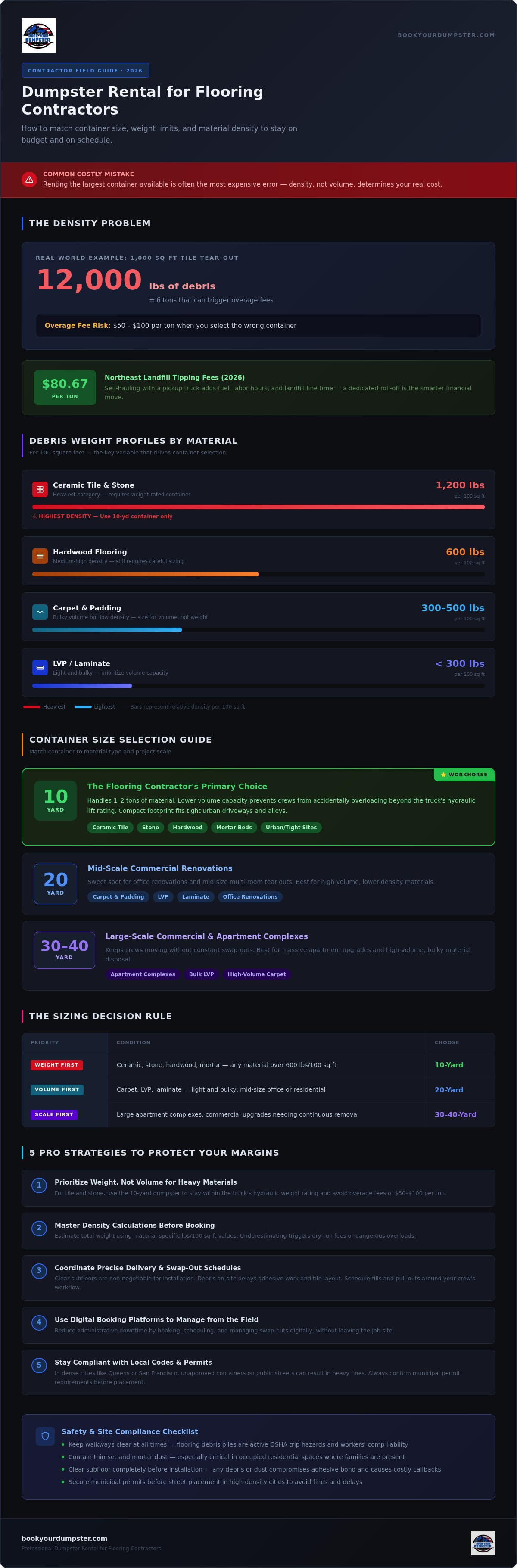
The biggest dumpster on the lot is often the most expensive mistake a flooring professional can make. While it is tempting to rent the largest container available, density usually dictates your bottom line more than volume. When managing a dumpster rental for flooring contractors, you must account for the fact that a 1,000 square foot tile tear-out can weigh up to 12,000 pounds. That is six tons of debris that can trigger overage fees of $50 to $100 per ton if you select the wrong equipment.
You understand that heavy materials like ceramic, stone, and hardwood require a specific logistical approach to stay profitable. This 2026 guide helps you master those logistics by providing a professional framework for sizing, weight limits, and cost-effective disposal. We will show you how to avoid hidden fees, prevent client driveway damage, and use the 10-yard workhorse to handle your heaviest loads. Follow these strategies to eliminate delivery delays and keep your installation schedules moving without unnecessary overhead.
Key Takeaways
- Prioritize the 10-yard dumpster for heavy materials like tile and stone to stay within weight limits and avoid expensive overage fees.
- Master debris density calculations to ensure your dumpster rental for flooring contractors protects project profit margins instead of draining them.
- Coordinate precise delivery and swap-out schedules to keep your job site clear and ensure subfloors are ready for immediate installation.
- Utilize digital booking platforms to manage equipment logistics from the field, reducing administrative downtime for your crew.
- Identify the specific weight profiles of hardwood, laminate, and carpet to select the most efficient container size for every project.
Why Flooring Contractors Need Specialized Dumpster Rental Solutions
Flooring projects don't produce standard trash. They produce density. A single room of ceramic tile can weigh as much as a small car. If you treat a dumpster rental for flooring contractors like a standard household clean-up, you will face overage fees and logistical delays. Professional flooring waste management focuses on weight-rated containers that handle the heavy lifting while you focus on the installation. Efficient removal is not just about cleanliness. It's about clearing the subfloor to ensure a flat, stable surface for the new material. Any leftover debris or dust can compromise the adhesive bond of your new floor. This results in callbacks and lost profit.
The Logistical Challenges of Flooring Debris
Speed is the currency of a successful flooring job. You cannot start the layout until the old material is gone. Managing the composition of flooring debris involves more than just tossing items in a bin. You are dealing with bulky carpet rolls, saturated padding, and heavy mortar beds. These materials take up space and add weight quickly. Some contractors attempt to haul debris themselves using a pickup truck. This usually backfires. Between rising fuel costs and the labor hours lost sitting in line at the landfill, a dedicated roll-off is the smarter financial move. Landfill tipping fees in the Northeast average $80.67 per ton in 2026. These costs add up quickly when hauling heavy tile or stone. Visit Book Your Dumpster USA to find a 10-yard workhorse that matches your project scale. This specific size is ideal for heavy loads like tile or hardwood.
Safety and Compliance on the Job Site
Piles of old flooring are trip hazards that invite OSHA inspections and worker compensation claims. Keep your walkways clear at all times. Proper containment also manages air quality. Dust from old thin-set or mortar can migrate through a client's home or commercial space if not handled correctly. This is especially critical in residential renovations where families are present. In high-density areas like Queens or San Francisco, local municipal codes are strict about debris containment on public streets. Failing to secure a permit or using an unapproved container can result in heavy fines. A professional dumpster rental for flooring contractors ensures your job site remains compliant. It protects your professional reputation and your bottom line.
Choosing the Right Dumpster Size for Flooring Projects
Selecting a container based solely on cubic yardage is a common error. If you underestimate the weight of your debris, you will face "dry run" fees or expensive overage charges when the driver cannot safely lift the load. If you overestimate, you are paying for empty air. For a successful dumpster rental for flooring contractors, you must match the container's weight rating to the specific material you are tearing out. This balance keeps your project on budget and your schedule on track. Strategic sizing also allows for better placement in tight urban driveways or alleys where space is a premium.
The 10-Yard Dumpster: The Flooring Contractor's Workhorse
This is your go-to for high-density materials. Ceramic tile and stone can weigh up to 1,200 pounds per 100 square feet. Hardwood flooring is lighter but still reaches approximately 600 pounds per 100 square feet. A 10-yard dumpster typically handles 1 to 2 tons of material. The 10-yard container is the safest choice for tile because its lower volume capacity prevents crews from accidentally loading more weight than the truck's hydraulic system can legally lift. Its compact footprint also makes it ideal for tight urban driveways or narrow alleys in cities like Queens or San Francisco. You can place it close to the entry point without blocking the entire job site or damaging the client's property.
20 And 30-Yard Options for Large-Scale Commercial Jobs
Volume becomes the priority when you are ripping out miles of carpet or luxury vinyl plank (LVP). These materials are bulky but relatively light. Carpet and padding only weigh about 300 to 500 pounds per 100 square feet. A 20-yard dumpster is often the sweet spot for mid-sized office renovations. Learn more about 20 yard dumpster rental options for these specific scenarios. For massive apartment complex upgrades, a 30 or 40-yard container provides the capacity needed to keep the crew moving without constant swap-outs. These larger containers allow your team to dispose of high-volume waste without stopping the installation flow.
Choosing between these sizes requires a professional eye. While reviews of the Best Dumpster Rental Companies offer general advice, your specific local debris must drive the decision. Book Your Dumpster USA provides the full range of 10, 20, 30, and 40-yard options to ensure you never pay for more than you need. Our team understands that a 40-yard bin filled with tile is an impossible lift, so we guide you toward the right tool for the job. Check our sizing guide to see which container fits your next project.
Managing Weight Limits: Tile, Hardwood, and Carpet Debris
Weight overages are the primary source of unexpected costs in any dumpster rental for flooring contractors. While a container might look half-empty, the density of the material inside determines the final bill. You must distinguish between volume and mass before you start the tear-out. Standard weight limits for a 10-yard dumpster typically range from 1 to 2 tons. Exceeding these limits results in overage fees that average between $50 and $100 per ton in 2026. Proper disposal follows EPA guidelines on C&D landfills, which classify most flooring materials as industrial waste requiring specific handling.
Calculate your debris weight accurately to protect your profit margins. Use these 2026 estimates for every 100 square feet of material removed:
- Tile or Stone: 800 to 1,200 lbs. This is the densest material you will handle.
- Hardwood Flooring: 400 to 600 lbs. Weight varies based on wood species and thickness.
- Carpet and Padding: 300 to 500 lbs. This material is bulky but generally stays within weight limits.
- Laminate Flooring: 200 to 400 lbs. This is usually the lightest tear-out option.
Understanding "clean load" vs. "mixed debris" pricing is also vital. Some facilities offer lower rates for containers filled exclusively with a single recyclable material like concrete or wood. Mixing tile with carpet and general construction trash usually defaults to the higher mixed-debris rate. Check our guide on dumpster rental prices to understand how these fee structures vary across different regions.
Prohibited Materials: Adhesives, Glues, and Underlayment
Don't toss everything into the bin. Flooring installed before the 1990s often contains hazardous substances like asbestos in the tiles or the black mastic adhesive underneath. Federal regulations require professional abatement for these materials. You also cannot dispose of flammable adhesives, solvents, or liquid floor finishes in a standard roll-off. Lead-based paint debris, often found in older subfloors, also requires specialized containment. Identify these materials during the estimate phase to avoid project stoppages or fines at the landfill.
Avoiding Overage Fees with Smart Loading
Distribute weight evenly across the floor of the container. Don't pile all the heavy tile at one end; this creates hydraulic strain on the truck and makes transport dangerous. Follow the "fill line" rule strictly. Heavy materials like tile or stone should never be heaped above the rim. If the driver deems the load unsafe or overweight, they will refuse the pickup. This results in a "dry run" fee and forces your crew to manually offload the excess. Load heavy items first and keep them flat to maximize the available weight capacity.
Optimizing Project Timelines with Reliable Roll-Off Services
Punctual delivery and swap-outs are critical for maintaining tight installation windows. A delay in waste removal stops your entire crew. If the old subfloor isn't clear, the new material stays in the truck. Use our streamlined online booking to secure a dumpster rental for flooring contractors directly from the job site. This digital-first approach removes administrative friction and allows you to schedule equipment while managing your team. We provide deep local expertise across NY, NJ, and MA. Our drivers understand the specific traffic patterns and parking hurdles in metro hubs like Queens and San Francisco. They get the container to your site on time, every time. Flexible rental periods also account for the reality of construction. If you discover unexpected subfloor rot or moisture issues, we adjust to your new timeline without the stress.
Strategic Placement for Faster Tear-Outs
Position the container as close to the primary exit as possible. Every extra foot your crew walks with heavy tile or hardwood increases labor costs and physical fatigue. Efficiency is about minimizing steps. Protect your client's property during the drop-off. Always use wood planks to shield driveways from the intense pressure of heavy steel rollers. This is especially important when loading high-density materials like stone or ceramic. Ensure the drop zone has at least 22 feet of vertical clearance for the truck's hoist. Check for overhead wires, low branches, or building overhangs before the driver arrives. Clear communication regarding the drop zone prevents delivery failures and "dry run" fees that eat into your profit.
Scheduling and Multi-Haul Logistics
Large commercial flooring upgrades often require more than one haul to stay organized. Coordinate "dump and return" services to maintain a continuous workflow. This strategy is vital for office renovations or apartment complexes where space for multiple containers is limited. Don't wait until the bin is overflowing to call for a swap. Schedule the next haul when the container is 75% full to ensure a seamless transition. Our 24/7 online booking system allows for early-morning or late-night planning when you are away from the job site. Explore our construction debris removal guide to learn more about managing large-scale project logistics. Efficient waste management is the silent partner in a successful flooring installation.
Reliable logistics prevent the bottlenecks that lead to liquidated damages or unhappy clients. Book your next roll-off online to guarantee your project stays on schedule and under budget.
Book Your Dumpster: The Contractor’s Partner for Flooring Waste
Book Your Dumpster USA functions as a high-performance tool for your business. We combine local reliability with a modern digital booking platform to remove the logistical stress from your job site. Successful project management requires more than just a container; it requires a partner who understands that a dumpster rental for flooring contractors must be punctual and weight-appropriate. Our transparent pricing acts as a verbal handshake. You can bid on jobs with total confidence in your disposal overhead because we eliminate the hidden fees that often plague the waste industry. We maintain a full fleet of 10, 20, 30, and 40-yard dumpsters ready for immediate dispatch across New York, Illinois, and Massachusetts. Whether you are tackling a residential bathroom or a 50,000-square-foot commercial warehouse, we provide the equipment necessary to keep your crew moving.
Streamlined Online Booking for Busy Crews
Stop wasting time on lengthy phone calls and manual quotes. Our interface allows you to select your size, set your delivery dates, and complete your payment in under three minutes. This mobile-friendly system is designed for use on active job sites where your focus needs to remain on the installation. Once you book, you receive digital receipts and tracking information instantly. This makes project expense accounting simple and accurate for your back-office team. You don't have to wait for a call back or wonder when the driver will arrive. You stay in control of your schedule and your budget from start to finish.
Serving the Major Metro Hubs
Our drivers possess the expertise required to navigate the narrow streets of Queens and Jersey City. We understand the specific parking hurdles and permit requirements of major metro areas. Compliance is a primary focus for our professional partners. In San Francisco, we help you meet CALGreen requirements, which mandate that at least 65% of nonhazardous construction and demolition debris be recycled or salvaged. In Massachusetts, our teams are well-versed in the Department of Environmental Protection's waste bans that prohibit the disposal of wood, metal, and concrete in landfills. We ensure your project remains compliant with local regulations in Boston, Chicago, and beyond. This local knowledge prevents fines and ensures that your waste management is as professional as your flooring installation. Rent your flooring dumpster online today and keep your project on schedule.
Streamline Your Flooring Waste Management Today
Success in the flooring industry depends on your ability to move from tear-out to installation without logistical bottlenecks. You now have the professional framework to master dumpster rental for flooring contractors by balancing material density against container capacity. Remember that the 10-yard dumpster remains the ideal tool for heavy tile and hardwood; larger 20 or 30-yard options serve high-volume commercial projects. By prioritizing weight limits over simple volume, you protect your profit margins from unexpected overage fees and keep your installation schedule on track.
Book Your Dumpster USA provides the professional-grade roll-off containers you need with the transparent pricing you deserve. We serve major hubs across NY, NJ, IL, MA, and SF with a focus on punctuality and digital convenience. Don't let debris slow down your crew or clutter your job site. Book your flooring contractor dumpster online now to secure the equipment you need in under three minutes. Clear the way for a perfect installation and keep your business moving forward with confidence.
Frequently Asked Questions
What size dumpster do I need for a 500 sq ft tile bathroom renovation?
A 10-yard dumpster is the correct choice for a 500 square foot tile tear-out. Ceramic tile weighs between 800 and 1,200 lbs per 100 square feet, meaning your debris will total between 4,000 and 6,000 pounds. The 10-yard container handles this weight safely while maintaining a small footprint for residential sites.
Can I put old carpet and padding in the same dumpster as tile?
You can mix these materials, but it changes your disposal category from a "clean load" to "mixed debris." Mixed loads are often processed at a higher rate at the landfill. Ensure the bulky carpet padding doesn't prevent the heavy tile from being distributed evenly across the floor of the container to maintain balance.
How much weight can a 10-yard dumpster hold for flooring debris?
A standard 10-yard dumpster rental for flooring contractors typically includes a weight limit of 1 to 2 tons. This equals 2,000 to 4,000 pounds. Because tile and stone are so dense, you will reach this weight limit long before the container is physically full. Monitor your fill line closely to avoid overages.
Are there extra fees for disposing of flooring adhesives or glues?
Yes, adhesives and solvents often fall under hazardous waste regulations and are prohibited in standard roll-offs. Disposing of flammable glues or old black mastic can result in significant environmental fines. Always separate these materials and check local municipal rules for the proper disposal of hazardous flooring substances.
Do I need a permit to place a dumpster on the street in Queens or San Francisco?
Street placement in Queens or San Francisco almost always requires a local permit from the city. Each jurisdiction has specific rules regarding duration, safety markings, and traffic flow. Additionally, San Francisco requires 65% of debris to be recycled under CALGreen standards. Verify permit requirements before scheduling your delivery to avoid project delays.
What happens if my flooring debris exceeds the weight limit?
Exceeding the limit results in overage fees, which average $50 to $100 per ton in 2026. If the load is dangerously overweight, the driver will refuse the pickup for safety and legal reasons. You will then be responsible for manually offloading the excess material and paying a dry run fee for the failed pickup attempt.
Can you deliver a dumpster to a residential driveway without damaging it?
We use specific placement strategies to protect your client's property from the weight of heavy flooring materials. Always ensure the driver places wood planks under the steel rollers to distribute the pressure. This simple step prevents cracks or ruts in asphalt and concrete driveways when loading dense materials like natural stone.
How quickly can I get a dumpster swap-out for a large commercial flooring job?
Use our 24/7 online booking system to schedule a dumpster rental for flooring contractors as soon as you anticipate a full bin. For large commercial jobs, coordinate a "dump and return" service in advance. This ensures a fresh container arrives exactly when you need it to maintain your installation window and keep your crew productive.


