
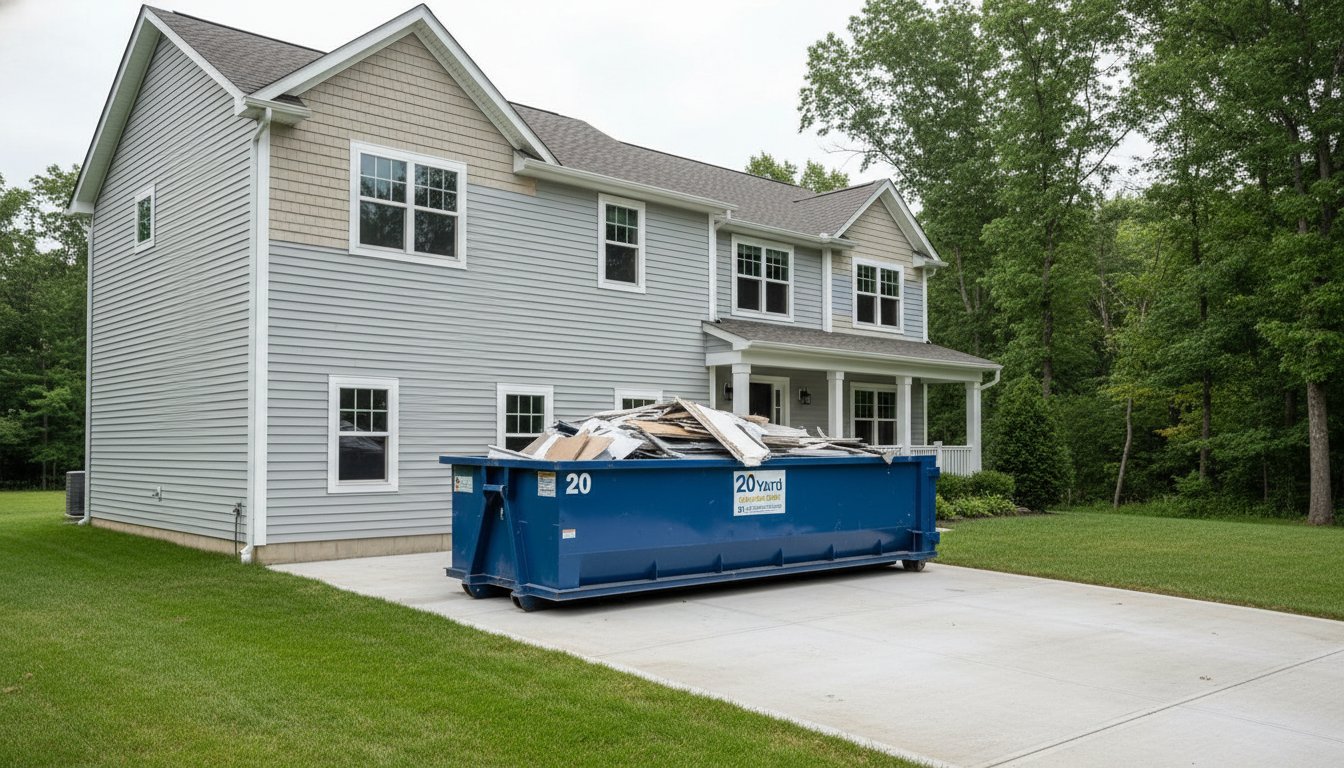
Most homeowners underestimate their siding debris by nearly 50 percent because they focus on weight rather than sheer bulk. Choosing the wrong dumpster rental for siding replacement leads to overflowing containers that stall your project and clutter your property. It's frustrating to watch a renovation stop because the waste management plan wasn't as precise as the contractor's measurements. You deserve a clean job site and a protected driveway without the stress of hidden fees or delivery delays.
This 2026 guide shows you exactly how to translate siding "squares" into cubic yards. Learn how to select the right 10, 20, 30, or 40 yard dumpster to match your specific project scale. We'll also cover essential 2026 updates, including mandatory asbestos surveys and local disposal regulations in New York, New Jersey, and Massachusetts. Follow these steps to secure cost-effective waste removal and keep your property clean from start to finish.
Key Takeaways
- Identify why siding debris requires a high-volume waste strategy to prevent sharp materials from littering your property.
- Learn the conversion rule for siding "squares" to ensure your dumpster rental for siding replacement is the correct size for the job.
- Determine if a 10, 20, or 30-yard dumpster is the most cost-effective choice for your home's square footage.
- Follow property preparation steps specific to NY, NJ, and MA to avoid delivery delays and protect your driveway.
- Streamline your project timeline by using digital booking tools to secure the right container for any siding scope.
Why Siding Replacement Requires a Dedicated Waste Strategy
Siding replacement generates a unique type of Construction and demolition debris. Unlike roofing shingles or concrete, siding is a high-volume, low-density material. It's exceptionally light but takes up massive amounts of physical space. If you don't have a dedicated disposal plan, your yard will quickly transform into a hazardous obstacle course. Plan your waste management before the first panel comes off the wall. A professional dumpster rental for siding replacement is the most efficient way to maintain a clean project site and protect your property value.
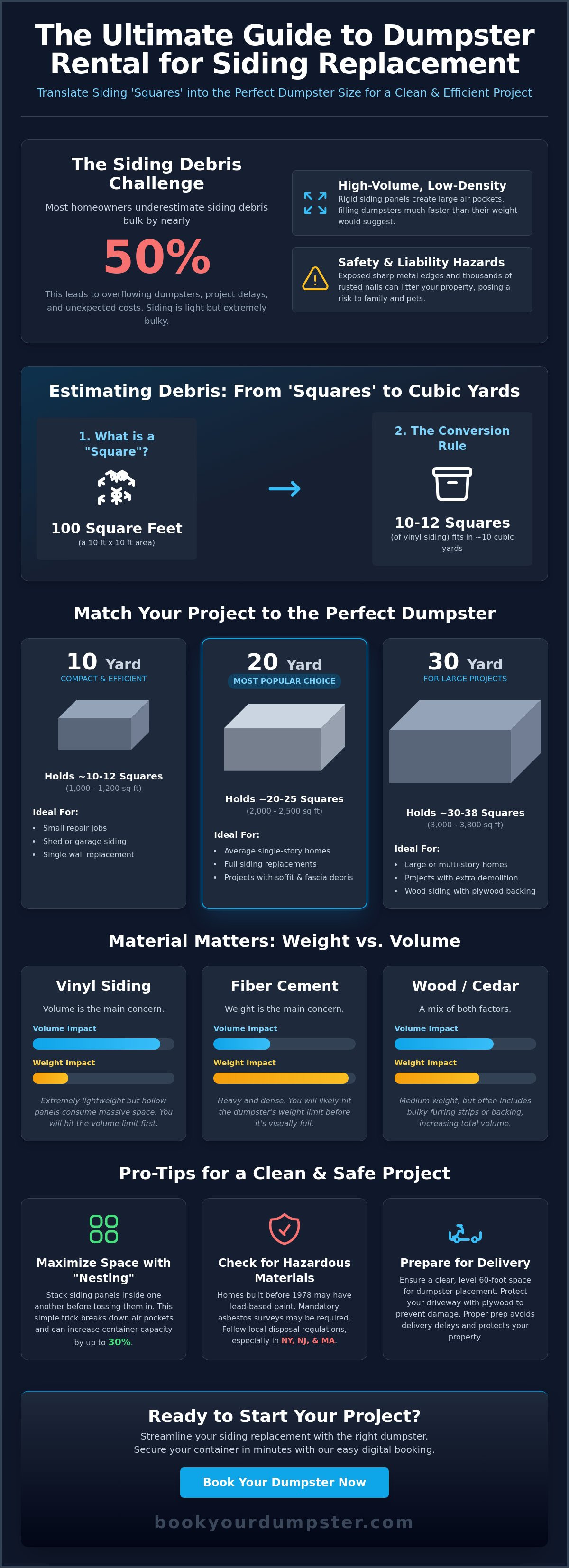
Contractors measure siding in "squares." One square represents 100 square feet of exterior wall surface. This is the primary unit you'll use to estimate your waste. Because siding is rigid and long, it doesn't settle like standard household trash. It creates tangled piles that are nearly impossible to move manually. Attempting to haul this material in a personal vehicle is a logistical nightmare. One roll-off container can hold the equivalent of 15 to 20 pickup truck loads, saving you hours of labor and fuel costs. Use a centralized container to keep the workflow moving and prevent project stalls.
The Bulk Factor: Why Siding Fills Dumpsters Fast
Vinyl and aluminum panels are designed to be weather-resistant and rigid. When these panels are ripped from a house, they don't lie flat. They twist and bend, creating large air pockets inside the container. These gaps waste valuable cubic yardage and can lead to a "false full" dumpster where the container looks packed but is mostly empty space. To maximize your efficiency, practice "nesting." Stack the panels inside one another before tossing them into the dumpster. This simple action can increase your container's capacity by up to 30 percent. Without a strategy for bulk, you'll find yourself paying for extra hauls you didn't need.
Safety and Liability on the Job Site
Old siding is dangerous. Sharp metal edges and thousands of rusted nails frequently fall into the grass around your home's foundation. These items are difficult to find with a rake but easy to find with a lawnmower or a child's foot. A dumpster placed directly under the work area catches debris as it falls, significantly reducing cleanup time. Safety is even more critical for older homes. If your house was built before 1978, your siding or the underlying paint may contain lead. Containing this material immediately prevents toxic chips from contaminating your soil. Visit Book Your Dumpster USA to select a container size that keeps your family safe and your job site professional. Don't let wind-blown debris become a liability issue with your neighbors or local municipality.
Estimating Your Debris: How Many Squares Fit in a Dumpster?
A "square" is a standard industry measurement representing 100 square feet of wall surface, typically covering a 10-by-10-foot area. Accurate estimation begins with this unit. For standard vinyl siding, a reliable rule of thumb is that 10 to 12 squares will occupy roughly 10 cubic yards of container space. This ratio changes significantly when switching to heavier or more rigid materials. Your dumpster rental for siding replacement must account for the specific material density to avoid overage fees or the need for a second container.
Don't forget the hidden bulk. While the panels make up the majority of the waste, you must factor in trim, soffits, fascia boards, and starter strips. These components are often irregularly shaped and don't stack neatly. They create additional air pockets that consume volume faster than expected. If you're working on an older home, check for specialized disposal requirements. Removing certain legacy materials may trigger federal hazardous waste regulations, especially if lead-based paint or asbestos is present. Always verify the contents with your provider before loading.
The Siding Material Weight Comparison
Material type dictates whether you'll hit the dumpster's volume limit or its weight capacity first. Vinyl is extremely lightweight but takes up massive volume because the panels are hollow and rigid. Fiber cement, such as HardiePlank, is the opposite. It's heavy and brittle; a single square weighs significantly more than vinyl. You'll likely hit weight limits on a 20-yard dumpster before you fill it to the brim with fiber cement. Cedar and wood siding fall into a medium-weight category. They often include extra bulk from furring strips or plywood backing, which requires a larger container regardless of the total square count.
Calculating Your Total Waste Volume
Use this formula to find your baseline: (Total Squares / 10) x Material Multiplier = Estimated Yardage. For vinyl, use a multiplier of 1.0. For fiber cement, use 1.5 to account for weight restrictions. For wood, use 1.2 to cover the extra bulk of underlying strips. Always add a 10 percent buffer to your final number. This accounts for packaging, incidental waste, and the "fluff factor" of haphazard loading. Once you have your number, view our available container sizes to match your project needs. Choosing a slightly larger size is almost always more cost-effective than paying for a second haul mid-project.
Choosing the Right Size: 10, 20, or 30 Yards?
Selecting the right dumpster rental for siding replacement requires balancing your home's total square footage with the physical space available on your property. Don't make the mistake of choosing a container based solely on price. A smaller unit might look cheaper upfront, but the cost of a second haul will quickly destroy your budget. Conversely, renting a massive 40-yard dumpster for a small garage project is a waste of resources. Evaluate your project scope and match it to the volume capacities below.
Consider the physical footprint of the container before you book. A standard 10-yard unit is approximately 12 feet long, making it easy to place in tight urban driveways or near side entrances. Larger 20 and 30-yard containers typically stretch to 22 feet. You must ensure your driveway is long enough to accommodate both the dumpster and the delivery truck's reach. Always clear at least 60 feet of linear space for a seamless drop-off. If you have a multi-story home with multiple layers of old siding, prioritize volume over floor space to keep the job site manageable.
The 10-Yard Dumpster for Small Projects
This size is the most efficient choice for focused, smaller-scale renovations. It's ideal for detached garages, garden sheds, or accent walls where the total material doesn't exceed 15 squares of vinyl. Because it occupies less space, it's a favorite for residential neighborhoods with strict parking rules. If your project involves partial repairs or replacing damaged sections after a storm, this compact option keeps your costs low and your driveway accessible. For a deep dive into dimensions and weight limits, read our 10 Yard Dumpster Rental: The Complete Buying Guide for 2026.
The 20 and 30-Yard Powerhouses
The 20-yard dumpster is the "sweet spot" for the average American home between 1,500 and 2,000 square feet. It provides enough headroom to handle a full siding tear-off along with incidental waste like old gutters, shutters, and downspouts. It's the most versatile tool for a standard renovation. If you're dealing with a large multi-story estate or removing several layers of historical siding, upgrade to a 30-yard container. The extra height allows you to toss in bulky corner posts and long panels without them sticking out over the top. For massive commercial-scale residential projects, we also offer 40-yard options to ensure you never run out of room mid-shift. Select your dumpster size online today to lock in your project timeline.
Preparing Your Property for Delivery in NY, NJ, and MA
Success with a dumpster rental for siding replacement depends on a clear logistics plan. A poorly placed container stalls the crew and risks property damage. Follow these four steps to ensure a seamless drop-off. First, identify a flat, stable surface. Your driveway is the best choice for stability. Avoid soft soil or grassy areas that can shift under a heavy load. Second, clear overhead obstacles. Roll-off trucks require at least 22 feet of vertical clearance to safely tilt the hoist. Look for low-hanging branches or power lines that could interfere with the delivery.
Third, check local street permit requirements. In cities like Queens or Boston, placing a dumpster on the street is strictly regulated. In New York City, permits for public property placement can cost between $135 and $385. In New Jersey, street permits typically range from $25 to $100. Failure to secure these documents before the truck arrives will lead to a dry-run fee. Fourth, communicate with the driver about precise placement. Use cones or plywood to mark the exact spot. Clear communication prevents the need for costly repositioning after the truck has left the site.
Driveway Protection and Safety
Asphalt and concrete can scar or crack under the weight of a loaded container. Use the "plywood method" by placing two 4x8 sheets of 3/4-inch plywood where the dumpster wheels will rest. Roll-off wheels distribute the total weight across a narrow surface area, creating high pressure. Plywood spreads that load and prevents the metal from gouging your driveway. Keep the container at least three feet away from retaining walls or underground utilities. This buffer zone protects your home's infrastructure and provides the siding crew with enough room to work safely around the bin.
Local Logistics: From Chicago to San Francisco
Narrow urban streets in cities like Chicago or San Francisco present unique challenges for large trucks. Ensure there are no parked cars blocking the approach on your scheduled delivery day. You should also factor in local snow removal or street cleaning schedules to avoid municipal fines. In Massachusetts, remember that the state prohibits disposing of construction and demolition debris with regular household trash. This makes a dedicated container essential for compliance. Review the Dumpster Rental Prices in New York, Illinois, and Massachusetts for a detailed breakdown of regional costs and logistics. Schedule your delivery today to secure your preferred placement window and keep your siding project on schedule.
Streamline Your Siding Project with Book Your Dumpster USA
Efficient project management requires reliable logistics. Our digital booking system removes the guesswork from securing a dumpster rental for siding replacement. Select your container, choose a delivery date, and provide placement instructions in minutes. This modern approach ensures your siding crew spends more time on the scaffolding and less time managing debris piles. We prioritize pricing integrity and punctuality so your project stays on budget and on schedule. You won't deal with the logistical stress of chasing down a delivery truck or deciphering a confusing invoice.
Pricing integrity is a core pillar of our service. You receive a clear, upfront quote that includes delivery, haul-away, and established weight limits. This transparency prevents the common industry practice of adding surprise surcharges for fuel or environmental processing at the end of the project. For contractors, this reliability allows for accurate bidding and tighter project management. For homeowners, it provides the peace of mind that comes with a predictable renovation budget. We offer 10, 20, 30, and 40-yard options to ensure every project scope has the perfect volume capacity.
Reliable Service for Homeowners and Contractors
We serve homeowners and professional contractors across NY, NJ, and IL with localized expertise. For residential siding updates, our 10 and 20-yard options provide a manageable footprint for suburban driveways. For large-scale commercial exterior renovations or multi-unit estates, our 30 and 40-yard containers handle massive volumes of debris without the need for constant, disruptive hauls. Our "drop and go" service model means we respect your site boundaries and your timeline. We understand that siding contractors need the container placed exactly where the debris falls to minimize double-handling of materials. Read our Roll Off Dumpster Rental: The Complete Guide to understand the full logistics of waste disposal.
Book Your Next Project Today
Don't let waste management become a bottleneck for your exterior renovation. Choosing a dependable partner prevents project delays and eliminates the risk of property damage from improper equipment handling. Use our online portal to browse available inventory and secure your container. We provide transparent communication from the moment you book until the final haul-away. By providing precise placement instructions through our portal, you ensure the truck driver drops the unit in the optimal spot without requiring your constant supervision on-site. This level of autonomy keeps your labor costs down and your productivity high. Rent your siding dumpster now at Book Your Dumpster USA and experience the efficiency of professional waste management.
Secure Your Project Timeline Today
Successful siding projects depend on precision. You now have the tools to translate siding "squares" into specific cubic yardage, ensuring your property remains clean and your budget stays intact. Avoid the logistical mess of overflowing containers by selecting the right 10, 20, 30, or 40-yard container from the start. A professional dumpster rental for siding replacement is the most effective way to manage high-volume debris while protecting your driveway and landscaping from sharp edges and rusted nails.
We provide modern, digital-first waste solutions across New York, New Jersey, Illinois, Massachusetts, and San Francisco. Our streamlined booking process removes the traditional friction of waste management, allowing you to focus on the renovation itself. Trust our commitment to pricing integrity and punctuality to keep your job site moving without delay. We handle the logistics so you can focus on the craftsmanship.
Ready to clear the way for your new exterior? Book Your Siding Dumpster Online in Minutes and take the first step toward a hassle-free renovation. You've planned the work; now let us handle the waste. Your clean, safe, and professional job site is only a few clicks away.
Frequently Asked Questions
What size dumpster do I need for a 2,000 square foot house siding replacement?
A 20-yard dumpster is the most efficient choice for a 2,000 square foot home. This size comfortably accommodates roughly 20 to 25 squares of vinyl siding along with incidental debris like trim and starter strips. If you're removing multiple layers of old material, consider upgrading to a 30-yard unit to prevent overfilling and ensure all waste fits in a single haul.
Can I put old vinyl siding and roofing shingles in the same dumpster?
You can typically mix vinyl siding and roofing shingles in the same roll-off container. However, you must monitor the total weight closely because shingles are significantly denser than siding panels. Loading too many shingles into a large container intended for lightweight siding can lead to overweight fees at the landfill. Always disclose the mixture of materials when you book your container.
How much does a dumpster for siding replacement typically cost in New Jersey?
Costs for a dumpster rental for siding replacement in New Jersey vary based on the container size and the total weight of the debris. Pricing is generally structured per haul, but local disposal fees and permit requirements also influence the final total. Request a specific quote through our online portal to get accurate figures for your specific project location and debris type.
Will a roll-off dumpster damage my concrete driveway?
Heavy containers can scratch or crack concrete driveways if they aren't properly supported. Protect your property by placing 4x8 sheets of plywood under the container's wheels to distribute the weight evenly. This simple precaution prevents the steel wheels from gouging the surface during delivery and pickup, keeping your driveway in its original condition.
Do I need a permit to put a dumpster on the street in Queens?
Yes, a permit is mandatory if you plan to place a dumpster on a public street in Queens. New York City requires specific documentation and fees for any container occupying public space. Check with the NYC Department of Transportation or your local municipality to secure the necessary paperwork before your scheduled delivery to avoid fines or project interruptions.
How long can I keep the dumpster for my siding project?
Standard rental periods usually range from seven to ten days, which is typically enough time for a full exterior tear-off and cleanup. If your project faces weather delays or labor shortages, you can often extend the rental for a daily fee. Always confirm the duration and any potential late fees when booking your dumpster rental for siding replacement to keep your budget on track.
Can I dispose of fiber cement siding in a standard roll-off container?
Fiber cement siding is acceptable for disposal in standard roll-off containers, but its weight requires careful management. Unlike vinyl, fiber cement is heavy and brittle, which can quickly push a container over its tonnage limit. Use a 20-yard dumpster for these materials to ensure the truck can safely lift the load without exceeding legal weight capacities on local roads.
What happens if I overfill the dumpster with bulky siding panels?
Overfilling a dumpster with bulky siding panels creates a significant safety hazard for the driver and other motorists. Drivers are legally prohibited from hauling containers with debris protruding over the top edge or hanging off the sides. If you overfill the unit, you'll need to remove the excess material before pickup, which leads to dry-run fees and unnecessary project delays.


