

Owning a dump trailer is often the most expensive way to save money on a job site. While the idea of total mobility sounds great, the reality involves rising insurance premiums, constant hydraulic repairs, and the struggle to find a driver with a clean record. When evaluating dumpster rental vs dump trailer for contractors in 2026, look past the initial sticker price. You're balancing the perceived control of a trailer against the high-volume efficiency and liability-free nature of professional roll-off services.
You already know that every hour your crew spends stuck in traffic hauling debris is an hour of lost billable labor. It's exhausting to watch profit margins shrink due to vehicle wear or unexpected DOT fines. This guide provides a pragmatic ROI comparison to help you choose the best tool for your project scale. We'll examine how to navigate permit requirements in high-regulation areas like Queens or Boston and show you how to streamline your waste logistics so you can focus on the build.
Key Takeaways
- Compare the hidden maintenance and insurance costs of trailer ownership against the fixed-cost predictability of professional roll-off rentals.
- Calculate the true ROI of the dumpster rental vs dump trailer for contractors debate by factoring in billable hours lost during landfill runs.
- Maximize project momentum by utilizing 30 or 40-yard containers for high-volume debris that would overwhelm a standard dump trailer.
- Navigate 2026 permit regulations in high-traffic cities to avoid unexpected DOT fines and site delays.
- Learn how digital-first scheduling tools allow project managers to coordinate waste logistics across multiple sites with minimal cognitive load.
Evaluating Waste Management for Modern Construction Sites
Efficiency on a 2026 job site is measured by how little time you spend thinking about trash. Contractors today generally rely on two primary methods for debris removal: maintaining a fleet of dump trailers or utilizing professional roll-off services. While both options get the job done, the choice between them dictates your project’s ultimate profit margin. In high-traffic hubs like New York or Chicago, the logistics of street parking and traffic congestion make self-hauling a liability rather than an asset. You must decide if your business is in the construction industry or the waste hauling industry.
The debate of dumpster rental vs dump trailer for contractors often centers on the "mobility vs. volume" trade-off. A dump trailer offers the ability to move waste between small sites, but it lacks the capacity for heavy-duty demolition. Conversely, professional Roll-off dumpsters provide a fixed-point solution that handles massive debris volumes without requiring your team to leave the site. Evaluate your debris output before the first hammer swing to avoid logistical bottlenecks that stall your progress.
The Logistics of Debris Removal
Managing waste involves hidden hours that rarely show up on an initial estimate. When you choose a dump trailer, you're responsible for the drive time, fuel, and the unpredictable wait lines at local transfer stations. Professional delivery removes this burden. Instead of pulling a crew member off a billable task to haul a load, you simply schedule a swap. This eliminates the opportunity cost of specialized labor. Don't pay a lead carpenter to sit in landfill traffic when they could be finishing a frame. Outsourcing waste management ensures your most expensive assets stay focused on the build.
Project Scope and Waste Volume
Project scale determines your breaking point. A bathroom gut might fit in a trailer, but a full-scale renovation requires a more robust strategy. For smaller residential jobs, 10 yard dumpsters serve as the entry-level standard for pros who want to keep a clean site without sacrificing driveway space. Once you move into new builds or commercial tear-outs, the limited volume of a trailer becomes a liability. You end up making three trips to the dump for every one roll-off pickup. Use the right tool for the volume. If your debris output exceeds 15 cubic yards per week, the dumpster rental vs dump trailer for contractors comparison heavily favors the efficiency of a 20 or 30-yard rental.
The Dump Trailer: Benefits and Hidden Costs of Ownership
Buying a dump trailer feels like a win for independence. You own the asset, and it sits on your job site 24/7, ready for immediate loading. In 2026, a mid-size 7'x14' trailer typically requires a capital investment between $7,000 and $13,000. For contractors managing small, scattered residential cleanouts, this mobility is a clear advantage. However, ownership introduces a suite of liabilities that go beyond the initial purchase price. You're now responsible for registration, specialized insurance, and the logistical burden of finding a secure place to park the unit between contracts.
The calculation for dumpster rental vs dump trailer for contractors must include the regulatory landscape. Properly managing Construction and Demolition materials requires strict adherence to weight limits and disposal protocols. While a trailer offers flexibility, it also places the entire legal burden of transport on your business. If you're looking to avoid the complexities of hauling, you can view streamlined rental options that remove these ownership headaches.
Payload and Weight Restrictions
Volume is deceptive. A trailer might look empty even when it's dangerously over its Gross Vehicle Weight Rating (GVWR). For example, a heavy-duty trailer with a 14,000 lb GVWR often weighs 4,000 lbs empty. This leaves only 10,000 lbs for actual debris. Hauling heavy materials like wet shingles or concrete blocks quickly exceeds these limits. Overloaded trailers don't just strain your truck’s transmission; they attract DOT roadside inspections. A single overweight fine can wipe out the profit margin for an entire project. Roll-off containers, by contrast, are designed for these high-density loads and are transported by specialized heavy-duty trucks.
The Maintenance Burden
Equipment downtime is a silent profit killer. Dump trailers rely on complex hydraulic pumps and dedicated battery systems that fail at the worst possible moments. Cold weather drains batteries, and abrasive construction dust ruins hydraulic seals. You also face the constant risk of tire blowouts from site nails and debris. When your trailer is in the shop for a three-day repair, your waste management stops completely. You must also factor in the cost of a dedicated towing vehicle. If your primary truck is tied up hauling a trailer to the landfill, it isn't moving materials or crews to the next site. Ownership means you're always one broken hose away from a logistical standstill.
Roll-Off Dumpster Rentals: Efficiency and Scalability
Efficiency on a job site depends on minimizing touchpoints. Roll-off rentals represent the "set it and forget it" standard for modern construction logistics. When you choose a professional service, you eliminate the need for a dedicated driver or a tow-ready vehicle. The bin stays exactly where you need it. Your crew fills it. We haul it away. This streamlined workflow allows you to maintain a professional site image. A clean, well-placed roll-off container looks significantly better to a homeowner or a commercial developer than a rusted dump trailer sitting in a driveway for weeks. Most importantly, your liability ends the moment that container is lifted onto the truck. You aren't responsible for road accidents, tire blowouts, or overweight violations during transport.
The core of the dumpster rental vs dump trailer for contractors comparison is scalability. A trailer is a fixed asset with a fixed capacity. If you have a sudden influx of debris, you're stuck making multiple trips. With roll-off services, you can scale your waste capacity up or down instantly by scheduling a swap or ordering an additional unit. This flexibility ensures that your project never grinds to a halt because the trash has nowhere to go.
Sizing for Professional Success
Capacity is the primary differentiator in this debate. Most commercial dump trailers top out at 12 to 14 cubic yards. Stepping up to a 20 yard dumpster effectively doubles your on-site capacity. For heavy commercial demolition, 40-yard units are essential. These massive containers handle bulky drywall, long timber, and industrial fixtures that would require four or five trailer trips to clear. Match your container to the debris type. Use 30-yard bins for major gut-outs and 40-yard units for new construction to keep the workflow moving without constant interruptions.
Navigating Local Permits and Regulations
High-density cities like San Francisco or Queens have strict rules for street placement. While a trailer is technically a vehicle, it still faces parking restrictions and can be ticketed for long-term placement on public roads. Professional rental companies specialize in navigating these local ordinances. They often handle the permit applications and renewals for you. This service saves you hours of paperwork at the local building department. It also allows you to avoid the commercial registration and insurance requirements associated with hauling your own waste. Focus on your build and let a dedicated logistics partner handle the red tape and DOT compliance.
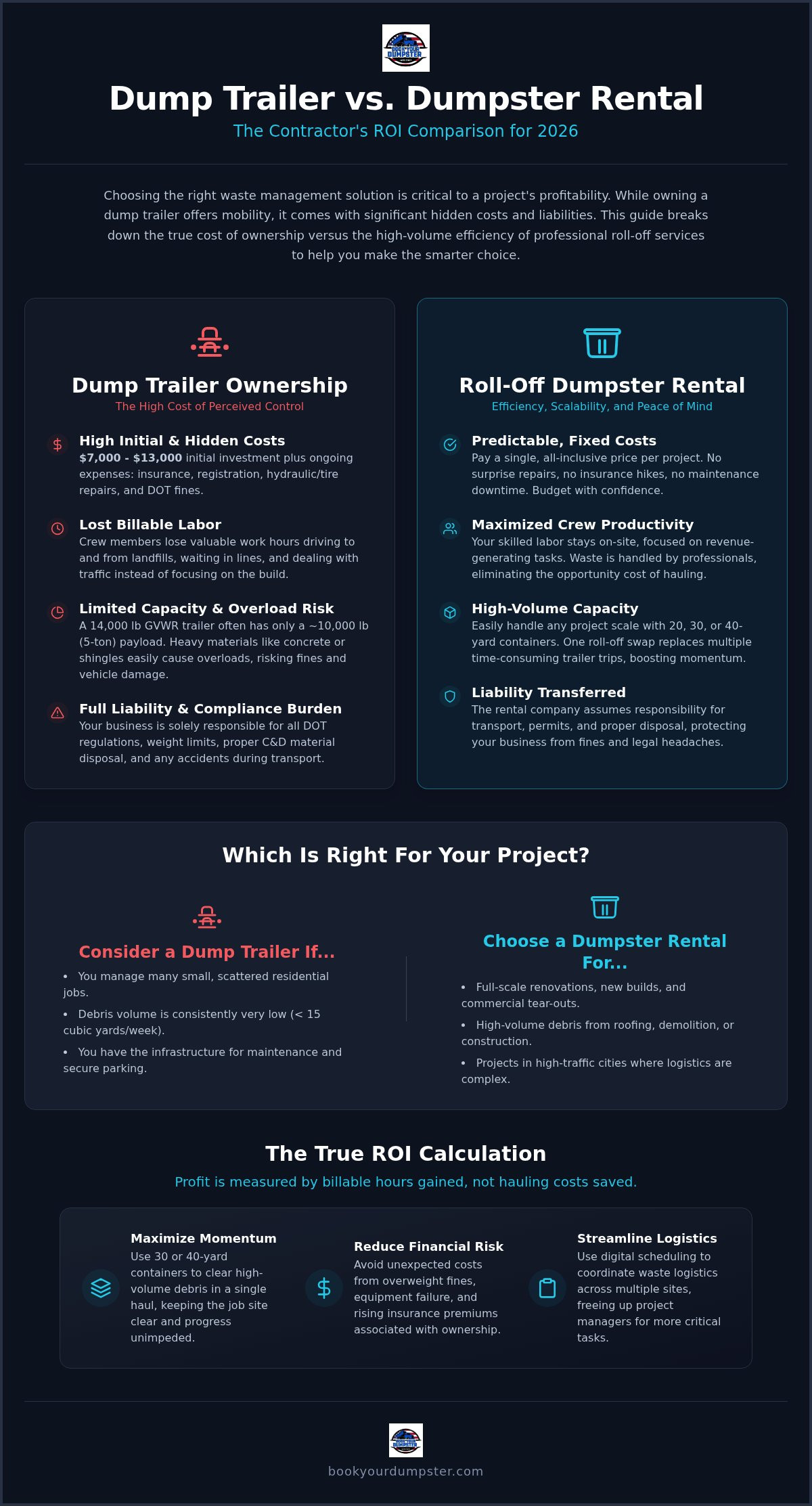
Labor and Logistics: The Real ROI of Debris Removal
ROI on a construction site isn't just about the cost of materials. It's about the billable hours you recover by optimizing your workflow. When you analyze dumpster rental vs dump trailer for contractors, you must look at the clock. Every trip to the landfill represents a significant drain on your human resources. You aren't just paying for the gas; you're paying for the specialized labor that is sitting idle in a truck. Utilizing a professional construction debris removal service allows your team to remain on-site, keeping your project on its 2026 timeline. This shift in logistics moves your business from a state of constant hauling to a state of constant building.
The High Cost of "Free" Hauling
Self-hauling with a dump trailer often looks cheaper on paper, but the math changes when you factor in reality. A single trip to a transfer station involves loading time, transit through city traffic, and the inevitable wait in line at the scales. Transfer stations in 2026 are increasingly crowded. A "quick trip" can easily turn into a ninety-minute ordeal during peak hours. If your lead hand earns a professional wage and spends three hours round-trip, you've already spent a significant portion of your daily profit on labor alone. Add in fuel costs and the tipping fees at the gate. Two of these trips per week can easily exceed the cost of a weekly roll-off rental. Keeping your best hands on the tools, not the steering wheel, is how you protect your profit margins. Stop treating your skilled trades like delivery drivers and start prioritizing billable output.
Insurance and Liability Management
Transporting waste is a high-risk activity that many contractors underestimate. Debris falling from an unsecured trailer on a highway can lead to catastrophic accidents and massive legal settlements. When you haul your own waste, your business carries 100% of that risk. Professional roll-off companies assume the liability for transport and disposal the moment they lift the bin. Additionally, standard dumpster rental prices typically include a set weight limit and disposal fees, providing you with a predictable flat cost. This transparency allows you to bid more accurately on future contracts without worrying about fluctuating landfill rates or vehicle accidents. You also avoid the hidden wear on your truck’s transmission and brakes from hauling heavy loads daily. These costs are often ignored until a major repair bill arrives and stalls your entire fleet.
Ready to stop wasting billable hours at the dump? Book your professional roll-off today and keep your crew focused on the build.
Scaling Your Business with Professional Waste Logistics
Scaling a construction business requires delegating every task that doesn't involve building. If you're comparing dumpster rental vs dump trailer for contractors while trying to manage three different job sites, the trailer becomes a bottleneck. You can't be in three places at once to haul debris. Professional waste logistics allow you to oversee multiple projects simultaneously without worrying about the logistics of the next dump run. By outsourcing this messy part of the business, you turn a variable labor headache into a fixed, manageable line item. This allows you to focus on client acquisition and project management rather than equipment maintenance.
Streamlined Scheduling and Online Booking
Efficiency in 2026 is digital. Book Your Dumpster USA simplifies the entire procurement process with a 24/7 online ordering system. You don't have to wait for business hours to schedule a swap or a new delivery. This platform provides a single point of contact for all your regional sites, whether you're working in New Jersey, Illinois, or Massachusetts. The "no surprises" pricing model ensures you know exactly what the costs are before the bin arrives on-site. This predictability is vital for accurate project bidding. When you know your waste costs upfront, you protect your margins from the start and avoid the hidden costs associated with vehicle registration and trailer insurance.
Sustainable Waste Management
Modern clients and municipal regulators demand better environmental accountability. Professional haulers utilize advanced sorting facilities that significantly improve recycling rates for construction waste compared to a standard dump run. If your project requires LEED certification, professional dumpster tracking is often the only way to verify that materials are being diverted from landfills correctly. This documentation is nearly impossible to maintain when you're self-hauling in a trailer. Choosing a professional partner helps you meet these green building standards while keeping your site organized and compliant with local regulations. Schedule your next construction dumpster today.
The final verdict is clear for the growing contractor. While a dump trailer might serve a solo operator doing small repairs, it cannot support a scaling construction firm. The roll-off dumpster remains the superior choice for professionals who value their time, their crew’s safety, and their project’s profitability. Stop investing in tires and hydraulic repairs. Invest in a logistics partner that grows with your business and removes the stress of debris removal from your daily to-do list.
Streamline Your Site Logistics for 2026
Choosing the right waste management strategy is the difference between a project that stays on schedule and one that bleeds profit through labor waste. The dumpster rental vs dump trailer for contractors debate ends when you prioritize billable hours over hauling duties. While trailers offer limited mobility, they can't match the high-volume efficiency of 30 or 40-yard roll-offs. Ownership creates a constant cycle of maintenance and liability that distracts from your core business of building.
Book Your Dumpster USA has provided professional roll-off logistics since 2018. We offer 10, 20, 30, and 40-yard sizes with transparent pricing for projects in NY, NJ, IL, and MA. Our streamlined online system removes the stress of waste management and ensures your crew stays focused on the job site. Build faster and maximize your margins by offloading your debris logistics to a dependable partner.
Book Your Construction Dumpster Online Now and secure your project’s profitability today.
Frequently Asked Questions
Do I need a permit to park a dump trailer on the street in New York?
Yes, you typically need a permit for any unattached trailer left on a public street in New York City. The Department of Transportation (DOT) regulates street occupancy strictly. Even if the trailer remains hitched, long-term parking can lead to expensive summonses. Check local borough-specific rules because enforcement patterns vary significantly between Queens and Brooklyn. Using a roll-off often avoids these specific vehicle-related parking violations.
How many pickup truck loads fit into a 20-yard dumpster?
A 20-yard dumpster holds approximately 8 to 10 standard pickup truck loads. A standard 8-foot truck bed filled to the rails holds about 2.5 cubic yards. Using a roll-off saves you about nine round trips to the transfer station. This efficiency is a major factor when evaluating dumpster rental vs dump trailer for contractors for medium-sized renovations or residential gut-outs.
What are the main disadvantages of owning a dump trailer for a small contractor?
The main disadvantages include high maintenance costs, insurance liabilities, and storage requirements. You're responsible for hydraulic repairs, tire blowouts, and battery failures. Additionally, owning a trailer ties up a truck that could be moving crews or materials elsewhere. This creates a logistical bottleneck that prevents you from managing multiple sites effectively. Ownership also requires a secure place to store the asset between contracts.
Can I put concrete and heavy masonry in a rental dumpster?
You can put concrete and masonry in a rental dumpster, but you must use specific heavy-debris containers. These are usually 10-yard or 20-yard bins because of strict weight limits on transport trucks. Never mix heavy masonry with general construction trash. Doing so often leads to overweight fees or a truck being unable to lift the load safely. Always specify your debris type when booking.
Is it cheaper to rent a dumpster or pay dump fees myself?
Renting is usually more cost-effective when you factor in labor and vehicle wear. While a single dump fee might look low, you must add the cost of fuel, the hourly wage of the driver, and the line wait time. For most professionals, the flat-rate predictability of a dumpster rental vs dump trailer for contractors outperforms the variable costs and hidden overhead of self-hauling.
What happens if I exceed the weight limit on my roll-off rental?
Exceeding the weight limit results in additional overage fees charged per ton. If the container is too heavy for the truck to safely lift, the driver will leave the bin on-site. You'll then have to remove the excess material yourself and pay a dry run fee for the attempted pickup. Always monitor your load height and material density to stay within legal transport limits.
Are there specific items contractors cannot put in a rental dumpster in Massachusetts?
Massachusetts has strict waste bans on materials like asphalt shingles, gypsum wallboard, and metal. These items must often be separated or sent to specific recycling facilities rather than a standard landfill. Other prohibited items include hazardous materials, paints, batteries, and tires. Check the latest MassDEP regulations to avoid significant site fines. Our local experts can help you navigate these specific regional requirements.
How quickly can I get a dumpster delivered to a job site in Chicago?
We typically offer next-day delivery for job sites in the Chicago area if you book during business hours. Our digital-first scheduling system allows you to see real-time availability instantly. Aim to schedule 24 to 48 hours in advance to guarantee your preferred container size during peak construction seasons. This ensures your project stays on schedule without the delays associated with searching for available hauling equipment.


