

Paying for empty air is the most common mistake made during a property transition. Most facility managers focus on the weight of the debris, but successful logistics depend on measuring the "voids" left by bulky furniture and equipment. If you are struggling with how to estimate waste volume for a commercial lease cleanout, you aren't alone. You likely feel the pressure to keep costs low while meeting a strict move-out deadline. Underestimating leads to costly delays, while overestimating means you're throwing money away on a 40-yard dumpster that is only half full.
This 2026 guide gives you the exact formulas to master debris volume for office, retail, and industrial spaces. You will learn how to build a defensible waste estimate that secures budget approval and ensures the correct equipment arrives on time. We'll walk through the "Bulk-First" inventory method, explain how to account for 2026 organic waste mandates, and provide the specific math needed to avoid hidden overweight fees. Stop guessing and start calculating your way to a clean, compliant, and cost-effective exit.
Key Takeaways
- Distinguish between general trash and construction debris to meet "broom-clean" or "white-box" lease standards without incurring extra fees.
- Master the Square Footage Multiplier and Inventory-Based methods to learn exactly how to estimate waste volume for a commercial lease cleanout.
- Convert bulky office furniture and retail fixtures into precise cubic yard measurements using updated 2026 volume conversion formulas.
- Select the right equipment by comparing 10, 20, 30, and 40-yard dumpsters to find the "sweet spot" for your specific square footage.
- Streamline your logistics by verifying local permit and insurance requirements for dumpster placement in major hubs like New York and San Francisco.
Understanding the Scope of a Commercial Lease Cleanout
A commercial lease cleanout is the process of removing all non-permanent fixtures to restore a space to a specific condition defined in your contract. Most leases require the unit to be returned in "broom-clean" or "white-box" condition. Failing to meet these standards often triggers security deposit deductions or holdover penalties. You must understand the nature of commercial waste before you can accurately calculate your disposal needs. Accuracy protects your budget from the hidden costs of over-ordering or under-ordering equipment.
Identify the types of debris you're handling before you book a container. Cleanouts typically involve a mix of general trash and Construction and Demolition (C&D) waste. General trash includes loose items like office supplies, breakroom furniture, and paper. C&D waste is more complex. It covers tenant-installed improvements like partition walls, flooring, and ceiling tiles. These materials require different disposal methods and have different density profiles. Sort your inventory into four major categories: office furniture, e-waste, partition walls, and flooring. This categorization is the first step in learning how to estimate waste volume for a commercial lease cleanout effectively.
The "Broom-Clean" Standard vs. Full De-fit
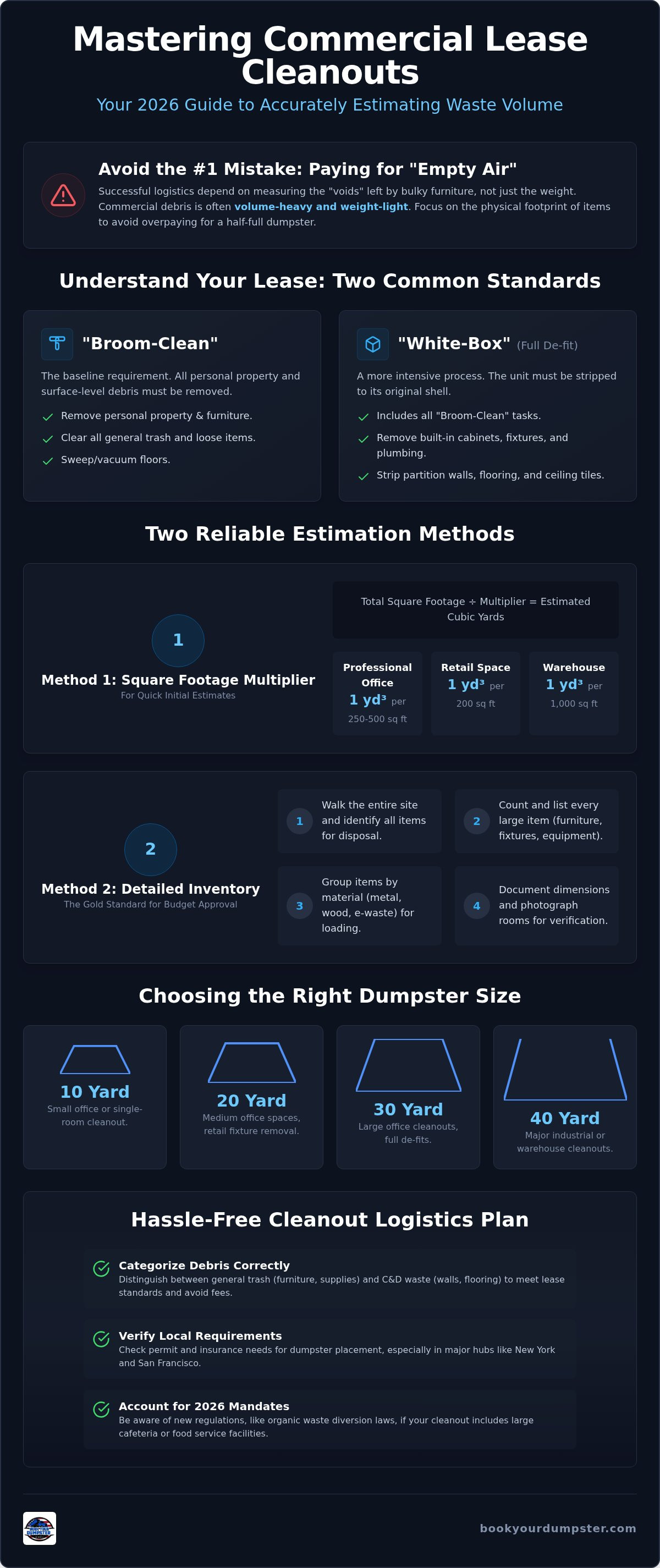
Lease language dictates your exit strategy. A "broom-clean" requirement is the baseline. It means you must remove all personal property, furniture, and surface-level debris. A full de-fit, or "white-box" requirement, is much more intensive. You must strip the unit back to its original concrete shell. This involves removing built-in cabinetry, lighting fixtures, and custom plumbing. These structural items create massive volume compared to freestanding furniture. Removing a built-in reception desk generates three times the debris of a standard office desk. Always verify the handover state with your landlord to avoid last-minute surprises.
Why Daily Waste Audits Fail for Cleanouts
Don't use your weekly trash pickup metrics to plan an exit. Standard business waste data usually tracks "waste per employee," which is a weight-based metric for recurring trash. Cleanouts are one-time, high-volume events. You aren't tossing paper and food scraps; you're tossing air. Commercial debris is often "volume-heavy and weight-light." Disassembled cubicles and storage racks create large "voids" in a container. They take up significant space without necessarily hitting weight limits. As of 2026, you must also account for specific mandates, such as the New York organic waste diversion law if your cleanout includes large cafeteria facilities. Focus on the physical footprint of the items rather than their weight to get an accurate count.
The Two Most Reliable Estimation Methods for Commercial Spaces
Precision is the only way to avoid the twin traps of overpaying for empty space or facing move-out delays. You must choose a method that balances your available time with your need for accuracy. If you are in the early planning stages, a ballpark figure suffices. However, as the deadline nears, you need a granular count. Learning how to estimate waste volume for a commercial lease cleanout requires understanding that items rarely pack perfectly. You aren't just measuring the physical objects; you are measuring the "void space" created when bulky items like chairs and cabinets are tossed into a container.
Method 1: The Square Footage Multiplier
Use the Square Footage Multiplier for a quick initial estimate. For a standard professional office, use a rule of thumb of 1 cubic yard of waste for every 250 to 500 square feet. Adjust this multiplier based on your specific industry. Retail spaces with heavy shelving and display fixtures often require 1 cubic yard per 200 square feet. Conversely, sparse warehouses might only generate 1 cubic yard per 1,000 square feet. To find your total, divide your total floor plan square footage by your chosen multiplier. This gives you a starting point for selecting a container size.
Method 2: The Detailed Inventory Walkthrough
The Inventory-Based Method is the gold standard for budget approval. Walk the entire site and count every large item that cannot be sold or donated. Group these items by material type, such as metal, wood, or electronics, to simplify the loading process later. To ensure your numbers are defensible for corporate approval, conduct a waste assessment that documents the dimensions of your largest furniture pieces. Take clear photographs of each room. These photos help your logistics provider confirm if your estimate matches the physical reality of the space.
Account for the "fluff factor" in your final tally. Most commercial items don't break down easily. A standard 30-yard dumpster may fill up quickly if you don't disassemble desks or stack chairs efficiently. Review our dumpster size guide to match your final calculations with the right equipment for your site. Choosing the correct method now prevents expensive overage fees or the need for a second haul later. Base your decision on the complexity of your de-fit and the strictness of your landlord's move-out window.
Converting Commercial Inventory into Cubic Yard Estimates
Visualizing volume is the hardest part of a property transition. To get your numbers right, start with the basic math: one cubic yard is a box measuring three feet wide, three feet long, and three feet high. If you can't picture that, think of a standard household washing machine. That is roughly one cubic yard. When you calculate how to estimate waste volume for a commercial lease cleanout, you must convert every piece of furniture and equipment into this unit of measurement. Use the EPA waste assessment guide to help categorize your materials before you start your tally.
Apply the "Disassembly Factor" to your inventory to save money. A standard executive desk consumes about 1.5 cubic yards of space when tossed whole. If you remove the legs and break the top into flat pieces, that same desk might only take up 0.5 cubic yards. However, you must also prepare for the "Stacking Penalty." Real-world volume is often 20% higher than your calculated volume because items rarely fit together perfectly. Gaps between chair legs and the voids inside empty cabinets create wasted space that you still have to pay for. Always add a 20% buffer to your final estimate to ensure you don't run out of room mid-project.
Volume Estimates for Common Office Fixtures
Use these baseline averages to build your inventory list. Most office items follow predictable volume patterns:
- Cubicle Panels: A standard 5-foot panel is roughly 0.5 cubic yards.
- Task Chairs: Expect each chair to occupy 0.3 cubic yards.
- Lateral Filing Cabinets: A four-drawer unit is approximately 1 cubic yard.
- Retail Shelving: Ten linear feet of disassembled metal racking equals about 1.5 cubic yards.
- Loose Items: Five standard banker boxes equal roughly 0.5 cubic yards.
Accounting for Weight and Density
Volume isn't your only constraint. You must track density to avoid overage fees. Large containers have strict weight limits based on the capacity of the delivery trucks. For example, a 40-yard dumpster typically has a weight limit of 5 to 6 tons. If you fill it with heavy materials like floor tiles, drywall, or glass, you will hit the weight limit long before the container is physically full. Heavy debris requires smaller, reinforced containers to ensure safe transport. Check the resources at Book Your Dumpster USA to match your specific material types with the correct container size. This prevents the logistical nightmare of a truck being unable to lift an overweight container on your move-out day.
Practical Checklist for a Hassle-Free Cleanout Logistics Plan
Success depends on more than just math. Once you understand how to estimate waste volume for a commercial lease cleanout, you must execute the physical removal without violating local laws or building rules. Logistics in high-density areas like New York or San Francisco require precise timing. A single oversight in permit paperwork can result in a rejected delivery and a missed move-out deadline. Start by verifying your building's insurance requirements. Most commercial landlords demand a Certificate of Insurance (COI) from the dumpster provider before any equipment arrives on site. This protects you from liability during the loading process.
Coordinate directly with property management for loading dock access. Secure a dedicated window for freight elevator use to prevent bottlenecks with other tenants. When the container arrives, follow a strict load order. Place your heaviest, densest items like flooring or metal shelving on the bottom. This creates a stable base and ensures the truck can safely lift the load. Fill the "voids" around these heavy pieces with smaller, loose items to maximize every cubic yard of space you've paid for. Don't leave empty pockets; they represent wasted budget.
Urban Logistics: NY, SF, and Chicago Considerations
Urban environments present unique obstacles. Tight alleyways in Chicago and low overhead wire clearances in San Francisco can prevent large 30 or 40-yard containers from reaching your site. You may need a "Street Use" permit if the loading dock is inaccessible. These permits often require 72 hours of lead time and specific signage to reserve the space. For localized regulations, review our Dumpster Rental in New York, Illinois, and Massachusetts: The 2026 Complete Guide. Getting the regional details right prevents costly municipal fines and keeps your project on track.
Hazardous Waste and E-Waste Separation
Standard roll-off containers are not for everything. You must separate hazardous materials and electronics before loading. Items like lithium-ion batteries, computer monitors, and chemical cleaners are prohibited in standard landfills. Estimate the separate volume for these items by counting units rather than square footage. As of July 2026, federal EPA regulations and state laws in Washington and California have increased the penalties for improper e-waste disposal. Disposing of regulated hazardous waste in a standard container can result in a refusal at the scales and a significant fine from your landlord. Keep your recycling stream separate to maintain compliance.
Ready to secure your equipment and finish your project? Book your dumpster online today to lock in your delivery window and ensure your cleanout stays on schedule.
Choosing the Right Dumpster Size for Your Cleanout Project
Selecting the right container is the final step in your logistics plan. You've done the math and performed the inventory. Now you must match your cubic yardage to the physical dimensions of the equipment. Choosing the wrong size creates immediate logistical friction. Under-sizing forces you into multiple trips and extra haul fees, which can delay your lease handover and trigger penalties. Over-sizing means you're paying for empty space. For a detailed look at container dimensions and weight limits, review our Roll Off Dumpster Rental: The Complete Guide to ensure your site can accommodate the delivery truck.
The 30-yard dumpster is the "sweet spot" for many medium-sized office cleanouts. It provides enough volume for bulky furniture and disassembled cubicles without the massive footprint of a 40-yard unit. If your calculation for how to estimate waste volume for a commercial lease cleanout falls between 25 and 30 yards, always choose the larger option. It's more cost-effective to have a little extra room than to pay for a second haul mid-project. Efficiency in waste management is about reducing the number of touches and the number of trips.
When to Choose a 10 or 20-Yard Unit
Small retail spaces or single-room office refreshes usually only require a 10 or 20-yard unit. These containers are ideal for heavy, dense debris. If you're removing commercial-grade carpeting, bathroom tile, or heavy floor plates, a 20-yard dumpster is often the safest choice to avoid exceeding weight limits. The smaller footprint also makes them easier to place in tight urban loading zones or alleyways. For specific measurements on our smallest units, see our 10 Yard Dumpster Rental guide to confirm it fits your designated space.
Large Scale Cleanouts: The 30 and 40-Yard Advantage
Large-scale de-fits and full-floor office removals demand 40-yard containers. These units are necessary when you're clearing out hundreds of task chairs, massive conference tables, and linear feet of partition walls. If site access is restricted, consider the logistics of using two 20-yard units instead of one 40-yard unit. While a 40-yard container is more efficient for volume, it requires significant clearance for the delivery truck to maneuver. Deciding between a single large drop or multiple smaller containers depends entirely on your loading dock's overhead and turning radius.
Don't let the complexity of waste management slow down your transition. Use our streamlined online system to secure your equipment and meet your move-out deadline. Book your dumpster online at Book Your Dumpster USA today and get back to managing your business.
Streamline Your Property Transition
Mastering the inventory walkthrough and applying the 20% "fluff factor" buffer ensures you don't overpay for empty containers. By categorizing your debris and coordinating with property management for loading dock access, you remove the logistical friction from your move-out. Understanding how to estimate waste volume for a commercial lease cleanout is the difference between a smooth handover and expensive landlord penalties. It's about taking control of the "void space" in your project budget so you only pay for what you actually toss.
Book Your Dumpster USA simplifies this process with transparent pricing and no hidden fees. We provide reliable delivery across major hubs including NY, NJ, IL, MA, and San Francisco. Whether your de-fit requires a compact 10-yard unit or a massive 40-yard container, our streamlined digital booking system keeps your project on schedule. Ready to clear out? Book your commercial dumpster online today. You have the formulas and the logistics checklist. Now, get the right equipment delivered on time and close your lease with confidence.
Frequently Asked Questions
How much waste does a typical 5,000 sq ft office generate during a cleanout?
A 5,000 sq ft office typically generates between 10 and 20 cubic yards of waste. This estimate assumes a standard professional density with desks, chairs, and paper files. If your space includes high-density storage or built-in cabinetry, expect to hit the higher end of that range. Order a 20-yard dumpster to ensure you have enough capacity for the "fluff factor" of bulky furniture.
Can I put office furniture and electronics in the same dumpster?
No, you must keep electronics separate from standard office furniture. Standard roll-off dumpsters accept desks, chairs, and partition walls; however, e-waste like monitors and batteries are prohibited. Mixing these items results in refusal at the disposal site and heavy fines. Arrange a separate pickup for all regulated electronic equipment to stay compliant with 2026 disposal laws.
What is the most common dumpster size for a commercial lease cleanout?
The 30-yard dumpster is the industry standard for commercial cleanouts. It provides the necessary volume for bulky items like conference tables and cubicle panels while maintaining a footprint that fits in most loading docks. If your project involves a full floor de-fit, this size offers the best balance of capacity and maneuverability for delivery trucks.
Do I need a permit to rent a dumpster in New York City for a cleanout?
You need a permit if the container sits on a public street or sidewalk in New York City. These Street Use permits must be secured before delivery. If you can place the dumpster on private property or within a dedicated loading dock, a city permit is generally not required. Always verify building-specific requirements with your property manager first.
How do I calculate the weight of my commercial waste to avoid overage fees?
Calculate weight by identifying the densest materials in your inventory. Standard office furniture is volume-heavy but relatively light; however, Construction and Demolition waste like drywall or floor tile adds weight quickly. Use a 20-yard dumpster for heavy materials to stay under the truck's lifting capacity. Check density charts to ensure your total tonnage doesn't exceed the container's limit.
What happens if I underestimate the volume of my lease cleanout debris?
Underestimating volume leads to project delays and additional haul fees. If you run out of space, you must schedule a swap-out where a full container is replaced with an empty one. This is why knowing how to estimate waste volume for a commercial lease cleanout is critical for meeting a strict move-out deadline. Always add a 20% buffer to your initial calculations to prevent these bottlenecks.
Are there items prohibited in commercial dumpsters in San Francisco?
San Francisco prohibits hazardous waste, electronics, and specific organic materials in standard dumpsters. As of 2026, the city has strict mandates regarding the diversion of recyclable and compostable materials. You cannot dispose of monitors, paints, or chemicals in a roll-off container. Review local ordinances to ensure your cleanout follows the city's mandatory recycling and diversion laws.
How far in advance should I book a dumpster for a lease termination?
Book your dumpster at least 72 hours before your project start date. This window allows time for permit processing and ensures your preferred container size is available. For cleanouts in high-traffic zones like Manhattan or downtown San Francisco, book one week in advance to secure specific loading dock windows and necessary street clearance.


