
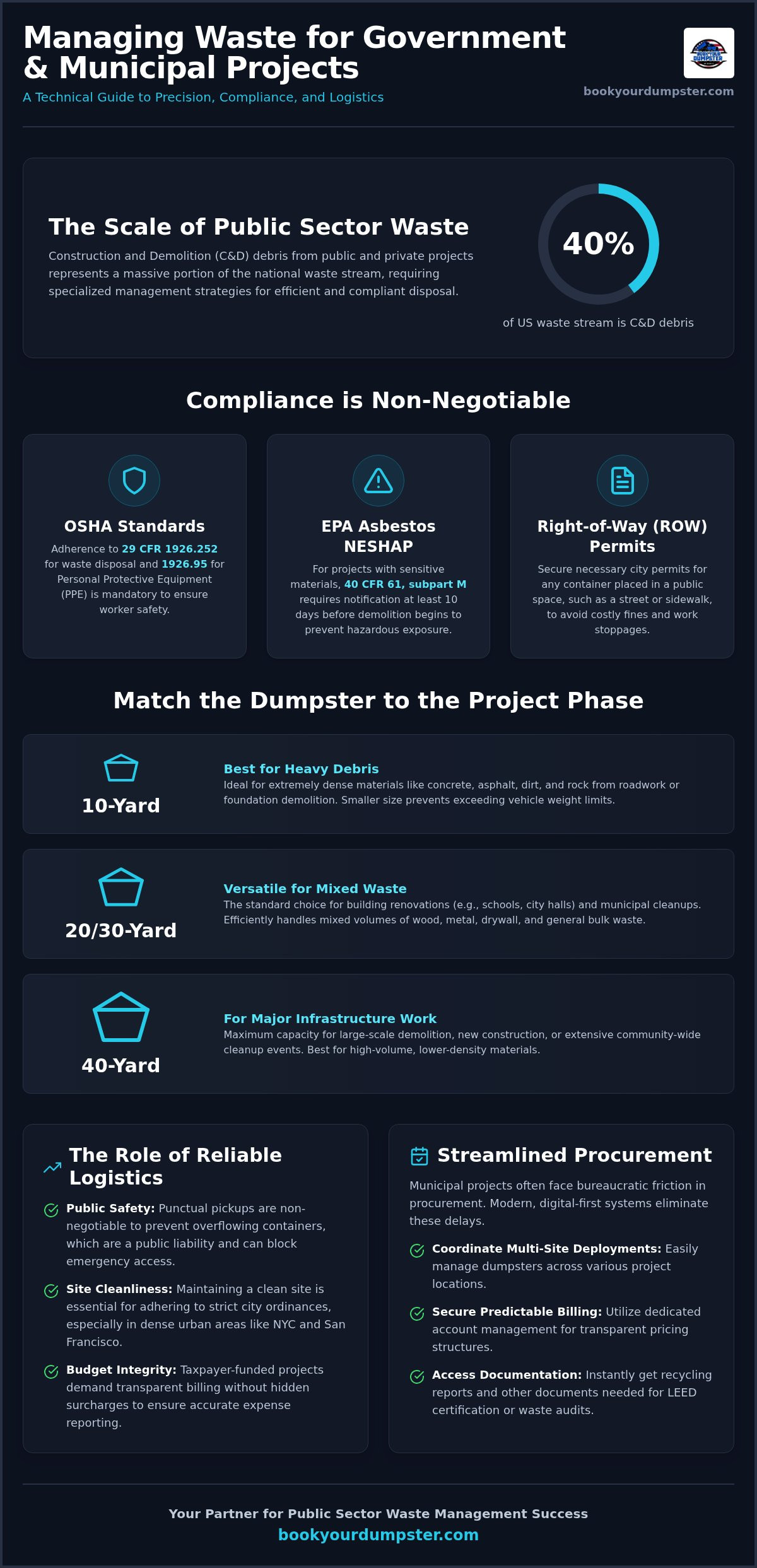
Construction and demolition debris accounts for up to 40% of the waste stream in the United States. Handling that volume requires more than just a container; it requires a specialized strategy for dumpster rental for government and municipal projects. You understand the pressure of working under public scrutiny. Bureaucratic delays, strict safety codes, and shifting landfill tipping fees make waste logistics a high-stakes task. One oversight in procurement or a single missed pickup can compromise an entire municipal budget.
Expect more from your waste partner. This guide provides the technical roadmap to manage public sector waste with precision. We'll outline how to maintain compliance with OSHA 29 CFR 1926.252 and EPA asbestos NESHAP standards while keeping your billing transparent. You'll learn to coordinate multi-site deployments and select scalable solutions, like 40-yard containers for major infrastructure work. Use these professional insights to eliminate logistical friction and ensure your next project stays on time and within its allocated funding.
Key Takeaways
- Understand the regulatory landscape, including Right-of-Way (ROW) permits and strict safety protocols required for public worksites.
- Match your project phase to the correct equipment, from 10-yard containers for heavy debris to 40-yard dumpsters for large-scale municipal infrastructure.
- Streamline your procurement of dumpster rental for government and municipal projects using modern digital tools that eliminate traditional bureaucratic friction.
- Secure predictable billing and punctuality for multi-site deployments through dedicated account management and transparent pricing structures.
- Maintain compliance with OSHA and EPA standards to avoid costly penalties and ensure safe handling of construction and demolition waste.
Waste Management Requirements for Government and Municipal Projects
Municipal waste management is the systematic handling of debris generated by public works and infrastructure projects. It is far more complex than standard residential or commercial trash collection. While a homeowner might need a bin for a garage cleanout, dumpster rental for government and municipal projects involves massive volumes of concrete, asphalt, and structural materials. These projects operate on strict timelines where a single delay ripples through the city's schedule. You need a partner who understands the scale and the stakes of public sector work.
Success depends on coordination between Department of Public Works (DPW) heads, city contractors, and site supervisors. These stakeholders require a high-functioning tool rather than just a service. Reliability and pricing integrity are the foundations of this partnership. Because these projects use taxpayer-funded budgets, every dollar must be accounted for. Transparent billing ensures that public agencies can report expenses accurately without the shock of hidden surcharges. It's about maintaining control over the logistics so the project stays on track.
Common Public Sector Waste Streams
Public projects generate specific types of debris that require different handling strategies. Infrastructure debris like asphalt and concrete from roadwork is extremely heavy. For these materials, a 10-yard dumpster is often the most efficient choice to avoid exceeding weight limits. Municipal cleanups, such as seasonal park maintenance or remediating illegal dumping sites, often produce mixed bulk waste that requires larger containers to handle high-volume, low-density materials.
Building renovations for public schools or city hall upgrades present their own challenges. These sites often generate a mix of wood, metal, and drywall. Utilizing 20 or 30-yard containers allows for efficient sorting and removal. In places like Morris County, New Jersey, where tipping fees for municipal and construction waste are $113.00 per ton as of January 1, 2026, efficient waste stream management is critical for staying within the allocated budget. Since construction and demolition materials constitute 25% to 40% of the waste stream in the U.S., volume control is essential.
The Role of Reliable Logistics in Public Safety
Public safety is the primary concern for any municipal project. Overflowing containers aren't just an eyesore; they are a significant liability for local governments. Debris that spills into public thoroughfares can cause accidents or block emergency vehicle access. This makes punctual pickup a non-negotiable requirement for any vendor.
Maintaining site cleanliness helps contractors adhere to strict city ordinances in major hubs like New York and San Francisco. In these densely populated areas, space is at a premium. Dumpsters must be deployed and removed exactly as scheduled to keep traffic flowing and pedestrians safe. Professional logistics ensure that waste management remains a background process, allowing city workers to focus on the infrastructure itself. Use a digital-first system to track these movements and ensure your site remains compliant and clear.
Compliance, Permitting, and Safety Standards
Public sector projects demand rigorous adherence to local and federal codes. When managing a dumpster rental for government and municipal projects, you're responsible for more than just the debris. You must secure Right-of-Way (ROW) permits whenever a container occupies public space. These permits typically range from $10 to $100 depending on the municipality, but the cost of non-compliance is significantly higher in fines and work stoppages. Professional waste partners act as a high-functioning tool here, helping you navigate the paperwork so your crew stays focused on the build.
Safety protocols on government sites are non-negotiable. You must adhere to OSHA standards like 29 CFR 1926.252 for waste disposal and 29 CFR 1926.95 for personal protective equipment. If your project involves sensitive materials, the EPA's Asbestos NESHAP requirements (40 CFR 61, subpart M) mandate a notification form at least 10 days before demolition begins. To ensure your project meets modern sustainability goals, use a digital-first booking system that provides the recycling reports and documentation needed for LEED certification or municipal waste audits.
Navigating City Permits in Major Metros
Each metropolitan hub has its own set of friction points. In New York City, the DOT requires specific permits for any container placed on a sidewalk or street. San Francisco utilizes "Street Space" permits, which are critical for maintaining traffic flow while housing large-scale construction debris. In Chicago and throughout Illinois, local rules often mandate specific container visibility, including reflective markings to protect nighttime drivers. Failure to follow these regional nuances can lead to immediate equipment impoundment.
Environmental and Regulatory Adherence
Proper disposal is a matter of legal record. You must strictly exclude prohibited materials like electronics, hazardous waste, and chemicals to comply with EPA 40 CFR Part 257. For workers handling hazardous materials, OSHA 29 CFR 1926.1200 requires documented training that must be verifiable during a site audit. Weight compliance is another critical factor. Overloading a 40-yard dumpster can damage city infrastructure and lead to significant structural liabilities.
Regional expertise is vital in states like Massachusetts and New Jersey. In New Jersey, specifically Morris County, the tipping fee for municipal and construction waste is $113.00 per ton as of January 1, 2026. Precise weight monitoring prevents budget overruns and ensures your project remains a model of public efficiency. Don't leave these details to chance. Partner with a vendor that understands the intersection of logistics and law.
Selecting the Right Dumpster Size for Public Works
Efficiency in public works starts with the footprint. Choosing the wrong container size leads to wasted space or dangerous overloads. For a dumpster rental for government and municipal projects, you must match the equipment to the physical density of the debris. Heavy materials require different logistics than bulky, light waste. Precision in selection prevents project delays and protects the integrity of public funding. Choose correctly to avoid unnecessary hauls.
Project-Specific Size Recommendations
Matching the container to the project phase ensures maximum utility. Road crews and sidewalk contractors frequently rely on the 10-yard dumpster. This size is specifically designed for heavy, dense materials like concrete, asphalt, and dirt. Using a larger bin for these materials often leads to weight limit violations, as the truck may be unable to lift a 30-yard bin filled with stone. Learn more about 10-yard dumpster rentals for smaller municipal tasks to see how they fit into narrow urban streets.
- 20-Yard Containers: These are the standard choice for municipal building cleanouts or roofing projects on local schools. They provide enough volume for bulky items without a massive footprint.
- 30-Yard Containers: Best for medium-scale construction and site clearing. Use these for park renovations where you're removing brush, fencing, and playground equipment.
- 40-Yard Containers: Position these as the essential tool for large-scale demolition or park cleanups. They are the gold standard for major infrastructure projects and disaster debris removal where volume is the primary challenge.
Calculating Volume for Public Budgets
Inaccurate volume estimates lead to frequent hauls and higher transportation costs. National landfill tipping fees rose 10% between 2023 and 2024, reaching an average of $62.28 per ton. This trend makes weight estimation a critical skill for site supervisors. When you're managing a dumpster rental for government and municipal projects, every extra trip to the landfill impacts the bottom line.
Select a larger container for light, bulky waste to minimize the number of hauls. Conversely, use smaller containers for heavy debris to ensure you stay within legal weight limits for city roads. This is especially important in cities like San Francisco, where weight limits are strictly enforced to protect aging infrastructure. For a deeper dive into managing these logistics, read our detailed guide on construction debris removal.
Procurement and Logistics for Large-Scale Rentals
Procurement for public sector work shouldn't be a hurdle. When managing a dumpster rental for government and municipal projects, you need a system that moves as fast as your crew. Traditional phone-tag and paper-heavy processes lead to errors. A streamlined online booking system replaces that friction with speed. It allows contractors to secure equipment, schedule drop-offs, and track billing from a single digital interface. This level of competence is essential for projects that must answer to public oversight and strict audit trails.
Dedicated account management is the backbone of multi-site municipal projects. You aren't just renting a box; you're hiring a logistics partner. Large contracts often span multiple city departments or geographic locations. Having a single point of contact ensures that a delivery in Queens follows the same rigorous standards as one in San Francisco. This consistency prevents the logistical drift that often plagues large-scale public works. It ensures that every site supervisor receives the same level of professional support.
Managing Multi-Site Municipal Contracts
Coordinating deliveries across a city requires a high-functioning tool. Use digital tracking to monitor container status and debris volume in real-time. This data helps you avoid overflowing bins and schedule pickups before they become a public safety issue. Whether you're managing a park renovation in Brooklyn or a road project in Chicago, digital visibility ensures every site remains clean and compliant. It removes the stress of manual tracking and reduces the risk of municipal fines.
The Bidding and Quote Process
Accuracy in the bidding phase prevents budget creep later. When responding to a government RFP, you need comprehensive quotes that account for all variables. Look for no-nonsense billing structures that eliminate hidden fees. This transparency is vital for government audits and internal reporting. Understanding dumpster rental prices for 2026 helps you build more competitive and realistic project proposals that stand up to financial scrutiny.
Public event timelines often shift. You need flexible scheduling to accommodate parade routes, emergency road repairs, or weather-related delays. A partner who understands these pressures will adjust hauls without complicating your paperwork. To secure a reliable partner for your next contract, book your dumpster online to lock in your schedule and ensure your project remains on track.
Partnering with Book Your Dumpster for Public Sector Success
Reliability in the public sector isn't optional. Book Your Dumpster USA provides the logistical control required for dumpster rental for government and municipal projects across New York, New Jersey, Illinois, and Massachusetts. We've modernized a traditional industrial sector by replacing opaque communication with digital convenience and straightforward honesty. Our digital-first approach ensures you spend less time on procurement and more time on project execution. We prioritize pricing integrity so your taxpayer-funded budgets remain predictable and transparent from the first drop-off to the final haul.
Public agencies require a partner that speaks the language of compliance. We don't just deliver containers; we provide a high-functioning tool that integrates into your project's workflow. Whether you're deploying a 10-yard dumpster for heavy sidewalk debris or a 40-yard dumpster for large-scale municipal debris, our system tracks every movement. This level of oversight is essential for maintaining public safety and adhering to local city ordinances in high-traffic hubs like San Francisco and New York City. Trust a vendor that understands the intersection of industrial service and digital efficiency.
Why Experience Matters in Government Logistics
Public works operate under unique pressures that residential services can't match. Whether you're managing roadwork in Chicago or infrastructure upgrades in Boston, you need a no-nonsense expert who understands the urgency of these tasks. We have a proven history of serving the complex needs of major U.S. metros. Our team understands regional nuances, from New York DOT permits to specific weight limits for 40-yard containers in San Francisco. Explore our full range of roll-off dumpster services to find the right capacity for your specific debris management plan.
Next Steps for Municipal Project Managers
Moving from a state of clutter to a state of resolution requires immediate action. Use our online system for instant scheduling and real-time status updates across all your active sites. If you're managing a complex, multi-site contract, consult with our experts to develop a custom debris management plan. We help you account for local tipping fees and recycling mandates to prevent budget creep. Verify service availability in your specific city or county to secure a partner who respects your time and your budget. Secure your municipal dumpster rental today and experience the efficiency of a truly professional waste management partner.
Streamline Your Public Works Logistics
Success in the public sector depends on precision and predictability. You've seen how matching the right equipment to your specific waste stream prevents budget overruns and safety violations. Whether you need a 10-yard container for heavy roadwork or a 40-yard bin for large-scale municipal debris, selecting the right tool is the first step toward project resolution. Maintaining compliance with OSHA and EPA standards protects your agency from liability while ensuring public thoroughfares remain clear and safe.
Logistics shouldn't be the bottleneck in your infrastructure projects. By utilizing a digital-first procurement system, you eliminate the friction of traditional waste management. Book Your Dumpster USA provides the no-nonsense scheduling and pricing integrity required for complex dumpster rental for government and municipal projects. We serve major metros across NY, NJ, IL, MA, and SF with a full range of 10 to 40-yard roll-off containers.
Take control of your site logistics today. Secure a partner that respects your timeline and your taxpayer-funded budget. Book Your Municipal Dumpster Rental Online to lock in your schedule and focus on building your community. Your project deserves a high-functioning tool that works as hard as your crew does.
Frequently Asked Questions
Do municipal projects require special dumpster permits?
Yes, most municipal projects require a Right-of-Way (ROW) permit if the container sits on a city street or sidewalk. These permits typically cost between $10 and $100 depending on your specific city's regulations. In major hubs like New York, you must coordinate with the DOT, while San Francisco requires "Street Space" permits to maintain public access.
What is the best dumpster size for a city park renovation?
A 30-yard dumpster is usually the most efficient choice for park renovations. It provides ample volume for bulky items like old fencing, brush, and playground equipment. If your project involves tearing up concrete paths or asphalt parking lots, use 10-yard dumpsters to handle the heavy, dense weight without exceeding legal limits.
Can you provide dumpsters for multiple municipal sites simultaneously?
Yes, we coordinate multi-site deployments across different city departments and geographic locations. Use our digital-first booking system to track every container and debris volume from a single interface. This ensures consistent service and logistical control whether you're managing a single park or a city-wide infrastructure upgrade.
How do you handle hazardous waste in government projects?
Hazardous materials, electronics, and chemicals are strictly prohibited in our roll-off containers. These items require specialized handling according to EPA 40 CFR Part 257 regulations. Ensure your site supervisors exclude these materials from the waste stream to maintain compliance and avoid municipal fines or work stoppages.
What are the weight limits for 40-yard dumpsters in public works?
Weight limits depend on local road infrastructure and municipal hauling regulations. Overloading a 40-yard dumpster creates significant liability and can damage city streets. Check specific local ordinances in cities like San Francisco, where weight restrictions are strictly enforced to protect aging public infrastructure.
Do you offer transparent billing for government audits?
Yes, we prioritize pricing integrity and provide comprehensive digital documentation for every haul. This level of transparency is essential for dumpster rental for government and municipal projects that rely on taxpayer-funded budgets. You'll receive clear, detailed reports that simplify your internal audits and public expenditure reporting.
How quickly can a dumpster be delivered to a municipal job site?
Delivery speed depends on current inventory and your project's specific location. Use our online booking tool to check real-time availability and schedule your drop-off immediately. Punctuality is a core part of our service, ensuring your project meets its public milestones without logistical delays.
Are there discounts for long-term government contracts?
We provide competitive, no-nonsense pricing tailored to the scale of your public sector needs. Contact our team to discuss the specific duration and volume of your municipal contract. We'll build a comprehensive quote that prevents budget creep and ensures reliable service for the entire lifespan of your infrastructure project.


