
The most dangerous dumpster rental scams in 2026 don't involve fake companies. They involve "ghost brokers" who steal your payment while using stolen credit cards to book a legitimate hauler in your name. This leaves you liable for the cost and puts your personal information at risk. You want a simple solution for your debris, but the industry is currently flooded with predatory middle-men who hide behind polished websites and local sounding phone numbers. Knowing how to avoid dumpster rental scams is now a critical part of your project planning process.
It's frustrating to deal with the anxiety of hidden fees or the fear of a service that never arrives. You deserve a transparent transaction and a reliable roll-off container on your property when you need it. We'll show you how to protect your wallet and your identity by spotting these sophisticated traps before you book. This guide provides a 2026 essential safety checklist to help you confirm price transparency, verify local haulers, and ensure your money goes to the people actually doing the work. Follow these steps to take control of your waste management logistics today.
Key Takeaways
- Identify "ghost brokers" who use stolen credit cards to book haulers after taking your payment. This scam leaves you liable for the full rental cost.
- Spot predatory listings by watching for prices 20% to 30% below market rates. High pressure sales tactics requiring non-reversible payments are immediate warning signs.
- Verify a company's physical yard in locations like Queens or Chicago using Google Street View. Legitimate local haulers maintain a traceable, professional footprint.
- Master the practical steps of how to avoid dumpster rental scams by requesting proof of insurance and licensing before sharing your credit card details.
- Book directly with a local hauler to eliminate middleman interference. Direct platforms ensure pricing integrity and guarantee the price you see is the final amount you pay.
Understanding the Dumpster Rental Scam Landscape in 2026
The waste management industry faces a significant shift in criminal activity. Scammers no longer just take your money; they orchestrate complex financial frauds that leave you legally and financially vulnerable. Central to this is the "Ghost Broker" scam. These predators pose as legitimate haulers on platforms like Facebook Marketplace or Craigslist. These sites lack the verification hurdles found on dedicated booking platforms, allowing scammers to post stolen photos of roll-off trucks and offer "flash sales" to lure in unsuspecting homeowners. They take advantage of the high-ticket nature of roll-off rentals and the urgency of construction deadlines to force quick, unvetted decisions. Understanding these shifts is the first step in learning how to avoid dumpster rental scams before your project begins.
The "Double-Loss" scenario is the most damaging outcome for any property owner. In this scheme, the scammer takes your payment and then uses a stolen credit card to book a real dumpster from a local company. When the cardholder reports the fraud, the local hauler may be forced to pick up the empty unit or refuse to haul your debris. You lose your initial payment, and your project grinds to a halt while trash piles up on your curb. This creates a logistical nightmare that costs twice as much to resolve.
The Rise of Digital-First Waste Fraud
Modern fraud relies on sophisticated digital tools. Scammers use AI to generate realistic websites and thousands of fake positive reviews in seconds. This creates a facade of reliability that can deceive even cautious contractors. These AI-generated websites often feature stock photos of trucks that don't actually exist in their fleet. Pay close attention to pricing in high-demand markets like New York, Chicago, and San Francisco. If a quote for a 20-yard dumpster is significantly lower than every other local provider, you are likely looking at bait-and-switch schemes designed to harvest your credit card data. A ghost broker is an unauthorized intermediary who collects payments without owning equipment.
Why Traditional Verification Isn't Enough
Don't trust a professional logo or a national 800-number at face value. Scammers often hijack the names and addresses of real local businesses to appear legitimate. They use these masked identities to hide their lack of local inventory. To protect yourself, verify the company's physical presence and operational history. For the highest level of security, use a direct booking platform like Book Your Dumpster USA to ensure you are dealing with the actual equipment owner.
- Check for a physical yard address in your service area using satellite maps.
- Call the local number and ask specific questions about permit requirements in your city.
- Avoid companies that demand payment through non-reversible apps like Zelle or Venmo.
- Confirm the hauler is a direct provider with their own fleet of trucks.
Taking these steps ensures you don't become another statistic in the growing world of waste fraud. Real haulers want you to ask questions because they have nothing to hide. If a company gets defensive when you ask for their physical location, hang up and move on to a verified professional.
The Anatomy of a Scam: How Customers Get Ripped Off
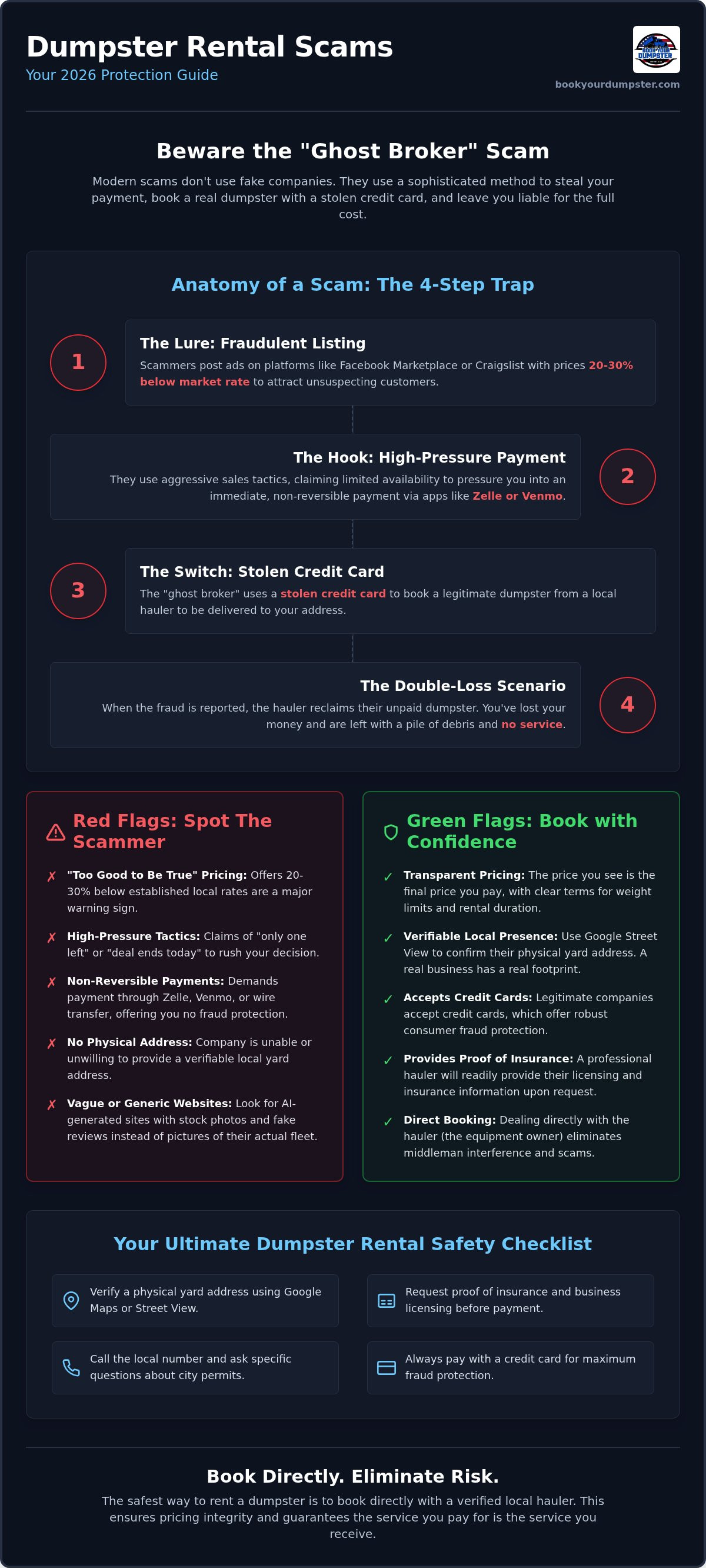
Scammers follow a precise, four-step process to exploit your project timeline and budget. It begins with a fraudulent listing, often for a 20-yard dumpster, priced 20% to 30% below the established market rate in your city. This price is the bait. Once you engage, the scammer uses high-pressure sales tactics to demand immediate payment. They often claim their inventory is nearly exhausted to force a rushed decision. This behavior contradicts standard FTC consumer advice, which warns against contractors who demand full upfront payments via non-reversible methods. Use these red flags as your first line of defense when learning how to avoid dumpster rental scams.
After you send the money, the scammer acts as a "ghost broker." They contact a legitimate local hauler and book a unit for your property using a stolen credit card. The dumpster arrives, and you assume the transaction is complete. However, once the actual cardholder flags the fraudulent charge, a "chargeback" occurs. The real hauler loses their payment and will return to your property to seize the equipment. This leaves you in a "double-payment" trap. You've already lost your money to a criminal, and now you must pay the local hauler again to keep the dumpster or face the cost of a mid-project removal. This logistical disaster can double your waste management costs in a single afternoon.
Payment Method Red Flags
Legitimate rental services like Book Your Dumpster USA rely on secure, traceable credit card processing. Avoid any company that insists on using CashApp, Venmo, Zelle, or wire transfers. These platforms offer zero buyer protection for service-based transactions. A professional business will always have a verifiable Merchant ID linked to their processing system. This ID ensures your financial institution can trace the funds if a dispute arises. If a provider cannot process a standard Visa or Mastercard through a secure portal, they aren't a real business. Verifying the payment gateway is a non-negotiable step in how to avoid dumpster rental scams.
The Hidden Fee Bait-and-Switch
Not every scam involves a disappearing broker. Some predatory companies are "real" but use deceptive tactics to inflate your final bill. They offer a low entry price but add massive "environmental fees" or "fuel surcharges" after the unit is picked up. Read our guide on How to Avoid Hidden Fees on Your Dumpster Rental to understand the standard costs in your area. Always demand a written quote that includes specific weight limits. Some scammers claim a load is "overweight" without providing a certified landfill receipt. If a company refuses to show you the official scale ticket from the dump, they are likely fabricating the overage charge to pad their profits. Demand transparency before you sign any rental agreement.
Red Flags vs. Green Flags: Evaluating a Rental Company
Evaluating a potential vendor requires more than a quick search. You need to look for specific "Green Flags" that indicate a legitimate, local operation. Start with the physical location. A real company has a yard in Queens, NJ, or Chicago that you can identify on a digital map. If the address listed on their website leads to a residential house, a parking lot, or a P.O. box, keep looking. Verifying a physical presence is a primary step in how to avoid dumpster rental scams. Legitimate businesses invest in the infrastructure required to house their fleet and equipment.
Professionalism extends to legal protection. Request proof of general liability and workers' compensation insurance before you book. A legitimate business will send these documents without hesitation. If a vendor is evasive about their coverage, they are likely uninsured or operating illegally. This puts you at direct risk for property damage or injury claims on your project site. Beyond insurance, demand contract transparency. The price must include tonnage, fuel surcharges, and the specific number of rental days. Vague quotes are a major red flag. Legitimate haulers provide a clear breakdown of costs upfront to protect your project budget.
Verifying Local Expertise in NY, NJ, and MA
Check for local area codes during your initial call. A generic 888 or 800 number often masks a lack of local inventory and suggests you are speaking with a broker. In high-scam regions like Queens or parts of New Jersey, verify that the company has a history of local service. Look for trucks with consistent branding in your neighborhood. Use the Better Business Bureau (BBB) to check for state-specific complaints. A legitimate hauler will have a track record of resolving issues in NY, NJ, and MA. Local knowledge also means they understand specific municipal permit requirements, which saves you from potential city fines.
The 'Direct Hauler' Advantage
Booking with a direct hauler provides a significant safety advantage. Companies that own their trucks, such as those featured in our roll-off dumpster rental guide, offer better accountability. Ask point-blank: "Do you own the containers?" and "Where is your dispatch office located?" Brokers often add hidden markups and complicate the customer service process. If a problem arises on-site, a direct hauler can solve it immediately. A broker has to call a third party, which leads to delays and confusion. This direct connection is a key component of how to avoid dumpster rental scams and ensures your money goes toward the actual service provided.
The Ultimate Dumpster Rental Safety Checklist
Protecting your project budget requires a systematic approach to verification. You shouldn't take a salesperson's word at face value when your property and credit card information are on the line. Use this structured checklist to vet every provider before you share any financial details. Following these steps is the most effective way to understand how to avoid dumpster rental scams in a market increasingly crowded with digital middle-men. Execution of these five steps ensures your money reaches a legitimate hauler who actually owns the equipment they promise to deliver.
- Get three local quotes: Establish the current market rate for your specific zip code. If one quote is 25% lower than the others, it is likely a scam designed to harvest your data.
- Verify the physical address: Use Google Street View to look at the company's listed location. You should see a yard with trucks and roll-off containers, not a residential house or a virtual office suite.
- Use major credit cards only: Never pay via wire transfer, Zelle, or CashApp. Major credit cards provide federal chargeback protection that non-reversible payment methods lack.
- Demand a written agreement: Ensure the contract explicitly lists the tonnage limit, rental duration, and any potential fuel surcharges. Verbal promises are unenforceable.
- Confirm truck branding: When the driver arrives, check the door of the truck. The branding must match the company you booked with. If an unmarked truck appears, stop the delivery until you verify the dispatcher's identity.
Essential Questions to Ask Every Dispatcher
Direct communication with a dispatcher reveals the legitimacy of the operation. Ask specific, technical questions to test their local knowledge. "What is the exact weight limit for this 10-yard dumpster?" is a great starting point. Follow up by asking if there are additional fees for local permits in cities like San Francisco or Queens. A real local hauler knows these regulations by heart. Finally, ask if they can provide a certified landfill weight ticket upon request. If they hesitate or claim they don't receive tickets, they are likely hiding predatory overweight charges. For more on managing your project waste safely, read our guide on Residential Dumpster Rental: Rules and Tips.
Documenting the Delivery and Pickup
Documentation is your best defense against post-rental fraud. Take clear photos of the dumpster's fill level when it arrives and right before it is hauled away. This prevents a company from claiming you overfilled the unit or added prohibited materials after you finished your work. Keep a digital copy of the signed delivery receipt and write down the driver's name. These small steps create a paper trail that makes it nearly impossible for scammers to succeed. To ensure a secure transaction with a verified local provider, book your dumpster through our transparent online platform today.
Why Direct Booking with Book Your Dumpster USA is Your Safest Bet
Choosing a direct provider is the most effective strategy for anyone wondering how to avoid dumpster rental scams. By removing the middleman, you eliminate the risk of communication breakdowns and financial fraud. Book Your Dumpster USA operates as a 100% direct-to-consumer platform. You don't deal with a call center in another country; you deal with the team that manages the trucks. We prioritize pricing integrity. The quote you receive through our online system is the final price you pay. There are no surprise environmental fees or unverified surcharges added after your project is complete.
Our service reliability spans major metro areas in New York, New Jersey, Illinois, Massachusetts, and San Francisco. We support both residential cleanouts and professional construction sites. In cities like Queens or San Francisco, local regulations change frequently. We stay updated on permit requirements so you don't have to. This expertise prevents costly city fines and ensures your roll-off is placed legally on the street or in your driveway. We understand the urgency of construction deadlines and the spatial constraints of residential projects. This local knowledge ensures your unit arrives on time and sits exactly where you need it.
Our Direct-to-Site Logistics Model
We eliminate the "Ghost Broker" risk by owning our logistics network and our fleet of trucks. When you book with us, you're securing a unit from our own inventory of 10, 20, 30, and 40-yard dumpsters. Our secure online booking system uses encrypted payment processing to protect your financial data. This direct control allows us to provide real-time updates and consistent service quality that brokers cannot match. For professional-grade projects, see The Ultimate Guide to Construction Debris Removal in 2026 to learn how we streamline large-scale waste management.
Ready to Book with Confidence?
Our platform simplifies waste management. Focus on your project instead of the logistics. We've refined the rental process into a simple 3-step system. Choose your size, select your dates, and enter your delivery details. You'll see real-time availability for residential and commercial projects in your specific neighborhood. This transparency is the ultimate tool in knowing how to avoid dumpster rental scams. We provide a verbal handshake through our digital platform, ensuring you get the service you paid for without the stress of predatory brokers.
Secure your reliable dumpster rental today at BookYourDumpster.com. Our team delivers the equipment you need with the honesty you deserve. Don't leave your project to chance with unverified brokers. Choose a partner that owns the tools and values your project timeline.
Take Control of Your Project Logistics
Scammers rely on project urgency to force mistakes. Protect your budget by verifying physical addresses and avoiding non-reversible payment methods. Always look for direct fleet owners who provide transparent, written contracts. Mastering how to avoid dumpster rental scams ensures your debris is hauled away without the risk of identity theft or financial loss. Your project deserves a reliable partner who understands local regulations in major metro areas.
Book Your Dumpster USA offers an A+ rating and total pricing integrity. We own our fleet and serve NY, NJ, IL, MA, and SF with zero broker interference. This direct model eliminates the confusion of middlemen and guarantees that the price you see is the price you pay. Book Your Reliable Dumpster Directly and Avoid the Scams.
Move forward with your renovation or cleanup project today. You've done the research; now choose the partner that delivers on its promises and respects your project timeline.
Frequently Asked Questions
What are the most common red flags of a dumpster rental scam?
Look for pricing that sits 20% to 30% lower than every other local quote you receive. High-pressure sales tactics that demand immediate action or claim inventory is nearly gone are another major warning sign. Legitimate haulers don't need to force a decision because their equipment levels and schedules are stable. If a representative gets evasive when you ask for a physical yard address, hang up the phone immediately.
Why should I avoid paying for a dumpster rental with Zelle or CashApp?
Avoid these platforms because they offer zero buyer protection for service-based transactions. Once you send money via Zelle or CashApp, it's gone forever with no way to file a formal dispute. Scammers prefer these methods because they can disappear with your payment before the dumpster even arrives. Stick to major credit cards that provide federal chargeback protection to ensure your project funds remain secure and traceable.
How can I tell if a dumpster rental website is a broker or a direct hauler?
Check the website for a physical yard address and local area codes instead of generic 800-numbers. Brokers often use stock photos of trucks without branding and won't have a verifiable presence on digital maps. Ask the dispatcher directly if they own the equipment and where their dispatch office is located. Direct haulers will have a yard you can find on a map, while brokers hide behind virtual offices.
What should I do if I realize I’ve been scammed after the dumpster is delivered?
Contact the local hauler who delivered the unit and explain the situation immediately. They are likely victims of credit card fraud themselves and may be able to work with you. Call your bank to initiate a chargeback if you paid via credit card and report the incident to the FTC. Learning how to avoid dumpster rental scams after the fact is difficult, but documenting the driver's info helps authorities.
Is it normal for a dumpster company to ask for payment before delivery?
It's standard practice for legitimate companies to require payment or a credit card on file before the unit is dropped off. This covers the initial rental fee and establishes a method for potential overweight charges. However, this payment should only happen through a secure, encrypted portal on the company's official website. Never share your card details over an unverified text link or a third-party messaging app that lacks merchant security.
Are there specific dumpster rental scams common in New York or New Jersey?
Scammers in NY and NJ often fabricate city permit fees or claim a load is overweight without providing a scale ticket. In Queens and Jersey City, ensure your provider understands the specific street placement laws and permit costs. Always demand a certified landfill receipt if you're charged for exceeding your weight limit. Verified local haulers in the Northeast will always provide this documentation to prove the integrity of their final billing.
How do I verify if a dumpster rental company is actually local to my city?
Use Google Street View to inspect the yard at the company's listed address. You should see containers and trucks, not a strip mall, a residential house, or a virtual office suite. Test the dispatcher's knowledge by asking which local landfill they use for disposal in your specific area. If they can't name the facility or explain the route, they are likely a national broker with no actual local presence.
What documentation should I receive to ensure my rental is legitimate?
Demand a written rental agreement that outlines the tonnage limit, rental duration, and all potential surcharges before you pay. Upon delivery, you should receive a signed receipt from the driver that includes the company's branding. After the unit is picked up, ask for the official weight ticket from the disposal facility. This paper trail is the best way to understand how to avoid dumpster rental scams and ensures your transaction remains transparent.


