
What if the most expensive part of your renovation isn't the rental itself, but the surprise $250 per ton bill that arrives after your project is finished? It's a common frustration for homeowners and contractors who don't know how to avoid overage charges on a dumpster. You see a fixed price online, only to face opaque fees because your debris weighed more than the initial allowance. Estimating weight is notoriously difficult, and nobody likes an unexpected bill after the hard work is done. We believe transparency is the foundation of a successful project, and you shouldn't have to guess what you'll owe.
Mastering your rental logistics starts with understanding the relationship between weight limits and material density. Whether you're navigating Massachusetts overage fees that range from $75 to $150 per ton or handling a cleanout in Southern Illinois at $105 per ton, you can stay on budget with a proactive strategy. This guide provides actionable tips on choosing the correct size and loading your container efficiently. You'll get a clear breakdown of regional regulations and a reliable approach to ensure your final invoice matches your initial quote every time.
Key Takeaways
- Understand the "Tipping Fee" concept and why landfills in New York and Illinois charge by weight rather than volume.
- Master the 250-pound rule for household junk to learn how to avoid overage charges on a dumpster before you start loading.
- Identify heavy debris like concrete and roofing shingles that can trigger penalties even when the container looks half empty.
- Use strategic loading techniques and weather-proofing hacks to prevent your debris from gaining heavy "rain weight" during storms.
- Compare the cost-benefit of different container sizes to see why upsizing is usually cheaper than paying a single overage fee.
What Are Dumpster Overage Charges and Why Do They Happen?
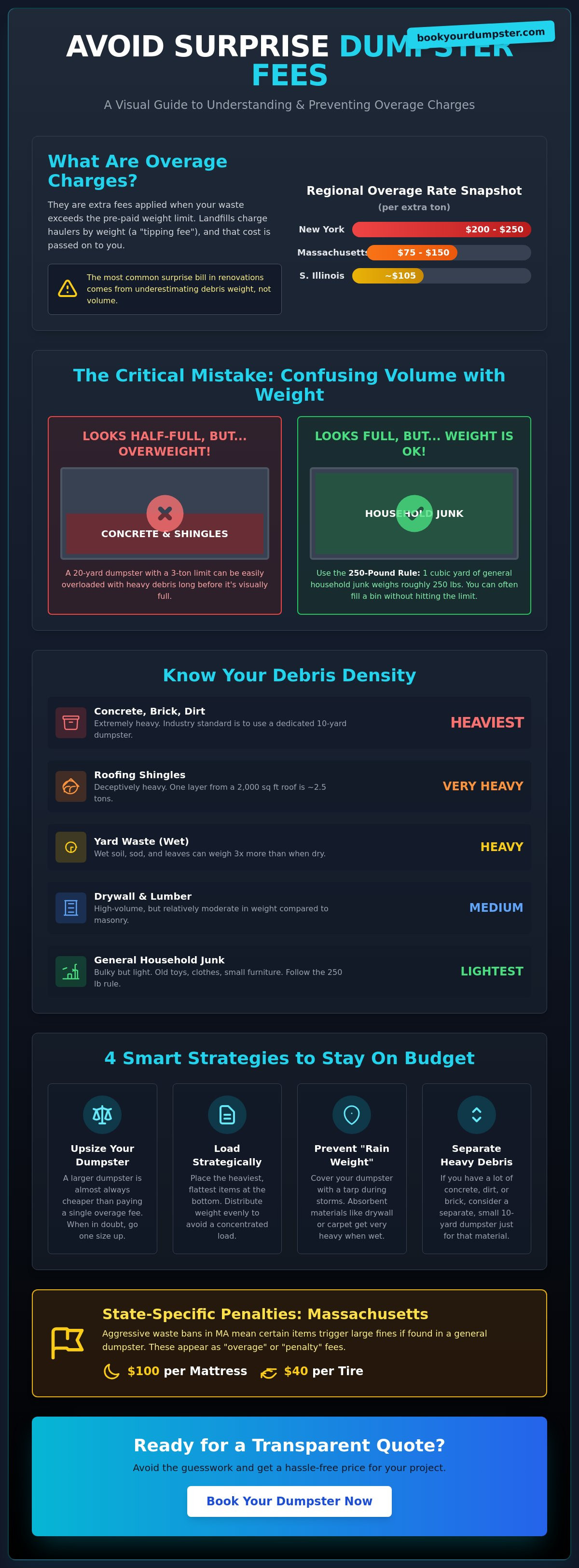
Overage charges are fees applied when your waste exceeds the pre-negotiated weight limit or the physical height of the container. Think of these as a logistical pass-through cost. Landfills and transfer stations charge haulers based on the weight of the material they drop off, a cost known as a tipping fee. When your project produces more weight than your initial plan covered, the hauler must pay the facility more to process it. These costs are then passed to you. Understanding these fees is the first step in learning how to avoid overage charges on a dumpster during your next project.
Regional infrastructure plays a massive role in these costs. In New York, where landfill space is at a premium, overage fees typically range from $200 to $250 per ton for material exceeding the limit. In Southern Illinois, these charges are often lower, averaging around $105 per ton. These figures aren't arbitrary; they reflect the local economic reality of waste management and the distance the truck must travel to reach a disposal site. If you are working in Massachusetts, you must also account for strict recycling mandates. State law requires the sorting of specific materials, and failing to do so can result in contamination penalties that look exactly like weight overages on your final bill.
The Difference Between Weight Limits and Volume
A common trap for homeowners is confusing the physical size of the bin with its weight capacity. Start by understanding roll-off dumpsters and their specific ratings. A 20-yard dumpster has plenty of room for bulky furniture, but if you fill it with shingles or dirt, it will exceed its 3-ton limit long before it looks full. Always respect the "Fill Line" painted on the side of the container. Loading debris above this line is a safety violation that prevents the driver from tarping the load securely. If a hauler cannot safely transport the bin, they will charge a trip fee or require you to remove the excess before they leave your site.
Regional Factors Influencing Fees in NY, IL, and MA
Geography dictates the rhythm of your waste disposal costs. In New York, the transport distance to upstate landfills significantly affects overage rates. Illinois projects often face specific disposal taxes that are passed down as surcharges. Massachusetts has some of the most aggressive waste bans in the nation. Tossing a mattress in a general dumpster in Boston can trigger a $100 penalty per item, while tires can add $40 each to your bill. Always clarify these local restrictions before you book your dumpster to keep your project on budget.
Estimating Your Debris Weight: The Weight vs. Volume Trap
The most common mistake in waste management is assuming a full dumpster is the same as an overweight one. These are two different metrics. A 20-yard container holds 20 cubic yards of volume, but its weight limit is typically capped at 3 or 4 tons. For standard household junk, use the 250-pound rule. One cubic yard of mixed debris, such as old toys, clothes, and small furniture, weighs approximately 250 pounds. This means you can often fill a large bin with general household items without hitting the limit. However, heavy debris changes the math instantly. This distinction is the core of how to avoid overage charges on a dumpster during a major cleanout.
One layer of asphalt shingles on a 2,000-square-foot roof weighs about 5,000 pounds. That is 2.5 tons of weight in a very small physical footprint. Compare that to a standard bedroom set, which might weigh only 400 pounds. You could fill an entire room with furniture and still weigh less than a single layer of roofing. Mixing these materials in a 30-yard or 40-yard bin is a recipe for surprise fees. If you place two tons of concrete at the bottom and then pile household trash on top, you will almost certainly exceed your weight allowance before the bin is physically full. Keep heavy materials separate to maintain control over your budget.
Density Guide for Common Project Materials
Drywall and lumber are high-volume materials. They take up significant space but are relatively light compared to masonry. A kitchen renovation is more deceptive. Old appliances and heavy oak cabinets add weight faster than you expect. Yard waste is another common culprit. Wet grass, sod, and soil are incredibly dense. A pile of wet leaves can weigh three times as much as dry ones. If you are cleaning out a yard after a storm, account for this added moisture weight immediately.
The "Heavy Debris" Rule for Contractors
Professional contractors use 10-yard dumpsters for heavy materials like concrete, brick, and dirt. This is the industry standard for a reason. Roll-off trucks in dense urban areas like Chicago or Boston have structural limits. Even if a 30-yard bin could physically hold 15 tons of concrete, the truck wouldn't be able to lift it without damaging the hydraulics or violating road weight laws. For these heavy-duty projects, a 10 yard dumpster rental is the safest choice. If you aren't sure which size fits your specific debris type, check our transparent sizing guide to see exact weight allowances for every container.
Choosing the Right Dumpster Size to Prevent Fees
Renting a size up is almost always cheaper than paying a single overage fee. Think of the larger container as an insurance policy for your budget. In New York, exceeding your weight limit by just one ton results in a $200 to $250 surcharge. The price difference between a 20-yard and a 30-yard dumpster is usually a fraction of that cost. If you are on the fence between two sizes, choose the larger one. This simple decision is a primary tactic for anyone figuring out how to avoid overage charges on a dumpster. Choosing the right size is the most effective method for how to avoid overage charges on a dumpster when dealing with mixed debris.
Many homeowners fall for the "Small Project" myth. They assume a 10-yard dumpster is enough for a basement cleanout, only to realize that a few pieces of bulky furniture and a dozen boxes have filled the bin to the brim. While 10-yard containers are perfect for heavy masonry, they lack the volume needed for most residential cleanouts. For more localized advice, consult our Dumpster Rental in New York, Illinois, and Massachusetts: The 2026 Complete Guide. Don't underestimate how quickly household clutter consumes cubic yardage.
Matching Container Capacity to Project Scope
- Garage cleanouts: These projects typically require a 10 or 20-yard container depending on the level of clutter.
- Full roof replacements: A 30-yard dumpster is the safest bet. It handles the weight of the shingles while providing enough volume for the underlayment, flashing, and trim waste. A 2,000-square-foot roof can produce several tons of debris.
- Commercial renovations: Use 40-yard containers. These are necessary for bulky, light materials like metal studs, ceiling tiles, and insulation that take up massive space.
Urban Constraints in New York and Chicago
Your location dictates your maximum dumpster size. In New York City or tight Chicago alleys, street space is a luxury. If a truck cannot access your site because of parked cars or narrow lanes, you will face a "dry run" fee. This fee averages $150 nationally and is charged every time a driver attempts a delivery or pickup but is blocked. Always measure your placement area and clear obstacles before your scheduled window. Remember that placing a dumpster on public property requires a permit. In NYC, these permits cost between $135 and $385. In Illinois, you might pay between $10 and $100 depending on the municipality. Factor these costs into your initial budget to avoid post-project sticker shock.
Proactive Loading Strategies to Manage Weight
Efficient loading is a learned skill that directly impacts your final invoice. It's not just about what you toss into the bin, but where you place it. Proper weight distribution ensures the truck can safely lift the container without straining its hydraulic systems. Place your heaviest items, such as appliances or large furniture pieces, at the bottom of the bin and spread them out evenly across the floor. This creates a stable foundation and prevents the load from shifting during transport. Mastering these physical loading mechanics is a critical part of learning how to avoid overage charges on a dumpster.
Volume management is equally important. Break down every cardboard box and disassemble large furniture items like bed frames or tables. This "Tetris" approach allows you to fill small gaps and maximize every cubic yard of space without significantly increasing the total weight. Most importantly, never stack items above the rim. Haulers are legally required to tarp every load for road safety. If debris is poking out of the top, the driver will likely refuse the pickup, resulting in a trip fee that averages $150 nationwide. Monitor your progress and stop loading once you reach the "Fill Line" painted on the interior wall.
The Tarp Method: Protecting Against Moisture
Environmental factors are the most overlooked cause of surprise weight spikes. Debris acts like a giant sponge during a storm. A 20-yard dumpster has a surface area of approximately 170 square feet. One inch of rain falling into an open container adds roughly 100 gallons of water. At 8.34 pounds per gallon, a single rainstorm adds more than 830 pounds to your load. In Illinois and Massachusetts, winter snow is an even bigger threat. A few inches of heavy, wet snow can easily push you over your ton limit. Secure a heavy-duty tarp over the top of your container every evening and during any forecast of precipitation. This simple five-minute task can save you from paying for hundreds of pounds of useless water weight.
Loading for Safety and Efficiency
Avoid using heavy machinery like a backhoe to compact the trash inside the bin. While it might seem like a good way to save space, it often results in a load that is too heavy for the roll-off truck to lift. Additionally, you must stay vigilant about prohibited items. In Massachusetts, tossing a single mattress or box spring can trigger a $100 flat-fee penalty. Illinois landfills strictly ban tires, liquid paint, and motor oil. These items aren't just heavy; they are environmental hazards that incur immediate fines regardless of your total weight. Before you start your project, book your dumpster online and review our prohibited items list to ensure a hassle-free pickup.
Transparent Booking with Book Your Dumpster USA
Book Your Dumpster USA operates on a foundation of straightforward honesty. We understand that the biggest fear in waste management is the final invoice. Our system eliminates this anxiety by providing a transparent breakdown of exactly what is included in your initial quote. When you choose a container, you aren't just getting a bin; you're getting a specific weight allowance tailored to the local regulations of your state. Whether you are working in the Boston area with $75 to $120 per ton landfill fees or in New York City where permits are mandatory, our platform accounts for these variables upfront. This clarity is the ultimate solution for anyone researching how to avoid overage charges on a dumpster.
Our online booking system is designed for speed and accuracy. It clearly states the weight limits for every container size, from the heavy-debris 10-yard bin to the high-volume 40-yard roll-off. You don't have to guess about tipping fees or surcharges. We present the facts so you can plan your budget with precision. For a deeper look at managing your project effectively, read our Roll Off Dumpster Rental: The Complete Guide to Efficient Waste Management. By providing all the necessary data at the point of purchase, we empower you to make informed decisions that prevent financial surprises.
Why Our Pricing Model Protects Your Budget
We strip away the industry jargon to give you a clear path forward. Our pricing model includes a set tonnage for every rental, ensuring you know your limits before the first piece of debris is tossed. We provide direct communication and on-time delivery to keep your project moving. If your project changes, we offer immediate support to adjust your service. This proactive approach ensures you never feel out of control of your logistics. We focus on reliability so you can focus on your construction or cleanout. Our commitment to no hidden fees acts as a verbal handshake, distinguishing us from the often-opaque structures found elsewhere in the industry.
We understand the pressure of deadlines. A delayed dumpster is a delayed project. We prioritize on-time delivery in every market we serve, from the busy streets of Chicago to the suburbs of Massachusetts. By matching material density to container capacity before the project starts, we eliminate the predictable logistical outcomes that lead to extra costs. Our goal is to move you from a state of clutter to a state of resolution with minimal friction.
Book Your Dumpster Today
Don't let opaque pricing structures derail your project. Take control of your waste management by using a partner that values transparency as much as you do. Our local expertise in New York, Illinois, and Massachusetts means we handle the permit details and landfill rules while you handle the work. Choose your size, schedule your delivery, and clear your debris with confidence. Use our digital-first platform to secure your rental in minutes and get back to what matters most.
Book your dumpster now at BookYourDumpster.com and experience a service with no hidden fees and a commitment to your timeline.
Take Control of Your Project Budget Today
Mastering your waste logistics means you won't be surprised by weight surcharges after your project ends. By matching material density to the correct container size and using proactive loading hacks like the tarp method, you stay within your tonnage allowance. You now have a clear roadmap for how to avoid overage charges on a dumpster by understanding the specific regional rules in New York, Illinois, and Massachusetts. Don't let unpredictable fees turn a successful renovation into a financial headache.
Book Your Dumpster USA provides the tools you need for a hassle-free cleanup. We offer a no hidden fees guarantee and ensure on-time delivery across our service areas. With sizes ranging from 10 to 40 cubic yards, we have the right fit for any residential or commercial job. Book your dumpster at BookYourDumpster.com to secure your delivery window. Start your renovation or cleanout with the confidence that your budget is protected and your timeline is secure.
Frequently Asked Questions
How much is a typical dumpster overage fee in New York?
Typical overage fees in New York range from $200 to $250 per ton. This figure applies to any material that exceeds the weight limit established in your rental agreement. In New York City, you must also account for permit fees between $135 and $385 if the bin sits on public property. Knowing these costs upfront is the best way to understand how to avoid overage charges on a dumpster during a renovation.
Can rain really make my dumpster overweight?
Rain significantly increases the weight of absorbent debris like drywall, wood, and carpeting. One inch of rainfall adds approximately 8.34 pounds for every gallon of water trapped in the bin. A standard 20-yard container can easily gain over 800 pounds during a heavy storm. Always secure a heavy-duty tarp over the opening when you aren't loading it to prevent paying for water weight.
What happens if I fill the dumpster past the top rim?
Filling a container past the top rim results in a refused pickup and a trip fee. Haulers cannot legally transport a dumpster if the debris prevents the safety tarp from being secured. This usually triggers a dry run fee that averages $150 nationally. You will be required to remove the excess material yourself before the driver returns for a second pickup attempt.
How do I know how much my debris weighs before it is picked up?
You can estimate your weight by using standard material density ratios. For general household items, expect one cubic yard to weigh roughly 250 pounds. If you are handling heavy debris, remember that a single layer of shingles on a 2,000-square-foot roof weighs about 5,000 pounds. Use these figures to calculate your total load before the truck arrives to avoid surprise surcharges.
Is it cheaper to rent two small dumpsters or one large one?
One large dumpster is generally more cost-effective than two smaller ones. Renting a single 30-yard bin avoids the second delivery fee and the higher per-yard cost associated with smaller containers. If you are unsure about your total waste volume, choosing the larger size is a primary strategy for how to avoid overage charges on a dumpster by providing a safety buffer for your budget.
What items are most likely to cause an unexpected overage charge?
Heavy masonry materials and wet organic waste are the most common causes of unexpected fees. Concrete, brick, and dirt are incredibly dense; a small pile can easily weigh several tons. Similarly, wet grass clippings or sod can weigh three times more than dry yard waste. If your project involves these materials, rent a dedicated 10-yard heavy debris bin to keep costs predictable.
Do I get a refund if my dumpster is under the weight limit?
Refunds are not typically provided if your load is under the weight limit. The base price of the rental covers the cost of the container, the delivery logistics, and the disposal of any weight up to the specified limit. You are paying for the availability of the equipment and the guaranteed disposal service. Think of the weight limit as a maximum allowance rather than a pay-per-pound scale.
Are there specific items that always trigger extra fees in Massachusetts?
Massachusetts state law mandates specific fees for banned items like mattresses and electronics. You should expect to pay $100 for each mattress or box spring and $50 for televisions or computer monitors. Tires often incur a $40 surcharge per item. These flat fees are applied separately from the total weight of the dumpster and are strictly enforced by local transfer stations.


