
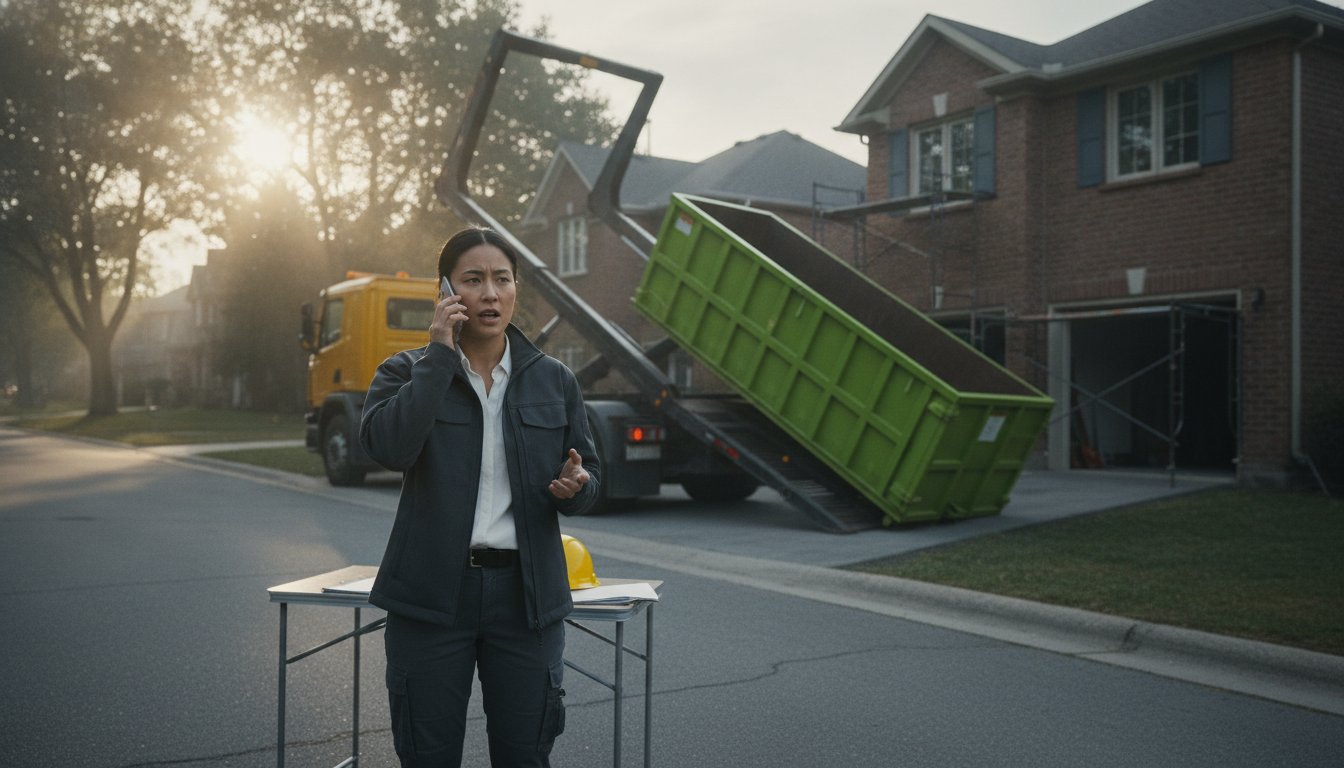
You have a crew standing by at 7:00 AM, but the driveway is empty and your project timeline is already slipping. A missed drop-off or a container placed three feet too far to the left isn't just a minor annoyance; it's a bottleneck that triggers expensive delays and potential dry run fees. Learning how to handle a dumpster delivery issue immediately is essential when you're managing a renovation in Queens or a commercial site in Chicago. You need the equipment to be where you need it, when you need it, without the anxiety of property damage or confusing permit violations.
This guide provides the exact steps to resolve delays, placement errors, and access problems in 2026. We understand that logistical friction costs money and stalls progress. We will walk through immediate troubleshooting tactics, how to navigate local permit requirements, and the best ways to communicate with your provider to avoid extra trip charges. Follow these steps to master the logistics of your roll-off container and keep your site moving toward completion.
Key Takeaways
- Recognize common delivery challenges like dry runs and size errors to prevent immediate project downtime.
- Learn exactly how to handle a dumpster delivery issue by implementing the 15-minute communication rule with dispatch.
- Master local logistics by securing necessary "Right-of-Way" permits for street placement in busy urban areas.
- Use the proactive site checklist to verify clearance and protect your driveway from structural damage.
- Document every step of the delivery process with photos to eliminate disputes regarding accessibility or property condition.
Identifying Common Dumpster Delivery Challenges
A failed delivery is more than an inconvenience; it's a financial drain. The most frequent issue is the "dry run." This occurs when a driver arrives at your site but cannot safely drop the container. Instead of waiting for you to move a vehicle or trim a branch, the driver often moves to the next stop to stay on schedule. You're left with an empty driveway and an additional trip fee. Knowing how to handle a dumpster delivery issue begins with understanding the difference between a carrier error and a site preparation failure.
Size discrepancies also stall projects. If you ordered a 10 yard bin for a concrete tear-out but a 20 yard unit arrives, you face two problems. First, the larger footprint might not fit your designated space. Second, larger bins often have different weight limits for heavy debris like dirt or brick. Always verify the dimensions of Roll-off dumpsters before they arrive to ensure the equipment matches your specific debris type and site capacity.
Physical Obstacles and Site Access Issues
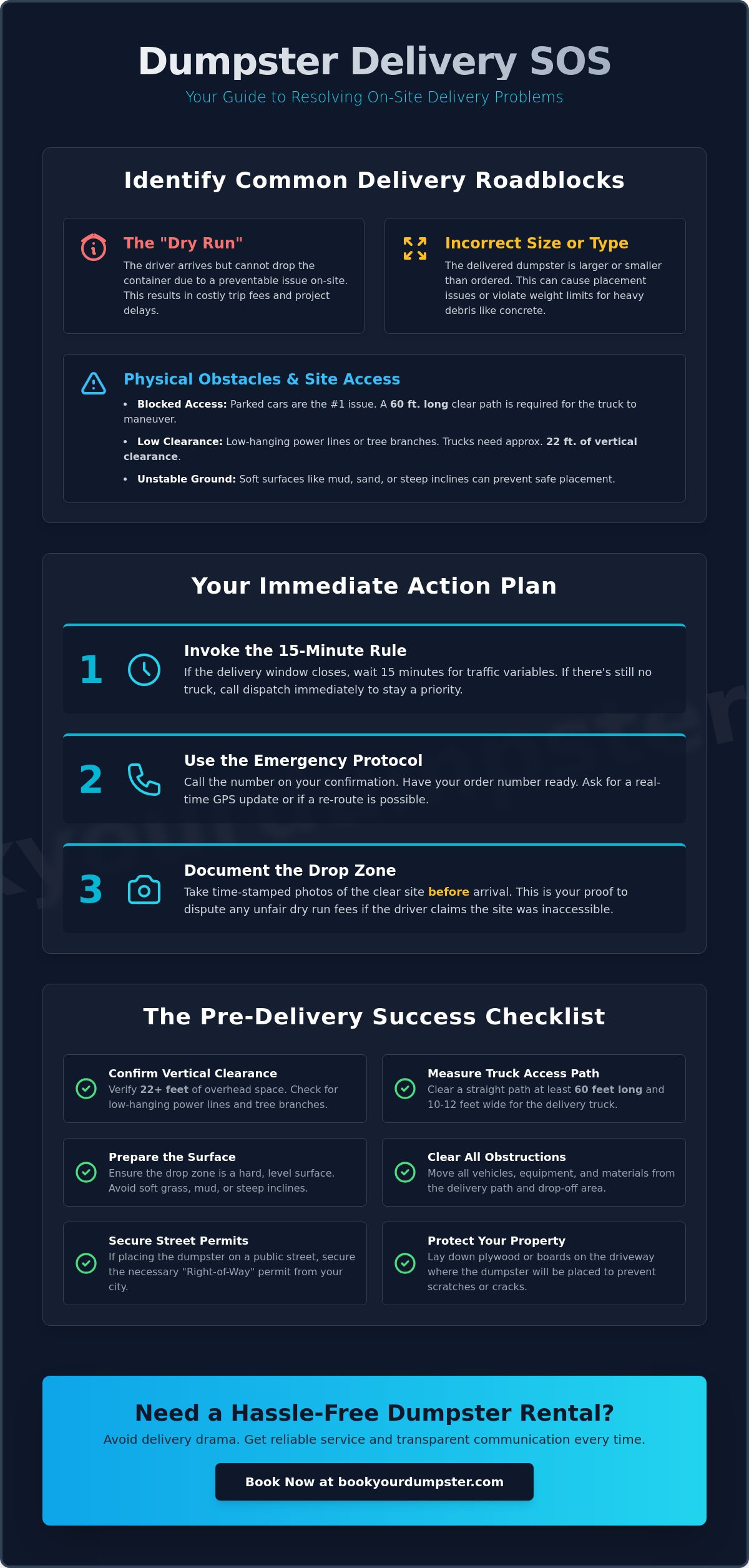
Drivers look for "un-droppable" surfaces immediately. Soft mud, loose sand, or steep inclines are major red flags. If the ground is unstable, the heavy truck can sink or the bin can slide after placement. Low-hanging tree limbs and power lines are equally problematic. Roll-off trucks need approximately 22 feet of vertical clearance to tilt the hoist and slide the bin off the rails. Parked cars in residential neighborhoods are the primary cause of blocked access. Clear a space at least 60 feet long to allow the truck to back in and maneuver without hitting local property or infrastructure.
Administrative and Scheduling Errors
Logistical breakdowns often stem from poor data or external factors. Check your booking confirmation at Book Your Dumpster to verify the drop-off window and placement instructions. Don't rely on "morning" or "afternoon" estimates as binding contracts. Traffic in high-density areas like Chicago or Queens can shift a 9:00 AM delivery to 1:00 PM instantly. Weather also plays a role. Heavy snow in Massachusetts or torrential rain in Illinois can lead to mandatory rescheduling for safety. If the truck doesn't show, contact dispatch within 15 minutes of your window's end to get a real-time GPS update on your equipment. Proactive communication is the only way to minimize the impact of these how to handle a dumpster delivery issue scenarios.
Step-by-Step: How to Handle an Active Delivery Problem
When the truck pulls away without dropping the bin, or your scheduled window closes with no sign of a driver, you must act. Speed is your primary tool. Follow the 15-minute rule. If the delivery window expires, wait exactly 15 minutes before calling the dispatch office. This allows for minor traffic delays while ensuring you remain a priority on the driver's route. Knowing how to handle a dumpster delivery issue requires immediate, documented communication to keep your project on track.
The Emergency Contact Protocol
Call the number on your booking confirmation immediately. If you booked through Book Your Dumpster, our team can track the truck's GPS in real time to provide an accurate arrival estimate. Don't wait for a callback. Ask the dispatcher if a re-route is possible if the driver missed the turn. This is often faster than rescheduling for the next day. Have your order number and the specific name of the on-site contact ready to share. This ensures the dispatcher can bridge the gap between the office and the driver's cab instantly.
Documentation and Evidence Gathering
Evidence prevents unfair fees. Take three photos of the drop zone before the truck arrives. Show the clear path, the absence of low-hanging wires, and the lack of parked cars. This creates a proactive checklist for large deliveries that protects you from dry run charges. If a driver claims the site is inaccessible, send these photos to the dispatcher while the truck is still in the area. Time-stamped images prove the site was ready. This documentation shifts the burden of proof back to the hauling company and provides a clear record for any fee disputes.
Negotiating dry run fees requires a professional approach. If you are hit with an extra charge, present your documentation. Point to the timestamps on your photos and the record of your 15-minute check-in call. Most companies will waive the fee if you can prove the site was clear and accessible. When the truck is on-site, stand at a safe distance and use clear hand signals to guide the driver. Confirm the placement matches your project needs before they unhook the rails. If the bin is placed incorrectly, ask for an adjustment immediately. It's much harder to move a 20 yard or 30 yard container once the truck has left the property.
Local Logistics: Navigating Permits and City-Specific Restrictions
Urban delivery is a game of inches. In high-density areas, the sidewalk and street are public assets governed by strict municipal codes. If you fail to secure the correct "Right-of-Way" permit, the driver will likely bypass your site to avoid heavy fines. These permits typically cost between $10 and $150 depending on the city. In San Francisco, fees can reach $194, while Phoenix remains lower at approximately $25. If you are wondering how to handle a dumpster delivery issue involving local authorities, start by verifying your permit status 48 hours before the truck arrives. Fines for non-compliance range from $50 to over $500 per day.
Noise ordinances and delivery window restrictions also dictate your schedule. Many cities prohibit heavy equipment operation before 7:00 AM or after 7:00 PM. If your project is in a residential zone, a 6:00 AM arrival could trigger a neighbor complaint and a city citation. Always confirm that your requested delivery time aligns with local bylaws to prevent a forced rescheduling or a "No-Drop" situation.
New York and Queens: The Permit Maze
The New York Department of Transportation (DOT) requires specific permits for any container placed on a public street. You must also coordinate with the NYPD if the delivery will block traffic or require a temporary lane closure. In Queens, narrow residential blocks often have "No Parking" signs that must be respected or legally suspended for the delivery window. Review our New York dumpster rental guide for borough-specific regulations. Never assume your driveway is exempt if the truck must cross a public sidewalk to reach it.
Tight Access in San Francisco and Chicago
Chicago's alleyways and San Francisco's steep inclines present unique physical barriers. Large 30 yard or 40 yard dumpsters require significant "swing room" to maneuver. If the street is too narrow, the driver cannot physically drop the bin without hitting parked cars or structures. Weight limits on residential bridges and historic Massachusetts streets can also trigger a reroute. Talk to your neighbors. Ask them to clear street space at least 60 feet in front of the drop zone. This proactive step reduces the risk of a dry run and ensures the driver can place the container safely on the first attempt. Knowing how to handle a dumpster delivery issue before the truck arrives is the best way to maintain your project timeline.
The Proactive Checklist: Preventing Future Delivery Failures
Prevention is the most effective way to manage site logistics. Instead of reacting to a crisis, use a standardized checklist to eliminate the variables that lead to failed drops. Most delivery failures are entirely avoidable through physical site preparation. Follow these steps to ensure your project stays on schedule and your property remains undamaged. Mastering how to handle a dumpster delivery issue starts 24 hours before the truck arrives at your curb.
Protect your driveway from structural damage. A loaded roll-off container exerts thousands of pounds of pressure on a small surface area. Lay down two sheets of 3/4-inch plywood where the bin's rails will rest. This distributes the weight and prevents the steel wheels from cracking your asphalt or sinking into pavers. Also, verify your debris type. Standard rentals do not accept hazardous materials. As of 2026, the EPA has added solar panels and lithium batteries to universal waste regulations. These items require specialized disposal and cannot go into a standard 20 yard or 30 yard bin. Mixing these in will trigger a rejection at the scales and significant environmental fees.
Preparing the Drop Zone
Mark the exact placement spot with orange cones or chalk. Drivers appreciate a clear visual target, especially in tight residential areas. Ensure the surface is level; a bin dropped on a significant slope can be impossible to load safely and may prevent the rear door from opening. Clear all overhead obstacles. Roll-off trucks require 22 feet of vertical clearance and 12 feet of width to operate. Remove basketball hoops, low-hanging holiday lights, and trim any tree limbs that encroach on the path. If you are unsure about dimensions, our roll off dumpster rental guide provides specific footprints for every container size.
Final Confirmation Steps
Confirm your delivery window one day in advance. Provide a secondary contact number for someone who will be physically on-site during the delivery. If the driver encounters a locked gate or a security guard who isn't briefed, they will leave to stay on schedule. Share gate codes and notify security personnel in advance to avoid a dry run fee. Understanding how to handle a dumpster delivery issue means removing the friction before the truck enters your neighborhood. Ready to start your clean-up? Book your dumpster online now to secure your preferred delivery date and size.
Why Reliable Logistics Matter: The Book Your Dumpster USA Standard
Reliable logistics are the backbone of any successful renovation or construction project. While previous sections detailed how to handle a dumpster delivery issue through site prep and documentation, the most effective strategy is choosing a partner that prioritizes transparent communication. Logistical stress occurs when there is a gap between your expectations and the driver's reality. We bridge that gap by using a digital-first approach that modernizes waste management. This ensures that every drop-off is treated as a precision maneuver rather than a best guess. Our system handles the heavy lifting of coordination so you can focus on your project.
Our expert dispatchers coordinate deliveries across challenging urban environments in NY, NJ, and IL daily. We understand the nuances of local street permits and the physical limitations of narrow alleyways. This regional expertise allows us to provide a level of service that generic brokers cannot match. We don't just book a bin; we manage the entire lifecycle of the delivery to ensure your crew isn't left standing around an empty driveway. If a problem arises, we apply our knowledge of how to handle a dumpster delivery issue to resolve it in real-time, often before you even notice a delay.
Simplified Online Booking
Our platform captures precise delivery instructions at the moment of purchase to minimize the risk of dry runs. You can select from a 10 Yard Dumpster, 20 Yard Dumpster, 30 Yard Dumpster, or 40 Yard Dumpster with real-time availability. The 10-yard model is particularly effective for tight residential projects where driveway space is limited. By requiring specific data on obstacles like low wires or narrow gates during the booking process, we ensure the driver arrives with the right equipment and a clear plan. Visit Book Your Dumpster USA to view our current inventory and schedule your delivery with a few clicks.
Professional Support Team
We navigate the permit mazes of San Francisco and the historic restrictions of Massachusetts so you don't have to spend hours on the phone with city hall. Our team acts as your professional advocate. If a hauler dispute occurs, we use the documentation strategies mentioned earlier to resolve the conflict in your favor. We verify timestamps and site photos to protect you from unnecessary trip fees. Our goal is to remove the logistical friction that usually accompanies waste management. Don't let logistics stop your project; rent your dumpster with confidence today and experience a higher standard of reliability.
Secure Your Project Timeline with Precision Logistics
Site management requires more than just a schedule; it requires a framework for handling the unexpected. You now have the tools to protect your driveway with surface protection and the data to verify vertical clearance. Remember to use the 15-minute communication rule and document every drop zone with photos. These steps ensure that municipal permits and physical obstacles don't turn into expensive trip charges. By following these protocols, you now know exactly how to handle a dumpster delivery issue without derailing your budget or your crew's progress.
We provide the professional 10 to 40-yard inventory you need across NY, NJ, IL, MA, and SF. Our streamlined online booking system captures the details that prevent delivery failures before they happen. Don't let logistical clutter slow you down. Book Your Reliable Dumpster Rental Now and take full control of your waste management strategy. Your project deserves a partner that values punctuality as much as you do. Let's get to work.
Frequently Asked Questions
What should I do if the dumpster driver says they can't drop the bin?
Ask for the specific safety or access reason immediately and contact the dispatch office while the truck is still on-site. Drivers often cite soft ground or overhead obstructions as "un-droppable" conditions. If you can resolve the issue instantly, such as moving a portable basketball hoop or trimming a low branch, do so to prevent the driver from leaving and charging a dry run fee.
Will I be charged a fee if the delivery is blocked by a car?
Expect a dry run fee if a vehicle prevents the truck from accessing the designated drop zone. Drivers operate on tight schedules and cannot wait for you to locate neighbors or move cars once they arrive. Clear the entire 60-foot approach path at least 30 minutes before your scheduled window to ensure the delivery goes through without additional costs.
Can a dumpster be placed on a steep driveway?
Most drivers will refuse placement on a steep incline because it creates a significant safety hazard. Gravity can cause the container to slide during the loading process or prevent the heavy rear door from opening or latching correctly. If your driveway has a notable grade, identify a level spot on the street and secure the required municipal permits before the truck arrives.
Do I need to be home when the dumpster is delivered?
You don't have to be present if the delivery area is accessible and your instructions are unmistakable. However, being on-site allows you to provide real-time guidance and verify the placement matches your project needs. If you cannot be there, ensure all gates are unlocked and the drop zone is marked clearly with cones or chalk to avoid any confusion.
What happens if the dumpster damages my driveway during delivery?
Take photos of the damage and the surrounding site conditions immediately to document the incident. Most rental agreements include a damage waiver that protects the hauler from standard wear and tear on asphalt or concrete. If you believe the driver acted negligently, contact the support team to discuss how to handle a dumpster delivery issue involving property damage while providing your time-stamped evidence.
How much clearance does a roll-off truck need for delivery?
A standard roll-off truck requires approximately 22 feet of vertical clearance and a path at least 12 feet wide. The vehicle also needs 60 feet of straight-line distance to back into the spot and tilt the hoist safely. Always check for low-hanging eaves, tree limbs, and utility lines that might obstruct the truck's hoist during the drop-off process.
How do I change my delivery instructions after I've already booked?
Call the dispatch office or update your order through the digital portal at least 24 hours before your scheduled date. Last-minute changes rarely reach the driver once they have started their daily route. Providing updated gate codes or specific placement shifts early is the most effective way to prevent a logistical breakdown and ensure your container ends up in the right spot.
Can I have a dumpster delivered to the street in New York City?
Yes, but you must secure a permit from the Department of Transportation before the truck arrives. Placing a container on a public road in NYC without a permit leads to immediate city fines and the potential removal of the bin at your expense. When learning how to handle a dumpster delivery issue in high-density areas, prioritize permit verification to avoid NYPD traffic intervention.


