

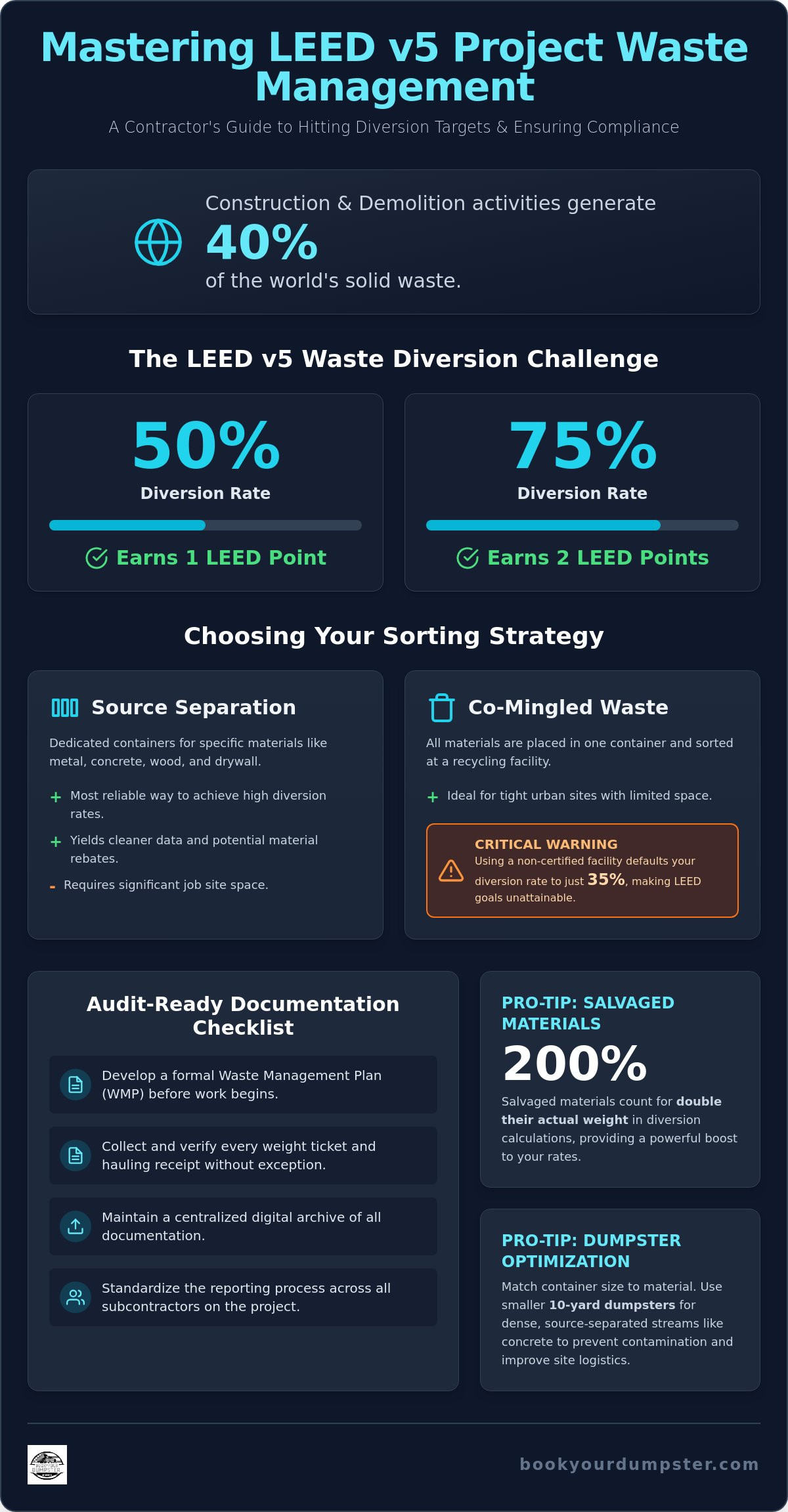
Construction and demolition activities generate about 40% of the world's solid waste. For contractors in 2026, managing that volume while meeting LEED v5 standards is a high-stakes logistics challenge. You already know that poor documentation or an unreliable hauler can cost you critical points and delay certification. Master your LEED project waste management and reporting now to avoid the headache of inaccurate weight tickets and audit failures.
This guide shows you how to hit 50% or 75% diversion rates without the usual site-level chaos. You'll learn how to navigate the new LEED v5 requirements for source-separated materials and third-party certified facilities. We'll break down the specific dumpster strategies for tight urban sites and show you how to maintain clean, audit-ready records from the first load to the final report.
Key Takeaways
- Learn the core shifts in LEED v5, including the new mandatory minimums for salvaged and source-separated materials.
- Understand how to achieve 50% or 75% diversion rates by utilizing third-party certified recycling facilities for commingled loads.
- Master the documentation process for LEED project waste management and reporting to ensure your weight tickets are audit-ready.
- Optimize your job site by matching dumpster sizes, from 10 to 40 yards, to specific material streams to prevent contamination.
- Navigate regional regulations in major markets like NYC and San Francisco to keep your project compliant and on schedule.
Understanding LEED Project Waste Management and Reporting Requirements
The Construction and Demolition (C&D) Waste Management credit is a core pillar of the Leadership in Energy and Environmental Design (LEED) program. It requires contractors to move beyond basic recycling and adopt a rigorous strategy for material recovery. Successful LEED project waste management and reporting starts with a clear understanding that every pound of material leaving your site must be accounted for. You aren't just hiring a hauler; you're managing a data stream that determines the final certification level of the building.
Reporting has shifted from simple recycling checkboxes to comprehensive diversion audits. Under the current LEED v5 standards, you can't rely on informal letters from facilities. If your commingled waste goes to a facility without third-party certification, you must assume a default diversion rate of only 35%. This makes high-quality documentation essential. Poor reporting puts the entire project's sustainability goals at risk. If the paperwork doesn't match the reality of the job site, those points vanish, potentially dropping a project from Gold to Silver status.
The primary responsibility for LEED project waste management and reporting falls on the project manager, but site supervisors and haulers play vital roles. The PM sets the strategy. Site supervisors enforce material separation. Haulers provide the verified weight tickets. Everyone must coordinate from day one to avoid logistical delays or documentation gaps.
The Core Objectives of LEED Waste Credits
LEED credits focus on three main goals. First, reduce waste generation through smarter material handling. Order only what you need and protect materials from weather damage. Second, maximize diversion. Keep as much material as possible out of landfills and incinerators. Third, support the circular economy. By source-separating materials like concrete or metal, you ensure they can be processed back into high-value products rather than being downcycled into low-grade fill.
Reporting Metrics: Weights, Volumes, and Diversion Rates
Weight-based reporting is the industry standard. While volume is an option, weight is more accurate and preferred for LEED v5 submissions. Calculate your diversion rate by dividing the weight of diverted materials by the total weight of all waste generated. Salvaged materials are highly effective because they count for 200% of their actual weight in your calculations. Your Waste Management Plan (WMP) is a living document. Update it as the project grows to reflect actual site conditions. Using Book Your Dumpster USA helps you maintain this digital trail by centralizing your roll-off orders and providing the clear records your LEED coordinator expects.
Developing a Compliant LEED Waste Management Plan
A successful LEED project waste management and reporting strategy begins with a technical Waste Management Plan (WMP). This document isn't just a formality. It's a roadmap for your crew and haulers. Align your plan with EPA construction waste management specifications to ensure you meet federal and industry performance standards. Your WMP must clearly define which materials you'll divert and which facilities will receive them. In 2026, you're likely transitioning to LEED v5. This version demands higher precision. You'll need to divert 50% of materials for one point or 75% for two points. Identify your primary streams like concrete, wood, metal, and drywall early in the pre-construction phase.
Source Separation vs. Co-Mingled Waste
Site constraints often dictate your sorting method. Source separation is the most reliable way to hit high diversion targets. It involves dedicated containers for specific materials like scrap metal or clean concrete. This method often yields higher rebates and ensures cleaner data. However, tight urban sites in New York or San Francisco rarely have space for five different dumpsters. In these cases, co-mingled containers are necessary. If you choose co-mingling, verify that your processing facility is third-party certified. Under LEED v5, using a non-certified facility drops your assumed diversion rate to a flat 35% regardless of what the facility claims in a letter. For smaller, high-density loads like concrete, ordering a 10-yard dumpster for source separation is often the most efficient choice.
Documentation and Tracking Procedures
Documentation is the only proof USGBC accepts. You must collect every hauling receipt and weight ticket without exception. One missing ticket can skew your entire diversion percentage. Create a digital archive immediately. Scan physical tickets or use digital manifests provided by your hauler. Standardize this process across all subcontractors. If the drywall crew uses their own hauler, they must provide the same level of detail as your primary waste provider. This centralized approach ensures your LEED project waste management and reporting is audit-ready and prevents last-minute scrambles during the final certification phase.
Optimizing Dumpster Logistics for LEED Projects
Logistics is where LEED points are won or lost. You can have a perfect plan on paper, but if your site is cluttered and disorganized, your data will suffer. Efficient LEED project waste management and reporting depends on the physical flow of materials from the building to the container. You must synchronize your hauling schedule with your production rate to avoid overflows. Overfilled bins lead to mixed waste and lost diversion opportunities. Review the LEED v4 Waste Management Credits to understand how different project types require specific container setups for maximum credit achievement.
Managing frequent pull and returns is essential for keeping a site clear and compliant. Don't let full dumpsters sit. Schedule a swap as soon as a container reaches 75% capacity. This proactive approach prevents subcontractors from tossing debris into the wrong bin because the correct one is full. High-velocity sites in Chicago or Boston require a hauler that respects your timeline. Reliable timing ensures that your waste logs remain accurate and your site stays safe for inspections.
Selecting the Right Container for the Job
Match your container size to the density of the material you're moving. Use 10-yard dumpsters for heavy, source-separated debris like concrete, brick, or dirt. These smaller bins prevent overweight issues and are easier to place in tight staging areas. For bulky, light materials like wood, metal studs, and cardboard packaging, leverage 30 and 40-yard dumpsters. These larger sizes reduce the number of hauls needed, which lowers your project's carbon footprint. Consult our Choosing a Construction Dumpster: Size Guide for a detailed breakdown of dimensions and weight limits for each stream.
Preventing Stream Contamination
Contamination is the fastest way to ruin a diversion report. One bag of lunch trash in a concrete bin can disqualify the entire load. Use clear, bilingual signage and color-coding for every container on site. Place your recycling bins in high-traffic areas and keep the general trash bins near the exits. Train every subcontractor on the importance of LEED-specific sorting during their initial safety briefing. Monitor your containers daily. If you're working on a busy city street, use locking lids or temporary fencing to prevent the public from dumping unauthorized waste into your LEED-tracked bins. This level of control is what separates a successful certification from an audit failure.
Local Compliance and Reporting in Major US Metros
LEED project waste management and reporting is a national standard, but local regulations often set a higher floor for performance. You cannot rely on LEED guidelines alone when working in high-density markets like New York, Chicago, or Boston. Local mandates frequently dictate where your waste can go and who can haul it. In New York City, you must navigate Local Law 19 and strict Business Integrity Commission (BIC) rules. These regulations ensure that only licensed carters handle trade waste. Failing to use a BIC-licensed provider doesn't just risk your LEED points; it risks heavy municipal fines and project shutdowns.
In Massachusetts, the Department of Environmental Protection (DEP) enforces strict waste bans on asphalt, brick, and concrete. These materials are legally barred from landfills. This makes your diversion strategy mandatory rather than optional. Similarly, Chicago's C&D recycling ordinance requires a minimum 50% diversion rate for most projects. While this matches the LEED baseline, the city's specific reporting forms must be filed alongside your LEED documentation. For a detailed breakdown of regional logistics, read our Dumpster Rental in New York, Illinois, and Massachusetts guide.
Urban Site Constraints in San Francisco and Queens
Space is your biggest enemy in vertical construction environments. In areas like San Francisco or Queens, you often need dumpsters placed on public right-of-ways. Secure your street permits weeks in advance to avoid logistical delays. Logistics for high-rise LEED projects require a "just-in-time" hauling approach. You don't have room for multiple bins, so you must rely on a hauler that can access local certified C&D processing facilities quickly. This ensures your co-mingled loads are processed at a facility that provides the third-party verification LEED v5 demands.
State-Specific Diversion Mandates
New Jersey's recycling laws are some of the most comprehensive in the country. They integrate directly with LEED v4.1 reporting by mandating the separation of corrugated cardboard and metal. In Massachusetts, the 'Recycle Smart' initiative provides clear guidelines for construction sites to maximize material recovery. Be aware that reporting requirements can vary significantly between suburban Illinois and downtown Chicago. While suburban projects might have more space for source separation, downtown sites must rely on high-efficiency co-mingling and rigorous facility audits to hit their targets.
If you're managing a project in these high-demand zones, order your roll-off containers online to ensure your documentation starts on the right foot with a reliable partner.
Streamlining Your LEED Reporting with Book Your Dumpster USA
Managing LEED project waste management and reporting shouldn't be a manual chore. You need a system that captures data the moment you place an order. Book Your Dumpster USA provides a streamlined online booking platform designed for the professional contractor. When you schedule a 10, 20, 30, or 40-yard roll-off container, our system initiates a clear digital trail. This trail is essential for your final LEED submission. You don't have time to chase down paper receipts from an unverified dump site. You need a partner that centralizes your hauling logs and provides the clean, audit-ready data your project demands.
Reliability is the foundation of site compliance. If a hauler misses a window, your site becomes cluttered. This leads to material contamination and lost points. We operate in key LEED markets including NY, NJ, IL, MA, and San Francisco. Our inventory is ready for large-scale commercial projects that require punctuality. Whether you're source-separating concrete in a 10-yard dumpster or managing bulky wood waste in a 40-yard unit, we provide the specific tools to keep your timeline on track. Our experience in major markets like Queens, NY and Chicago, IL means we understand the local nuances of C&D waste management.
The Professional Partner for Commercial Waste
A professional logistics partner offers more than just a bin. We understand that LEED tracking is a high-stakes data game. Unlike a generic dump site, we focus on the documentation you need for certification. Tailor your rental schedules to meet the high-velocity demands of your site. We ensure pricing integrity so your project overhead remains predictable. There are no hidden fees or surprise surcharges here. You get direct, professional service that respects your budget and your deadline. This level of control is vital for maintaining your LEED project waste management and reporting standards throughout the build.
Next Steps for Your LEED Project
Success starts with a proactive approach to your waste streams. Follow these steps to get your project moving:
- Evaluate your streams: Determine which materials you'll source-separate and which will be co-mingled.
- Size your containers: Match your 10, 20, 30, or 40-yard dumpsters to the density and volume of your debris.
- Set your schedule: Plan your deliveries to coincide with major demolition or framing milestones.
- Start your trail: Use our online system to keep all your weight tickets and receipts in one digital location.
Don't wait until your site is buried in debris to think about your reporting requirements. Book Your Dumpster today to simplify your LEED reporting and ensure your project hits its sustainability targets without logistical delays.
Master Your Site Logistics for 2026
Successful LEED project waste management and reporting depends on a mix of early planning and precise execution. You now have the roadmap to navigate LEED v5 requirements and avoid the common pitfalls of site contamination. Matching your 10 to 40-yard containers to specific material streams is the most effective way to protect your diversion rates. Whether you're working in the high-density streets of San Francisco or the vertical construction environments of New York City, your reporting must be beyond reproach.
Don't let poor documentation or a slow hauler put your sustainability targets at risk. We provide the inventory and digital tracking necessary for commercial success in NY, NJ, IL, MA, and SF. Our online booking system creates an immediate paper trail for every load, keeping your project audit-ready from day one. Take control of your waste stream now to ensure your project stays on schedule and meets its environmental goals. Secure your LEED-ready dumpster rental today and simplify your path to certification.
Frequently Asked Questions
What is the minimum diversion rate required for LEED certification in 2026?
Projects must divert at least 50% of construction and demolition materials from landfills to earn one point under LEED v5. To earn two points, you must reach a 75% diversion rate. Keep in mind that a specific portion of this diverted material must be salvaged or source-separated for single-material recycling to qualify for these credits.
Can I use co-mingled recycling and still earn LEED points?
Yes, you can use co-mingled containers, but you must use a third-party certified recycling facility. If you use a facility without this certification, LEED v5 requires you to assume a default diversion rate of only 35%. This makes choosing a professional logistics partner essential for hitting your 50% or 75% targets.
How do I calculate the diversion rate for my LEED project report?
Calculate your rate by dividing the total weight of diverted materials by the total weight of all waste generated. For accurate LEED project waste management and reporting, weight-based data is the required standard. Note that salvaged materials are valued at 200% of their actual weight, which helps you reach higher diversion thresholds more quickly.
What documentation do I need from my dumpster rental provider for LEED audits?
Collect every weight ticket and hauling receipt for every container that leaves your site. You also need a certified diversion report from the processing facility for any co-mingled loads. Use a digital booking system to maintain a centralized, audit-ready paper trail that clearly shows the final destination and processing method for all debris.
Are there specific dumpster sizes recommended for source-separated LEED waste?
Use 10-yard dumpsters for heavy, source-separated materials like concrete, brick, or scrap metal. These smaller containers are easier to manage and help prevent overweight charges. For bulky but lighter materials like wood or cardboard packaging, 30 or 40-yard dumpsters are more efficient and reduce the number of hauls required for your project.
What happens if my waste diversion rate falls below the 50% LEED threshold?
If your diversion rate falls below 50%, you will not earn any points for the Construction and Demolition Waste Diversion credit. You must still provide a full accounting of all waste generated to meet basic project requirements. Failing to hit this threshold can prevent your project from reaching higher certification levels like Gold or Platinum.
Does LEED v5 change the way waste management is reported?
LEED v5 introduces a new requirement that at least 10% of diverted materials must be salvaged or source-separated. For projects aiming for 75% diversion, that requirement increases to 25%. This shift means your LEED project waste management and reporting must now distinguish between materials sorted on-site and those sent to a co-mingled facility.
How do local waste bans in Massachusetts affect my LEED project?
Massachusetts bans materials like asphalt, brick, concrete, and clean wood from landfills. This legal mandate forces high diversion rates for these specific streams, which directly supports your LEED goals. Your reporting must reflect that these materials were sent to proper recycling outlets to remain compliant with both state law and LEED standards.


