

Choosing the wrong waste container can turn a simple cleanup into a logistical nightmare of city fines and overweight fees. Whether you are managing a construction site in Chicago or a retail shop in Manhattan, the roll off vs front load dumpster decision dictates your daily efficiency. A roll-off is a heavy-duty tool for a specific job. A front-load is a permanent system for your business. Selecting the wrong one doesn't just waste space; it wastes money and slows down your project.
You probably want to avoid the stress of ordering a bin that's too small or facing a surprise bill for an overweight load. We understand that logistics should be the easiest part of your job. This guide clarifies the critical differences in volume, placement, and service frequency. You'll learn how to match a container to your specific waste output, navigate local permit requirements in cities like New York and San Francisco, and use a streamlined online booking system to secure your rental without the headache. Get the facts now to keep your project on schedule and your site clean.
Key Takeaways
- Differentiate between one-time cleanouts and recurring commercial service to ensure you select the right waste management model for your needs.
- Master the roll off vs front load dumpster logistics by evaluating your site’s available "pull-in" space and loading access.
- Select the exact container size needed, from 10-yard residential starters to 40-yard construction bins, to avoid unexpected overage fees.
- Navigate urban constraints and permit requirements in major hubs like NYC and San Francisco to prevent costly city fines and placement delays.
- Streamline your project timeline by using a digital booking system that handles scheduling and transparent pricing in seconds.
Roll Off vs. Front Load Dumpster: Understanding the Core Differences
Choosing between a roll off vs front load dumpster isn't just about size. It's about the nature of your waste. If you're tearing out a kitchen in Queens or clearing a construction site in Chicago, you need a temporary solution. If you're running a restaurant in San Francisco, you need a permanent fixture. Choosing the wrong one causes immediate logistical friction. A front-load bin won't handle a ton of concrete; a roll-off container is overkill for daily office trash. Select the tool that matches your waste flow to avoid unnecessary expenses.
Understanding the basic design helps you avoid costly errors. According to Wikipedia's overview of dumpster types, these containers vary significantly in how they are loaded and emptied. Roll-offs are rectangular, open-top boxes designed for high-volume, heavy debris. Front-load dumpsters are smaller, lidded units meant for compact, recurring waste streams. You must distinguish between project-based waste and daily operational waste before you sign a service agreement.
What is a Roll-Off Dumpster?
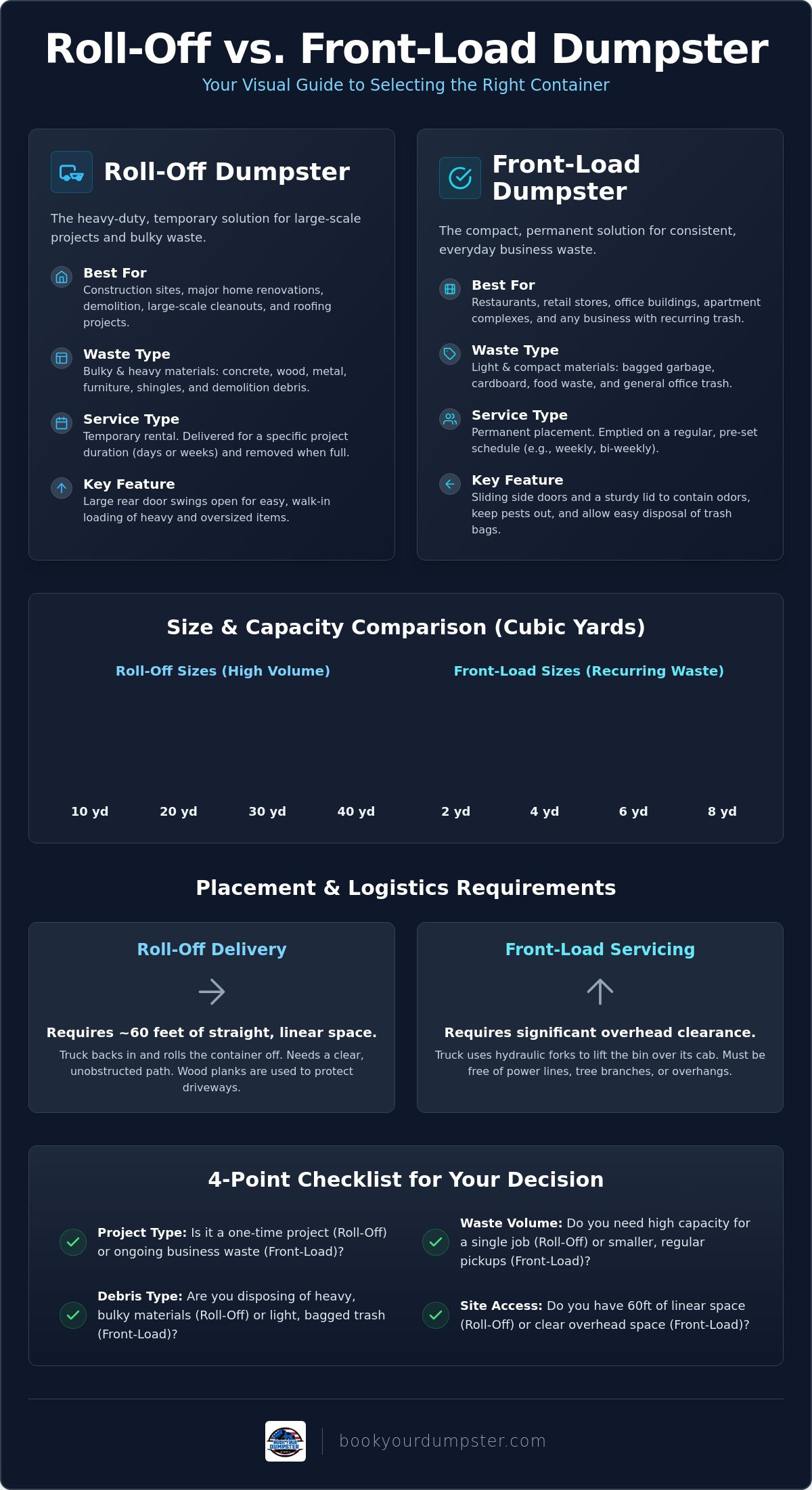
These containers get their name from the delivery method. A specialized truck uses a hoist and cable system to "roll" the bin off the back of the bed. They feature an open top and a large rear door, making them ideal for bulky items like old furniture, roofing shingles, or demolition waste. We offer these in 10, 20, 30, and 40-yard capacities to fit everything from small home cleanouts to massive commercial builds. Check our options at Book Your Dumpster USA to see which volume fits your site. These are temporary rentals, typically used for a few days or weeks until the job is done.
What is a Front-Load Dumpster?
These are the workhorses of the commercial world. They are compact, usually ranging from 2 to 8 yards. A garbage truck equipped with hydraulic forks approaches the bin from the front, slides the forks into side pockets, and lifts the container over the cab to dump it into the hopper. The slanted tops and heavy-duty lids keep pests out and odors in. These are best for businesses with a steady, predictable flow of trash that requires a weekly or bi-weekly pickup schedule. They stay on your property permanently as part of your facility's infrastructure.
Miscalculating this choice leads to unexpected fees. If you put heavy construction debris in a front-load bin, the truck may not be able to lift it. If you keep a roll-off on-site for months without filling it, you're paying for space you don't need. Align your choice with your project’s lifespan and waste volume. This simple step ensures your site remains clean and your budget stays intact.
Functional Breakdown: How They Work and Why It Matters
Efficiency depends on more than just container volume. You must account for the physical footprint of the delivery vehicle and the bin itself. When evaluating a roll off vs front load dumpster, consider your site's physical limitations first. A container that fits on paper might be impossible to deliver if your access point is too narrow or obstructed by low-hanging utilities. Logistics fail when placement isn't planned.
Truck Requirements and Placement
Roll-off trucks require roughly 60 feet of linear space for delivery. This provides the driver enough room to back in, tilt the bed, and slide the container onto the ground. If you're working in a tight urban environment, check NYC dumpster permit regulations to ensure your street placement is legal and safe. Front-load trucks operate differently. They need significant overhead clearance to lift bins over the truck cab without hitting power lines or tree branches. Roll-offs are placed on temporary wood planks to protect driveways from the weight of the steel rollers. Always clear the path before the truck arrives to avoid delay fees.
Loading and Weight Capacities
Loading methods vary based on the debris type. Roll-offs feature a swinging rear door. This allows you to walk heavy items like concrete, old cabinetry, or roofing bundles directly into the bin. It's the only practical way to handle dense construction materials without risking injury or equipment damage. Front-loads are designed for bagged trash and light commercial waste. You toss items through the top or side doors, which are then secured with a lid. The weight capacity of a roll-off is significantly higher. Heavy materials like concrete or dirt will quickly exceed the lift capacity of a front-load truck. If you're disposing of dense debris, a roll-off is your only viable option. You can browse our 10 to 40-yard roll-off sizes to find a weight capacity that matches your specific debris type.
Visualizing the footprint is critical for site safety. A 10-yard roll-off takes up about the same space as a standard SUV. A front-load bin is much more compact, often fitting into a small corner of a parking lot or a dedicated enclosure. Match your container to your available square footage. If you don't have 60 feet of clearance, you may need to rethink your placement strategy or opt for a smaller bin size. Proper planning ensures the truck can service the bin without damaging your property or blocking traffic.
Choosing Based on Project Type: Temporary vs. Permanent Solutions
Waste management isn't a one-size-fits-all service. Your specific project timeline dictates the equipment you need. When comparing a roll off vs front load dumpster, start by defining your end date. One-time cleanouts require high-capacity, temporary bins. Ongoing operations require scheduled pickups and permanent infrastructure. Choosing the wrong service model leads to service gaps or paying for empty space. Align your waste solution with your project's lifecycle to maintain a lean budget.
When to Choose a Roll-Off Container
Select a roll-off for any project with a defined start and finish. These containers are the standard for construction debris removal because they handle the sheer weight of wood, metal, and drywall. If you're clearing out a basement, replacing a roof, or managing a job site, you need the volume of a 10 to 40-yard bin. These are essential for roll off dumpster rental in active construction zones where waste accumulates quickly. You get the bin, fill it up, and we haul it away. It's a clean, linear process designed for efficiency.
When to Choose Front-Load Commercial Service
Businesses generating a steady stream of daily trash require front-load service. This is the preferred choice for retail centers, office buildings, and restaurants where space is limited. These bins stay on-site permanently. You don't have to worry about scheduling a new delivery every week. Instead, you set a recurring pickup schedule that fits your operational flow. If your site cannot accommodate a 60-foot truck maneuver, a compact front-load bin is your only viable solution. It provides a reliable, lidded waste point that keeps your property professional and clean.
Sometimes your needs overlap. A retail store might keep a front-load bin for daily cardboard but need a 20-yard roll-off for a weekend renovation. This hybrid approach is common for businesses staying compliant with Massachusetts solid waste regulations or other local mandates during facility upgrades. In these cases, the roll off vs front load dumpster distinction is clear: use the front-load for your process and the roll-off for your project.
Cost-efficiency also varies by service type. Roll-offs usually involve a flat rental fee for a specific duration, often with weight limits tailored to heavy materials. Front-load services operate on monthly contracts. You pay for the reliability of the schedule rather than the one-time haul. Evaluate your waste volume over a 30-day period. If the volume is high but temporary, rent a roll-off. If the volume is low but constant, secure a front-load contract. Make the choice that removes logistical stress from your daily routine.
Navigating Local Constraints: Placement in NYC, Illinois, and Massachusetts
Urban density creates unique challenges for waste management. In high-traffic areas like Queens or San Francisco, the roll off vs front load dumpster choice often comes down to inches. If you're working on a residential street in Queens, you likely face the "Queens constraint." Large 40-yard bins simply won't fit in narrow driveways or tight alleys. In these cases, a 10-yard bin is your only viable option for a home cleanout. Navigating these tight spaces requires a driver with specialized local experience to avoid property damage or traffic blockages.
Permits are non-negotiable for street placement in major metros. In New York City, a DOT permit for a dumpster on a city street costs between $135 and $385. Chicago follows a different structure, with application fees ranging from $22.60 for residential streets to $92.63 for the Central Business District. Failing to secure these documents leads to immediate work stoppages and heavy fines. Check your local city ordinances before the truck arrives to ensure the site is ready. Always remember that front-load bins usually require a permanent concrete pad or a fenced enclosure to meet local zoning laws in Illinois and Massachusetts.
Space and Permit Considerations in Urban Areas
Winter adds another layer of complexity to dumpster rental in the Northeast. Snow removal season in cities like Boston or Chicago means street space is at a premium. You must ensure your container doesn't obstruct plows or emergency vehicles. Massachusetts solid waste regulations also prohibit hazardous items like paints or oils, which can be harder to manage when bins are buried under snow. Plan your project timeline to account for these seasonal shifts and potential delays in pickup during storms.
Frequency of Pickup and Waste Volume
High-volume sites in downtown Chicago or Midtown Manhattan require precise scheduling. You must balance pickup frequency with the limited space available for multiple bins. If you're managing a major demolition, you might need daily roll-off swaps to keep the site clear and safe. Commercial entities in NYC must also navigate the transition to Commercial Waste Zones between July 1, 2026, and August 31, 2026. Book Your Dumpster USA handles the logistics for local deliveries in these major hubs. We ensure your bin arrives on time and stays compliant with local laws.
Don't let local regulations stall your progress. Book your local dumpster delivery online to secure the right size and ensure your placement meets all city requirements.
Streamlining Your Selection with Book Your Dumpster USA
Finalizing your waste management plan shouldn't be a difficult process. Once you understand the roll off vs front load dumpster trade-offs, you need to select the specific container that fits your site. We've simplified this by offering a range of sizes that handle everything from light household junk to heavy demolition debris. Don't guess which bin you need. Use our size guide to match your waste volume to the right steel container and avoid the stress of an overfilled bin.
Sizing Your Container (10-40 Yards)
Matching the bin to your debris type is the most effective way to control costs. A 10 yard dumpster rental is perfect for small garage cleanouts or minor landscaping work. It fits easily in tight urban driveways where larger trucks can't maneuver. For residential roofing projects and kitchen remodels, our 20 and 30-yard bins are the standard workhorses. They provide enough depth for bulky items without taking up your entire property. If you're managing a commercial construction site or a large-scale estate cleanout, our 40-yard container offers maximum capacity. This ensures you aren't paying for multiple hauls when one large bin can do the job.
Instant Online Booking and Reliability
Our digital-first system eliminates the back-and-forth of traditional rentals. You don't have time to wait for return calls or vague quotes. Book Your Dumpster USA provides transparent dumpster rental prices immediately. You see the total cost, choose your delivery date, and finalize the order in minutes. This pragmatic approach saves contractors and homeowners hours of phone time. We focus on on-time delivery and removal because we know your project schedule is tight. There's no fluff; just reliable service that keeps your site clean.
Before you finalize your order, run through this quick checklist to ensure a smooth delivery:
- Clear a 60-foot straight path for the truck to back into the placement area.
- Check for low-hanging wires, tree branches, or roof overhangs that might obstruct the hoist.
- Have your city permit number ready if the bin is going on a public street in NYC or Chicago.
- Ensure the drop-off point is on a flat, stable surface like concrete or asphalt.
Logistical stress shouldn't be part of your project. We handle the delivery details and permit navigation so you can stay focused on the work at hand. Book your dumpster today to clear the clutter fast and keep your project moving forward on schedule.
Secure Your Waste Solution Today
Success on any job site depends on efficient logistics. You now understand the roll off vs front load dumpster trade-offs. A roll-off container handles high-volume debris for one-time projects, while a front-load bin manages your business’s daily operational waste. Matching the right container to your specific volume and site constraints prevents unexpected fees and city fines. Don't let waste pile up and slow your progress. Use the data from this guide to make an informed choice that keeps your project lean and your site clear.
We serve major urban hubs across NY, NJ, IL, MA, and SF with a specific size range from 10 to 40 yards. Our no-nonsense online booking system removes the back-and-forth of traditional rentals, giving you instant control over your delivery schedule. This digital-first approach ensures you get the exact tool you need without wasting hours on the phone. Clear your site and stay focused on the work that matters. Ready to start your project? Book Your Dumpster online now! Your project deserves a reliable partner who values your time and budget. Let's get to work.
Frequently Asked Questions
Can I use a front-load dumpster for a one-week home renovation?
No, you cannot use a front-load dumpster for a temporary home renovation. Front-load units are designed for permanent commercial waste streams and typically require long-term service contracts. For a one-week project like a remodel, rent a temporary roll-off container instead. This allows you to walk in heavy debris through the rear door and have the bin removed immediately once your specific job is finished.
What happens if my roll-off dumpster exceeds the weight limit?
Exceeding the weight limit results in overage fees and potential safety risks during transport. In New York City, overage fees for exceeding the weight limit are approximately $200 to $250 per ton, while Chicago fees are around $85 per ton. If the load is too heavy, the hydraulic hoist may fail to lift the container safely. You would then need to remove debris before pickup can occur.
Do front-load dumpsters always have lids?
Yes, front-load dumpsters are manufactured with heavy-duty lids. These lids are essential for permanent commercial sites because they prevent pests from entering the bin and help contain odors. They also prevent rainwater from adding unnecessary weight to your waste. In contrast, roll-off dumpsters are open-top containers. This design allows for the easy loading of bulky construction materials that wouldn't fit through a standard lid.
How much space do I need for a 20-yard roll-off dumpster delivery?
You need approximately 60 feet of linear space to deliver a 20-yard roll-off dumpster safely. This space allows the truck to back into position, tilt the bed, and slide the container onto the ground. You also need at least 23 feet of vertical clearance to avoid hitting power lines or tree branches during the unloading process. Always clear the area of vehicles and obstructions before the driver arrives.
Is a permit required for a dumpster on my own driveway in Illinois?
No, a permit is typically not required for a dumpster placed on your own private driveway in Illinois. Permits are mandatory only when the container occupies public property, such as a city street or sidewalk. In Chicago, the application fee for a street permit starts at $22.60 for residential streets. If you have space on your driveway, you avoid these municipal fees and the administrative application process entirely.
Can I switch from a roll-off to a front-load service later?
Yes, you can transition from a roll-off to a front-load service if your project needs change. This often happens when a construction phase ends and a business begins daily operations. For example, a new retail store might use a 30-yard roll-off for the initial build-out and then switch to a 4-yard front-load bin for recurring trash pickup once the doors open to the public. Contact us to adjust your service model.
What materials are prohibited in both roll-off and front-load bins?
Both container types prohibit hazardous materials, including paints, oils, batteries, and liquid waste. Massachusetts regulations specifically ban these items from all waste containers to protect local landfills. Other common prohibited items include tires, mattresses, and electronics like televisions. Loading these materials can result in significant fines or the driver refusing to pick up the container until the prohibited items are removed from the load.
How do I know if a 10-yard dumpster is big enough for my project?
A 10-yard dumpster is ideal for small-scale projects like a single-car garage cleanout or a small bathroom remodel. It holds roughly 50 to 60 large trash bags, which is equivalent to about three standard pickup truck loads. If you're comparing a roll off vs front load dumpster for a small home project, the 10-yard roll-off is the most maneuverable and cost-effective option available for residential driveways.


