

That "free" truck your neighbor lent you might be the most expensive tool in your renovation project. Saving money by handling your own waste disposal seems like a smart move until you actually do the math. You assume a few trips to the local landfill will protect your budget, but the fuel and time cost of hauling debris yourself in 2026 often exceeds the price of a professional rental. Between gasoline prices averaging nearly $4.00 per gallon and the reality of spending your entire Saturday in a landfill queue, the DIY route quickly becomes a logistical nightmare. You're likely underestimating the sheer volume of waste and the physical toll of loading a personal vehicle multiple times.
This guide breaks down the hidden expenses you'll face at the gate and the pump. We calculate the true impact on your wallet, from rising tipping fees to the potential for costly vehicle damage. You'll see a side-by-side comparison of self-hauling versus a roll-off dumpster rental. We will show you why a single 10-yard dumpster can replace four exhausting truck trips. This allows you to reclaim your weekend and finish your project on schedule without the stress of multiple landfill runs. Stop wasting your time and start managing your project like a professional.
Key Takeaways
- Calculate your "time-tax" to see the real dollar value of hours spent loading, driving, and waiting at the landfill.
- Evaluate the fuel and time cost of hauling debris yourself by accounting for reduced MPG and wear on your personal vehicle's suspension.
- Factor in landfill tipping fees and minimum charges that often apply to even the smallest DIY loads in 2026.
- Compare the expenses of five manual truck trips against the convenience of a single 10-yard dumpster to find the most efficient option.
- Use online booking systems to secure transparent, upfront pricing and eliminate the stress of navigating complex disposal regulations.
The Hidden Math of DIY Hauling: Calculating the Time-Tax
Many homeowners view DIY hauling as a cost-saving measure. They see the price of a rental and compare it to a zero-dollar line item for their own labor. This logic ignores the "Time-Tax," which is the actual market value of the hours you spend loading, driving, and waiting. When you analyze the fuel and time cost of hauling debris yourself, you quickly realize that your personal time has a high price tag. Spending 10 hours at the dump isn't free; it's a debt paid in lost productivity and physical strain.
Consider the capacity of your equipment. A standard pickup truck bed holds roughly 2 cubic yards of material. If your cleanup project generates enough waste to fill a 10-yard dumpster, you are committing to five separate round trips. Each trip requires you to navigate the waste management process, which includes securing the load and waiting for professional inspections. A single 10-yard rental replaces a full workday of driving and heavy lifting.
Valuing Your Labor Hourly
Determine your "DIY wage" by dividing your perceived savings by the total hours spent on the road. In cities like New York or San Francisco, professional labor is expensive. If your DIY efforts save you $200 but cost you 10 hours of grueling work, you've essentially hired yourself for $20 an hour. This is far below the professional rates in these regions. Don't forget the hidden cost of recovery. Manual unloading takes a toll on your back and joints, often resulting in a lost Sunday spent on the couch instead of finishing your home project.
The Round-Trip Reality Check
Drive times in major metropolitan hubs are rarely consistent. A trip to a transfer station in Illinois or New Jersey can easily consume two hours when you factor in traffic and landfill logistics. Once you arrive at the facility, gate wait times frequently exceed 60 minutes during peak weekend hours. Most landfills close early on Saturdays and remain shut on Sundays. This limited window means that three trips often turn into a two-day project. You can avoid this bottleneck by visiting bookyourdumpster.com to schedule a drop-off that keeps your project moving. The fuel and time cost of hauling debris yourself simply doesn't compete with the efficiency of a professional container placed exactly where you need it.
Fuel, Truck Wear, and the Logistics of Heavy Debris
Hauling 1,500 pounds of construction debris transforms your vehicle's performance. Fuel economy drops sharply as the engine works harder to move the extra weight. This reality is a central component of the fuel and time cost of hauling debris yourself. Most personal trucks and SUVs aren't geared for maximum efficiency under heavy payloads. You'll burn significantly more gasoline per mile than during your daily commute. The weight also increases your stopping distance, putting extra heat and friction on your brake pads.
Consider the "Clean-Up After the Clean-Out." Hauling drywall dust, wet wood, or jagged metal scraps leaves a mess in your truck bed. Professional detailing or high-pressure power washing is often necessary to prevent rust or permanent staining. This is another hidden expense that homeowners frequently forget to budget. While a trailer rental might seem like a middle-ground solution, it adds the complexity of hitching, backing up in tight landfill spaces, and paying additional daily rental fees. A roll-off container eliminates these logistical hurdles entirely.
Fuel Costs for Multiple Trips
Fuel consumption varies wildly between a heavy-duty truck and a standard SUV. A loaded SUV will struggle with the weight, causing the transmission to hunt for gears and burn fuel at an alarming rate. You must also factor in idling time while waiting at the landfill scale. Landfills often have long lines where engines run for 30 to 60 minutes just to reach the drop-off point. This wasted fuel adds up across five or six trips. When you compare this to the flat delivery fee of a dumpster, the rental often wins on fuel savings alone.
The Risk of Vehicle Damage
Personal vehicles face real mechanical risks when used as work trucks. Blown shocks and suspension damage are common when hauling heavy shingles or concrete. A single minor repair, like replacing a cracked tailgate or fixing a scratched bed liner, can cost hundreds of dollars. This expense instantly negates any savings from avoiding a professional service. Professional roll off dumpster rentals shift these maintenance risks to the provider.
When you look at the average landfill tipping fees, remember that those are just the starting point. The real cost includes the depreciation of your vehicle. Protect your truck and use our online booking system to see clear pricing before you put your suspension at risk. Letting a professional truck handle the heavy lifting ensures your personal vehicle stays in the driveway and out of the shop.
Landfill Gate Fees and Disposal Regulations
Arriving at the landfill gate is often the most frustrating part of the DIY process. You've already endured the physical labor of loading your vehicle, yet the financial hurdles are just beginning. Landfills use industrial scales to determine "tipping fees" based on tonnage. While the national average is approximately $62.28 per ton, Northeast regions like New York and Massachusetts see averages climb over $80 per ton. Most facilities enforce a minimum charge, typically between $15 and $30, regardless of how light your load is. These fixed costs quickly inflate the fuel and time cost of hauling debris yourself.
The queue at the scale is a major time sink that many homeowners overlook. On a busy Saturday, you might sit in line for 45 minutes before even reaching the drop-off point. This idling time burns fuel and extends your project timeline. Three trips aren't just three drives; they are three separate sessions of waiting in a line of heavy commercial vehicles. This delay is a primary reason why DIY projects often bleed into a second weekend.
The Tipping Fee Trap
Residential users often pay higher retail rates compared to commercial accounts. Landfills also apply heavy surcharges for specific items. Tires, mattresses, and electronics can add $20 to $50 per item to your bill. If your load is improperly sorted, the facility may reject it entirely. A rejected load forces you to drive home and sort through the mess manually, doubling your labor. This risk is amplified when you consider the average cost to operate a truck, which includes maintenance and fuel that are wasted on every failed trip.
Navigating Local Regulations
Disposal laws vary significantly by state and city. For example, navigating construction debris removal in New York requires understanding specific mandates for recyclable materials like concrete and wood. In 2026, many jurisdictions have increased fines for unsecured loads to improve road safety. A professional service manages these complexities for you. They handle the necessary permits and ensure compliance with municipal codes. Instead of researching local ordinances and risking a fine at the gate, you can focus on your project while the rental provider handles the legal logistics. Professional hauling removes the guesswork from waste management.
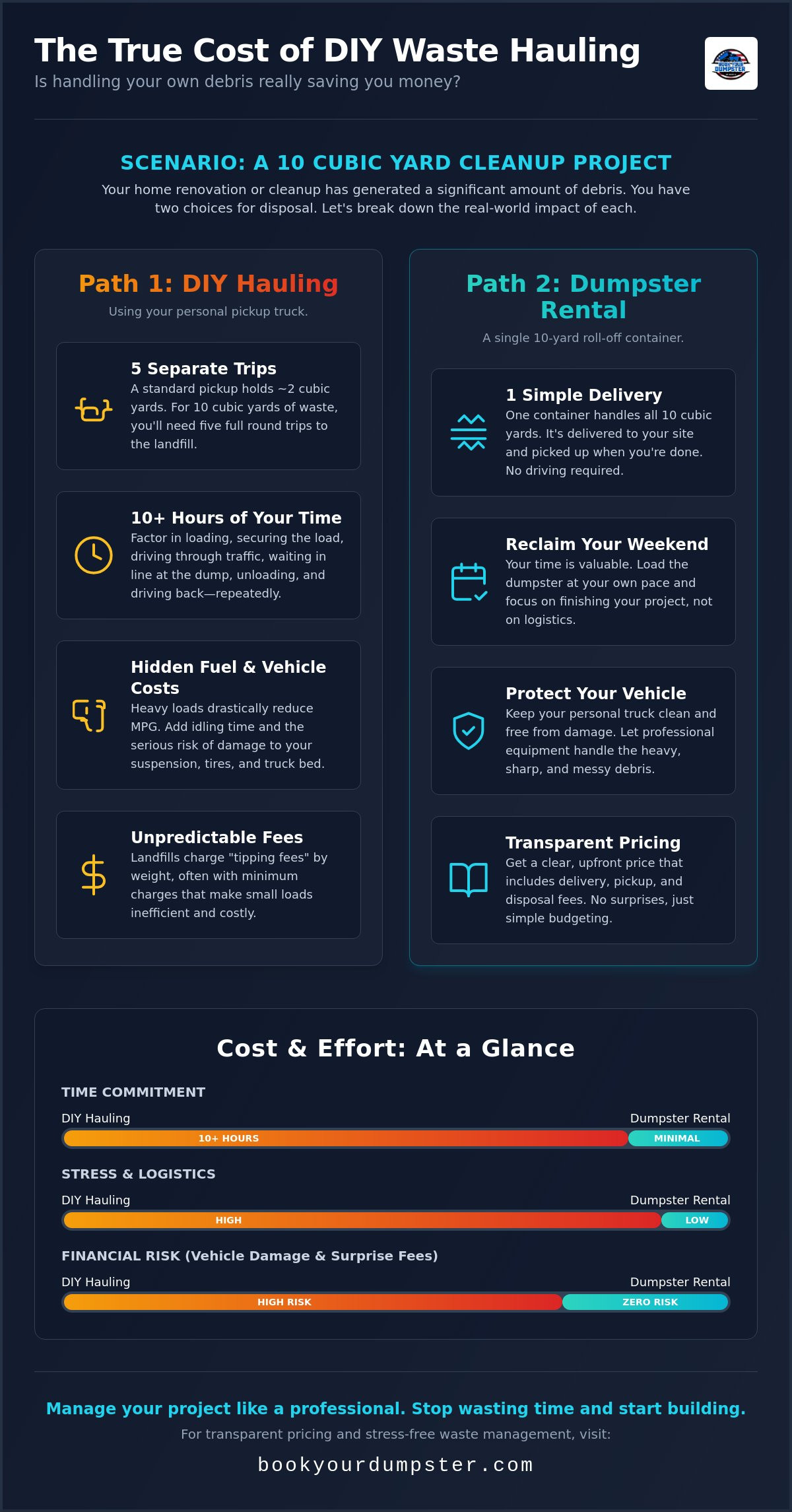
Cost Comparison: Hauling Yourself vs. 10-Yard Dumpster
The "Break-even Point" is the moment your DIY project becomes a financial liability. For most home renovations, this point occurs much earlier than you expect. When you evaluate the fuel and time cost of hauling debris yourself, you must look beyond the gate fee at the landfill. A single 10-yard dumpster provides a fixed cost that covers delivery, weight allowance, and pickup. In contrast, DIY hauling is a series of escalating expenses that multiply with every trip. Having a container on-site allows you to toss debris as you work, keeping your job site clean and safe without constant interruptions.
Analyze the numbers for a standard medium-sized project requiring five truck trips:
- Gate Fees: Five trips at a $25 minimum charge equals $125 before tonnage is even calculated.
- Fuel: At roughly $4.00 per gallon, five round trips to a distant facility can easily cost $50 to $75 in a thirsty pickup truck.
- Time Value: 12.5 hours of labor (loading, driving, and waiting) at a modest $25/hr rate equals $312.50.
- Vehicle Wear: Standard depreciation and maintenance for heavy hauling adds another $40 to $60.
The "hidden" cost of these five trips totals over $500. This figure often exceeds the cost of a professional rental, proving that DIY is rarely the cheaper route for significant debris volumes.
The 5-Trip Comparison Model
A professional 10 yard dumpster rental effectively replaces five full pickup truck loads. In high-traffic areas like Queens or Boston, the logistics of five round trips are staggering. You'll spend hours fighting metropolitan traffic and navigating narrow landfill access roads. Choosing a dumpster means "one and done" disposal. You load it once and we haul it away. This efficiency saves you at least one full workday, allowing you to focus on the actual renovation instead of the waste.
When DIY Actually Makes Sense
Self-hauling is only logical for very small projects. If your total waste fits in under 2 cubic yards, such as a single closet cleanout or a small landscaping task, your own truck is sufficient. However, anything larger than a small bathroom remodel generates enough volume to make a roll-off container the superior choice. Evaluate your project volume honestly before you start. If you expect more than two truckloads, visit bookyourdumpster.com to compare sizes and secure a rental. Avoid the frustration of the fifth trip and choose the professional alternative from the start.
Streamlining Your Project with Book Your Dumpster USA
You've seen the data. The fuel and time cost of hauling debris yourself is a hidden debt that drains your budget and ruins your weekend. Stop acting as your own waste contractor and start using a tool designed for efficiency. Book Your Dumpster USA removes the logistical stress of cleanup projects by providing a dependable, no-nonsense service. Our digital platform at bookyourdumpster.com offers immediate price transparency. You'll know exactly what you're paying before the container arrives. There are no surprise gate fees or fluctuating fuel surcharges to track. We provide professional reliability across major metropolitan hubs, including NY, NJ, IL, MA, and SF.
Our service model focuses on pricing integrity and punctuality. We understand that your project operates on a tight schedule. A late delivery or pickup can stall an entire crew. That's why we've modernized the traditional waste sector with a digital-first approach that prioritizes your time. Whether you're a homeowner clearing out a basement or a contractor managing a job site, our 10, 20, 30, and 40-yard dumpsters provide the capacity you need. Eliminate the need for multiple landfill runs and keep your project moving forward without interruption.
How to Choose the Right Size
Selecting the correct container size is the first step toward a successful project. Use this quick guide to match your debris volume to the right dumpster:
- 10-Yard Dumpster: Best for small basement cleanouts, yard waste, or minor bathroom refreshes.
- 20-Yard Dumpster: The standard choice for kitchen remodels, deck removals, or flooring projects.
- 30-Yard & 40-Yard Dumpsters: Necessary for full-home cleanouts, large-scale construction, or commercial roofing jobs.
Always size up if you're between two options. It's more cost-effective to have extra space than to pay for a second rental because the first one overflowed. If you have questions about local weight limits or complex disposal laws in your city, our expert support team is available to provide direct, pragmatic answers.
Book Your Solution in Minutes
Reclaim your weekend by using our streamlined booking platform. The process is simple and requires zero phone tag. Enter your project location, select your dumpster size, and choose your delivery date. Our system handles the rest. You get the peace of mind that comes with professional waste management and a clean job site. Don't risk the suspension of your personal truck or waste hours in a landfill queue. Protect your vehicle and your schedule. Visit our website today to secure your rental and experience a faster, cleaner way to handle debris.
Reclaim Your Weekend and Protect Your Assets
Managing a renovation is demanding enough without the added burden of multiple landfill runs. You've seen how the fuel and time cost of hauling debris yourself can quickly outpace the price of a professional rental. Between the rising tipping fees in major hubs like NY and SF and the risk of mechanical damage to your personal truck, the DIY approach is a gamble with your budget. Choosing a roll-off container means you avoid the "time-tax" and keep your project on schedule. This decision protects your vehicle's suspension and your weekend plans.
Book Your Dumpster USA provides the local expertise and reliable service you need in NJ, IL, MA, and beyond. Our full range of 10 to 40-yard containers handles everything from small residential cleanouts to large-scale commercial construction. Use our simplified online system to secure your solution in minutes with full price transparency. There is no need to navigate complex disposal laws on your own when a professional partner is ready to help.
Calculate your savings and book your dumpster online today. Finish your project with confidence and get back to enjoying your home.
Frequently Asked Questions
How much fuel does a truck use when hauling a full load of debris?
Fuel economy drops by 20% to 30% when your truck is carrying a payload of 1,500 pounds or more. The engine works harder to maintain speed, which increases consumption significantly compared to your daily commute. You must also account for the fuel burned while idling in long landfill queues, which often lasts 30 to 60 minutes per trip.
What is the average landfill tipping fee for construction waste in 2026?
The national average for landfill tipping fees is approximately $62.28 per ton, but regional prices vary. In the Northeast, including New York and Massachusetts, fees frequently exceed $80 per ton. Most facilities also enforce a minimum charge between $15 and $30 for any vehicle entering the gate, regardless of the load weight.
Is it cheaper to rent a trailer or a dumpster for a home cleanout?
Dumpster rentals are generally more cost-effective for projects generating more than two truckloads of waste. While a trailer has a lower daily rate, you remain responsible for fuel, gate fees, and the physical labor of unloading. A dumpster provides a fixed price and eliminates the need for multiple trips to a disposal site.
How many pickup truck loads fit into a 10-yard dumpster?
A 10-yard dumpster holds roughly five full pickup truck loads. This calculation is based on a standard truck bed capacity of 2 cubic yards. Using a single container saves you from the repetitive fuel and time cost of hauling debris yourself across an entire weekend of driving.
Do I need a permit to park a dumpster on my street in New York or Chicago?
Yes, placing a dumpster on a public street in cities like New York or Chicago typically requires a municipal permit. These permits ensure the container does not obstruct traffic or violate local safety codes. Check with your local building department or our support team to confirm the specific requirements for your service area.
Can I throw heavy materials like concrete and brick in a standard rental truck?
Personal trucks and standard rental vehicles often have weight limits that masonry materials will quickly exceed. Hauling concrete or brick in a vehicle not rated for the payload risks permanent suspension damage and tire failure. Use a professional roll-off container specifically designed to handle the extreme weight of heavy debris.
What happens if I bring hazardous waste to the dump myself?
Landfill operators will reject your entire load if they find hazardous materials like paint, oils, or chemicals. You'll be forced to drive the waste back home and may face municipal fines for attempted improper disposal. Hazardous items require separate, specialized disposal streams that are not included in general waste services.
How much time should I budget for a single trip to the local transfer station?
Budget at least three hours for each round trip to a local transfer station. This estimate includes the time required to load your vehicle, navigate metropolitan traffic, and wait in the scale line. During peak weekend hours, wait times at the gate can easily add an extra hour to your project timeline.


