
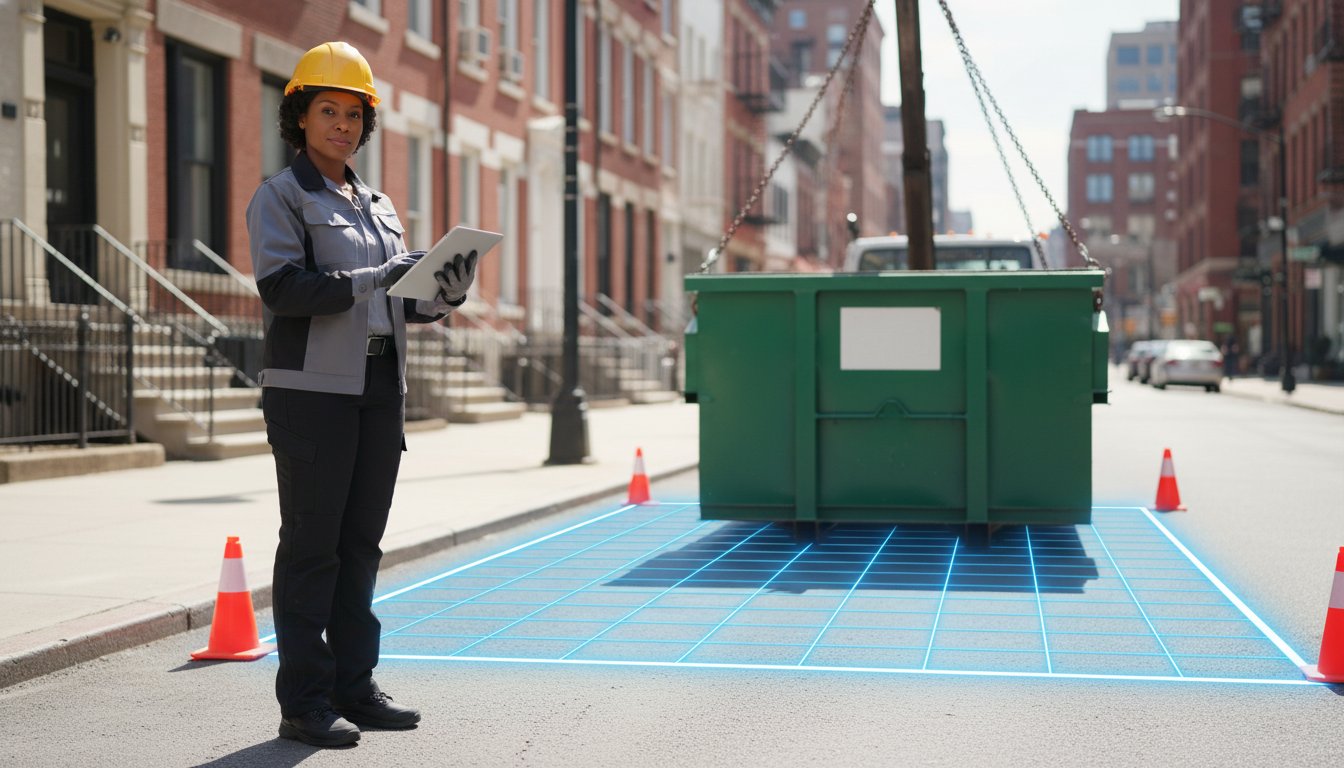
A single misstep in dumpster placement can turn a productive cleanup project into a series of expensive municipal fines and legal headaches. You expect your renovation or clean-out to be straightforward, but the line between your private driveway and the city-owned "Right-of-Way" is often blurry and frustrating. Navigating city ordinances for dumpster placement doesn't have to be a guessing game that ends in a citation. Whether you're coordinating a residential project or managing a commercial site, understanding the boundary rules is the first step toward a successful delivery.
You likely feel the pressure of complex permit applications and the fear of an inspector showing up at your door. We understand that logistical stress. This guide provides a clear framework to master local regulations and secure the necessary permits to ensure your dumpster placement is legal, safe, and fine-free. From the mandatory NYC-branded bins required for small residential buildings to Chicago's online-only permit portal, we cover the essential details you need to stay compliant.
Read on to learn how to distinguish between public and private land requirements and follow our step-by-step checklist to avoid HOA or municipal penalties. We'll show you how to turn compliance into a simple logistical workflow so you can focus on the work that matters.
Key Takeaways
- Define the "Right-of-Way" boundary to determine if your project requires a city permit or can proceed on private property without one.
- Save time by navigating city ordinances for dumpster placement through online portals and identifying the correct governing body in NYC, Chicago, or Boston.
- Avoid application rejections by preparing essential documentation, including site maps and insurance information, before you apply.
- Implement mandatory safety standards like reflective DOT tape and traffic cones to ensure your placement remains compliant and visible.
- Select the optimal 10, 20, 30, or 40-yard dumpster size to fit within your specific permitted footprint and avoid blocking public access.
Private Property vs. Public Right-of-Way: Do You Need a Permit?
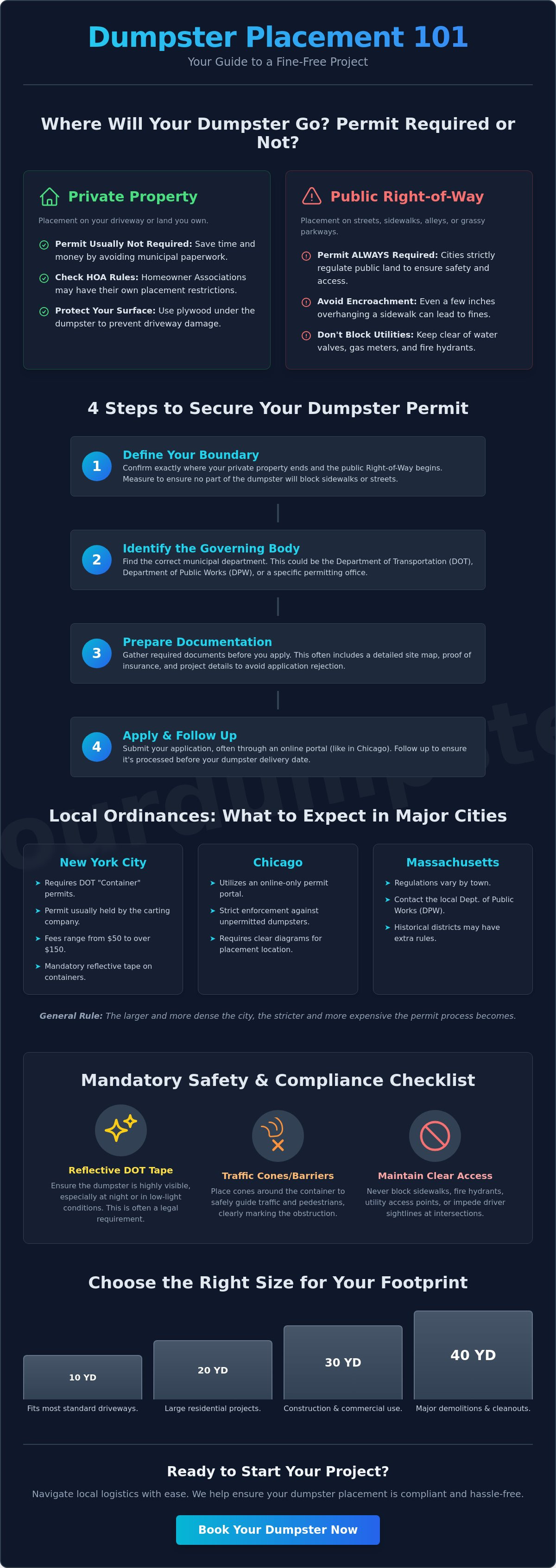
The first step in any cleanup project is determining exactly where your property ends and city land begins. This distinction dictates whether you need a permit or can proceed without one. A "Right-of-Way" (ROW) refers to land owned by the municipality for public use, including streets, sidewalks, and alleys. Cities regulate these areas strictly to ensure emergency vehicles have clear paths and pedestrians remain safe. Successfully navigating city ordinances for dumpster placement requires you to identify these boundaries before your rental arrives.
Generally, the "driveway rule" applies: if the dumpster sits entirely on your private property, you usually bypass municipal permit requirements. However, this isn't a universal green light. Historical districts often require special notifications for any heavy equipment, and Homeowner Associations (HOAs) frequently enforce their own aesthetic or placement restrictions. You must also avoid "encroachment." This occurs when a dumpster is technically on your driveway but hangs over the sidewalk or blocks a public path. Even a few inches of overlap can trigger a citation from a city inspector. Reviewing Understanding Dumpster Types helps you visualize how these large steel containers occupy space and why precise placement is critical for compliance.
When Private Placement is the Best Strategy
Prioritize private placement whenever possible to eliminate permit costs and paperwork. For smaller residential cleanouts, evaluating driveway clearance for 10-yard dumpsters is a smart move. These units fit comfortably in most standard driveways without overextending into the street. Protect your property by using thick plywood sheets under the dumpster's wheels; this prevents heavy loads from cracking your private asphalt or concrete. Remember that your HOA might have stricter rules than the city. Check your bylaws to ensure you aren't violating neighborhood standards regarding container duration or visibility.
Identifying the Public Right-of-Way Boundary
Don't guess where your property line sits. A common rule of thumb is that the city owns everything from the sidewalk to the curb, including any grassy "parkway" strips. Utility easements also complicate matters. You cannot block access to water shut-off valves or gas meters, even if they are located on your own lawn. Verify local setbacks to ensure the unit does not obstruct driver sightlines at nearby intersections. Clear communication with your driver is essential. Confirm your property lines are marked clearly to prevent accidental placement in the public ROW, which would immediately require you to begin navigating city ordinances for dumpster placement to avoid fines.
Understanding Local Ordinances in New York, Chicago, and Massachusetts
Geography dictates your compliance strategy. As a general rule, the larger the city, the more specialized and expensive the placement permit becomes. Municipalities in high-density areas view the street as a finite resource, and they regulate it to prevent traffic congestion and safety hazards. Successfully navigating city ordinances for dumpster placement requires a localized approach that accounts for specific department requirements, whether you're dealing with the Department of Transportation (DOT) in New York or the Department of Public Works (DPW) in a small Massachusetts town.
In New York City, you cannot simply drop a container on the curb. You must secure New York City Dumpster Permits through the DOT. Specifically, "Street Opening" or "Container" permits are required for any public space placement. Unlike other cities where the homeowner might apply, NYC typically requires the carting company or general contractor to hold the permit. Fees often range from $50 to over $150 depending on the duration and the specific borough. San Francisco follows a similarly strict path, requiring "Street Space" permits that account for the city's unique slopes and narrow transit corridors. If you don't account for these variables before the truck arrives, you risk immediate impoundment of the unit.
New York and New Jersey: High-Density Hurdles
Density brings extra layers of safety regulation. NYC DOT standards require specific reflective tape and nighttime visibility markers to prevent collisions in poorly lit areas. Across the Hudson, Jersey City enforces ordinances that mandate leak-resistant and rodent-proof container standards to maintain urban hygiene. For a deeper look at these regional nuances, consult our Dumpster Rental in New York, Illinois, and Massachusetts guide. These rules aren't suggestions; they're enforced with heavy fines that can derail your project's budget.
Illinois and Midwest Specifics
Chicago presents its own set of challenges, particularly regarding the "Public Way Use" permit. All applications must go through the city's online portal; paper applications are no longer accepted. If your project falls between December and April, you must respect "Snow Route" restrictions. Placing a dumpster on a designated snow route during a winter weather emergency will result in an immediate tow. Additionally, Chicago’s historical brick streets and narrow residential alleys often have strict weight limits. You may need to file for a "No Parking" sign permit 48 hours in advance to clear enough space for the delivery truck to maneuver. To ensure you have the right equipment for these tight spaces, view our available dumpster sizes and match them to your local street capacity. Navigating city ordinances for dumpster placement in the Midwest means planning for both the weather and the architecture of the neighborhood.
Step-by-Step: How to Secure a Dumpster Placement Permit
Start your permit process early. You shouldn't wait until your crew is on-site to realize you lack the legal right to place a container on the street. Identifying the correct governing body is your first priority. While smaller towns use the Department of Public Works (DPW), major metropolitan areas almost always funnel these requests through the Department of Transportation (DOT). Visit the city's official website to locate the specific "Street Occupancy" or "Public Way" permit application. Successfully navigating city ordinances for dumpster placement requires you to treat the permit as a prerequisite, not an afterthought.
Once you locate the application, follow these steps to ensure approval:
- Verify the department: Confirm whether the city or your rental provider is responsible for the filing.
- Gather documentation: Prepare your site map and insurance certificates.
- Submit and pay: Complete the online form and pay the municipal fees immediately to avoid processing delays.
- Print and display: Keep a physical copy of the permit on the job site for inspectors to review.
Documentation and Site Mapping
Cities need to know exactly how much space you'll occupy. Your site plan must include the dumpster's dimensions and its distance from the nearest intersection. If you're placing a 30-yard or 40-yard unit, the city needs to ensure it doesn't create a "blind spot" for passing motorists. Attach photos of the intended drop zone before the delivery occurs. This protects you from being blamed for pre-existing cracks in the asphalt or sidewalk. Ensure your rental provider's insurance meets the city's minimum liability thresholds. Most urban areas require at least $1 million in coverage to protect against potential utility damage.
Timelines and Fee Structures
Don't rush the process. Apply at least 7 to 10 days before your project begins. While some towns process permits in 48 hours, major hubs often take longer during peak construction seasons. Understand your permit duration. A 3-day permit might work for a quick residential cleanout, but a 30-day permit is often more cost-effective for major commercial renovations. If your project hits a snag, initiate the renewal process at least three days before the current permit expires. Letting it lapse for even 24 hours can result in a "stop work" order. Once you have the permit number in hand, schedule your roll off dumpster rental to lock in your delivery date. This ensures your project stays on track while remaining fully compliant with navigating city ordinances for dumpster placement.
Critical Placement Safety and Compliance Standards
Securing a permit is only half the battle. Once the container is on the ground, your focus must shift to operational safety. City inspectors don't just look for a permit number; they look for hazards that could endanger pedestrians or block emergency services. Safety compliance is an ongoing requirement that lasts from the moment of delivery until the truck pulls away for the final haul. Successfully navigating city ordinances for dumpster placement requires a strict adherence to visibility and accessibility standards.
Accessibility is the most common reason for heavy municipal fines. You must maintain a clear path for fire trucks, ambulances, and police vehicles. This means ensuring the dumpster does not narrow the street beyond the minimum width required by local fire codes. Prohibited zones are non-negotiable. Never place a container within 15 feet of a fire hydrant, inside a bus stop zone, or in front of a handicapped ramp. Even if your permit allows street placement, these specific zones remain off-limits. Environmental compliance is also critical. Use a heavy-duty tarp to cover the load every night. This prevents debris from blowing into the street and stops rainwater from washing silt into the municipal sewer system.
DOT Visibility Requirements
Visibility prevents accidents and reduces your liability. Follow the "Four Corner" rule by placing high-visibility orange traffic cones at every exterior edge of the dumpster. In high-traffic areas, cities often mandate the use of reflective "DOT tape" on the sides of the container. This alternating red and white tape ensures the steel unit is visible to drivers in low-light conditions. If your project is in a poorly lit urban corridor, you might be required to attach battery-operated flashing amber lights to the corners. Keep the exterior of the unit clean. If mud or dust obscures your permit display or the reflective markings, you risk a citation. Before you start your project, select a dumpster size that fits safely within your marked visibility zone.
Protecting the Infrastructure
Heavy steel containers can easily gouge asphalt or crack sidewalk concrete. Protect the public infrastructure by placing "street pads" or thick wood blocks (such as 2x4s or 4x4s) under the rollers before the driver sets the unit down. This distributes the weight and prevents the dumpster from sinking into soft summer asphalt. Weight limits are strictly enforced. A construction dumpster must never be overfilled; debris should never extend above the "fill line" on the side of the container. Finally, avoid catch basins. Placing a dumpster directly over a storm drain is a major violation that can lead to drainage backups and immediate fines. Navigating city ordinances for dumpster placement means respecting the street surface as much as the legal paperwork.
Navigating Local Logistics with Book Your Dumpster USA
Experience is the most valuable asset when you're navigating city ordinances for dumpster placement in high-density markets. We operate in some of the most regulated environments in the country, including New York, New Jersey, Illinois, Massachusetts, and San Francisco. Each of these regions requires a specific logistical approach. We've modernized traditional waste management by combining local regulatory knowledge with a digital-first booking system. This ensures you spend less time worrying about city inspectors and more time completing your project.
Selecting the correct container size is the bridge between your project's volume and the city's physical space constraints. We offer 10, 20, 30, and 40-yard dumpsters to ensure you have the right tool for the job. Our drivers are experts at pragmatic delivery. They understand that urban placement is often a game of inches. Whether it's a narrow Chicago alley or a steep San Francisco street, our team prioritizes precision to keep your container within the legal boundaries of your permit. We focus on reliability so you can maintain control over your project's timeline.
Professional Support for Complex Sites
Size selection impacts your permit approval chances. A 10-yard dumpster is often the easiest to permit because its small footprint minimizes the impact on public traffic. For larger-scale industrial or residential projects, we provide contractor-grade service for construction debris removal. We don't just drop and leave. We maintain direct communication between our dispatch team and your site manager. This ensures our drivers know exactly where your permit allows placement before they arrive. This proactive coordination prevents the "encroachment" errors that lead to immediate city citations.
The Book Your Dumpster USA Advantage
Transparency is our verbal handshake. We believe in pricing integrity, which means you won't find hidden "compliance fees" or surprise surcharges on your final invoice. Our streamlined online platform allows you to select your equipment and schedule delivery in minutes. We align our drop-off and pickup times strictly with your permit's start and end dates. This punctuality is a recurring promise of reliability that distinguishes us from opaque competitors. Don't let logistical hurdles stall your progress. Book your dumpster online today and clear the clutter with a partner who understands navigating city ordinances for dumpster placement.
Finalize Your Project Compliance
Mastering the logistics of dumpster placement ensures your job site remains efficient and legal. You now know how to distinguish between private driveway rules and the strict "Right-of-Way" boundaries enforced by municipal inspectors. By identifying the correct governing body and preparing your site map in advance, you eliminate the stress of unexpected citations and keep your project on schedule.
Successfully navigating city ordinances for dumpster placement requires a partner who understands the specific hurdles of your local market. Whether you're working in the tight corridors of San Francisco or the high-density streets of New York, we provide the localized knowledge needed for a friction-free delivery. Since 2018, we've provided professional waste management solutions across NY, NJ, IL, MA, and SF. Select from our 10, 20, 30, or 40-yard dumpster sizes to match your specific permit requirements and project volume.
Take the final step toward a clean and compliant workspace. Secure your project today and Book Your Dumpster online to lock in your delivery schedule. We handle the heavy lifting so you can focus on finishing the job. Get your project started with confidence today.
Frequently Asked Questions
Do I need a permit if the dumpster is on my own driveway?
You generally don't need a municipal permit if the container sits entirely on your private driveway. However, you must ensure no part of the unit overlaps onto the sidewalk or public right of way. Check if your property is in a designated historic district, as these areas often have unique local restrictions regardless of property lines. Always verify that the delivery truck has enough clearance to drop the unit without blocking public access.
How much does a city dumpster permit typically cost in 2026?
Permit costs vary significantly by city and placement duration. In New York City, street placement permits typically range from $50 to $150. Chicago's fee structure depends on the dumpster size and location, with 1 to 3 day permits costing between $50 and $200 as of June 2026. Always check your specific municipal portal for the most current fee schedule before you submit your application and payment.
What happens if I place a dumpster on the street without a permit?
Placing a container on the street without a permit leads to immediate municipal fines and the potential towing of the unit. City inspectors frequently patrol for unpermitted obstructions in the public way to ensure safety. In addition to financial penalties, the city may issue a stop work order on your renovation project. This causes expensive delays and logistical friction that can derail your entire cleanup schedule.
Can my HOA block me from putting a dumpster in my driveway?
Yes, your Homeowners Association can enforce stricter rules than the city regarding dumpster placement on your property. While the municipality might allow a unit on your driveway, your HOA bylaws may prohibit them or limit their duration to 48 hours. Review your neighborhood covenants and secure written approval from the HOA board before delivery to avoid private penalties or a forced removal of the container.
How far in advance should I apply for a street placement permit?
Apply for your permit at least 7 to 10 days before your project start date. While some smaller towns process applications in 48 hours, major cities like Chicago require online submissions that can take a week or more during peak construction seasons. Early application ensures your delivery driver has the legal clearance to drop the unit exactly when your crew is ready to start working.
Are there weight limits for dumpsters placed on city streets?
Yes, city streets often have specific weight limits to prevent damage to the public infrastructure. This is especially true for historical brick streets or residential alleys with thinner asphalt. Navigating city ordinances for dumpster placement involves checking for these local weight restrictions to ensure your loaded container doesn't exceed the street's structural capacity. Overloading a unit can lead to expensive infrastructure damage fees from the city.
Do I need to put lights on the dumpster at night?
Nighttime visibility requirements depend on your local DOT regulations and the specific density of your street. Many urban areas require flashing amber lights or reflective DOT tape on every corner of the unit to prevent vehicle collisions. Even if not strictly mandated, using traffic cones and reflective markers is a professional safety standard. These measures reduce your liability and ensure the unit remains visible to drivers after dark.
Who is responsible for getting the permit, me or the rental company?
Responsibility varies by location and the type of permit required. In New York City, the carting company or general contractor is responsible for obtaining the DOT permit. In other cities like Chicago, the property owner or contractor must apply through the city's online portal. When navigating city ordinances for dumpster placement, always confirm with your provider during the booking process to see who handles the specific paperwork for your address.


