

Your commercial waste contract is likely designed to benefit the hauler, not your business. Most companies treat waste removal as a fixed utility, but auto-renewal traps and unpredictable fuel surcharges can quickly turn a standard service into a financial drain. It is frustrating to watch your invoices climb while your service remains the same. Mastering the art of negotiating long-term commercial dumpster contracts is the only way to stop this cycle and secure the pricing integrity your business deserves.
You probably feel stuck with high rates for capacity you don't even use. This guide will show you how to lock in predictable rates for 12 to 36 months and eliminate hidden fees. We provide a clear roadmap to negotiate better terms for overage and tonnage limits while prioritizing partners that offer transparent digital booking. Follow these steps to move from logistical stress to total control over your bottom line. It's time to stop overpaying for front load commercial waste pickup and start holding your providers accountable through smarter, more aggressive contract management.
Key Takeaways
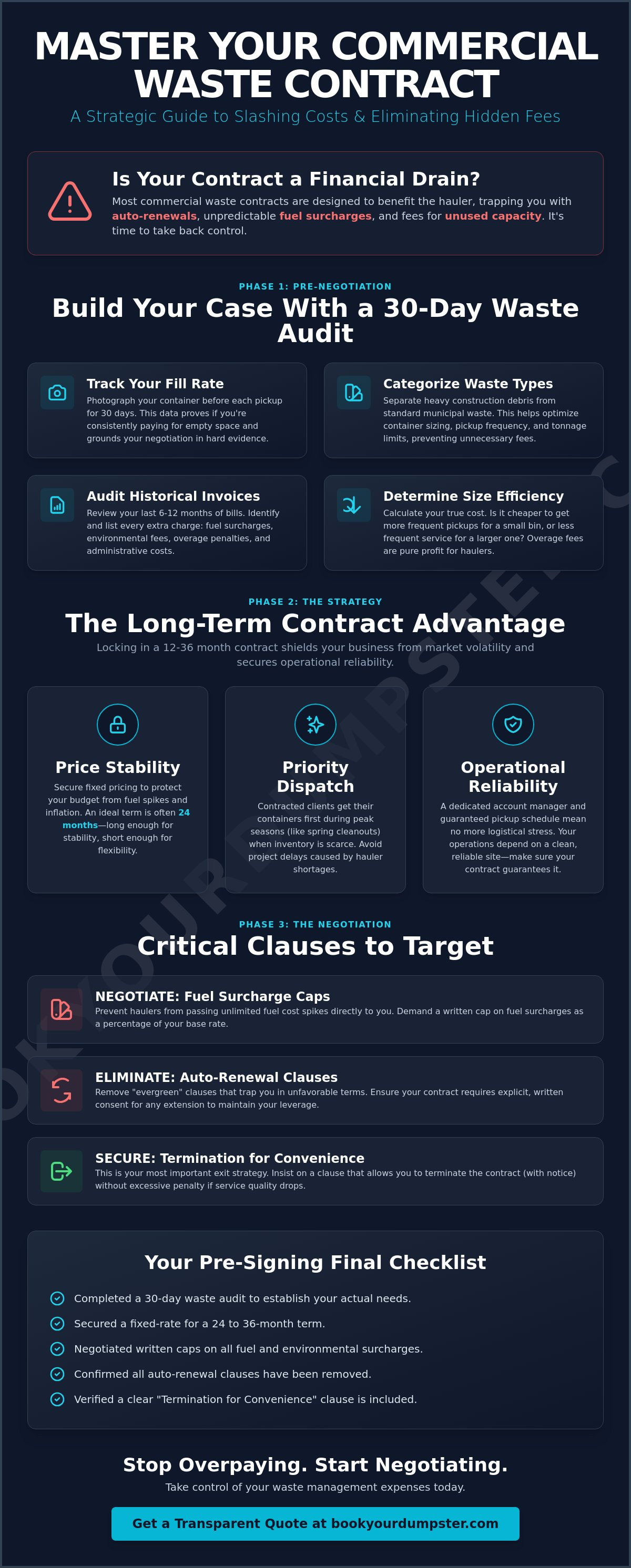
- Perform a 30-day waste stream audit to identify your actual fill rate and stop paying for unused container space.
- Master the specific tactics for negotiating long-term commercial dumpster contracts to secure fixed pricing and shield your business from 2026 market volatility.
- Eliminate hidden costs by negotiating caps on fuel surcharges and removing restrictive clauses that limit your future market leverage.
- Navigate localized regulations like New York City's Commercial Waste Zones and use seasonal timing to gain an advantage in regional markets.
- Secure a clear exit strategy by verifying "Termination for Convenience" terms before signing any long-term service agreement.
The Strategic Advantage of Long-Term Commercial Waste Agreements
A commercial waste contract is a multi-year service commitment between your business and a hauler. In 2026, market volatility is the new normal. Retail and industrial sectors face rising fuel costs and equipment shortages that make month-to-month pricing a gamble. Negotiating long-term commercial dumpster contracts allows you to secure a fixed rate, trading short-term flexibility for long-term financial predictability. You get price protection and priority service during peak seasons when demand for containers often outstrips supply.
Distinguish between standard service agreements and long-term roll-off rental contracts before signing. Service agreements usually involve permanent Front load Commercial Waste Pickiup with scheduled weekly collections. Roll-off contracts are better suited for ongoing industrial projects or large-scale renovations where waste volume fluctuates. Choosing the right structure ensures you don't pay for capacity you don't need while maintaining the ability to scale up when necessary.
Fixed Pricing vs. Market-Rate Fluctuations
Fixed-rate contracts shield your business from fuel price spikes in high-traffic areas like New York. Without a contract, you are at the mercy of the market. Ensure your agreement includes price caps to manage annual inflation adjustments. Compliance with U.S. waste management laws often involves new disposal fees or environmental mandates. A well-negotiated contract prevents the hauler from passing these costs directly to you without limits. A 24-month term is often the sweet spot. It offers enough stability for your annual budget without locking you into outdated service models for too long.
Operational Reliability and Priority Dispatch
Long-term partners receive priority during high-demand periods. During spring cleanouts or peak fall months, haulers often run out of inventory. Contracted clients get their bins first. If you manage multi-unit commercial sites, insist on a dedicated account manager. This person ensures your pickups happen on time and handles any billing discrepancies immediately. For a broader view of service types and how to manage larger volumes, see our guide on roll off dumpster rental. Secure your service now to avoid logistical stress later. Reliability is just as important as the base rate when your operations depend on a clean site.
Pre-Negotiation: Conducting a Waste Stream Audit
Before you begin negotiating long-term commercial dumpster contracts, you need hard data. Most businesses overpay because they guess their waste volume. Stop guessing. Start a 30-day tracking period. Take a photo of your container right before every scheduled pickup. This reveals your fill rate. If your bin is consistently half-empty, you are subsidizing the hauler's fuel for no reason. Use this evidence to demand a service schedule that matches your actual output.
Follow these four steps to build your case:
- Track your fill rate: Monitor your containers for 30 days to see if you are paying for empty space.
- Categorize waste types: Separate heavy construction debris from standard municipal waste to optimize container sizing and tonnage limits.
- Review historical invoices: Audit your last six months of billing. Identify every extra charge, such as fuel surcharges or overage fees.
- Determine size efficiency: Compare costs between frequent pickups for a 10 yard dumpster versus less frequent service for a 40-yard unit.
If you are unsure where to start, learn how to conduct a waste audit using a structured methodology. This data forces the vendor to speak in specifics, not generalities. It shifts the power balance back to you.
Right-Sizing Your Container for Maximum ROI
Overage fees are profit centers for haulers. It is often cheaper to pay for a larger 30 or 40-yard container than to trigger a single overage penalty on a smaller bin. Do the math. If you are paying for weekly pickups but the bin is rarely full, switch to a larger container with bi-weekly service. Use your audit photos as leverage during your first meeting. Show the vendor that your current service level doesn't match your actual needs. If you need to scale up or down, you can easily view container dimensions and availability online to find the right fit for your site.
Identifying Waste Diversion Opportunities
Weight drives cost. Separating recyclables or organic waste reduces the total tonnage of your primary landfill dumpster. In 2026, many regions offer green credits for documented waste diversion. Local laws in Massachusetts and San Francisco are strict about what enters the landfill. Compliance isn't just about avoiding fines; it's about reducing the volume you pay to haul away. Use these diversion stats to demand lower base rates. A lighter dumpster is a cheaper dumpster.
Critical Contract Clauses: Negotiating Beyond the Base Rate
Negotiating long-term commercial dumpster contracts requires a focus on the fine print that actually drives your final invoice. The base rate is often just a starting point. Ancillary fees, such as fuel and environmental surcharges, can account for 20% to 30% of your total waste costs if left unchecked. Demand a hard cap on these surcharges. If the hauler refuses to limit them to a specific percentage of the base rate, look for another partner. These hidden costs are often where vendors recover the margins they lost during base rate negotiations.
Strike the 'Right of First Refusal' clause immediately. This provision allows your current hauler to match any competitor's bid, effectively killing your leverage when you try to shop around for better rates in the future. Without it, you maintain the power to walk away for a superior deal. Similarly, watch out for 'Evergreen' or automatic renewal clauses. Ensure the contract includes a clear 60-day window to opt-out before the term resets. If you miss this window, you could be locked into high rates for another three years without any way to renegotiate.
Negotiate a higher 'floor' for your tonnage allowances. Most contracts set a low weight limit and then charge heavy per-ton penalties for anything over that amount. If your waste audit showed consistent heavy loads, push for a higher allowance in the base price. It is cheaper to pay a slightly higher monthly fee than to face unpredictable overage penalties every month. You can schedule your service with transparent terms that avoid these common traps.
The Battle Against Price Escalation Clauses
An escalation clause is the mechanism vendors use to bypass fixed pricing by linking rate increases to external indices. Protect your budget by setting a hard cap of 3% to 5% on annual price increases. This cap should apply regardless of changes to the Consumer Price Index (CPI). Require the vendor to provide at least a 30-day written notice before any service-related fee changes take effect. This prevents invoice shock and gives you time to dispute unauthorized hikes before they are charged to your account.
Service Level Agreements (SLAs) and Penalties
Accountability is the backbone of a successful waste partnership. Define a 'timely pickup' in the contract. If the hauler is more than 24 hours late, they should issue a service credit to your account. Negotiate a waiver for the first two 'Dry Run' fees per year. These fees often occur due to minor logistical errors, and you shouldn't be penalized for occasional blocked access. Finally, ensure the contract states that container maintenance, including cleaning and structural repairs, is covered by your monthly lease fee. You shouldn't pay extra to keep a 40 Yard Dumpster or Front load Commercial Waste Pickup bin in working order.
Regional Negotiation Tactics for NY, NJ, and Illinois Markets
Regional regulations dictate your leverage. In New York City, the Commercial Waste Zones program is reaching full implementation throughout 2026. Businesses in Lower Manhattan must sign a contract with an authorized hauler by May 31, 2026. If you miss this deadline, the DSNY will assign you a hauler at the maximum allowable rate, which is currently $26.87 per cubic yard. Negotiating long-term commercial dumpster contracts before these specific zone deadlines is the only way to secure a competitive rate below the city-mandated ceiling. Use the rollout schedule for Midtown South (August 31) and Brooklyn North (November 30) to time your negotiations while haulers are still competing for new zone territory.
Illinois and Massachusetts markets fluctuate significantly with the seasons. Winter is the ideal time to negotiate because construction waste volume typically drops, leaving haulers with excess 20, 30, and 40 Yard Dumpsters. They are often more willing to offer price concessions during these slow months to keep their fleet moving. In New Jersey, tipping fees continue to rise. For 2026, Burlington County set municipal waste at $105.44 per ton, while Morris County is at $113.00. Clarify who absorbs these tonnage increases in your long-term agreement. If you don't negotiate a gross price, your monthly bill will fluctuate with every county rate adjustment.
Urban Constraints and Access Fees
Negotiate 'scout truck' fees if your business is located in a tight alley in Chicago or Boston. Large trucks often can't reach these bins, requiring a smaller vehicle to move the container to the street for pickup. Address street permit renewals in NYC directly in the contract. Decide if the hauler or your business is responsible for these filings to avoid service interruptions. For high-density areas, discuss 'over-the-top' (OTT) container placement. This ensures your Front load Commercial Waste Pickup doesn't block pedestrian traffic or violate local zoning ordinances.
State-Specific Environmental Surcharges
Understand the 'Solid Waste Management Tax' in your specific jurisdiction before signing. Negotiate a 'gross' price that includes all state-mandated disposal fees to prevent invoice creep. This is especially important in New Jersey, where new food waste reduction laws are changing disposal requirements for large producers. Check our Dumpster Rental Prices Guide for specific regional benchmarks. If you are ready to secure a reliable rate and avoid city-assigned haulers, view commercial service options to start your agreement today.
Securing Your Contract: A Final Checklist for Commercial Success
Negotiating long-term commercial dumpster contracts isn't finished until the ink is dry on a document that matches your verbal agreement. Conduct a final walkthrough of the written contract versus the verbal quote you received. Discrepancies often hide in the fine print. If a fee appears in the contract that wasn't discussed in your initial meeting, strike it immediately. Ensure your agreed-upon base rate and capped surcharges are explicitly stated in writing before you sign anything.
Verify the 'Termination for Convenience' clause to ensure you have a clear exit path if service quality fails. This clause allows you to end the partnership without proving a breach of contract, provided you give sufficient notice. Additionally, check for 'Hostile Environment' clauses. These can limit your container placement options or trigger extra fees for sites the hauler deems difficult to access. List Book Your Dumpster as a primary or secondary provider for project overflows. Even with a long-term agreement, your main hauler may lack inventory for 30 or 40 Yard Dumpsters during peak demand, and having a reliable backup prevents site clutter.
The 24-Hour Review Rule
Never sign a commercial waste contract on the spot. Take at least 24 hours to have a second set of eyes, such as your legal or operations lead, review the document. Focus specifically on the section regarding liquidated damages. Liquidated damages are the #1 cost for businesses trying to switch vendors before their contract term expires. Understanding these exit costs now prevents you from being trapped in a high-rate agreement later if your business needs change.
Transitioning to Your New Agreement
Coordinate the removal of old containers with the delivery of your new bins. Aim for a same-day swap to avoid service gaps. Set up your digital dashboard immediately to track your monthly spend and haul frequency. The Book Your Dumpster online system provides a streamlined way to manage your waste logistics with total transparency. Finally, conduct internal training with your staff. Ensure everyone knows the specific tonnage limits for your 20 or 30 Yard Dumpsters to avoid accidental overages. Clear communication inside your business is the best way to maintain the pricing integrity you worked hard to negotiate.
Lock in Your Competitive Waste Strategy for 2026
Success in waste management isn't about finding the lowest initial quote. It's about using your audit data to demand right-sized service and purging your agreement of "Evergreen" traps. Timing your agreement with regional market shifts, such as the NYC waste zone deadlines or winter slowdowns in Illinois, provides the leverage you need to win. Successfully negotiating long-term commercial dumpster contracts transforms a messy logistical burden into a predictable line item.
Stop overpaying for empty space and eliminate the stress of hidden surcharges. Rely on our local expertise across NY, NJ, IL, and MA to simplify your operations with pricing integrity. Get a Transparent Commercial Dumpster Quote from Book Your Dumpster to see the difference that direct online booking and tracking can make for your bottom line. Secure your fixed rates now and focus on growing your business while we handle the heavy lifting. You have the tools to take control of your waste logistics today.
Frequently Asked Questions
What is the typical length of a commercial dumpster contract?
Commercial waste contracts typically last between 12 and 36 months. Aim for a 24-month term to balance price protection with the flexibility to reassess your waste volume. Shorter terms often lack the stability needed for annual budgeting; however, five-year deals can lock you into outdated rates. Use a two-year agreement to secure fixed pricing while maintaining your ability to shop the market if service quality declines.
Can I negotiate out of an automatic renewal clause?
Yes, you can and should negotiate out of automatic renewal clauses. Insist on a hard expiration date or a 60-day window to opt-out in writing before the term resets. Removing these evergreen traps is a vital part of negotiating long-term commercial dumpster contracts. It prevents you from being locked into high rates for another multi-year term without the chance to shop for better service or lower fees.
How do fuel surcharges work in 2026 waste contracts?
Fuel surcharges in 2026 are variable fees tied to national fuel price indices. They allow haulers to pass on the cost of diesel fluctuations to the customer. Demand a hard cap on these surcharges, such as a maximum of 10% of your base rate. Without a cap, your invoice can spike unexpectedly during fuel surges. Ensure your contract requires the hauler to provide documentation for any surcharge adjustments before they charge your account.
What happens if I exceed the tonnage limit in my contract?
Exceeding your tonnage limit triggers expensive per-ton penalties that are added to your monthly bill. Review the specific "overage" rate in your agreement before you sign. If your waste stream audit shows you're consistently heavy, negotiate a higher tonnage allowance in your base price. It's cheaper to pay a slightly higher monthly fee than to face unpredictable penalties every month for a 30 or 40 Yard Dumpster.
Is it better to rent a roll-off or a front-load dumpster for long-term use?
The choice depends on your waste type and pickup frequency. Front-load dumpsters are best for permanent, scheduled service for standard municipal trash. Roll-off dumpsters, available in 20, 30, or 40-yard sizes, are better for high-volume construction debris or large-scale industrial projects. Choose Front load Commercial Waste Pickup for consistency and roll-off containers for bulk disposal needs identified in your waste audit. Use the right tool for the specific job to avoid overpaying.
What is a 'Right of First Refusal' and should I agree to it?
A 'Right of First Refusal' is a clause that lets your current hauler match any competitor's bid to keep your business. Do not agree to this term. It kills your leverage during future negotiations because competitors won't waste time bidding on a contract they can't win. Deleting this clause ensures you maintain the power to walk away for a better deal. Keep your options open to ensure long-term pricing integrity.
How do I know if I'm being overcharged on my waste invoice?
Compare your actual pickup logs against your monthly invoices to identify discrepancies. Look for "dry run" fees for pickups that didn't happen or "environmental fees" that weren't in your original quote. If your bin is consistently half-full at pickup, you are paying for capacity you don't use. Use photos of your fill rate to negotiate a more efficient service schedule and lower your monthly spend immediately.
Are there specific dumpster rental regulations in New York City I should know?
New York City is implementing Commercial Waste Zones with strict deadlines throughout 2026. Businesses in Lower Manhattan must sign with an authorized hauler by May 31, 2026, while the deadline for Midtown South and Staten Island is August 31, 2026. If you miss your zone's deadline, the city will assign you a hauler at the highest allowable rate. Act early to negotiate a better deal before the city takes the choice out of your hands.


