
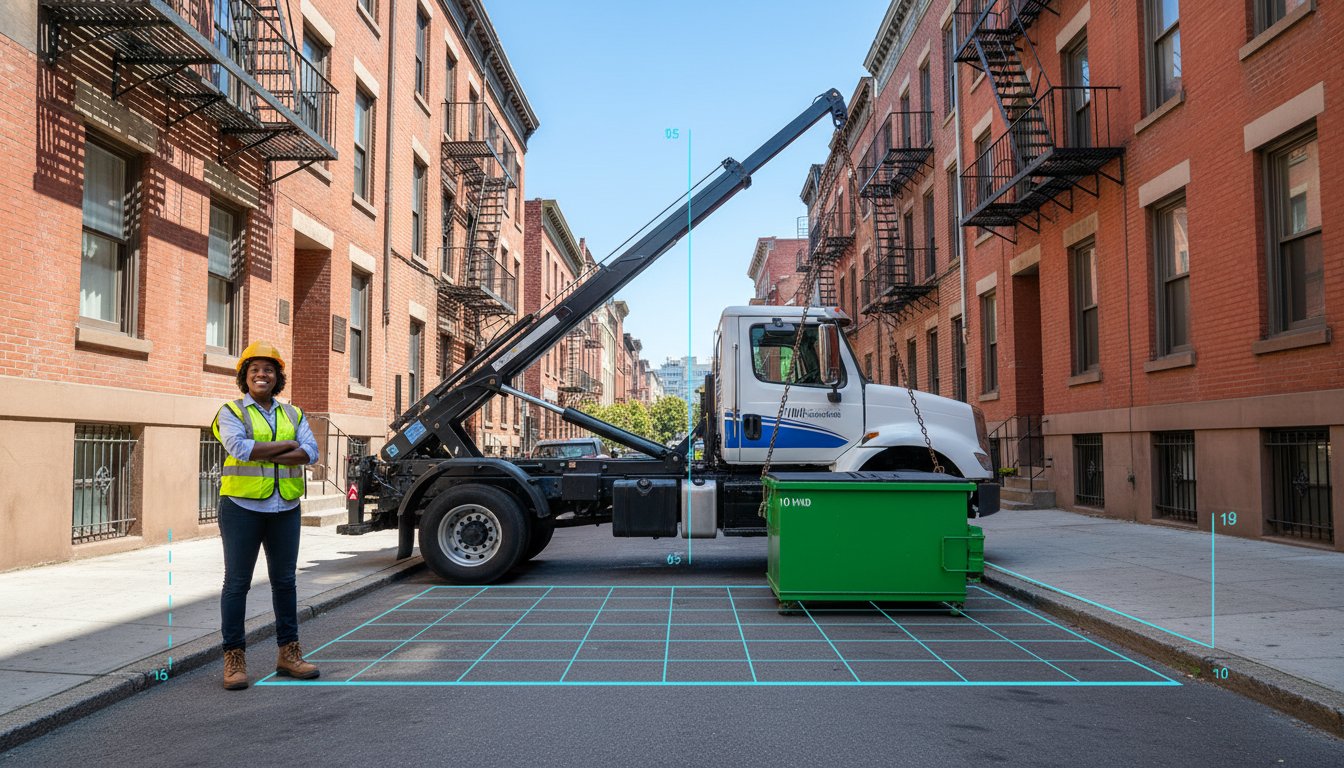
Most urban dumpster deliveries fail before the truck even leaves the yard because the property owner measured the ground but forgot to measure the air. Renting a dumpster for a tight urban space requires more than just finding an open patch of pavement; it requires mastering the delivery envelope that a heavy roll-off truck needs to operate. You likely worry about a driver refusing the delivery or your bin blocking a neighbor's access. These are valid concerns in dense city environments where every inch of curb space is contested and overhead wires create constant obstacles.
We understand that managing a renovation in a crowded neighborhood is already a logistical headache. This guide provides the professional strategy you need to secure permits, calculate clearance, and select the right container size for a standard parking spot. You will learn the exact steps to prep your site and navigate 2026 municipal requirements, such as the 15-foot fire hydrant clearance rule and the 20-foot crosswalk buffer. Follow these instructions to turn a high-stress delivery into a controlled, efficient start to your project.
Key Takeaways
- Learn the exact dimensions and air-space requirements for renting a dumpster for a tight urban space to prevent delivery refusals.
- Discover why the 10-yard dumpster is the most efficient choice for standard parking spots and narrow city lots.
- Master the permit process for street and alley placements to stay compliant with 2026 municipal regulations.
- Use our site-prep checklist to clear a 50-foot approach and secure vertical clearance for the roll-off hoist.
- Gain professional tips on coordinating with neighbors and local authorities to minimize traffic disruptions during delivery.
The Logistics of Renting a Dumpster for a Tight Urban Space
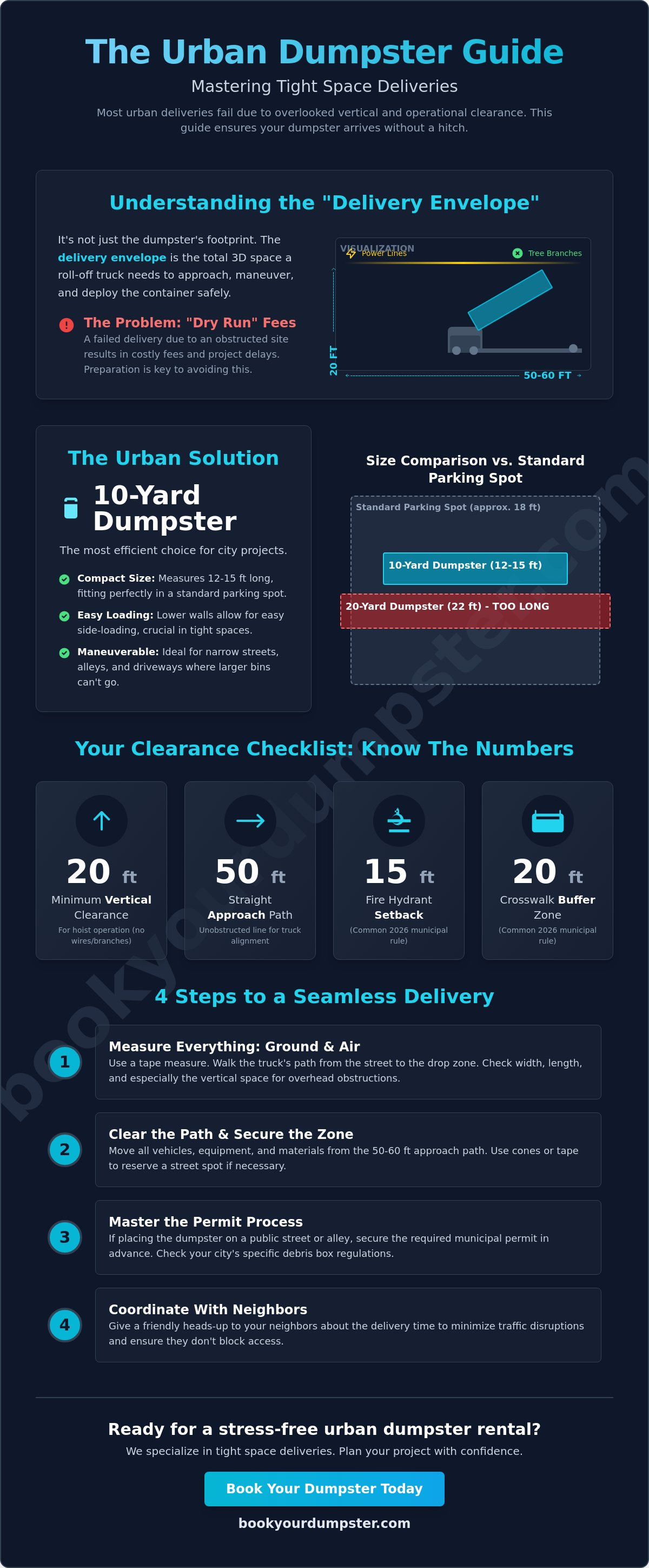
In the context of waste management, a tight urban space is any location where physical constraints like narrow lanes or low overhangs limit the movement of heavy machinery. Renting a dumpster for a tight urban space involves more than checking the ground dimensions of the bin itself. You must account for the delivery envelope. This is the total cubic area required for the truck to approach, tilt its bed, and safely slide the container into place. Standard delivery protocols often fail in city environments because they assume wide-open suburban driveways and 50 feet of straight-line clearance. In a city, you work with inches, not feet, and a single poorly parked car can stop the entire process.
Understanding what is a roll-off dumpster is the first step in planning your project. These units are transported by large trucks that use a hydraulic hoist to load and unload the container. Because the truck must tilt its bed to a steep angle, vertical space is just as critical as ground clearance. For most residential city projects, the 10-yard dumpster is the urban gold standard. It features a compact 15-foot length that fits within the footprint of a standard parking spot. This makes it the most reliable choice for narrow streets and compact driveways where larger 30 or 40-yard bins simply cannot go.
Common Urban Obstacles for Roll-Off Trucks
Older neighborhoods in cities like Queens or Boston present unique challenges for drivers. Low-hanging power lines and thick tree branches can snag the hoist during the drop-off process. Narrow one-way streets lined with permanent street parking often leave no room for the truck to swing its cab. Tight turns and blind alleys require high-precision driving and a clear path that is often obstructed by unauthorized vehicles. Operational clearance is the total space a truck needs to lift and drop a bin.
Why Proper Placement Prevents Costly 'Dry Run' Fees
A dry run occurs when a driver arrives but cannot complete the delivery due to an obstruction or lack of space. This results in a fee for the driver's time and fuel. In a dense city, a failed delivery stalls your entire construction timeline. Without the bin, debris piles up and stops your crew's progress. You are responsible for ensuring the path is clear by moving vehicles and checking for low wires before renting a dumpster for a tight urban space. Taking these steps ensures a seamless start to your project with Book Your Dumpster.
Measuring Your Space: Footprint vs. Operational Clearance
Measuring for a dumpster in a city is a two-part process. You must measure the bin, but you also must measure the truck. Renting a dumpster for a tight urban space often fails because customers focus only on the ground footprint. A 10-yard dumpster is the most common choice for city projects because its 15-foot length fits into a standard driveway or parking spot. However, the truck delivering it needs significantly more room to operate. You must account for the width of the truck's mirrors and the stabilizers that extend from the sides during the drop-off process. If your driveway is exactly eight feet wide, a standard truck cannot enter without risking damage to your property.
Vertical clearance is the most overlooked factor in urban deliveries. Follow the 20-foot rule for overhead obstructions. When the truck tilts its bed to slide the dumpster off, the highest point of the hoist can reach 20 feet in the air. Low-hanging power lines, cable wires, and tree branches will prevent a successful delivery. If you plan to place the bin on the street, review San Francisco's debris box permit requirements or your local equivalent to ensure you have the necessary clearance from municipal infrastructure. A roll-off truck typically requires 60 feet of straight-line approach to drop a 15-foot container safely.
Technical Dimensions of Urban-Friendly Dumpsters
The 10-yard dumpster is designed for density. It typically measures 12 to 15 feet long and 8 feet wide. Compared to a 20-yard dumpster, which is usually 22 feet long, the 10-yard unit is much easier to maneuver into narrow alleys. Its lower walls are a major advantage in tight spots. You can easily lift debris over the side of the bin rather than relying solely on the rear door. This is critical when the dumpster is tucked against a wall or fence. Select your container size at Book Your Dumpster once you have confirmed your measurements.
Determining Your Property's 'Drop Zone'
Use a standard tape measure to verify your space before the truck arrives. Walk the entire path from the street to the final placement spot. Look for any narrow points where the truck mirrors might clip a gate or gutter. Mark the four corners of your intended drop zone with chalk or orange cones. This gives the driver a clear target and ensures the bin doesn't block essential access points. If the truck has to navigate a curve, add an extra five feet of width to your measurements to account for the swing radius of the trailer.
Placement Strategies: Driveway vs. Street vs. Alley
Your choice of placement determines your total project cost and legal liability. When renting a dumpster for a tight urban space, the driveway is always the preferred option. It is private property, which usually means you don't need a municipal permit. This saves you money and eliminates the risk of tickets from city inspectors. However, urban driveways are often narrow. Ensure yours is at least 10 feet wide to allow for the truck's stabilizers. If your driveway is shared with a neighbor, obtain written permission before scheduling your delivery to avoid disputes that could halt your work.
Street placement is the reality for many city residents without off-street parking. This involves placing the bin on the public right-of-way, which requires coordination with local authorities. You must follow the 'Sidewalk Gap' rule: never allow any part of the dumpster or the delivery truck to block the sidewalk. Pedestrian access must remain completely unobstructed to comply with safety codes. Blocking a sidewalk is a fast way to get your bin impounded or receive a heavy fine. Alleys offer a high-reward alternative for backyard renovations, but they carry the highest risk. A driver needs enough room to maneuver without hitting brick walls or utility meters. Only attempt an alley delivery if you have verified the width at the narrowest point of the entry.
Navigating City Permits in NY, IL, and MA
Permit requirements vary significantly by region. In New York City, the DOT requires a specific highway permit for any container placed on the street. Chicago residents must secure a 'Public Way' permit, which often has stricter duration limits than suburban rules. If you are operating in these dense hubs, consult our guide on dumpster rental in New York, Illinois, and Massachusetts for a detailed breakdown of 2026 regulations. Always apply for these permits at least five business days before your project starts to account for processing times.
Protecting Your Surface in Tight Quarters
Dense urban lots often have older asphalt or decorative pavers that crack under pressure. Renting a dumpster for a tight urban space increases the concentrated load on your surface. Use 3/4-inch plywood sheets or professional street pads under the dumpster's rollers to distribute the weight. This is especially critical if you are loading heavy debris like concrete, brick, or dirt. Proper surface protection prevents thousands of dollars in property damage and ensures the bin doesn't sink into soft ground during a rainstorm.
Step-by-Step Preparation for a Seamless Urban Delivery
Preparation is the difference between a successful drop-off and a dry run fee. Confirm your reservation 24 hours in advance to ensure the schedule remains on track. On the day of delivery, clear all vehicles from the street and your driveway at least 50 feet back from the drop zone. This provides the truck with the necessary pivot space to align with your property. If you are placing the bin on a public street, secure your permit and tape a physical copy to a visible location, such as a front door or a nearby pole. Drivers often need to verify this documentation before they can legally drop the container on city-owned land.
Check for temporary city restrictions before the truck arrives. Street cleaning, utility work, or emergency "No Parking" signs can appear overnight and block access. Renting a dumpster for a tight urban space requires constant vigilance regarding these municipal changes. If your city has specific safety requirements, such as the Denver rule requiring reflective tape on the corners of the bin, verify that your site is ready for these additions. Taking these steps protects your project timeline and keeps your neighborhood accessible. Once you have cleared the path, schedule your urban delivery with confidence.
Neighbor Diplomacy and Communication
Proactive communication prevents neighbors from calling code enforcement. Inform the people on both sides of your property about the delivery time and the expected duration of the rental. If you live in a multi-family urban dwelling, explain that the dumpster is for a specific project to discourage "midnight dumpers." These are individuals who use your rented bin for their own household trash, which can quickly push you over your weight limit. Consider using a heavy-duty tarp and bungee cords to cover the bin at night. This simple step signals that the container is private property and helps maintain neighborhood standards.
Final Site Check: The Morning of Delivery
Perform a final walkthrough the morning your dumpster is scheduled to arrive. Look for new obstacles like low-hanging telecommunications wires or recently parked scooters. Ensure all gates are unlocked and pets are secured indoors. If you are operating in a cold climate, verify that the drop surface is completely clear of snow and ice to prevent the bin from sliding. For a deeper look at managing your waste project, read our Roll Off Dumpster Rental Guide. Finally, confirm that your placement spot respects the 15-foot fire hydrant clearance and 20-foot crosswalk buffer required in most dense urban zones.
Why Book Your Dumpster USA is the Urban Specialist
Managing a project in a high-density neighborhood requires a partner who understands that space is your most valuable resource. We specialize in renting a dumpster for a tight urban space by providing equipment and logistics specifically designed for city limits. Our fleet is equipped to handle the unique challenges of narrow streets and compact lots. We remove the guesswork from the process with transparent pricing. You won't find hidden city surcharges or opaque fees in our quotes. This commitment to honesty serves as our professional handshake with every customer.
Our drivers are the core of our urban strategy. They undergo specific training to master high-precision placement in environments where a single inch matters. Whether you are tucking a bin into a narrow alley or dropping it between two parked cars, our team has the technical skill to execute the delivery without property damage. Our online booking platform is built for the 2026 urban professional. It allows you to schedule, manage, and track your waste removal from any device. This digital-first approach reduces the administrative burden on your project.
The 10-Yard Hero: Our Most Popular Urban Container
The 10-yard dumpster is our most requested unit for homeowners in New Jersey and Queens. Its compact footprint allows it to sit comfortably in a driveway while still providing enough volume for significant debris. It is the ideal size for kitchen and bathroom remodels where you need to dispose of heavy tiles, cabinets, and drywall. For a deeper breakdown of how to maximize this container, consult our 10 Yard Dumpster Rental Guide. Choosing the right size from the start prevents the logistical nightmare of a bin that is too large for your street.
Reliability You Can Count On
Punctuality is essential when you have a crew waiting and a narrow window of permitted street time. We understand the volatility of heavy city traffic and plan our routes to ensure your bin arrives as scheduled. Our system simplifies city waste management by providing clear communication at every step. You receive updates from the moment you book until the final pickup is complete. This reliability allows you to focus on your renovation instead of worrying about the logistics of your trash. Book Your Dumpster Now to secure your delivery slot and take control of your urban project.
Take Control of Your Urban Project Today
Mastering the logistics of renting a dumpster for a tight urban space is about precision and planning. You now know that vertical clearance and the operational delivery envelope are just as important as the ground footprint of the bin itself. By securing your municipal permits early and prepping your site 24 hours in advance, you eliminate the risk of dry run fees and neighborhood complaints. This strategy ensures that even the narrowest city lot can accommodate a professional waste management solution without disrupting traffic or pedestrian access.
We provide the specialized inventory you need, including 10, 20, 30, and 40-yard containers designed for various project scales. Our expert drivers are specifically trained for high-precision placement in the tightest spots, ensuring your property remains protected throughout the process. With transparent, upfront pricing and a digital-first booking system, we remove the logistical stress from your renovation. Secure your 10-yard urban dumpster today at BookYourDumpster.com. Start your cleanup with a partner who understands the unique demands of city living and get your project moving forward today.
Frequently Asked Questions
Will a 10-yard dumpster fit in a standard residential parking space?
Yes, a 10-yard dumpster fits into a standard parking spot. These spots are usually 9 feet wide and 18 feet long, while our 10-yard bin is approximately 15 feet long and 8 feet wide. You must ensure the truck has enough room to maneuver into the spot without hitting neighboring vehicles. Clear the adjacent spaces if possible to give the driver maximum visibility and a wider turn radius during the drop-off.
Do I need a permit if the dumpster is placed entirely on my driveway?
Permits are generally not required for placement on private driveways. Private property falls outside the jurisdiction of the Department of Transportation or Public Works in most cities. However, verify your local HOA rules or historic district guidelines before ordering. If your driveway is too short and the bin overhangs the sidewalk, you must obtain a public right-of-way permit to avoid fines and potential impoundment of the container.
How much vertical clearance does a roll-off truck need for delivery?
Plan for a minimum of 20 feet of vertical clearance. The truck must tilt its hoist high into the air to slide the bin off the bed. Renting a dumpster for a tight urban space requires you to look up, not just down. Identify any low-hanging wires, cable lines, or building eaves that could snag the equipment. If overhead obstructions are present, you must find an alternative drop zone with a clear sky.
What happens if the truck cannot fit into my narrow street?
The driver will bypass the delivery if the approach is too narrow for safe passage. This results in a dry run fee and delays your project. To prevent this, measure the narrowest point of your street and inform us of any permanent obstructions like concrete bollards or tight corners. If a standard roll-off truck cannot enter, you might need to relocate the drop zone to a wider intersecting street with a permit.
Can I place a dumpster in a city alleyway?
You can place a dumpster in an alley if you maintain clear passage for emergency vehicles. Check your local municipal code, as many cities require a minimum of 10 to 12 feet of remaining width for through traffic. You must also secure an alley permit. Never block garage doors, fire escapes, or utility access points. If the alley is a dead end, the truck needs a wide enough area to reverse safely.
How do I prevent other people from throwing trash in my urban dumpster?
Secure your dumpster with a heavy-duty tarp and bungee cords every evening. This simple step discourages neighbors and passersby from dumping their own trash into your bin. In dense urban environments, unauthorized dumping can quickly push your load over the allowed weight limit. If possible, place the bin in a well-lit area or under a security camera. Clear communication with your neighbors about the project also helps reduce unwanted debris.
Are there weight limits for dumpsters placed on city streets?
Weight limits apply to all street-placed containers to protect the underlying infrastructure. Most urban permits specify a maximum tonnage, often ranging from 2 to 4 tons for residential projects. If you fill the bin with heavy materials like soil, concrete, or asphalt, you risk damaging the street and facing municipal fines. Always use street pads or plywood to distribute the weight and protect the road surface from the dumpster's steel rollers.
How far in advance should I book for a tight space delivery?
Schedule your rental at least 7 to 10 days before your project begins. This window is critical for renting a dumpster for a tight urban space because it allows time for permit approval. Many city offices require a week to process right-of-way applications. Booking early also ensures that a 10-yard or 20-yard container is available, as these compact sizes are in high demand for city renovations and cleanouts.


