

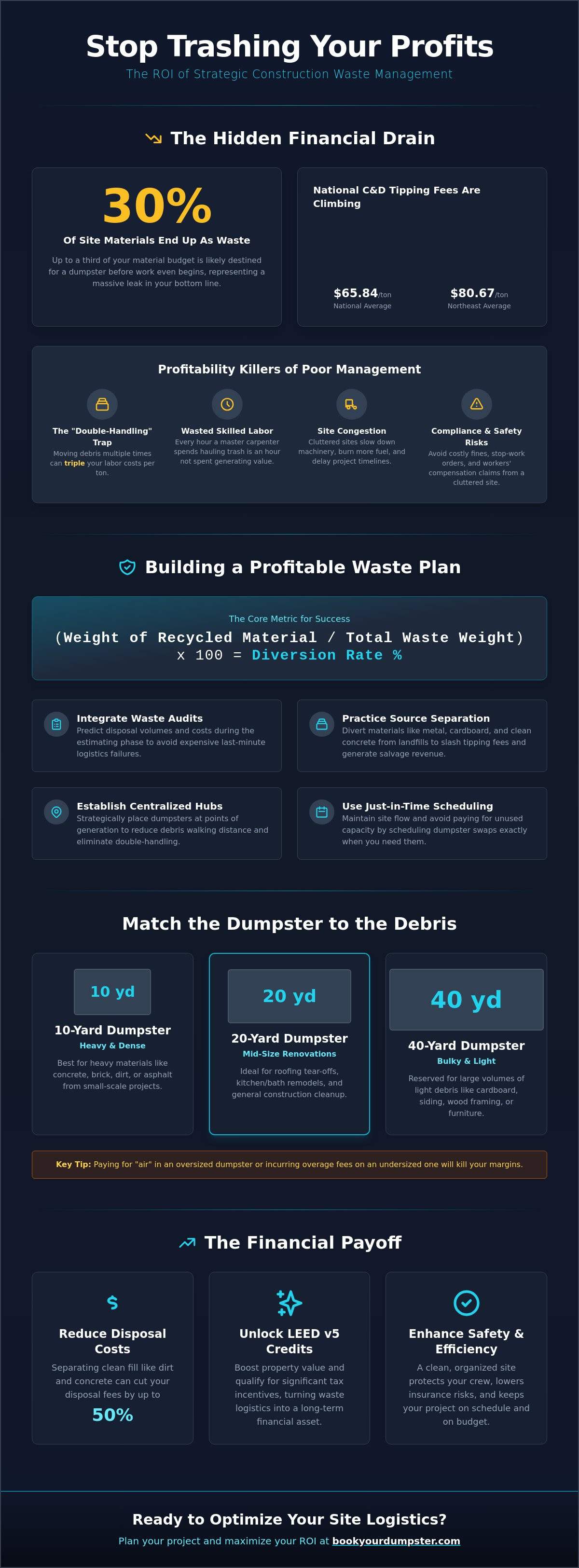
Up to 30% of the materials delivered to your project site will likely end up in a dumpster. When you consider that national C&D tipping fees have climbed to an average of $65.84 per ton, that waste represents a massive leak in your bottom line. Calculating the ROI of proper construction site waste management is the only way to stop that drain on your capital. You know that unpredictable disposal costs and wasted labor hours spent hauling debris can crush a tight margin. It's time to stop treating waste as an afterthought and start treating it as a line item for profit.
This guide shows you how a strategic plan transforms disposal expenses into operational efficiency. You'll learn how to navigate the 2026 financial landscape, including the latest LEED v5 standards and regional fee spikes in areas like the Northeast where costs average $80.67 per ton. We'll walk through the specific logistics of source separation and deconstruction so you can reclaim your project's lost revenue. Stop letting your budget disappear into a landfill and start optimizing your site logistics today.
Key Takeaways
- Identify the "double-handling" trap where moving debris multiple times can triple your labor costs per ton.
- Apply the Diversion Rate Formula to accurately measure the ROI of proper construction site waste management and track project performance.
- Establish centralized waste hubs to reduce debris walking distance and use just-in-time dumpster scheduling to maintain site flow.
- Integrate waste audits into your estimating phase to predict disposal volumes and avoid expensive, last-minute logistics failures.
- Select the right equipment for the job by choosing between 10, 20, 30, or 40-yard roll-off dumpsters based on material weight and volume.
The Hidden Financial Drain: What Poor Waste Management Really Costs
ROI isn't a vague concept; it's a survival metric. In the context of your job site, the ROI of proper construction site waste management is the ratio of cost savings and revenue generated through diversion versus your total disposal expenses. If you treat waste as a "fix it later" problem, you are bleeding capital every day. Most contractors focus only on tipping fees. This is a massive oversight. The real drain is the "double-handling" trap. This occurs when debris is piled in a corner only to be moved again when it blocks access. Moving construction and demolition debris twice doesn't just double your labor costs; it often triples them per ton. You pay for the initial cleanup, the secondary relocation, and the final load-out. Eliminate this cycle by placing dumpsters at the point of generation.
Labor Loss and Productivity Killers
Stop paying master carpenters to act as cleanup crews. Every hour a skilled tradesperson spends clearing a path is an hour they aren't generating project value. Define your indirect waste costs as any labor spent on non-productive material handling. Site congestion also destroys machinery efficiency. Skid steers and forklifts burn more fuel and take longer to maneuver when they must navigate around haphazard scrap piles. A cluttered site is a slow site. Clean sites move faster and cost less to operate.
The Price of Poor Compliance
Regulatory bodies in strictly monitored areas like NYC or San Francisco have turned waste enforcement into a revenue stream. In 2026, EPA and OSHA fine structures for site hazards and improper material sorting have reached record highs. A single stop-work order triggered by a cluttered walkway can freeze your project financing and ruin your delivery schedule. These penalties often exceed the cost of a professional waste management plan. Proper sorting isn't just about being green; it's about avoiding the financial catastrophe of non-compliance.
Safety is the final piece of the financial puzzle. There is a direct, documented link between site clutter and workers' comp claims. Trips, falls, and puncture wounds from stray nails are preventable. By maintaining a clean site, you lower your risk profile and protect your insurance premiums from spiking. Don't wait for an inspector or an injury to fix your logistics. Implement a system that keeps the site clear from day one to protect your margins and your crew.
Calculating the ROI: Direct Savings from Optimized Disposal
Quantifying your success starts with the Diversion Rate Formula: (Weight of Recycled Material / Total Waste Weight) x 100. This percentage is the core metric for the ROI of proper construction site waste management. A high diversion rate doesn't just look good on a sustainability report; it represents a direct reduction in landfill tipping fees and a potential increase in salvage revenue. When you divert metal, cardboard, or clean concrete, you're essentially performing tipping fee arbitrage. You're choosing the lower-cost recycling route over the high-cost landfill route. This strategy is particularly effective in 2026 as national C&D tipping fees have risen to an average of $65.84 per ton.
Tipping Fees and Material Value
In high-cost metros like Boston or Chicago, the price gap between commingled debris and source-separated recycling is staggering. Adopting Sustainable Materials Management practices allows you to exploit this gap. For instance, separating dirt and concrete into a "clean fill" load can reduce your disposal costs by up to 50% compared to a mixed container. Use our guide on 10 yard dumpster rental prices to establish a baseline for small-load ROI in these regulated markets. Proper management also unlocks LEED v5 certification credits. These credits increase property value and can qualify your project for significant tax incentives, turning waste logistics into a long-term financial asset.
Right-Sizing Your Waste Strategy
Paying for "air" in an oversized dumpster kills your margins. If you rent a 40-yard dumpster for a project phase that only generates 15 yards of debris, you're wasting capital on unused capacity. Conversely, overloading a small container with heavy masonry leads to overage fees that quickly erase your profits. Match your container to the material density:
- 10-Yard Dumpster: Best for heavy, dense materials like concrete, brick, or dirt.
- 20-Yard Dumpster: Ideal for mid-sized renovations or roofing projects.
- 40-Yard Dumpster: Reserved for bulky, light debris like cardboard, siding, or scrap wood.
Infrequent massive hauls might seem cheaper on paper, but they often lead to site bottlenecks and double-handling. Frequent, scheduled hauls keep the site fluid and prevent the accumulation of "shadow waste" that slows down your subcontractors. Choosing the right size at Book Your Dumpster USA ensures you only pay for the capacity your project phase requires, maximizing your logistical ROI from day one.
Strategy vs. Chaos: Comparing Logistics Frameworks
A disorganized job site is a financial liability. When waste management is left to chance, the result is "chaos logistics," where debris piles up in work zones and subcontractors spend hours navigating around clutter. Implementing a structured framework is essential to realizing the full ROI of proper construction site waste management. One of the most effective strategies is the creation of centralized waste hubs. By strategically placing containers closer to the point of generation, you drastically reduce the "walking distance" for debris disposal. If a crew spends 10 minutes every hour walking to a distant dumpster, you lose nearly 17% of your daily labor productivity on that task alone. Hubs eliminate this waste and keep your trades focused on building.
Just-in-time dumpster delivery is another pillar of a profitable strategy. Scheduling pickups and drop-offs to coincide with specific project phases prevents site bottlenecks. A full dumpster sitting idle for 48 hours is more than an eyesore; it is a barrier that blocks access for heavy machinery and prevents new material deliveries. Following EPA guidelines on construction waste helps you transition from reactive disposal to proactive resource management. This shift reduces the total volume of waste sent to landfills and maximizes the recovery of valuable scrap. Streamline your procurement by moving away from phone tag and manual invoicing. Platforms like Book Your Dumpster USA allow for digital booking that fits into a project manager's mobile workflow. For contractors managing sites across NY, NJ, and MA, vendor consolidation simplifies accounting and ensures consistent pricing integrity across every zip code.
The Myth of the 'One-Size-Fits-All' Dumpster
Relying on a single 40-yard bin for the duration of a project often leads to contamination. When wood, metal, and concrete are mixed, recycling facilities charge higher "commingled" sorting fees. Instead, use a staged roll off dumpster rental strategy. Deploy a 10-yarder for heavy masonry during demolition, then swap it for a 30-yarder for framing debris. This approach protects your site access and ensures subcontractors have room to work safely and efficiently.
Procurement Efficiency
Modern project management demands speed. Online booking systems save hours of administrative time that would otherwise be spent on hold with local haulers. Transparency in pricing is vital. Avoid the "hidden fee" trap by checking dumpster rental prices before you even bid a project. Knowing your exact logistics costs upfront allows you to protect your margins and provide more accurate estimates to your clients. Optimizing these logistics frameworks is the most direct path to boosting the ROI of proper construction site waste management.
Implementing a Profitable Waste Management Plan
A plan only generates profit if it is executed with precision. Start by conducting a waste audit during your estimating phase. Predict the volume of concrete, wood, and drywall you'll generate before the first shovel hits the ground. This foresight allows you to book the correct equipment, such as a 10-yard dumpster for heavy demo or a 40-yarder for bulky framing debris, rather than guessing on the fly. Assign a Waste Coordinator to every project. Even on small crews, one person must be responsible for monitoring bin contamination. Contaminated loads are the primary reason projects fail to meet the ROI of proper construction site waste management. If a subcontractor tosses food waste into a clean wood bin, your recycling savings vanish instantly.
Focus on source separation for high-value materials to maximize salvage revenue. As of May 2026, Bare Bright copper wire is trading at $5.30 per pound and yellow brass at $2.85 per pound. These aren't just scraps; they are liquid assets. Separate these from general debris to capture their full value. Schedule your hauls based on volume triggers rather than fixed calendar dates. Hauling a half-empty container is a waste of fuel and transport fees. Finally, review every load ticket. These documents are your data trail. Use them to identify which project phases or crews are generating excessive waste and adjust your logistics accordingly.
Local Compliance in Major Metros
High-cost markets require specific paperwork to avoid massive fines. In New York, ensure your haulers meet Business Integrity Commission (BIC) requirements to prevent site shutdowns. Massachusetts has strict waste bans on materials like cardboard and metal; ignore these, and you'll face rejected loads and surcharges. In San Francisco, you must document your diversion rates to comply with local green building ordinances. Use these regulations as a framework for efficiency rather than a hurdle. Compliance ensures you avoid the 53% tipping fee hikes seen in some regions this year.
Subcontractor Accountability
Protect your margins by including waste disposal clauses in every subcontractor agreement. Define exactly which bins they can use and the penalties for contamination. The ROI of back-charging for improper disposal is immediate. It shifts the financial burden of waste onto those who create it. Train your crew with clear signage and place bins at the point of generation to minimize walking time. A well-trained team is your best defense against rising disposal costs. For reliable equipment and transparent pricing, order your next roll-off container from a partner who understands your site logistics.
Scaling Success with Professional Roll-Off Solutions
Scaling your operations requires a logistics partner that treats your project budget with the same respect you do. Book Your Dumpster USA is the strategic choice for contractors focused on the ROI of proper construction site waste management. We provide the infrastructure to turn your waste plan into a profit center. From the 10 yard dumpster for heavy demolition to 40-yarders for bulk materials, we offer the flexible sizing you need to avoid paying for empty space. Transparent pricing is our standard. This allows you to bid projects with confidence, knowing your disposal costs won't fluctuate and eat your margins. We remove the guesswork from your estimates.
Reliability is the foundation of site efficiency. An on-time swap prevents the double-handling trap. When your crew is ready to load and the bin is full, every minute of delay costs you in labor hours. If a framing crew stops work to wait for a container, you lose hundreds of dollars in productivity per hour. We ensure your containers are where you need them, when you need them. This punctuality is a recurring rhythmic promise of reliability that distinguishes us from the often-opaque communication found elsewhere in this industry.
The Book Your Dumpster USA Advantage
Gain direct access to 10, 20, 30, and 40-yard containers across major US markets. We simplify logistics for multi-state contractors operating in NY, NJ, IL, MA, and SF. Managing multiple vendors in different cities is an administrative nightmare. We consolidate that complexity. One partner means one point of contact and unified accounting for all your debris management needs. This level of control is essential for maintaining site safety and regulatory compliance in high-stakes environments. Optimize your site logistics today and secure the equipment you need for your next project phase.
Next Steps for Your Project
Take control of your project's financial health. Review the Ultimate Guide to Construction Debris Removal for deeper technical insights into material sorting and diversion strategies. Get an instant quote now to lock in your budget and protect the ROI of proper construction site waste management. For high-volume commercial needs, schedule a consultation to build a custom waste strategy that scales with your business. Don't let your profits disappear into a landfill. Start your next project with a partner who understands the logistics of success.
Secure Your Project Financial Future
Stop treating debris as a sunk cost. By eliminating the double-handling trap and tracking your diversion rates, you turn site cleanup into a profit-generating activity. Proper waste management protects your labor budget and keeps your high-paid trades focused on building rather than clearing paths. Navigating the strict regulations of New York or San Francisco becomes a competitive advantage when you have a structured logistics plan in place.
Maximizing the ROI of proper construction site waste management requires the right equipment and a reliable partner. We provide 10, 20, 30, and 40-yard containers to match every project phase across NY, NJ, IL, MA, and SF. Our transparent, no-nonsense pricing ensures your project bids remain accurate and your margins stay protected. Don't let logistical chaos drain your capital. It's time to prioritize site efficiency and stop the financial leak.
Secure Your Project ROI—Book Your Dumpster Now
Take control of your site logistics and build a more profitable future today.
Frequently Asked Questions
What is the typical ROI for construction waste management?
Implementing a formal waste management plan typically increases project costs by 0.4% to 6%. However, these initial expenses are almost always offset by long-term savings. Effective site management can reduce total material waste by up to 90%. You gain financial value through avoided tipping fees and the recovery of high-value salvage materials that would otherwise be lost in a commingled bin.
How does source separation impact disposal costs?
Source separation reduces your costs by allowing you to bypass expensive commingled sorting fees at transfer stations. Clean fill loads consisting only of dirt or concrete can cost up to 50% less to dispose of than mixed debris. Additionally, separating metals like copper wire or brass allows you to capture salvage revenue based on current 2026 market rates rather than paying to landfill them.
What are the most common hidden fees in dumpster rentals?
Hidden costs usually stem from overage charges, contamination fees, and permit requirements. Overage fees occur when you exceed the weight limit of your container, so match your material density to the right dumpster size. Contamination fees apply if you mix prohibited items or food waste into a recycling load. Always verify local street permit costs with your municipality before scheduling a drop-off.
How do I choose the right dumpster size for a demolition project?
Use a 10-yard dumpster for heavy, dense materials like concrete, brick, or asphalt to stay within weight limits. For whole-structure demolition involving bulky framing, siding, and roofing, choose a 40-yard dumpster. This maximizes volume and reduces the frequency of hauls. Match the container capacity to your specific project phase to avoid paying for unused space or incurring multiple transport fees.
Are there tax incentives for recycling construction debris in New York or Illinois?
Many projects qualify for federal tax deductions by donating salvaged materials through a formal deconstruction process. In New York and Illinois, local green building programs often provide property tax abatements or grants for projects that achieve high diversion rates. Check with your local development authority for specific 2026 incentives related to sustainable building and LEED certification to maximize your project's financial return.
What materials are banned from landfills in Massachusetts?
Massachusetts prohibits several easy-to-recycle materials from landfills, including cardboard, metal, glass, plastic, and clean gypsum wallboard. You must separate these items into dedicated recycling streams. Failure to comply leads to rejected loads at the transfer station and significant fines. Using a dedicated 20 or 30-yard dumpster for these specific materials ensures you stay compliant with state environmental regulations.
How can I track my site's diversion rate for LEED credits?
Track your rate using the formula: (Weight of Recycled Material / Total Waste Weight) x 100. Collect and archive every load ticket provided by your hauler to document the final destination of your debris. Under LEED v5, commingled recycling rates are capped at 35% without third-party verification. Prioritize source separation on-site to achieve the higher 50-75% diversion thresholds required for maximum certification points.
Does a waste management plan actually save labor time?
A strategic plan saves labor by eliminating the double-handling of debris. When you place containers at the point of generation, crews spend less time moving scrap and more time on productive tasks. This efficiency is a primary driver for the ROI of proper construction site waste management. A clean site also reduces the time spent clearing paths for heavy machinery and material deliveries.