

The success of your home cleanout isn't determined by how much junk you throw away; it's decided by the 48 hours of preparation you do before the truck even arrives. You want your clutter gone without worrying about cracked driveway pavement or surprise overweight fees. It's often stressful to navigate local permit laws in cities like New York or San Francisco when you just want a clear workspace. This dumpster rental checklist for homeowners provides the exact steps you need to protect your property and keep your waste removal project on budget.
Following this guide ensures you choose the right container size, whether you need a compact 10 yard dumpster for a bathroom remodel or a 40 yard dumpster for a total home restoration. You'll learn how to prep your site to avoid structural damage and exactly which items, like tires or appliances containing Freon, must stay out of the bin to avoid penalties. We will walk you through the logistics of placement, permit requirements, and weight limits so you can finish your project with total confidence and zero logistical headaches.
Key Takeaways
- Match your project scope to the correct container size to ensure you have enough capacity without paying for unused space.
- Identify whether your placement zone requires a municipal permit and learn how to prep your driveway to prevent surface damage.
- Use this dumpster rental checklist for homeowners to recognize prohibited hazardous materials and avoid expensive overage fees.
- Master the "bottom-up" loading strategy and utilize the walk-in door to maximize every cubic yard of your rental.
- Streamline the final stage of your project by scheduling your pickup 24 hours in advance and keeping the access path clear.
Step 1: Project Assessment and Selecting the Right Dumpster Size
Define your project scope immediately. A successful dumpster rental checklist for homeowners starts with a realistic look at the debris you're moving. An attic cleanout produces light, bulky items, while a kitchen renovation generates heavy drywall and cabinets. Identify your waste stream before you call for a quote. This prevents you from underestimating the volume and facing the logistical nightmare of a container that's full before the job is half finished.
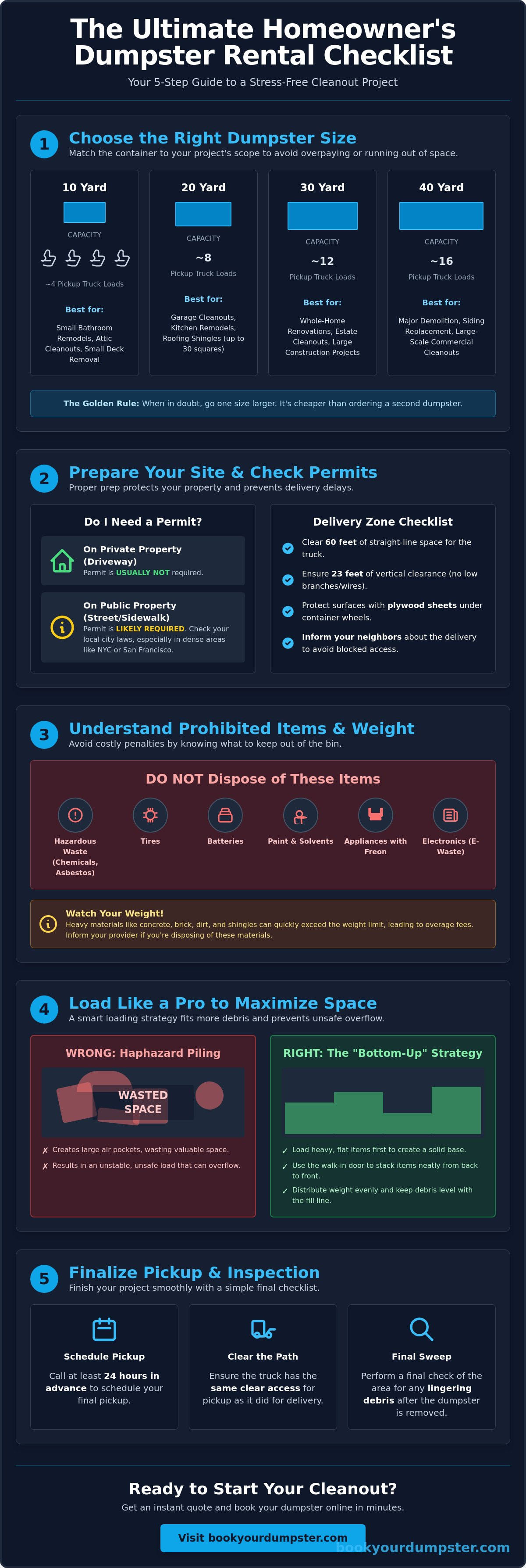
Understand cubic yardage to avoid overpaying or under-ordering. We offer four primary sizes: a 10 Yard Dumpster, 20 Yard Dumpster, 30 Yard Dumpster, and 40 Yard Dumpster. Visualize a cubic yard as a block roughly the size of a standard washing machine. If you're debating between two sizes, follow the "Golden Rule" of waste removal: always go one size larger. It's a key part of any dumpster rental checklist for homeowners because it's significantly more cost-effective to have extra space than to pay for a second rental and a second delivery fee.
Weight is just as critical as volume. Heavy materials like concrete, brick, or dirt are dense and hit weight limits quickly. A 10-yard container filled with concrete weighs much more than a 40-yard container filled with old mattresses. Proper planning involves understanding waste management principles regarding density and disposal regulations. If you're hauling "clean fill" like gravel or soil, tell your provider upfront so they can supply a reinforced container designed for heavy loads.
Estimating Your Waste Volume
Use the standard pickup truck visualization for a quick estimate. A 10-yard dumpster holds roughly four pickup truck beds worth of material. For specific rooms, a standard bathroom gut usually fits in a 10 yard dumpster. Don't forget to factor in "fluff." Bulky furniture and rigid items create air pockets that eat up space. You can't compress a sofa like you can old carpet, so account for that wasted volume in your final size choice.
Matching Size to Common Homeowner Tasks
Choose a 10-20 yard container for garage cleanouts, small deck removals, or roofing shingles. These sizes fit easily on most driveways and handle moderate weight well. For whole-home renovations or large-scale estate cleanouts, you'll need the 30-40 yard options. These larger bins are designed for high-volume debris like lumber, siding, and large furniture sets. If you're managing a professional-scale project, consult our guide to construction debris removal for advanced waste strategies.
Step 2: Navigating Local Permits and Site Preparation
Identify your placement zone before the truck leaves the yard. This is a critical item on your dumpster rental checklist for homeowners. Most residential projects utilize the driveway. This is private property and usually doesn't require a permit. However, if your driveway is too steep or space is limited, you might need street placement. In high-density cities like New York, Chicago, or San Francisco, street placement is often the only option. These locations have strict right-of-way laws that dictate exactly where a container can sit and for how long. Check your local city portal for specific zoning restrictions before you book.
Communication prevents project delays. Talk to your neighbors if the dumpster might block a shared view or create noise during early morning delivery. You should also clear the "swing path" completely. A delivery truck needs approximately 60 feet of straight-line clearance to drop the container safely. It also needs about 23 feet of vertical clearance to raise the hoist. If a neighbor's car or a low-hanging tree limb is in the way, the driver cannot complete the drop. This usually results in a "trip fee" added to your bill, which is an avoidable expense if you plan ahead.
Securing a Right-of-Way Permit
Check if your municipality requires a permit for dumpsters placed on public curbs or sidewalks. These permits often have a specific duration, so verify that the permit covers your entire project timeline. If you're working in a major metro, Book Your Dumpster USA can often provide guidance on local dumpster rental rules. Always display the permit clearly on the container or a nearby structure if required by local law. Failing to secure these documents can lead to immediate impoundment of the dumpster at your expense.
Driveway Protection Checklist
Protect your property from the weight of heavy steel. While dumpsters are essential tools, they can crack aged asphalt or scratch decorative concrete if not placed correctly. Lay down 4'x8' sheets of plywood to distribute the weight of the steel rollers. Sweep the area thoroughly before the truck arrives. A single small stone trapped under a roller can be crushed into your driveway surface under the weight of several tons. Ensure the ground is level to prevent the container from shifting while you're loading heavy debris. This is a simple but vital part of any dumpster rental checklist for homeowners.
While prepping your site, remember that physical placement isn't the only restriction you'll face. You must also account for what goes inside the bin. Federal regulations managed by the EPA list several prohibited household items that cannot be placed in a standard roll-off, regardless of where it's parked. If you've confirmed your site is ready and your permits are in order, you can schedule your delivery to keep your project moving forward without delay.
Step 3: Understanding Prohibited Items and Weight Restrictions
Do not treat your rental like a bottomless pit. Every dumpster rental checklist for homeowners must prioritize compliance with environmental laws to avoid significant financial penalties. Landfills have strict rules about what they accept. If a driver spots prohibited items during pickup or at the disposal site, you'll face contamination fees or a rejected load. This means the truck won't take the bin, and you'll pay a trip fee plus the cost of removing the offending items yourself. Categorize your waste stream before you start tossing.
Hazardous waste is the most common cause of rejected loads. This category includes wet paint, motor oil, batteries, and tires. While you are planning your project, set aside a separate area for these materials. Electronic waste like televisions and computers also requires specialized recycling. Appliances containing refrigerants, specifically refrigerators and air conditioners, are strictly prohibited unless a certified technician has removed the Freon and tagged the unit. Note that these rules protect the environment and the safety of the disposal facility staff.
Safety dictates the "level full" rule. Never load debris above the top rim of the container. During transport, loose items can fly out and cause accidents. Drivers are legally required to refuse any load that isn't level. This is a non-negotiable safety standard that protects other drivers on the road. If you find yourself with more trash than space, don't try to cram it in. Order a second bin or wait for a swap out to stay compliant.
The 'Never-Toss' List for Homeowners
Keep these items out of your bin to stay on budget. This is a vital part of your dumpster rental checklist for homeowners. Paint cans are only acceptable if the paint is completely dried with sawdust or kitty litter. Flammable liquids, motor oil, and automotive batteries pose fire risks and must go to a specialized disposal center. If your home was built before 1980, be vigilant about asbestos-containing materials in flooring or insulation. These require professional abatement and cannot go into a standard roll-off.
Managing Heavy Debris Loads
Define your "clean fill" before loading. Materials like soil, brick, and concrete are recycled differently than general household trash. Because these items are extremely dense, avoid filling a 30 yard or 40 yard dumpster with them. You will likely exceed road weight limits long before the bin is full. Review our dumpster rental prices guide to understand how exceeding your weight allowance by even one ton can add between $40 and $200 to your final bill.
Step 4: Loading Strategy to Maximize Your Rental Value
Maximize your investment by loading with a strategic plan. Most people treat a roll-off like a giant trash can and throw bags over the side. This creates massive air pockets and fills the container twice as fast as necessary. Instead, use the rear walk-in door. This is a vital part of your dumpster rental checklist for homeowners that allows you to walk items directly to the front of the bin. You can stack materials tightly rather than letting them land in a tangled pile. This method is safer for your back and far more efficient for your budget.
Start with the "Bottom-Up" approach. Place flat, heavy items like plywood, old doors, or sheets of drywall on the floor first. This creates a solid foundation and ensures you're utilizing every square inch of the floor space. Once the base is set, begin breaking down everything else. Collapse cardboard boxes and dismantle furniture. A dresser takes up much less room when it's reduced to flat boards. Air pockets are wasted money; eliminate them by filling small gaps with loose debris or bagged trash. This is especially important when using a 10 yard dumpster or 20 yard dumpster where space is at a premium.
Distribute weight evenly across the length of the container. If you pile all the heavy materials at one end, the dumpster could tip or become unstable when the truck attempts to pull it onto the hoist. Keep the load balanced from front to back and side to side. This ensures a safe haul-away and prevents the driver from having to ask you to redistribute the load before they can leave. Proper balance is a hallmark of a professional-grade cleanup.
The Tetris Method of Loading
Fill the voids between large items with smaller scraps. Think of your dumpster as a puzzle. Use loose wood pieces or smaller bags of trash to plug the holes created by bulky items. Always keep the load "level full." Nothing should protrude above the top rail. If items are sticking out, the driver cannot tarp the load, which is a legal requirement for transport. Place lighter materials like insulation or plastic sheeting on top and weigh them down with heavier items to prevent them from blowing out during transit.
Safety Protocols During Loading
Prioritize personal safety during the cleanup process. Wear puncture-resistant gloves and steel-toed boots to protect against nails and sharp metal edges found in construction debris. Keep children and pets away from the work zone at all times; a dumpster is a heavy industrial tool, not a playground. Never attempt to compact the trash by jumping on it inside the container. This is extremely dangerous and can lead to serious injury if the debris shifts under your weight. If you follow these loading strategies, you'll get the most value out of your residential dumpster rental and finish your project faster.
Step 5: Finalizing Pickup and Post-Rental Inspection
Don't treat the end of your rental as an afterthought. Scheduling your pickup is the final mandatory step in any dumpster rental checklist for homeowners. Most providers require at least 24 hours of notice to integrate your location into their route. If you wait until the last minute, you might be stuck with a full container on your driveway for several extra days. This delay can lead to additional daily rental fees or complaints from your HOA. Set a reminder to call or log in once your project is 90% complete.
Ensure the path is entirely clear before the truck arrives. Move all vehicles to the street or a neighbor's driveway to provide the driver with ample room to maneuver. If you're working in a region with winter weather, clear any snow or ice from around the container. The driver must have unobstructed access to the bin to safely engage the hoist. If equipment, parked cars, or debris blocks the truck, you'll likely incur a trip fee, and the removal will be rescheduled. This is an avoidable logistical headache that is easily solved with five minutes of site prep.
Review your final invoice carefully once the project is closed. This document should align with your initial quote, but it will also detail any weight overages or environmental fees if you exceeded your limits. As mentioned in Step 3, weight limits are strictly enforced. If you filled a 30 yard dumpster with heavy shingles or concrete, expect to see the specific tonnage recorded by the scale at the disposal facility. Transparency in billing is a hallmark of a professional service, so ensure you understand every line item before closing out your project file.
The 24-Hour Pickup Rule
Confirm your pickup date through the Book Your Dumpster USA online portal to ensure the request is logged and scheduled. Before the driver arrives, perform a quick inspection of the contents. In high-density urban areas, neighbors sometimes "gift" prohibited items like tires or paint cans to your dumpster overnight. Remove these immediately to avoid the contamination fees we covered earlier. Finally, ensure the rear walk-in door is securely latched and locked. A loose door can swing open during transport, creating a major road hazard for other drivers.
Final Property Walkthrough
Perform a thorough inspection once the truck hauls the container away. Check your driveway for any new indentations or scratches. If you followed the advice in Step 2 and used plywood sheets, your surface should be intact. Use a magnetic sweep tool to find stray roofing nails or metal shards that might have fallen during the loading process. This prevents flat tires and keeps your property safe for pets and children. Ready for your next project? Book your next dumpster rental online for instant scheduling and reliable waste removal.
Start Your Cleanup with Confidence
Successful waste removal is about maintaining control over your project's logistics. You now have the specific tools to select the right container size, protect your driveway, and load debris with maximum efficiency. By following this dumpster rental checklist for homeowners, you eliminate the threat of hidden fees and structural property damage. You've learned how to navigate complex local permit laws and how to separate prohibited hazardous materials from your general waste stream.
We provide deep local expertise across NY, NJ, IL, and MA. Our service focuses on pricing integrity and punctuality. Use our simple 3-step online booking process to secure your 10, 20, 30, or 40 yard container without unnecessary industry fluff. Ready to start your project? Book Your Dumpster USA online in minutes!
Take back your space today. With a solid plan and a dependable partner, your renovation or cleanout will move from a state of clutter to a state of resolution quickly. You've got this.
Frequently Asked Questions
Can I put the dumpster on the street in front of my house?
You can place a dumpster on the street provided you obtain the necessary municipal permit first. Most cities require a right-of-way permit for any container sitting on public property like a curb or sidewalk. These permits typically cost between $10 and $150 depending on your location. Check your local city portal for specific regulations in major metros like New York or San Francisco before scheduling your delivery.
What happens if I overfill the dumpster past the top rim?
The driver will refuse to pick up the container if any debris is stacked above the top rail. This is a non-negotiable legal safety requirement for road transport because loose items can fly out during transit. You'll be forced to remove the excess material yourself and pay a trip fee for the rescheduled pickup. Always keep your load level with the rim to ensure a seamless removal process.
Do I need to be home when the dumpster is delivered or picked up?
You don't need to be present for delivery or pickup as long as the access path is completely clear. Ensure all vehicles are moved from the driveway and that there are no low-hanging wires or tree limbs blocking the truck's hoist. Provide specific placement instructions via the Book Your Dumpster USA online portal so the driver knows exactly where to drop the bin. This is a key part of any dumpster rental checklist for homeowners to avoid logistical delays.
How much weight can a 10-yard dumpster actually hold?
A 10-yard dumpster typically has a weight capacity of 2 to 3 tons. This size is ideal for small bathroom remodels or garage cleanouts and holds roughly four pickup truck beds of debris. If you're disposing of heavy materials like concrete or brick, you'll reach this limit much faster than you'll fill the volume. Always discuss your specific debris type with your provider to ensure you don't exceed road weight limits.
Will the dumpster damage my asphalt or concrete driveway?
Heavy steel containers can cause surface indentations or scratches if you don't take proper precautions. Lay down 4'x8' sheets of plywood to distribute the weight of the rollers and prevent the steel from making direct contact with your driveway. Sweep the area thoroughly before the truck arrives. A single small stone trapped under a roller can be crushed into your asphalt under the weight of a loaded container.
What should I do if my project takes longer than the rental period?
Contact your provider at least 24 hours before your scheduled pickup to request a rental extension. Most companies offer daily rates for extra time, but you must communicate this early to prevent the driver from arriving on your original date. Because the dumpster rental checklist for homeowners prioritizes efficiency, proactive scheduling ensures you have the bin as long as you need it without incurring unexpected "dry run" fees.
Can I mix yard waste with household junk in the same container?
You can generally mix household junk with yard waste like branches and grass in the same roll-off. However, some local municipalities have strict regulations that require organic matter to be processed separately from construction debris. Confirm these rules during your initial project assessment. Mixing materials in a region that requires separation can lead to contamination fees at the disposal facility, which increases your total project cost.
Are there items that carry an extra disposal fee even if they aren't prohibited?
Certain bulky items often incur individual surcharges because they require specialized handling at the transfer station. This typically includes mattresses, box springs, and large tires. While these items aren't prohibited like hazardous waste, they're more difficult to process than standard debris. Always declare these items upfront during the booking process so your quote accurately reflects the total cost of your waste removal project.