The average person in the U.S. generates 4.9 pounds of municipal solid waste every single day. For high-volume businesses, this volume translates into a logistical nightmare of overflowing bins and skyrocketing hauling fees. You probably feel like you're paying to transport more air than actual waste. It's frustrating to watch your budget disappear into frequent, inefficient pickups that don't solve your space or odor issues. Stop paying for empty space and start managing your volume with a professional trash compactor service to regain control over your facility's waste stream.
You'll learn how to master the logistics of commercial waste and determine if a specialized compactor or a 40 yard roll-off dumpster fits your specific footprint better. We'll show you how to optimize your haul frequency for maximum cost efficiency while staying ahead of the mandatory digital waste tracking requirements starting in October 2026. This guide provides a no-nonsense breakdown of equipment selection, maintenance expectations, and strategies to remove the friction from your daily operations. Get ready to transform your waste management from a messy expense into a streamlined, high-functioning tool.
Key Takeaways
- Learn how to consolidate four to five loads of loose waste into a single haul to eliminate unnecessary transportation fees and reduce your carbon footprint.
- Differentiate between stationary units for bulky dry materials and self-contained units designed for leak-proof wet waste management in food service environments.
- Determine the exact volume threshold where a professional trash compactor service offers a better ROI than a traditional 40 yard dumpster.
- Audit your facility’s electrical capacity and clearance space to ensure a seamless equipment installation and heavy-duty hauler access.
- Use digital logistics tools to simplify high-volume waste scheduling and maintain compliance with upcoming 2026 tracking regulations.
Understanding Trash Compactor Service for Commercial and Industrial Needs
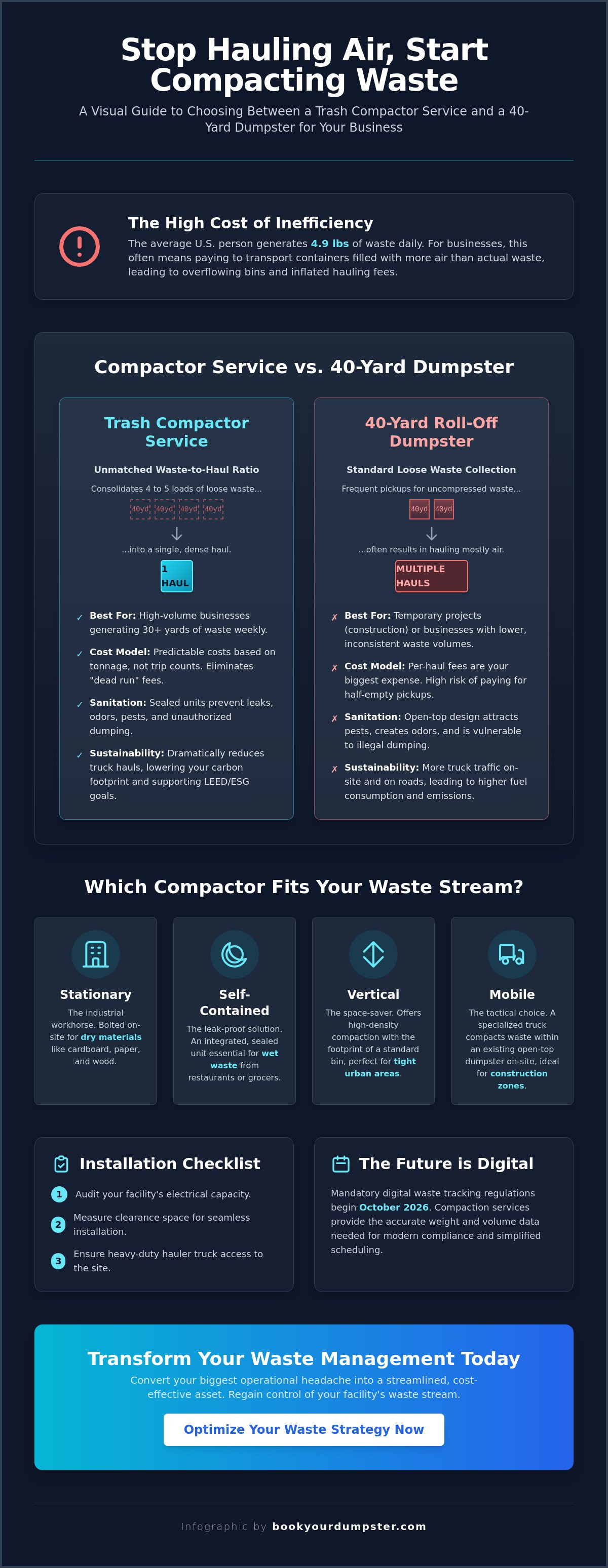
A Compactor is a mechanical system designed to crush waste into a dense mass. In a professional trash compactor service, this technology becomes a logistical strategy rather than just a piece of equipment. The goal is simple: maximize density to minimize transportation. Most commercial operations currently use standard open-top containers, which means they're frequently paying to haul more air than actual debris. Choosing a trash compactor service allows you to turn four or five loads of loose waste into a single, high-density haul. This immediate volume reduction is the foundation of a modern waste management plan.
For businesses generating 30 yards or more of weekly waste, the return on investment is undeniable. High-volume environments like distribution centers, large retail hubs, and manufacturing plants see the most significant benefits. By consolidating pickups, you cut the most expensive variable in your contract: the haul fee. Beyond the numbers, compaction improves your facility's daily environment. A sealed unit eliminates the odors and pest issues common with open bins. It also provides a higher level of security. Locked, enclosed units prevent unauthorized dumping from outsiders and stop scavengers from creating a mess in your loading dock area.
Why Haul Frequency is Your Biggest Waste Expense
Every time a truck arrives at your site, you pay for the trip. "Dead runs" occur when a truck picks up a container that isn't fully loaded just to stick to a rigid schedule. This is a waste of your budget. Compaction technology stabilizes your monthly expenses by making waste costs predictable based on actual tonnage rather than trip counts. Fewer truck visits also mean less wear on your asphalt and reduced congestion in tight urban grids. It's a pragmatic shift from reactive disposal to proactive volume control.
The Role of Compaction in LEED and Sustainability Goals
Reducing truck traffic is a direct win for your sustainability metrics. Fewer hauls result in lower diesel consumption and a smaller carbon footprint for your entire operation. If your business is pursuing LEED certification or internal ESG goals, density is your best friend. Modern systems provide the accurate documentation needed for corporate audits. By tracking exact weights and volumes, you can prove your landfill diversion rates and efficiency gains. This data becomes even more critical as digital waste tracking becomes mandatory in some regions starting in October 2026. Whether you're managing mixed debris or clean cardboard streams, compaction provides the transparency required for modern compliance.
Key Types of Compaction Equipment and Service Models
Selecting the right hardware defines the success of your trash compactor service. If you choose a machine that doesn't match your specific waste stream, you'll face constant mechanical failures and sanitation issues. Most commercial operations select from four primary equipment categories based on their volume and material type. Understanding these differences is the first step toward removing logistical friction from your loading dock.
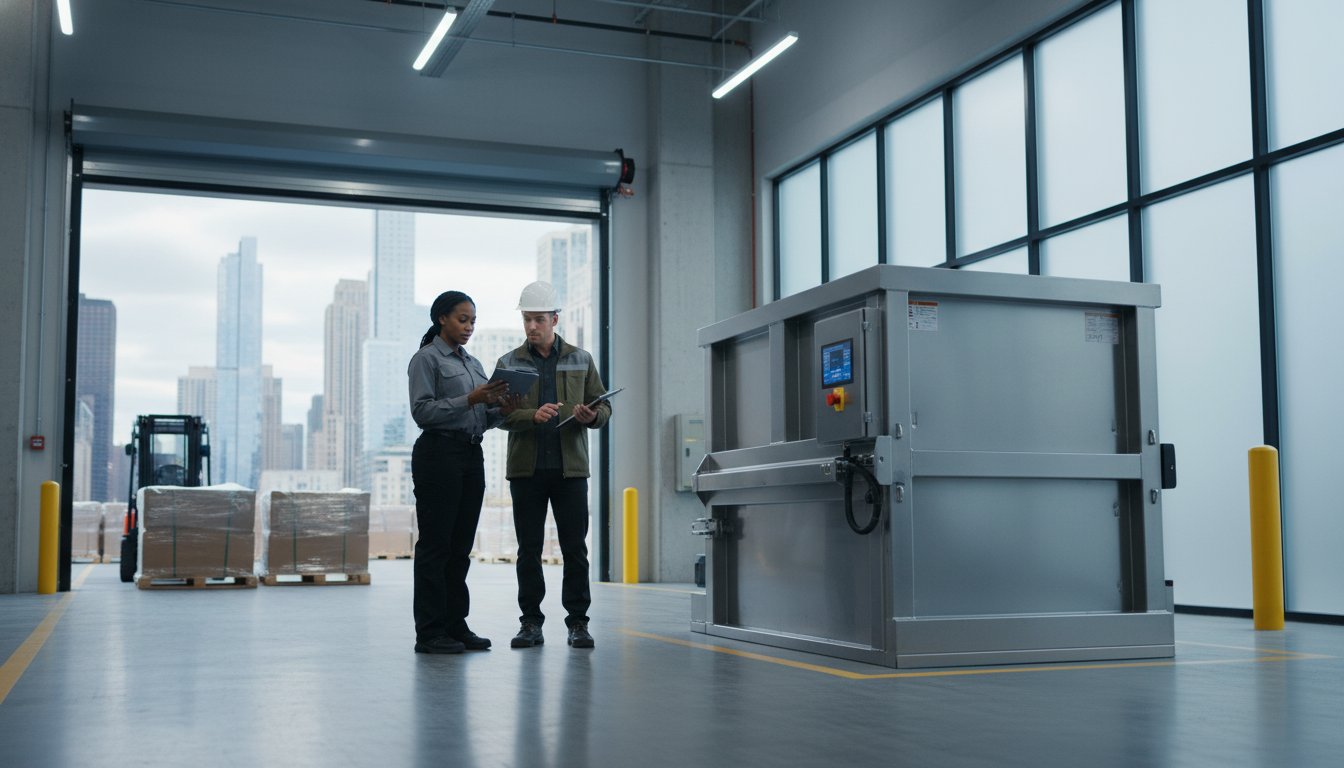
Stationary compactors are the workhorses of the industrial world. These units are bolted to a concrete pad and stay on-site while a roll-off truck hauls away only the receiving container. Use these for dry materials like cardboard, paper, or wood. Self-contained units are different. The compactor and container are integrated into one liquid-tight machine. If you manage a restaurant or grocery store, this is your only viable option to prevent leaks and comply with local health codes. Vertical compactors solve the "tight space" problem in dense urban areas like Queens. They take up about the same footprint as a standard front-load bin but offer the density of a much larger unit. Finally, mobile compaction involves a specialized truck that visits your site to crush materials inside an existing open-top dumpster. This is a tactical choice for construction sites where permanent equipment isn't feasible.
Stationary vs. Self-Contained: Choosing by Waste Stream
The main technical difference lies in the seal. Stationary units have a break-away point where the ram meets the container. This isn't liquid-tight. If you put food waste in a stationary unit, you'll end up with a mess on your loading dock and a pest problem. Self-contained units use heavy-duty gaskets to ensure everything stays inside. To keep these machines running, prioritize regular inspections of the hydraulic lines and ram guides. Following a Guide for Commercial Buildings helps you audit your waste stream before committing to a specific machine type.
Leasing vs. Owning Compaction Equipment
Deciding between CapEx and OpEx is a financial strategy. Purchasing a unit outright is a significant upfront investment, but it removes monthly rental fees from your long-term budget. However, owning means you're responsible for every repair and hydraulic leak. Leasing is often the more pragmatic choice for businesses that want a predictable monthly expense. Most rental agreements include full maintenance and emergency repairs. This removes logistical stress from your facility manager. If you need a simpler solution for high-volume projects, you can always schedule a 40 yard dumpster to handle the overflow while you evaluate long-term equipment options. Look closely at the fine print of service contracts. Ensure they specify response times for mechanical failures and include a clear schedule for preventative maintenance.
Compactor Service vs. High-Capacity Roll-Off Dumpsters: Which Wins?
Choosing between a stationary compactor and a high-capacity roll-off isn't just about volume. It's about footprint and frequency. A standard 40-yard dumpster is usually 22 feet long. A full stationary compactor setup, including the power unit and receiving box, often exceeds 35 feet. If your loading dock is cramped, the roll-off wins on space alone. However, the financial break-even point usually occurs when you reach 30 to 40 cubic yards of waste per week. At this volume, the reduction in haul fees provided by a trash compactor service offsets the equipment's monthly cost. You're trading frequent, expensive trips for fewer, denser hauls.
Waste density also dictates your disposal fees. Landfills charge by tonnage, and compaction significantly increases the weight of every load. While you'll pay more per pull due to the weight, you eliminate the "dead runs" associated with loose-fill containers. For materials like cardboard or plastic film, the density gain is massive. You can often fit 8 to 10 tons of compacted material into a space that would only hold 2 tons of loose debris. This efficiency is the key to stabilizing a commercial waste budget.
When a 40-Yard Roll-Off is the Smarter Move
For construction sites or short-term renovation projects, 40-yard dumpster rentals are the superior choice. Compaction is often impractical for heavy debris like concrete, masonry, or large timber. These materials can jam the hydraulic ram and cause expensive downtime. Roll-offs require zero installation, no electrical wiring, and no long-term maintenance contracts. You avoid the risk of mechanical failure entirely. If a ram breaks on a compactor, your waste management stops. With a roll-off, the system is low-tech and highly reliable for rugged materials.
The 'Right-Sizing' Framework for Property Managers
Property managers must audit weekly cubic yardage to avoid paying for air. Don't just guess. Measure your peak volume over a 30-day period. Often, a hybrid approach works best. Use 10-yard dumpsters for specialized recycling streams like glass or heavy metal, while directing high-volume general waste to a compactor. This strategy allows you to adjust service levels for seasonal peaks. In retail or hospitality, waste volume can double during holidays. A flexible service model ensures you aren't stuck with fixed capacity during slow months or overflowing bins during busy ones.
Site Requirements and Logistics for Compactor Installation
Setting up a trash compactor service requires more than just signing a contract. You must prepare your facility's physical infrastructure to handle industrial-grade machinery. Most commercial compactors require three-phase power, typically at 208, 230, or 460 volts. Don't guess on your electrical capacity. Hire a licensed electrician to install a dedicated fused disconnect within ten feet of the unit. If your voltage doesn't match the motor specifications, you risk burning out the expensive hydraulic pump before the first haul.
The ground beneath the machine is equally critical. You can't place a high-pressure compactor on asphalt. The 20,000 to 30,000 pounds of force generated by the ram will eventually crack and sink into soft surfaces. Pour a reinforced concrete pad at least six inches thick using 4,000 PSI concrete. This pad must extend far enough to support both the compactor and the front wheels of the hauler truck. If you're unsure about your site's current load-bearing capacity, contact our logistics team to review your site layout before delivery.
Space for the hauler is the final piece of the puzzle. A standard roll-off truck needs approximately 60 feet of straight-line approach and 25 feet of vertical clearance to safely tilt and pick up the container. In tight urban grids, this often means coordinating with local authorities for temporary street closures or parking permits. Check your local zoning laws in cities like Boston or New York, where specific setback requirements may dictate exactly where a compactor can sit on your property.
Urban Logistics: Managing Waste in San Francisco and Queens
Density creates challenges. In residential-adjacent areas, you must comply with strict noise ordinances. Modern compactors often feature silent hydraulic pumps to minimize disruption during late-night cycles. Many metro codes also mandate specific enclosure types for fire safety and pest control. These enclosures must be accessible for the hauler while keeping the charging chamber hidden from public view. Schedule your hauls during off-peak hours to avoid gridlock and street cleaning schedules that could block truck access.
Safety Protocols and Staff Training
Operating heavy machinery brings inherent risks. Follow OSHA standards to protect your team from injury. Implement a strict lockout/tagout (LOTO) procedure for all maintenance tasks. This ensures the ram can't move while a technician is inside the unit. Install safety interlocks on all access gates to prevent the machine from cycling while a door is open. Train every employee on how to clear jams safely without reaching into the charging chamber. Unauthorized access is a major liability. Keep your compactor area locked when not in use to prevent accidents involving trespassers or untrained personnel.
Optimizing Your Waste Strategy with Book Your Dumpster USA
Efficient waste management requires a partner who understands that your time is as valuable as your budget. Book Your Dumpster USA provides a digital-first approach to logistical challenges. Our platform removes the complexity of managing a professional trash compactor service by giving you direct control over your scheduling and container mix. Whether you need a permanent compaction solution or supplementary roll-off dumpster rentals, our system ensures you have the right capacity at the right time.
Transparency is the core of our pricing model. We eliminate the hidden environmental surcharges and fuel fees that often inflate commercial waste contracts. You receive clear, upfront costs that allow for accurate budget forecasting. Our broad service footprint extends from New Jersey to Illinois. This coverage allows us to maintain high standards of punctuality and reliability across major metropolitan hubs. We act as a high-functioning tool for your business, moving you from a state of clutter to a state of resolution with minimal effort.
- Select from 10, 20, 30, or 40 yard containers to match your project's density.
- Coordinate front load commercial waste pickup for consistent daily volume.
- Manage private curbside trash pickup for smaller professional storefronts.
From Construction Sites to Commercial Storefronts
Scaling your waste strategy shouldn't be difficult. As your project grows or your business expands into new markets, your waste requirements change. We specialize in localized expertise, offering comprehensive dumpster rental in New York and Massachusetts. This local knowledge is vital for navigating regional regulations and disposal mandates. Contractors managing multi-state portfolios can centralize their waste logistics through one dependable interface, ensuring consistency across every job site.
Schedule Your Next Haul in Seconds
Stop wasting time on long phone calls or waiting for email replies. Use our online booking system to arrange your next pickup or container swap instantly. This speed is essential for maintaining site safety and compliance with local ordinances. Punctuality is our promise. We keep your loading docks clear so your operations never stall. Visit our site now. Get a direct quote for your high-volume waste needs and experience a trash compactor service built for the modern industrial sector.
Take Control of Your High-Volume Waste Logistics
Mastering your facility's waste density is the fastest way to eliminate logistical stress and reduce hauling expenses. You've learned how a professional trash compactor service consolidates multiple loads into one high-density haul. You also know that site readiness, from reinforced concrete pads to three-phase power, is non-negotiable for a successful installation. Whether you require a permanent stationary unit or a high-capacity 40-yard roll-off for a short-term project, the right equipment removes the friction from your daily operations.
Book Your Dumpster USA simplifies this process with a digital-first platform serving NY, NJ, IL, MA, and San Francisco. We provide a reliable inventory of 10 to 40-yard containers with transparent pricing that respects your budget. Don't let waste management become a bottleneck for your business or construction site. Use our system to secure the capacity you need without the traditional industry headaches. Book Your Next High-Capacity Dumpster Online Now in under two minutes. Start optimizing your waste strategy today and regain command of your loading dock.
Frequently Asked Questions
How much does a commercial trash compactor service cost?
Pricing for a trash compactor service depends on your specific haul frequency, disposal tonnage, and equipment lease terms. You should evaluate the total cost of ownership, which includes monthly rental or purchase payments alongside per-pull fees. Always verify if your service contract includes preventative maintenance and emergency repairs to avoid unexpected operational expenses. Rates vary significantly based on your geographic location and the volume of waste managed.
What are the power requirements for a stationary trash compactor?
Most stationary units require three-phase electrical power at 208, 230, or 460 volts. You must install a dedicated fused disconnect within reach of the power unit to ensure safety and compliance. Consult with a licensed electrician to verify your building's current capacity before scheduling an installation. Using the wrong voltage can burn out the hydraulic motor and lead to expensive equipment downtime.
Can I put construction debris in a trash compactor?
Avoid putting heavy construction debris like concrete, bricks, or large timber into a standard compactor. These materials can damage the hydraulic ram or jam the charging chamber. For rugged materials, a 40 yard dumpster is the safer and more efficient choice. It handles heavy loads without the risk of mechanical failure or expensive repairs to compaction equipment that isn't designed for masonry debris.
How often does a compactor need to be emptied compared to a standard dumpster?
A professional trash compactor service typically reduces your haul frequency by a ratio of 4 to 1 or 5 to 1. This means you might only need one pickup for every five loads of loose waste you previously managed in open-top containers. The exact frequency depends on your material's density. Cardboard and plastic compress more efficiently than mixed office waste, allowing for much longer intervals between scheduled hauls.
Is a self-contained compactor better for grocery stores?
Self-contained compactors are the best choice for grocery stores and restaurants because they are liquid-tight. These units integrate the compactor and the container into a single sealed machine. This design prevents leaks, controls odors, and stops pests from accessing food waste. It's a critical tool for maintaining sanitation standards and passing health inspections in high-volume food service environments where organic waste is common.
What size concrete pad do I need for a 30-yard compactor?
You need a reinforced concrete pad that is at least 10 feet wide and 35 to 40 feet long for a 30-yard unit. The concrete must be 6 inches thick with a 4,000 PSI rating to support the machine's weight and the pressure of the hauler truck. This pad ensures the equipment remains level and prevents the heavy container from sinking into the ground during the high-pressure loading process.
Do I need a permit for a trash compactor in New York City?
You likely need a permit if the compactor sits on public property or if the installation requires significant electrical upgrades. New York City has strict zoning laws regarding waste equipment placement and noise levels in residential-adjacent areas. Check with the Department of Buildings and local sanitation authorities to ensure your setup complies with metro codes. Proper permitting avoids costly fines and prevents the forced removal of your equipment.
What is the difference between mobile compaction and stationary compaction?
Mobile compaction uses a specialized truck to crush waste inside an existing open-top dumpster on-site. Stationary compaction involves a fixed machine bolted to a concrete pad that pushes waste into a separate receiving box. Mobile service is ideal for temporary construction projects with fluctuating volumes. Stationary units are better for permanent commercial facilities that need consistent waste reduction and a smaller long-term footprint on their loading docks.