

In the first quarter of 2026, U.S. flippers averaged a gross profit of $66,000 per property, but much of that margin can vanish when debris piles up. Effective waste management for property flippers isn't just about hauling trash; it's a critical logistical lever that dictates your project speed. You've likely felt the frustration of a renovation stalling because a full container is blocking the driveway or a surprise permit fee appeared on your invoice.
We understand that a cluttered job site is both a safety hazard and a drain on your ROI. This guide provides a direct roadmap to streamlining your debris removal process so you can protect your flipping margins and keep your renovation timelines on track. You'll learn how to select the right container sizes, from 10-yard cleanout kings to 40-yard construction staples, while staying compliant with local regulations in high-flip markets like NYC and San Francisco. We'll show you how to build a repeatable disposal system that eliminates downtime and removes the stress of site cleanup.
Key Takeaways
- Learn how streamlined waste management for property flippers prevents site delays and keeps high-cost plumbing and electrical crews on schedule.
- Discover a phase-specific approach to disposal that scales from initial property cleanouts to full-scale gut renovations.
- Identify the exact dumpster size needed for your specific scope of work to avoid paying for unused space or unnecessary overage fees.
- Navigate complex permit requirements and placement ordinances in major flip markets like New York and Chicago.
- Establish a repeatable logistical system for booking and scheduling that removes friction from your renovation timeline.
The Role of Waste Management in Property Flipping ROI
Every day a property sits unfinished, you lose money to interest, taxes, and insurance. Efficient waste management for property flippers is the invisible engine of a fast closing. If your site is buried in debris, your subcontractors can't work effectively. An electrician shouldn't spend thirty minutes moving old drywall to reach a junction box. You're paying professional rates for manual labor when the site isn't clear. A clean site allows crews to move fast, finish their tasks, and clear the way for the next trade.
Clutter creates bottlenecks that ripple through your entire timeline. Beyond productivity, a messy site is a liability. OSHA standards require that scrap lumber and rubbish be removed from the work area as the project progresses. Use a systematic disposal plan to reduce the risk of trips, falls, and expensive workers' comp claims. Budget for this early. Successful flippers often allocate a fixed percentage of their renovation costs to disposal. This ensures that waste management for property flippers remains a predictable line item rather than a surprise expense that erodes ROI.
From Cleanouts to Closing: The Debris Lifecycle
Manage your waste in stages to maintain control. Start with the initial property assessment. Clear out tenant remains and junk immediately to see the structural reality of the building. This prevents hidden surprises from appearing mid-renovation. During the full demolition phase, you will generate the highest volume of Demolition waste in short bursts. Plan for larger containers or frequent swaps during this peak. Finally, handle the finish work. Even small scraps of drywall, flooring remnants, and appliance packaging can quickly clutter a nearly finished home. Keep a small container on-site until the final walkthrough to ensure the property is market-ready.
The Logistics of Speed
Waiting for a pickup is the most expensive mistake a flipper makes. If your container is full and the demo crew has nowhere to put debris, they stop working. You still pay for their time. Coordinate your dumpster swaps with your project milestones. If you know the kitchen tear-out starts Monday, schedule your swap for Tuesday morning. Leveraging a professional roll off dumpster rental ensures you have the capacity to keep the job moving. Use a digital booking system to secure your equipment without playing phone tag. This proactive approach keeps your site clean and your crews productive.
Step-by-Step: Managing Waste Through the Flip Phases
Successful property flipping requires a modular approach to debris. You can't treat a kitchen gut the same way you treat a final yard cleanup. Effective waste management for property flippers involves matching your disposal capacity to the specific volume of each renovation stage. With the average flip taking 165 to 166 days in 2026, every day lost to a cluttered site extends your carrying costs and narrows your profit margin.
Mastering the Initial Cleanout
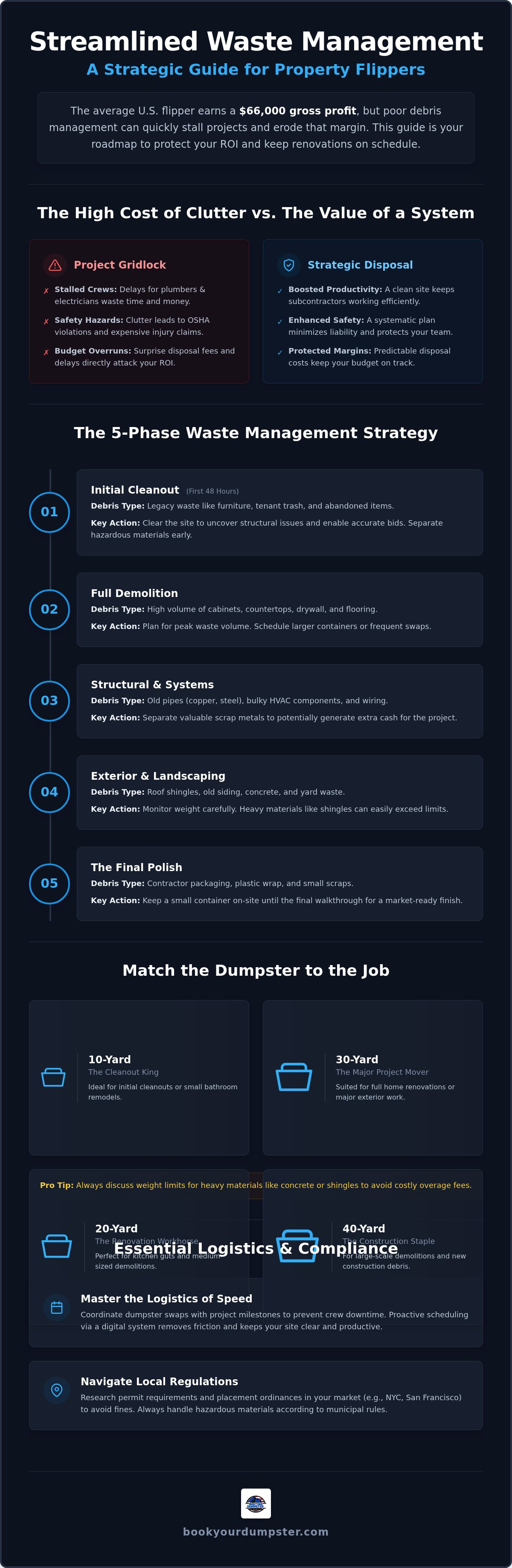
The first 48 hours of a flip are the most critical for waste removal. This is when you remove "legacy" waste like old mattresses, tenant trash, and abandoned furniture. Sorting these items immediately prevents them from burying structural issues you need to inspect before the real work begins. You must separate hazardous materials like old paint cans, chemicals, or cleaning supplies early to avoid steep fines from local municipalities. Clearing the site completely is essential for accurate contractor bidding, as it allows tradespeople to see the exact condition of the subfloors and framing without obstruction.
Once the cleanout is finished, the project moves through four distinct stages of debris generation:
- Phase 2: Full Demolition. This is the gutting stage for kitchens and bathrooms. Expect high volumes of cabinets, countertops, and structural debris.
- Phase 3: Structural & Systems. During this phase, you'll pull old copper pipes, galvanized steel, and bulky HVAC components. These materials often require separate handling if you plan to scrap them for extra cash.
- Phase 4: Exterior & Landscaping. Roof shingles, old siding, and yard waste can quickly fill a container. Shingles are particularly heavy and require careful weight monitoring.
- Phase 5: The Final Polish. This involves disposing of contractor packaging, scrap drywall, and flooring remnants. It's the "fine-tuning" of site cleanliness.
Optimizing Demolition Debris
Managing heavy debris requires a specific strategy. Concrete, brick, and tile are exceptionally heavy and can easily exceed container weight limits if you aren't careful. Use the "fill as you go" method to keep the workspace clear and safe. This is far more efficient than letting a massive pile accumulate in the center of a room, which forces your crew to move the same pile multiple times. This proactive approach aligns with the EPA's recommendations for the Sustainable Management of Construction and Demolition Materials, which emphasizes efficient material handling.
Ensure your crew knows exactly what can and cannot go into a construction dumpster. Prohibited items like tires or electronics can lead to rejected loads or expensive overage fees. If you're managing multiple projects, you can book your dumpster rentals online to ensure a fresh bin arrives exactly when the demo crew finishes their first pass. This keeps the project moving and your site compliant with local safety standards.
Choosing the Right Dumpster Size for Your Flip
Selecting the wrong container size is a fast way to blow your budget. In the context of waste management for property flippers, precision matters. Underestimating your debris volume leads to overfill situations where haulers cannot legally transport the bin. Conversely, overestimating means paying for air. Match your container to the specific work phase to keep your site lean. Use this breakdown to align your project scope with the correct capacity.
- 10-Yard Dumpster. Positioned as the "cleanout king," this is your best choice for initial property assessments. It handles small kitchen remodels or the removal of old furniture and tenant remains. Refer to our 10 yard dumpster guide for specific dimensions.
- 20-Yard Dumpster. This is the industry workhorse. It's the standard for full bathroom guts and medium residential renovations.
- 30-Yard Dumpster. Essential for major gut jobs. If you're tearing down walls or doing a large residential flip, this provides the necessary capacity.
- 40-Yard Dumpster. Reserved for massive commercial-to-residential conversions or full roof replacements.
Calculating Your Waste Volume
Estimating yardage requires looking at your square footage and the density of your materials. A general rule is that a full gut renovation produces roughly one cubic yard of waste for every 50 to 100 square feet. Consult a professional Guide to Construction Waste Management to build a formal plan. Avoid the overfill trap at all costs. Renting a container that's too small often results in paying for a second rental. This costs significantly more than upgrading to a larger size at the start of the project.
Weight Limits and Heavy Materials
Volume isn't your only metric. Weight limits are strict, especially for heavy materials like shingles, dirt, and concrete. In markets like New York, a 20-yard dumpster might have a 4 to 5 ton limit, while a 40-yard has a 6 to 7 ton limit. Exceeding these leads to overweight penalties or dry run fees if the truck can't lift the load. Tare weight refers to the weight of the empty container, which is subtracted from the total weight to determine the actual weight of your debris. Understanding this number is vital for your bottom line. High-functioning waste management for property flippers requires monitoring these limits daily during heavy demolition phases.
Navigating Local Regulations in Major Flip Markets
Local compliance is the difference between a profitable project and a stop-work order. Waste management for property flippers becomes significantly more complex in high-density urban centers. In New York and Queens, managing dumpsters requires navigating tight residential streets where every inch of curb space is contested. You must secure Department of Transportation (DOT) permits for any container placed on a public street. Failure to display a valid permit can result in immediate fines and the removal of your equipment at your expense.
Chicago and Illinois present different logistical hurdles. Many Chicago flips rely on alleyway placement, which requires strict adherence to city waste ordinances to ensure emergency vehicle access isn't blocked. In Massachusetts, particularly Boston, historical district restrictions often dictate when and where you can place a container. You may need specific sidewalk permits or approval from local historical boards before demolition begins. San Francisco is perhaps the most challenging, as steep inclines require expert driver precision. Additionally, California is actively enforcing SB 1383, which mandates the diversion of organic waste from landfills; non-compliance fines typically range from $50 to $500 per violation.
Permit Checklists for Urban Projects
Determine your placement strategy before the dumpster arrives. If you can fit a container on private property, such as a driveway, you generally avoid city permit requirements. However, street placement is often unavoidable in major hubs. Check local lead times early. You can find detailed breakdowns of typical permit costs and lead times in New York and Illinois to help plan your schedule. Don't forget parking logistics. You may need to block street spaces with traffic cones or official signage 24 to 48 hours in advance to ensure the delivery truck has enough clearance to drop the bin safely.
Waste Diversion and Compliance
Modern waste management for property flippers requires a focus on diversion. Many cities now mandate that a specific percentage of construction and demolition (C&D) waste be recycled. In San Francisco, strict ordinances require that all C&D debris be processed at a registered facility to maximize material recovery. Keep your tipping receipts and weight tickets. These documents are vital for proving compliance and can sometimes help you secure tax credits or green building certifications. Always screen your loads for prohibited items. Disposing of paint, batteries, or asbestos in a standard roll-off can trigger EPA penalties, which can reach up to $87,249 per day for significant Resource Conservation and Recovery Act (RCRA) violations.
Avoid the stress of regulatory guesswork by partnering with a provider that understands your specific market. You can book your dumpster through our streamlined system to ensure you get the right equipment for your local site conditions.
Streamlining Your Flip with Book Your Dumpster USA
High-velocity renovation projects don't have room for logistical friction. Book Your Dumpster USA provides a specialized approach to waste management for property flippers by replacing manual phone calls with a streamlined digital platform. You can secure a 10, 20, 30, or 40-yard container in minutes rather than hours. This speed is essential when a demo crew is ready to start and you need equipment on-site immediately. By centralizing your disposal needs through one reliable partner, you eliminate the downtime that typically follows a full container and keep your project on its 165-day target.
Budgeting remains the most volatile part of any flip. We remove that uncertainty through transparent dumpster rental prices with no hidden fees or opaque surcharges. You get a direct quote that helps you maintain your gross profit margins without surprise invoices at the end of the project. Whether you're working in Queens, San Francisco, or Chicago, our pricing integrity acts as a verbal handshake. We ensure your margins stay protected from the start of the cleanout to the final haul-away.
The Advantage of Digital-First Waste Management
Professional flippers prefer online scheduling because it fits the reality of a busy job site. You don't have time for phone tag with local haulers while managing subcontractors and inspections. Use our system to schedule swaps and pickups directly from your smartphone while standing in the property. This real-time control ensures your site stays clear for the next trade, whether it's the plumbing crew or the flooring installers. Managing your account digitally allows you to track multiple containers across different zip codes, giving you total oversight of your project's debris lifecycle.
Partnering for Scalable Flipping Success
Scaling from one flip to a portfolio of ten requires a logistical partner who understands the high stakes of real estate. We support your growth by providing reliable delivery and placement, even in tight urban environments where precision is non-negotiable. Our team knows the specific container range designed for construction volumes, from the "cleanout king" 10-yard bin to the heavy-duty 40-yard units. As you expand your operations, having a repeatable waste management system becomes a competitive advantage. It allows you to close projects faster and reinvest your capital into the next deal with confidence. Don't let debris dictate your timeline. Book your next roll-off dumpster today and keep your crews moving toward the closing table.
Master Your Renovation Logistics
Efficient waste management for property flippers is the difference between hitting your 165-day flip target and bleeding profit through carrying costs. You've learned that sizing your container precisely to the project phase prevents expensive overage fees and site bottlenecks. Whether you're starting with a 10-yard cleanout or managing a 40-yard gut renovation, matching capacity to debris volume is a non-negotiable step for protecting your ROI. You also know that proactive permit management in urban hubs like NYC or San Francisco keeps your crews working without the threat of city fines.
Book Your Dumpster USA provides the reliable tools you need to stay in control. We specialize in 10, 20, 30, and 40-yard roll-offs serving major flip markets including NY, NJ, IL, MA, and San Francisco. Our simplified online booking system allows busy investors to coordinate disposal in minutes; it removes the stress of logistical coordination. Don't let a cluttered job site slow down your trades or delay your closing date. Secure your next flip’s dumpster at Book Your Dumpster USA and keep your renovation timeline on track. Your next successful closing starts with a clear site.
Property Flipping Waste Management FAQs
What is the best dumpster size for a whole-house flip?
A 20-yard or 30-yard dumpster is typically the best choice for a whole-house flip. Use the 20-yard container for standard renovations involving kitchen and bath guts. Upgrade to a 30-yard bin if you are removing structural walls or handling high-volume debris from a large residential property. Matching the container to your specific phase of work prevents overage fees and keeps the driveway clear for your contractors.
Do I need a permit for a dumpster in New York City or Chicago?
You must obtain a permit if you place a dumpster on a public street or sidewalk in New York City or Chicago. NYC requires a DOT permit, while Chicago has specific ordinances for street and alleyway placement. Always check local requirements before scheduling delivery to avoid stop-work orders. If you have space on private property like a driveway, you can usually avoid these extra fees and logistical delays.
Can I put old appliances and furniture in a construction dumpster?
You can put old furniture in a construction dumpster, but appliances often require special handling. Items like refrigerators or AC units contain refrigerants that must be removed according to EPA standards. Consult local regulations regarding "white goods" before loading them into your roll-off. Many municipalities require these items to be recycled separately to prevent hazardous materials from entering the standard waste stream.
How much does waste management typically cost for a property flip?
The cost of waste management for property flippers depends on the container size and your specific market. National averages for standard rentals range from $386 to $621, though construction-heavy projects often average closer to $867. Factor in local tipping fees, which average $62.28 per ton nationally for municipal waste. Always budget for potential permit fees if your job site requires street placement in a major metro area.
How quickly can I get a dumpster delivered to my job site?
Most dumpsters can be delivered within 24 to 48 hours of your online booking. Schedule your delivery at least two days before your crew arrives to ensure the site is ready for demolition. Use our digital platform to check real-time availability in your specific zip code. Rapid delivery is critical for maintaining your 165-day flip timeline and avoiding expensive downtime for your subcontractors.
What happens if my dumpster gets too heavy with concrete or roofing?
If your dumpster exceeds its weight limit due to heavy materials like concrete or shingles, you will face overweight penalties. Drivers may also refuse to pick up the load if it is unsafe for the truck to transport. Monitor your load levels carefully and use a dedicated heavy-debris container for masonry or dirt. This prevents "dry run" fees and ensures your project stays compliant with local hauling regulations.
Can I rent multiple dumpsters for different properties at once?
You can absolutely rent multiple dumpsters for different properties simultaneously. Our digital-first system allows you to manage several job sites from a single account. This is a critical feature for investors scaling their operations across high-demand markets like Queens or San Francisco. Centralizing your logistics helps you track disposal costs across your entire portfolio and ensures every site remains clear for incoming trades.
What items are strictly prohibited in a roll-off rental?
Prohibited items include hazardous waste, tires, lead-acid batteries, and asbestos. Disposing of these materials in a standard bin can lead to significant EPA penalties and rejected loads at the landfill. Always check with local authorities for specific rules on electronics or chemicals. If you encounter these materials during a cleanout, set them aside for specialized disposal to protect your project timeline and avoid legal liability.


