You might think your pickup truck is the most cost-effective way to clear out a renovation project, but you're likely signed up for seven separate trips to the landfill. Before you start loading your tailgate, calculating pickup truck loads for a 20 yard dumpster is the only way to avoid wasting an entire weekend in traffic. You probably want to save money and keep your project moving, but the reality of hauling heavy debris often involves unexpected costs and significant vehicle wear. Driving back and forth to a transfer station isn't just exhausting; it's a logistical drain on your time and resources.
DIY hauling often appears cheaper at first. However, with national landfill tipping fees rising 10% this year to an average of $62.28 per ton, those individual trips add up fast. This guide breaks down the exact math to show you how one 20 yard dumpster replaces a fleet of small loads. You'll learn how to justify the rental cost by factoring in fuel, gate fees, and the 15 hours of logistics you'll save. Whether you're dealing with the tight streets of San Francisco or the heavy traffic in Queens, we'll provide the definitive numbers to help you plan your project with professional efficiency.
Key Takeaways
- Understand the volume math where one 20-yard dumpster replaces 6 to 8 full pickup truck loads.
- Master the art of calculating pickup truck loads for a 20 yard dumpster by accounting for weight limits that often trigger early landfill trips.
- Analyze the true cost of DIY hauling by factoring in fuel, vehicle wear, and the 10% increase in 2026 tipping fees.
- Recover up to 15 hours of your weekend by eliminating the need for repetitive, high-traffic drives to the local transfer station.
- Identify project-specific volume needs for kitchen and basement cleanouts to ensure you select the right container size from the start.
The Math: How Many Pickup Truck Loads Fill a 20-Yard Dumpster?
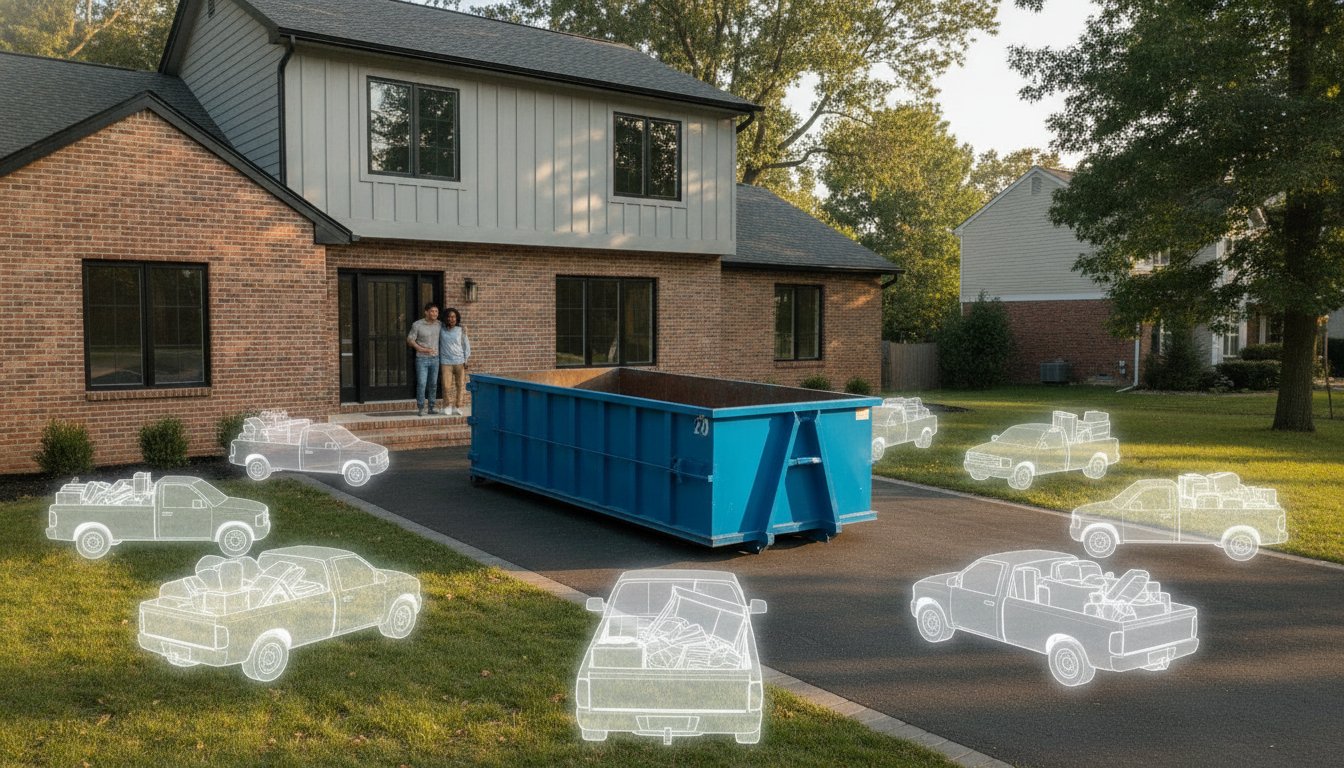
A 20-yard dumpster holds exactly what the name suggests: 20 cubic yards of waste. To understand the scale, visualize a standard kitchen stove; that is roughly one cubic yard. When calculating pickup truck loads for a 20 yard dumpster, many homeowners assume a simple one-to-one ratio between a "truckload" and a specific volume. In reality, a single 20-yard container replaces approximately 6 to 8 trips in a full-size pickup truck.
Precision matters when you plan a renovation. Use this mathematical formula to determine the capacity of your specific vehicle: (Bed Length x Width x Depth) / 27 = Cubic Yards. If you measure in feet, this calculation provides the volume for a "level load," meaning the debris does not rise above the top of the bed rails. Most DIYers overestimate their truck's capacity because they ignore the space lost to wheel wells and bed liners.
Calculating by Truck Bed Size
Not every truck is built for heavy hauling. Capacity varies significantly based on the bed length, which changes the total number of trips required to empty your job site:
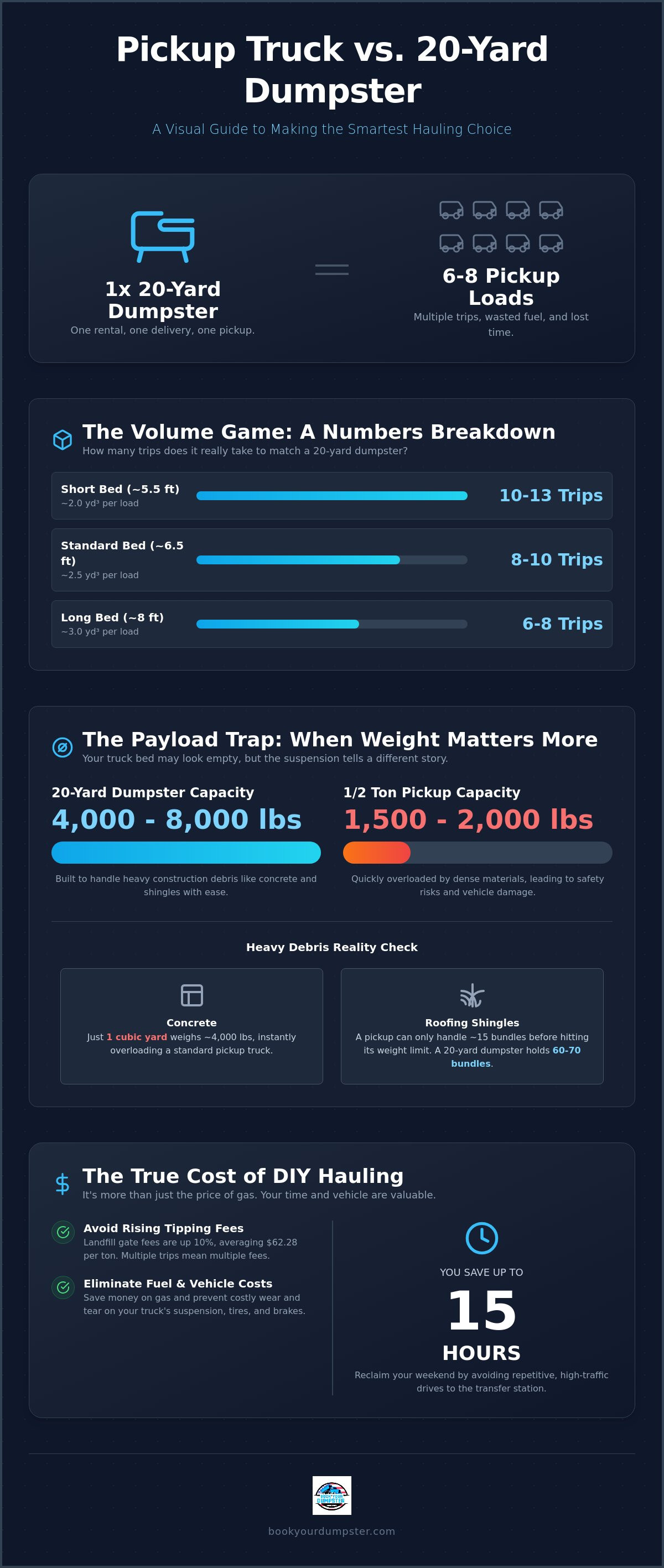
- Short Bed (approx. 5.5 ft): These beds are common on crew cab models. They typically hold 1.5 to 2.0 cubic yards per trip.
- Standard Bed (approx. 6.5 ft): This middle ground typically accommodates 2.5 cubic yards.
- Long Bed (approx. 8 ft): This is the industry standard for 3.0 cubic yards per load.
Using these figures, a short bed truck requires 10 to 13 trips to match the capacity of one 20-yard unit. Even a long bed truck requires seven perfect loads to reach the same volume.
The "Heaping" Factor: Volume vs. Reality
Many DIYers attempt to "heap" debris four feet high to reduce trips. This is a safety hazard and often illegal on public roads. You must secure every load with tarps and straps, which naturally restricts how much you can actually carry. A cubic yard is a 3x3x3 foot cube; once you factor in the need for a flat surface to secure a tarp, your effective capacity drops. When you compare these manual logistics to standard dumpster sizes, the efficiency gap becomes clear. A 20-yard roll-off is designed to handle the volume of an entire kitchen gut or a large basement cleanout in a single placement. You avoid the "Level Load" trap and the physical toll of loading and unloading a truck bed eight times.
Factors That Change the Calculation: Volume vs. Weight
Volume is only half the story. While calculating pickup truck loads for a 20 yard dumpster, you must account for the "Payload Trap." This occurs when your vehicle reaches its maximum weight capacity long before the bed is physically full. A standard 20-yard dumpster typically handles a weight limit of 2 to 4 tons, or 4,000 to 8,000 lbs. In contrast, a half-ton pickup truck like an F-150 often has a real-world payload capacity between 1,500 and 2,000 lbs. If you're hauling heavy materials, your truck might be "full" by weight with only a fraction of the volume a roll-off container provides.
Understanding your vehicle's Gross Vehicle Weight Rating (GVWR) is critical for safety. Overloading a three-quarter-ton truck with heavy debris leads to blown tires, warped suspension, or brake failure. When you switch from household junk to masonry or roofing, the ratio of truck loads to dumpster volume shifts dramatically. You aren't just comparing space; you're comparing structural integrity and road safety.
Heavy Debris: Shingles, Concrete, and Dirt
Heavy materials expose the limits of DIY hauling immediately. A 20-yard dumpster can hold roughly 60 to 70 bundles of roofing shingles, which is a standard size for many residential roof replacements. If you attempt this with a pickup, you'll find that just 15 bundles can push a half-ton truck to its limit. Concrete is even more restrictive. One cubic yard of concrete weighs approximately 4,000 lbs. Loading just a single cubic yard will bottom out most personal trucks instantly. Professional roll-offs are the only safe choice for masonry waste because they are engineered to distribute these extreme weights across a reinforced steel frame.
Bulkier Items: Furniture and Appliances
Lightweight but awkward items present a different challenge known as the "Tetris Effect." Old sofas, refrigerators, and intact cabinetry create significant "air space" in a truck bed. You might find your truck full after loading just one sectional sofa and a few chairs. A roll off dumpster rental handles these large items better because of its high side walls and wide footprint. You can stack furniture higher and more securely than you ever could in an open truck bed. If you're gutting a kitchen, remember that disassembled cabinets take up 30% less space than intact ones. Even then, a single 20-yard container remains the most efficient way to manage the bulk. Before you commit to a dozen landfill runs, check the available dumpster sizes to see how a professional rental simplifies your logistics.
DIY Truck Hauling vs. 20-Yard Dumpster: A Cost-Benefit Analysis
Many homeowners assume that using a personal vehicle is the budget-friendly choice. However, calculating pickup truck loads for a 20 yard dumpster reveals a different financial reality once you account for the "True Cost" of disposal. As of July 2026, the national average landfill tipping fee has climbed to $62.28 per ton. If you are in the Northeast, that average jumps to $80.67 per ton. When you multiply these fees across seven or eight individual trips, the cost of DIY hauling begins to rival a professional rental before you even factor in fuel or your own time.
Time is your most valuable resource during a project. A single round trip to a transfer station typically takes two hours. In high-traffic corridors like Queens, New York, or downtown Chicago, landfill queues and city congestion can easily double that estimate. Making seven trips means losing 14 to 20 hours of your week just sitting in traffic or waiting at the scale. A 20-yard dumpster eliminates this logistical drain, providing a central point for debris that is hauled away in one efficient motion.
Vehicle depreciation is the most overlooked expense. Personal trucks aren't designed for the repetitive stress of hauling heavy construction debris. Scratched bed liners, dented tailgates, and strained suspension systems can lead to repair bills that far exceed the cost of a dumpster. You are essentially trading the long-term health of your vehicle for a few days of manual labor.
The Hidden Logistics of Landfill Trips
Hauling your own waste requires perfect alignment with landfill operating hours. Most facilities close by 4:00 PM and have limited weekend availability, which often conflicts with your project's peak work hours. You also face the physical toll of unloading a pickup truck by hand seven times. This isn't just exhausting; it's a safety risk. Additionally, local highways have strict regulations regarding debris. If your load isn't perfectly secured, you risk heavy fines for "unsecured loads," which can range from $25 to $100 depending on your municipality.
When a Dumpster is Actually Cheaper
A 20-yard roll-off offers a "one-and-done" disposal solution that protects your schedule and your vehicle. Instead of managing seven separate tipping fees and fluctuating fuel costs, you benefit from a transparent, flat-rate model. This predictability is essential for staying on budget. If you're planning a project in a high-cost area, check out our dumpster rental prices guide for 2026 to see how regional fees impact your bottom line. Choosing a professional container isn't just about convenience; it's about making a pragmatic financial decision that respects your time and equipment.
Project-Specific Scenarios: When 7 Truck Loads Isn’t Enough
The standard math assumes your debris is uniform and easily stackable. When calculating pickup truck loads for a 20 yard dumpster, you must account for the specific geometry of your waste. Mixed junk from a basement cleanout often includes old boxes, plastic bins, and discarded toys that don't compress well. These items create massive gaps of air in a truck bed, meaning you hit your volume limit long before you reach the 2.5 cubic yard capacity of a standard pickup. You might find yourself making 10 trips for a project that technically only contains 15 yards of material.
Yard waste presents a similar challenge. While 20 cubic yards of soil is heavy but compact, 20 yards of brush and branches is incredibly difficult to pack. Branches are springy and resist compression. In a pickup truck, a "full" load of unchipped brush might only represent half a cubic yard of actual material once processed. A 20-yard roll-off allows you to toss large branches and root balls directly into the container without the constant need for precision stacking or dangerous highway hauling.
The Kitchen Remodel Breakdown
A standard 10x10 kitchen remodel is the most common residential project. It typically generates between 12 and 15 cubic yards of waste. This includes the following components:
- Old cabinetry and hardware.
- Laminate or stone countertops.
- Multiple layers of flooring and subflooring.
- Old appliances like dishwashers and range hoods.
A full kitchen gut requires at least 5 to 6 trips in a standard pickup truck. This assumes you break everything down perfectly. If you leave the cabinets intact, that trip count can easily double. The 20-yard dumpster is the "Goldilocks" size for these mid-sized renovations because it provides enough buffer for the unexpected debris that always surfaces once the walls come down.
Demolition Debris and Long Materials
Deck demolition introduces the hazard of long materials. Most pickup trucks have beds between 5.5 and 8 feet long. Attempting to haul 10-foot or 12-foot pressure-treated boards creates a significant safety risk. Overhanging debris is illegal in many jurisdictions without specific permits and flags. Roll-off containers are typically 20 to 22 feet long, allowing you to lay long boards flat and secure. You can maximize your container space by breaking down larger items and placing long boards along the bottom of the bin. This creates a stable base for smaller, loose debris on top. To simplify your next renovation and avoid the risks of DIY hauling, rent a 20-yard dumpster online and get back to your project.
Simplifying Your Cleanout with a Professional 20-Yard Rental
Stop wasting your weekends at the landfill. After calculating pickup truck loads for a 20 yard dumpster, the logistical burden of DIY hauling is undeniable. You are choosing between a single delivery or a week of manual labor and heavy traffic. Book Your Dumpster USA removes this friction through a streamlined online booking system. We provide the 20-yard "Goldilocks" container directly to your site. This allows you to focus on the renovation rather than the waste. Professional hauling means you skip the landfill lines and protect your personal vehicle from structural damage. A 20-yard dumpster is the flagship for residential renovations for a reason. It offers the perfect balance of capacity and footprint. It fits in most standard driveways while holding the equivalent of seven truckloads of debris. This removes the mental load of scheduling multiple trips and the physical stress of unloading by hand. Trust a professional partner to handle the logistics so you can stay on schedule.
Preparing for Your 20-Yard Dumpster Delivery
Placement is the most critical part of the process. A 20-yard container requires a flat, stable surface like a driveway or a designated street spot. If you live in high-density areas like San Francisco or NYC, verify local permit requirements immediately. Most cities charge between $25 and $100 for a temporary street permit if the container cannot fit on private property. Clear any low-hanging branches or power lines before the delivery truck arrives. Ensure there is at least 60 feet of linear space for the driver to drop the bin. This ensures a smooth delivery without damaging your property or the surrounding infrastructure. For more detailed logistics, read our complete guide to construction debris removal.
Book Your 20-Yard Solution Today
By calculating pickup truck loads for a 20 yard dumpster, you've identified the most efficient disposal method for your project. Our digital platform allows you to schedule a delivery in minutes. We provide transparent weight limits and flexible rental periods to match your specific timeline. Don't worry about hidden transfer station fees or the 10% increase in national tipping fees. Our pricing model is direct and honest. We handle both residential cleanouts and commercial projects with the same level of professional urgency. Take the next step in your project by measuring your available space today. Book your 20-yard dumpster now and resolve your waste management needs with one click.
Master Your Next Project with the Right Disposal Strategy
Calculating pickup truck loads for a 20 yard dumpster reveals that DIY hauling isn't just a physical burden; it's a financial one. You've learned that a single 20-yard container replaces roughly seven full-size truck trips and protects your vehicle from the "payload trap." By choosing a professional roll-off, you recover nearly two full workdays of time otherwise lost to traffic and landfill queues. This efficiency is essential for keeping your renovation on track and under budget.
Book Your Dumpster USA provides transparent, upfront pricing with no hidden fees across NY, NJ, IL, MA, and San Francisco. We schedule reliable delivery and pickup around your specific project needs to ensure your site stays clear. Rent a 20-Yard Dumpster from Book Your Dumpster USA today to secure your workspace and eliminate logistical stress. Focus on the quality of your build while we handle the heavy lifting. Your project deserves a professional finish without the landfill headache.
Frequently Asked Questions
How many pickup truck loads are in a 20-yard dumpster?
A 20-yard dumpster holds approximately 6 to 8 full-size pickup truck loads. This calculation assumes you are using an 8-foot long bed filled to the top of the rails. If your vehicle has a short 5.5-foot bed, you'll need to make 10 to 12 trips to match the volume of a single 20-yard container. Calculating pickup truck loads for a 20 yard dumpster is the best way to visualize the scale of your disposal needs before starting a project.
Is it cheaper to haul trash yourself or rent a dumpster in 2026?
Renting a dumpster is usually the more economical choice for large projects. With national landfill tipping fees averaging $62.28 per ton in July 2026, making seven separate trips results in high cumulative gate fees and fuel costs. When you add the value of your time and the risk of vehicle damage, a flat-rate dumpster rental often costs less than DIY hauling.
Can a 20-yard dumpster hold a full kitchen remodel?
Yes, a 20-yard dumpster is the standard size for a full kitchen gut. A typical 10x10 kitchen generates between 12 and 15 cubic yards of waste, including cabinets, flooring, and countertops. The 20-yard model provides a necessary buffer for bulky items and unexpected debris that often appears once you start tearing down walls.
What is the weight limit for a 20-yard dumpster rental?
The weight limit for a 20-yard dumpster typically ranges from 2 to 4 tons, or 4,000 to 8,000 pounds. This limit is designed to accommodate standard household junk and construction debris. If you are hauling heavy materials like concrete, dirt, or roofing shingles, you must monitor your weight carefully to avoid overage fees that range from $40 to $100 per ton.
Will a 20-yard dumpster damage my driveway?
Driveway damage is easily preventable with proper placement. Ask your delivery driver to place the container on a flat, stable section of your driveway. You can further protect the surface by laying down plywood or 2x4 boards for the dumpster's wheels to rest on. This distributes the weight and prevents the steel rollers from scratching or cracking your concrete or asphalt.
How many trips to the landfill can I make in one day?
Most people can only manage two or three landfill trips in a single day. Between loading the debris by hand, navigating traffic, and waiting in line at the transfer station, each round trip usually takes at least two hours. To match the capacity of a 20-yard dumpster, you would likely spend an entire weekend or more just driving back and forth.
What happens if I exceed the weight limit of my truck?
Exceeding your truck's payload capacity causes immediate mechanical stress and safety risks. You risk blowing out tires, damaging your suspension, or experiencing brake failure under the heavy load. It's also illegal to operate an overweight vehicle on public roads, which can lead to significant fines if you're stopped by local law enforcement.
Do I need a permit for a 20-yard dumpster in my city?
You generally don't need a permit if the dumpster is placed entirely on your private property. However, if the container must sit on a public street or sidewalk, most cities require a temporary permit. These permits typically cost between $25 and $100. Calculating pickup truck loads for a 20 yard dumpster helps you determine if the container fits in your driveway to avoid these extra municipal costs.