
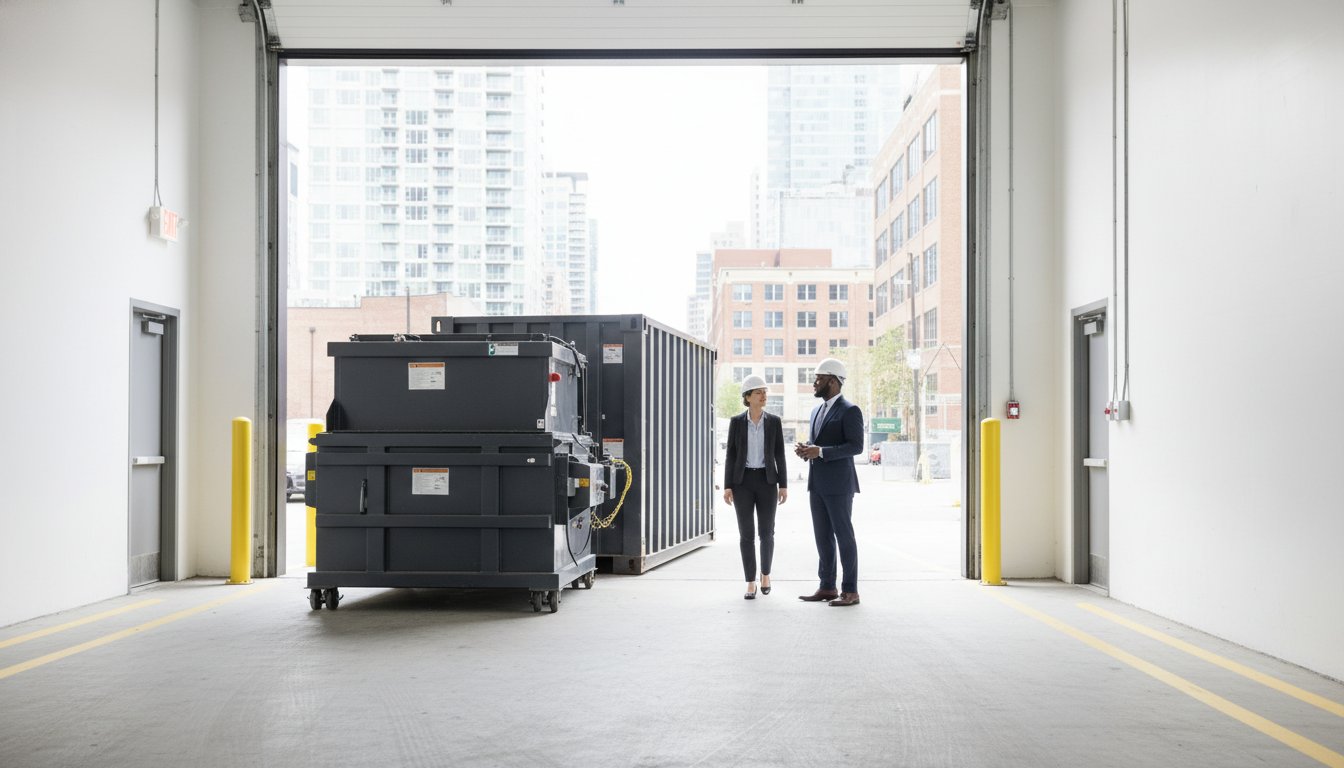
What if you could stop paying for the air inside your dumpsters and start paying only for the actual waste? You likely feel the sting of rising tipping fees and the frustration of watching trucks pull away from your site more often than necessary. Managing waste in high-density areas across New York, Illinois, and Massachusetts is already complex. Between the New York Commercial Waste Zone implementation and strict new disposal bans on textiles and organics, the pressure to optimize is higher than ever. Utilizing a professional compactor service allows you to take control of your logistics by reducing waste volume at the source.
You already know that frequent truck visits lead to exorbitant hauling fees and increased site traffic. We promise to show you how to cut those costs, lower your carbon footprint, and eliminate issues like odor and illegal dumping. This guide covers how to streamline your operations, meet regional mandates, and turn a messy necessity into a clean, secure, and cost-effective system. Learn how to maximize your 30 or 40 yard dumpster capacity and reduce the frequency of waste removal from your facility today.
Key Takeaways
- Understand how hydraulic systems compress waste volume by up to 75% to maximize space in your 30 or 40 yard containers.
- Identify the best equipment for your specific waste stream by comparing stationary units for dry materials with self-contained units for organics.
- Navigate urban site requirements by calculating necessary clearances and overhead space for high-density locations like Manhattan or Chicago.
- Calculate the ROI of a professional compactor service to see how fewer hauls directly reduce your monthly tipping fees and fuel surcharges.
- Streamline your transition from standard roll-off dumpsters to advanced compaction systems with a focus on reliability and local logistics.
What is Compactor Service and How Does it Optimize Waste?
Professional compactor service is an integrated waste management solution that combines heavy-duty machinery with scheduled logistics. It moves beyond the standard drop and swap model of traditional waste removal. By using high-pressure hydraulic rams, these units crush loose debris into a dense mass. This waste compaction process can reduce the physical volume of your trash by up to 75%, allowing you to store significantly more material before a haul is required. It's a system designed for high-output environments where efficiency is the priority.
If your business or job site generates more than 30 cubic yards of waste every week, you're likely overspending on hauling. Standard dumpsters fill up quickly with air and loose items, leading to constant truck traffic and high fuel surcharges. A compactor service eliminates these inefficiencies. You'll see fewer trucks on your property, which lowers on-site emissions and reduces the risk of accidents in busy loading docks. Additionally, because these units are fully enclosed, they offer a layer of security for sensitive debris and prevent unauthorized dumping from outside parties.
The 4:1 Ratio: Understanding Volume Reduction
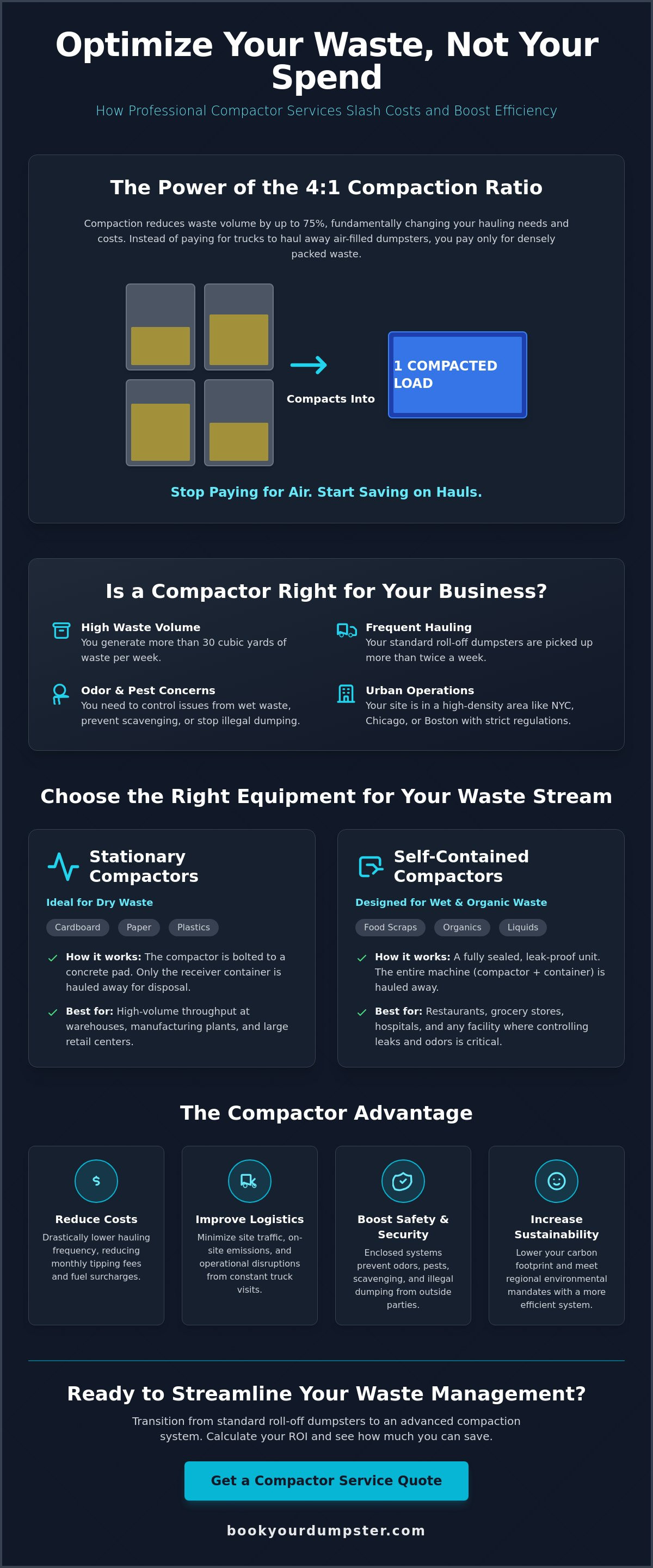
Think of the 4:1 ratio as a tool for financial clarity. In many applications, four standard dumpster loads can fit into a single compacted load. This doesn't just save physical space in your parking lot or alleyway; it fundamentally changes your billing structure. Instead of paying for the volume of a container that might be half-full of empty space, you pay based on the density of the material. You stop paying for air. This efficiency is critical in states like Massachusetts and New York, where disposal regulations are tightening and tipping fees are based on strict weight limits. Fewer hauls mean a smaller carbon footprint and a more predictable monthly budget.
Compactor vs. Traditional Roll-Off Dumpsters
Deciding when to stick with a roll off dumpster rental and when to upgrade depends on your volume and site constraints. Traditional roll-offs are excellent for temporary projects or lower-volume retail sites. However, once your pickup frequency exceeds twice a week, the logistics of a compactor become more attractive. Compactors are enclosed systems. This prevents scavenging and keeps pests away from wet waste, which is a major concern for food service providers in Illinois and New York City. You'll trade the disruption of daily truck visits for a streamlined, high-capacity system that stays out of the way.
Choosing the Right Equipment: Stationary vs. Self-Contained Units
Selecting the right machinery is the most critical step in establishing a reliable compactor service. If you choose a unit that doesn't match your waste profile, you risk environmental fines or mechanical downtime. You must evaluate your waste stream first. Is it primarily dry, like cardboard and plastic, or is it wet and organic? Beyond the waste type, consider your business lifecycle. Leasing a unit provides the flexibility to change equipment as your volume grows. Purchasing is a sound investment for established facilities with permanent, long-term waste management needs.
Durability is non-negotiable in this industry. Demand equipment constructed from heavy-gauge steel with industrial-grade hydraulics. These components must withstand thousands of cycles under extreme pressure without warping or leaking. Safety is equally paramount. You must ensure all staff are trained according to federal compactor operation regulations. These rules dictate specific age requirements and safety standards for equipment use to prevent workplace injuries. Following these guidelines protects your workforce and your bottom line.
Stationary Compactors for Dry Waste
Stationary units are the workhorses of warehouses, manufacturing plants, and large-scale retail centers. These machines are bolted directly to a concrete pad at your facility. The compaction head stays on-site while only the receiving container is hauled away for emptying. This setup is ideal for dry materials such as cardboard, paper, and non-organic construction debris. Because the machine remains stationary, it allows for high-volume throughput. It's the most efficient choice for businesses that need to process massive amounts of packaging material without the logistical complexity of moving the entire machine.
Self-Contained Compactors for Wet Waste
For restaurants, hospitals, hotels, and grocery stores, a self-contained unit is the standard. These machines feature liquid-tight seals that prevent leakage and contain odors. This is a critical feature for maintaining a clean environment and discouraging pests. Unlike stationary models, the ram and the container are built as a single, integrated unit. When it's time for a pickup, the entire machine is loaded onto a truck and transported to the disposal site. This design is essential for managing organic waste and liquid-heavy trash streams. It ensures that nothing spills during the compaction or transport process. If you aren't sure which unit fits your facility, you can evaluate your equipment options with a specialist to ensure your compactor service is a perfect match for your specific waste volume.
Site Requirements and Urban Logistics for Compactor Installation
A successful compactor service depends on more than just high-quality machinery. Your site must be physically and legally prepared to host the equipment. In dense urban centers like New York City or Chicago, space is your primary constraint. You must calculate the exact footprint of the unit plus the "swing room" required by the hauling truck. Roll-off trucks need significant linear space to back into position and vertical clearance to hoist the container. Check for low-hanging wires, building overhangs, and tight alleyway corners that could block access before the delivery truck arrives.
Safety and compliance are non-negotiable. Your installation must adhere to OSHA standards to protect your employees and minimize liability. Additionally, local zoning laws in cities like Boston or Queens often dictate where a compactor can be placed. If you plan to position equipment in a public right-of-way, secure the necessary permits well before the delivery date. Failure to do so leads to city fines and service delays that disrupt your daily operations. Proper planning ensures the machine functions safely without becoming a logistical bottleneck.
Electrical and Structural Prerequisites
Prepare your infrastructure before the unit arrives. Most industrial compactors require 208, 230, or 460 volt, 3-phase electrical connections. This is not a standard plug-and-play setup. You will need a certified electrician to install a fused disconnect box within reach of the unit. Structurally, a reinforced concrete pad is mandatory. A fully loaded 40 yard unit exerts immense pressure. Asphalt will soften and crack under this weight, leading to unlevel equipment and potential hydraulic failure. If you are installing a self-contained unit for wet waste, integrate floor drains and wash-down areas to maintain site hygiene and prevent runoff.
Urban Delivery and Servicing Challenges
Managing logistics in high-traffic zones requires precision. In New York, the Commercial Waste Zone program is currently being implemented. Businesses in Lower Manhattan must have their authorized hauling contracts in place by May 31, 2026, to avoid service gaps. For sites in Midtown South or Chicago's Loop, schedule your hauls during off-peak hours. This ensures the truck can navigate narrow streets without getting stuck in gridlock. Coordinate with your service provider to establish a routine that minimizes business disruption while keeping your waste area clear and secure.
The Economics of Waste Compaction: Calculating ROI and Savings
Switching to a professional compactor service is a financial decision based on density. Most businesses focus on the monthly rental fee of the equipment, but the real savings live in the reduction of hauling frequency. With the waste management industry facing a shortage of approximately 3.6 million drivers as of 2026, the cost of every truck visit is rising. By compressing your waste, you move from a high-frequency model to a high-density model. This shift directly lowers your carbon footprint and eliminates the frequent fuel surcharges that plague standard roll-off services.
Your break-even point arrives when the equipment costs are fully offset by the reduction in tipping fees and hauling charges. Beyond the obvious invoices, consider the hidden savings in labor. When your staff spends less time managing overflowing bins or cleaning up loose debris, your operational efficiency improves. A clean, compacted waste area also reduces the risk of workplace injuries, which protects your workers' compensation rates and overall site safety. It's a strategic move that turns a logistical headache into a predictable line item.
Reducing Hauling Frequency
Compare the logistics of a standard operation versus a compacted one. For a high-volume site, you might typically require four hauls of a 30 yard roll-off container to manage your weekly output. With a 30 yard compactor, that same volume fits into a single haul. You effectively eliminate 75% of your administrative overhead and scheduling stress. You also avoid "dry runs" where you pay for a truck to arrive when a container isn't actually full. Review our dumpster rental prices guide to see baseline costs in New York, Illinois, and Massachusetts. Once you see the per-haul rates, the math for a compactor becomes undeniable. Contact us today to run the ROI numbers for your specific site.
Long-Term Maintenance and Equipment Lifespan
Invest in preventative maintenance to extend your machine's life to 10 years or more. While a total equipment failure is a massive expense, routine hydraulic checks and seal inspections are manageable costs. Modern "Smart" monitoring systems now use IoT sensors to track fullness levels in real time. This ensures you only pay for a haul when the unit is at maximum capacity. This data-driven approach removes the guesswork from your logistics and ensures you never pay to haul air. It's a pragmatic way to modernize a messy part of your business while securing long-term financial predictability.
Implementing Compactor Service with Book Your Dumpster USA
Transitioning from standard roll-offs to a full-scale compactor service shouldn't be a bureaucratic nightmare. We take a pragmatic, direct approach to waste management. Our team handles the heavy lifting, ensuring your site is equipped with the right machinery while you focus on your core business. Whether you're managing a high-volume warehouse or a busy retail center, we prioritize transparency and punctuality. If you have smaller debris streams that don't fit the compactor profile, we can integrate 10 yard dumpster rentals to ensure every waste type is covered. We act as a high-functioning tool for your business, removing logistical stress through digital convenience and straightforward service.
Localized Service in Major Markets
We understand the specific logistical hurdles of dumpster rental in New York and other major hubs. In New York City, the Commercial Waste Zone program is currently changing how businesses contract for waste removal. For businesses in Lower Manhattan, the new mandates will be fully implemented by May 31, 2026. In Massachusetts, we help you navigate the expanded waste disposal bans that now include materials like mattresses and textiles. In Illinois, we support large facilities in meeting the 2024 recycling laws for events with a capacity of at least 3,500 people. Our local technicians are stationed throughout these regions, providing rapid maintenance and repairs to keep your compactor running without interruption.
The Streamlined Booking Process
Avoid the slow, paperwork-heavy processes common with national brokers. Our workflow is designed for speed and clarity. We start with a comprehensive site assessment to calculate your clearance and electrical needs. From there, we move quickly to equipment delivery and staff training. We offer flexible service terms that match your project duration, whether it's a long-term commercial lease or a shorter industrial cleanup. Stop guessing about your waste volume and start managing it with precision. Get a professional waste audit and compactor quote today to see how much you can save on your monthly hauling costs.
Take Control of Your Waste Logistics
Efficient waste management is a competitive advantage. You've seen how a professional compactor service reduces your physical waste volume by up to 75%, effectively cutting your hauling frequency and associated fees. By matching the right stationary or self-contained equipment to your specific waste stream, you ensure environmental compliance and site security. Navigating the tight alleys of New York or the strict mandates in Massachusetts becomes a manageable task when you have the right infrastructure and expert support in place.
Stop paying to haul air and start maximizing your site's potential. We specialize in expert logistics for complex urban environments across NY, NJ, IL, MA, and SF. Our streamlined online booking process removes the bureaucratic friction, allowing you to focus on your operations while we handle the mess. It's time to move from a state of clutter to a state of resolution with minimal cognitive load.
Optimize your waste management with Book Your Dumpster USA and experience a cleaner, more efficient facility today.
Frequently Asked Questions
How much waste do I need to generate to justify a compactor?
You should generate at least 30 to 40 cubic yards of loose waste per week to justify the investment. If your site currently requires more than two pickups of a standard 30 or 40 yard dumpster every seven days, switching to a compactor service will likely reduce your monthly expenses. It turns multiple hauls into a single trip, significantly lowering your administrative overhead and fuel surcharges.
What is the difference between a stationary and a self-contained compactor?
Stationary compactors are bolted to a reinforced concrete pad and are designed specifically for dry waste like cardboard and plastic. The machine stays on-site while only the container is hauled away. Self-contained units are liquid-tight and designed for organic or wet waste. The entire integrated machine is transported to the disposal site for emptying to prevent leaks and spills during transit.
Do I need a special electrical hookup for a trash compactor?
Yes, you'll need a 208, 230, or 460 volt, 3-phase electrical connection to power the hydraulic system. This requires a dedicated fused disconnect box installed by a certified electrician near the unit's permanent location. Standard commercial outlets don't provide enough power for industrial hydraulic rams. Ensure your facility's infrastructure is upgraded before you schedule your equipment delivery.
How often does a commercial compactor need maintenance?
Schedule preventative maintenance at least twice a year to ensure hydraulic seals and oil levels remain optimal. High-volume industrial sites often require quarterly inspections to prevent mechanical downtime. Consistent checks on the ram and safety switches can extend the machine's lifespan beyond 10 years and help you avoid the high cost of emergency repairs or total equipment failure.
Can I put recyclables and trash in the same compactor?
No, you must keep recyclables and trash separate to avoid contamination fees and meet state mandates. In New York, businesses can face a $500 contamination fee if recyclables or organics are found in the trash stream. If you have significant volumes of both, use a stationary compactor for cardboard and a separate system for general waste to maintain compliance with regional recycling laws.
How much space is required for a compactor installation?
You need a reinforced concrete pad large enough for the unit's footprint, which is typically 10 feet wide by 25 feet long for larger models. Beyond the machine, you must calculate at least 50 to 60 feet of linear space for the roll-off truck to back into position. Vertical clearance is also critical. Ensure there are no overhead wires or building overhangs lower than 20 feet at the installation site.
Will a compactor help with pest control and odor issues?
Yes, self-contained compactors are specifically designed with liquid-tight seals to contain odors and deter pests. Because the waste is fully enclosed in a heavy-duty steel container, it eliminates the issues of scavenging and illegal dumping common with open-top containers. This makes them the standard choice for restaurants, hospitals, and grocery stores where maintaining site hygiene is a top priority.
What are the safety requirements for employees operating a compactor?
Employees must be trained on OSHA safety standards and the specific operating manual for your machinery. Federal regulations strictly prohibit minors under the age of 18 from operating or loading industrial compactors. Ensure all safety interlocks are functional and that your staff understands the lockout/tagout procedures for clearing jams or performing routine cleaning to prevent workplace injuries.


