

You're standing in the middle of a room facing a mountain of charred drywall and furniture that weighs twice what it should because it's saturated with water. The volume of debris is overwhelming, and the clock is already ticking on your insurance claim. Securing a reliable dumpster rental for fire damage cleanup is the first critical step toward reclaiming your property. You need a solution that handles the physical weight of wet materials while respecting strict local regulations on hazardous waste.
Cleaning up after a fire is an exhausting, high-stakes race against structural damage and restoration deadlines. We understand that you need to clear the site quickly so contractors can begin work and insurance payouts stay on schedule. This guide provides the practical steps you need to manage fire-damaged debris safely. You'll learn how to choose the right dumpster size for heavy, water-soaked materials and how to coordinate your rental with insurance adjusters. We'll also break down the essential disposal rules to help you avoid fines and keep your project moving forward without unnecessary delays.
Key Takeaways
- Prioritize debris removal immediately to stabilize the site and prevent ongoing smoke and soot contamination.
- Select the correct dumpster rental for fire damage cleanup by accounting for the increased volume of distorted, charred items.
- Prevent overage fees by calculating the significant weight increase in materials like insulation and carpet due to the "Fire Hose Effect."
- Coordinate your rental schedule with insurance adjusters to ensure all high-value items are documented before disposal.
- Navigate regional permitting and hazardous waste rules in NY, IL, and MA to keep your restoration project on schedule and avoid fines.
Immediate Post-Fire Logistics: Why Debris Management Comes First
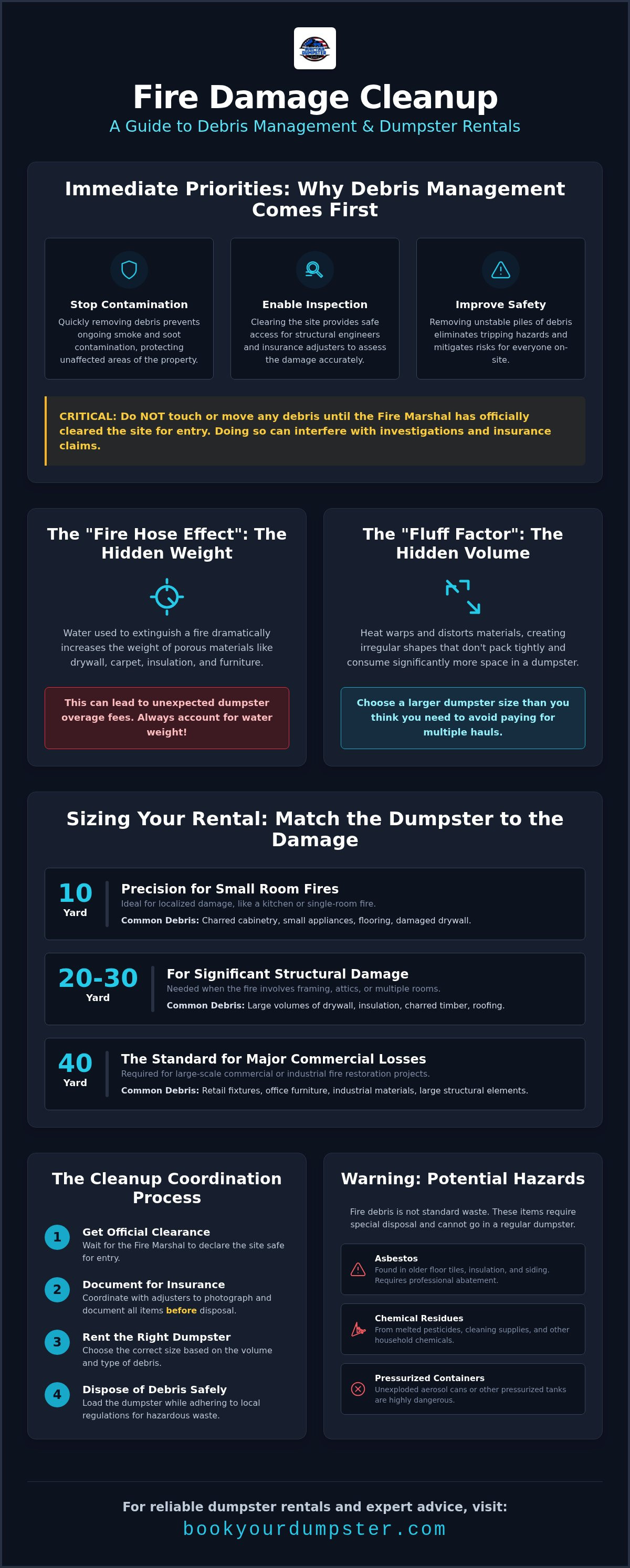
Effective recovery begins the moment the flames are out. Debris management isn't just a cleanup task; it's the foundation of the entire disaster restoration process. You can't assess structural integrity or begin repairs while charred remains clog the site. Removing these materials immediately stabilizes the environment and prevents secondary damage from taking hold.
Charred wood, melted plastics, and burnt upholstery continue to release toxic odors and fine particles long after the fire is extinguished. By securing a dumpster rental for fire damage cleanup early, you physically remove the source of ongoing smoke and soot contamination. This step protects the unaffected parts of the building from further air quality degradation and permanent staining that occurs when soot settles into porous surfaces.
Structural engineers and insurance adjusters need clear, safe access to every corner of the property. Piles of unstable debris create tripping hazards and hide critical damage to load-bearing walls or floor joists. Clearing these paths ensures a faster, more accurate inspection, which leads to quicker claim approvals and repair starts. Leaving unstable debris on-site for extended periods isn't just a logistical bottleneck; it's a safety liability for everyone involved.
Stabilizing the Structure for Cleanup
Start with the most volatile materials. Wet, burnt carpeting and heavily charred furniture should be the first items tossed. These hold moisture and toxins that rot and smell within hours. A roll-off dumpster acts as your primary containment zone, keeping the surrounding clean areas from being cross-contaminated during the haul-out process. Don't touch a single piece of debris until the fire marshal has officially cleared the site for entry. Moving items too early can disturb evidence needed for the investigation or compromise your insurance coverage.
Hazards Found in Fire-Damaged Debris
Fire debris isn't standard construction waste. It's a complex mix of ash, soot, and potentially hazardous chemical residues. In properties built before the late 1970s, fire often disturbs hidden asbestos in floor tiles or pipe insulation, requiring professional abatement before you load a container. You must distinguish between what goes in a standard roll-off and what requires specialized disposal. Hazardous fire waste includes unexploded aerosol cans, partially melted pesticide containers, or concentrated chemical residues that pose an immediate risk to haulers and landfills. Always verify local disposal rules for these specific items before loading your dumpster rental for fire damage cleanup.
Sizing Your Rental: Matching Dumpster Volume to Fire Damage
Standard debris packs tightly. Fire-damaged debris does not. Intense heat warps appliances and melts plastics into irregular shapes that create massive air pockets in your container. When choosing a dumpster rental for fire damage cleanup, you must account for this "fluff factor." Items that once stacked neatly now consume significantly more space because of their distorted forms. If you underestimate the volume, you'll end up paying for multiple hauls that could have been avoided with a larger bin.
For kitchen fires or damage limited to a single room, the 10 yard dumpster is the most efficient choice. It handles the specific debris profile of a localized fire without taking up excessive space on your property. However, if the fire reached the attic or involved structural framing, you'll likely need to scale up to a 20-yard or 30-yard option. These larger sizes are necessary for the high volume of drywall, insulation, and charred timber generated during the demolition phase of restoration.
Commercial fire restoration in dense urban centers like Chicago or New York typically requires a 40-yard dumpster. These units are the industry standard for major losses. They handle the massive volume of retail fixtures, office furniture, and industrial roofing materials efficiently. Using a 40-yard bin ensures that your crew spends more time clearing the site and less time waiting for a replacement container to arrive.
The 10-Yard Dumpster: Precision for Small Room Fires
Selecting a dumpster rental for fire damage cleanup requires precision when space is limited. The 10-yard bin features a compact footprint, typically 12 feet long and 8 feet wide. This makes it ideal for tight residential driveways or narrow city alleys. It's the perfect size for removing charred cabinetry, floor tiles, and small appliances from a single room. Refer to our 10 yard dumpster guide for detailed capacity specs to ensure it fits your specific debris load.
Large-Scale Structural Loss: 30 and 40-Yard Solutions
Whole-house restoration projects generate a staggering amount of drywall and insulation. These materials are bulky and difficult to compress. A 30-yard bin provides the necessary depth for long structural beams and large sections of roofing. Using a larger unit is a pragmatic way to reduce the total number of hauls, which keeps your project on a strict insurance timeline. Be aware that placing these larger units on city streets in Queens or Boston requires specific municipal permits. Measure your drop-off zone carefully to ensure the delivery truck has enough clearance to safely drop and retrieve the unit.
Managing Weight Limits and Water-Soaked Debris
While volume determines the size of your bin, weight determines your final cost. The "Fire Hose Effect" is a reality in every restoration project. Firefighters often pump thousands of gallons of water into a structure to extinguish the flames. This water doesn't simply evaporate; it's absorbed by your property's structural and personal components. When you arrange a dumpster rental for fire damage cleanup, you must account for this massive weight increase to avoid unexpected overage charges.
Monitor your weight limits carefully. A standard roll off dumpster rental comes with a specific tonnage allowance. Exceeding this limit results in fees that can quickly inflate your restoration budget. Being proactive about weight management is the only way to maintain pricing integrity during a high-stress cleanup. Don't let water weight drain your insurance payout before the actual repairs even begin.
Identifying High-Weight Culprits
Identify the materials that act as weight traps. Insulation, carpeting, and upholstered furniture are the primary offenders. These items are designed to be porous, meaning they hold water deep within their fibers. Wet drywall is significantly denser than dry drywall, often doubling or tripling in weight as the gypsum core absorbs moisture and loses its structural integrity. Standard construction weight guides are useless here because they assume dry conditions. Always assume your fire-damaged load is at least 50% heavier than a typical renovation haul.
Strategies to Mitigate Overage Fees
Control your costs with smart loading practices. If the site is secure and the weather permits, allow heavy materials like carpeting or large furniture to drain on a tarp before tossing them into the bin. This reduces the "water weight" you pay for at the landfill. Follow the "level-load" rule strictly, especially in high-traffic areas like San Francisco. Items must not protrude above the rim of the dumpster. For larger demolition projects, segregate your loads. Keep heavy masonry, such as bricks or concrete from a collapsed chimney, in a separate, smaller bin. Mixing heavy stone with light, scorched wood in a large dumpster is a fast way to trigger an overage penalty.
Coordinating Cleanup with Insurance and Contractors
Integrating a dumpster rental for fire damage cleanup into an insurance-driven project requires a systematic approach. This isn't just about hauling away trash; it's about preserving a paper trail for reimbursement. Follow this 5-step process to ensure your cleanup costs are covered: notify your provider, schedule the dumpster for the day after the initial inspection, document every major item before it enters the bin, retain all digital invoices, and submit your documentation for final settlement. Professional dumpster services provide the transparent, line-item invoicing your adjuster needs to process your claim without friction.
Documentation is your most powerful tool during restoration. Take clear photos of the dumpster contents as you load it. These images serve as physical proof of the volume and type of material removed from the site. If an adjuster questions the necessity of a 30-yard bin or multiple hauls, your photo log provides the evidence needed to justify the expense. Before you start the process, book your dumpster online to secure the equipment you need for a documented, professional cleanup.
The Insurance Adjuster's Timeline
Never throw away high-value items before the adjuster completes their first walkthrough. Tossing "evidence" too early is a common mistake that leads to denied claims. If the adjuster can't verify the existence or condition of a lost item, they won't pay for it. Stage your debris in a designated area near the dumpster rather than loading it immediately. Ensure the adjuster sees the following before the bin is hauled away:
- Major appliances and electronics.
- Damaged structural components like charred beams.
- High-end finishes or custom cabinetry.
- Samples of destroyed flooring and insulation.
Working with Restoration Professionals
Restoration contractors move fast once they have the green light. In dense urban areas like New York or San Francisco, you must coordinate dumpster placement to avoid blocking contractor vehicles or specialized equipment. Use a "swap-out" strategy for high-volume cleanups. Schedule a fresh bin to arrive exactly when the full one is pulled to keep your demolition crew working without downtime. For more contractor-specific strategies, consult our construction debris removal guide to streamline your site management.
Local Rules for Fire Debris in NY, IL, and MA
Local regulations for fire debris disposal vary significantly by state and municipality. Navigating these rules is essential to avoid fines and project delays. In the New York and Queens market, street placement requires specific permits that often range between $135 and $385. Book Your Dumpster USA simplifies this process by handling the logistical coordination, ensuring your dumpster rental for fire damage cleanup complies with all local ordinances from the moment it's dropped off.
If your driveway is inaccessible due to structural damage or emergency vehicle access, you must secure a public right-of-way permit. Start this process immediately after the fire marshal clears the scene. Most cities require at least 48 to 72 hours to process street permits. We coordinate with local haulers in NY, IL, and MA to ensure your container is placed legally and safely, keeping your restoration timeline intact.
Navigating City Permits and Street Placement
Distinguish between placement on private property and the public right-of-way. Private driveways typically don't require city permits, but street placement in dense hubs like Boston or Chicago is strictly regulated. You must post "No Parking" signs at least 24 hours in advance to ensure the delivery truck has enough clearance. Failure to secure the space often results in missed deliveries and added costs. Consult our local resource guide for city-specific contact information and permit application links.
Prohibited Materials in Fire Cleanups
Standard roll-off containers cannot accept all fire-related waste. Prohibited items common to Illinois and Massachusetts include fire extinguishers, wet lead-acid batteries, and unconsumed household chemicals. Industrial fire sites may also fall under the "Segregated Waste" rule, requiring separate bins for hazardous materials and standard construction debris. Massachusetts specifically requires that most construction and demolition waste be sent to recycling facilities rather than landfills.
Handle ash with extreme caution to prevent secondary fires or environmental violations. Never load hot ash into a dumpster. Follow these steps for safe ash disposal:
- Allow all ash and scorched wood to cool for at least 96 hours.
- Check for hidden "hot spots" within deep piles of debris before loading.
- Moisten the ash slightly to prevent it from becoming airborne during transport.
- Verify if your local Illinois or Massachusetts landfill requires ash to be double-bagged.
Adhering to these safety protocols protects the haulers and ensures your dumpster rental for fire damage cleanup stays compliant with state environmental protection agencies.
Secure Your Site for Restoration
Fire recovery is a high-pressure process that demands precise logistics and immediate action. You now have the framework to manage charred debris effectively by accounting for the "Fire Hose Effect" and selecting the appropriate container size for your specific loss. Coordinating your dumpster rental for fire damage cleanup with insurance adjusters and local permit offices ensures that your restoration stays on track and within your budget. By following these professional protocols, you remove the physical and administrative bottlenecks that often delay property repairs.
Book Your Dumpster USA provides the reliable tools you need to clear the site and move forward. We offer 10 to 40-yard sizes for immediate delivery across NY, NJ, IL, MA, and San Francisco. Our transparent pricing and streamlined online booking system remove the logistical stress from an already difficult situation. Take the first step toward a clean site today.
Book Your Fire Restoration Dumpster Online Now
Focus on your rebuilding process while we handle the disposal logistics. You have a clear path to a restored property. We're ready to help you reach it.
Frequently Asked Questions
Can I put fire-damaged electronics in a rental dumpster?
No. Electronics like televisions, computers, and tablets contain hazardous components such as lead and mercury that are banned from standard landfills. States like Massachusetts and Illinois have strict e-waste disposal laws that require these items to be taken to specialized recycling centers. Consult your insurance adjuster about separate e-waste abatement services for scorched appliances and devices.
How long can I keep a dumpster for a fire restoration project?
Standard rental periods typically range from 7 to 14 days, but fire restoration projects often require more time. Because structural demolition and insurance inspections can be unpredictable, you should discuss long-term rental options with your provider. We offer flexible scheduling to ensure the bin remains on-site until the debris removal phase is complete.
Will the insurance company pay for my dumpster rental?
Yes. Most standard homeowner insurance policies cover debris removal as a necessary part of the property restoration process. You must provide a professional, line-item invoice from your dumpster rental for fire damage cleanup to your adjuster. This documentation proves the expense was essential for site stabilization and allows for a smoother reimbursement process.
What size dumpster is best for a whole-house fire cleanup?
A 30 or 40-yard dumpster is the standard choice for whole-house cleanups involving structural damage. These large-capacity units are necessary for bulky framing, roofing materials, and large furniture sets. If the fire was contained to a kitchen or single bedroom, a 10 or 20-yard bin is usually sufficient for the debris load.
Can I put wet, water-soaked carpet in the dumpster?
Yes, you can dispose of water-soaked carpeting, but you must be mindful of the weight limit. Saturated carpet is exponentially heavier than dry material and can quickly trigger overage fees. If you have a massive amount of wet flooring, consider using a 20-yard dumpster. This size is specifically designed to handle the weight of heavy, dense materials without exceeding the truck's lifting capacity.
Do I need a permit to put a dumpster on the street in New York or Chicago?
Yes. Any container placed on a public right-of-way in New York City or Chicago requires a municipal permit. In New York City, these permits currently cost between $135 and $385 depending on the duration and location. We coordinate the local logistics to ensure your dumpster is placed legally and your project remains compliant with city ordinances.
What happens if my fire debris exceeds the weight limit?
If the load exceeds the pre-negotiated tonnage, you'll be charged an overage fee based on the actual weight recorded at the landfill scale. These fees cover the additional tipping costs charged by the disposal facility. You can avoid these charges by keeping heavy masonry or concrete separate from lighter, scorched wood and household items.
How quickly can a dumpster be delivered after a fire emergency?
We prioritize emergency restoration requests and can typically deliver a bin within 24 to 48 hours. Use our streamlined online booking system to secure your dumpster rental for fire damage cleanup as soon as the fire marshal clears the property for entry. Immediate delivery is critical for preventing secondary smoke damage and stabilizing the site for contractors.


