

What if the lowest quote you received for your Chicago renovation is actually a financial trap designed to hit you with a $250 overweight fee three weeks after your project ends? It's a common story in 2026, especially for homeowners and contractors in high-regulation zones. You want a clean site and a predictable bill, not a credit card statement filled with $165 Albany landfill tipping fees or unexpected Boston overage charges. Choosing between a flat rate dumpster rental vs variable pricing is the most important financial decision you'll make before the first load of debris leaves your property.
Stop guessing how much your drywall weighs and start protecting your bottom line. We understand that managing waste in New York, Illinois, or Massachusetts shouldn't feel like a gamble. This guide shows you how to lock in costs and avoid the "haul plus ton" risks that inflate project budgets. You'll learn the exact 2026 permit rates and disposal fees that make flat-rate options the only logical choice for a stress-free cleanup. Book your dumpster with confidence by choosing transparency over hidden administrative headaches.
Key Takeaways
- Understand how all-inclusive fees differ from pay-as-you-go models to protect your project budget from unexpected spikes.
- Compare the financial risks of flat rate dumpster rental vs variable pricing by analyzing delivery, tonnage, and haul fees side-by-side.
- Learn why predictable pricing is essential for contractors protecting profit margins and homeowners avoiding post-pickup credit card surprises.
- Navigate specific 2026 landfill regulations and tipping fees in New York, Illinois, and Massachusetts to avoid regional overcharges.
- Discover how transparent booking eliminates the "variable pricing gamble" for a faster, stress-free debris removal experience.
Decoding Dumpster Rental Costs in New York, Illinois, and Massachusetts
Choosing the right disposal model is the difference between a successful project and a budget disaster. A flat-rate rental bundles delivery, pickup, a fixed rental period, and a specific weight allowance into one upfront price. This model provides the predictability you need for a residential cleanout or a commercial job site. It eliminates the stress of watching the scale at the landfill. You know exactly what you'll pay before the container even arrives at your driveway.
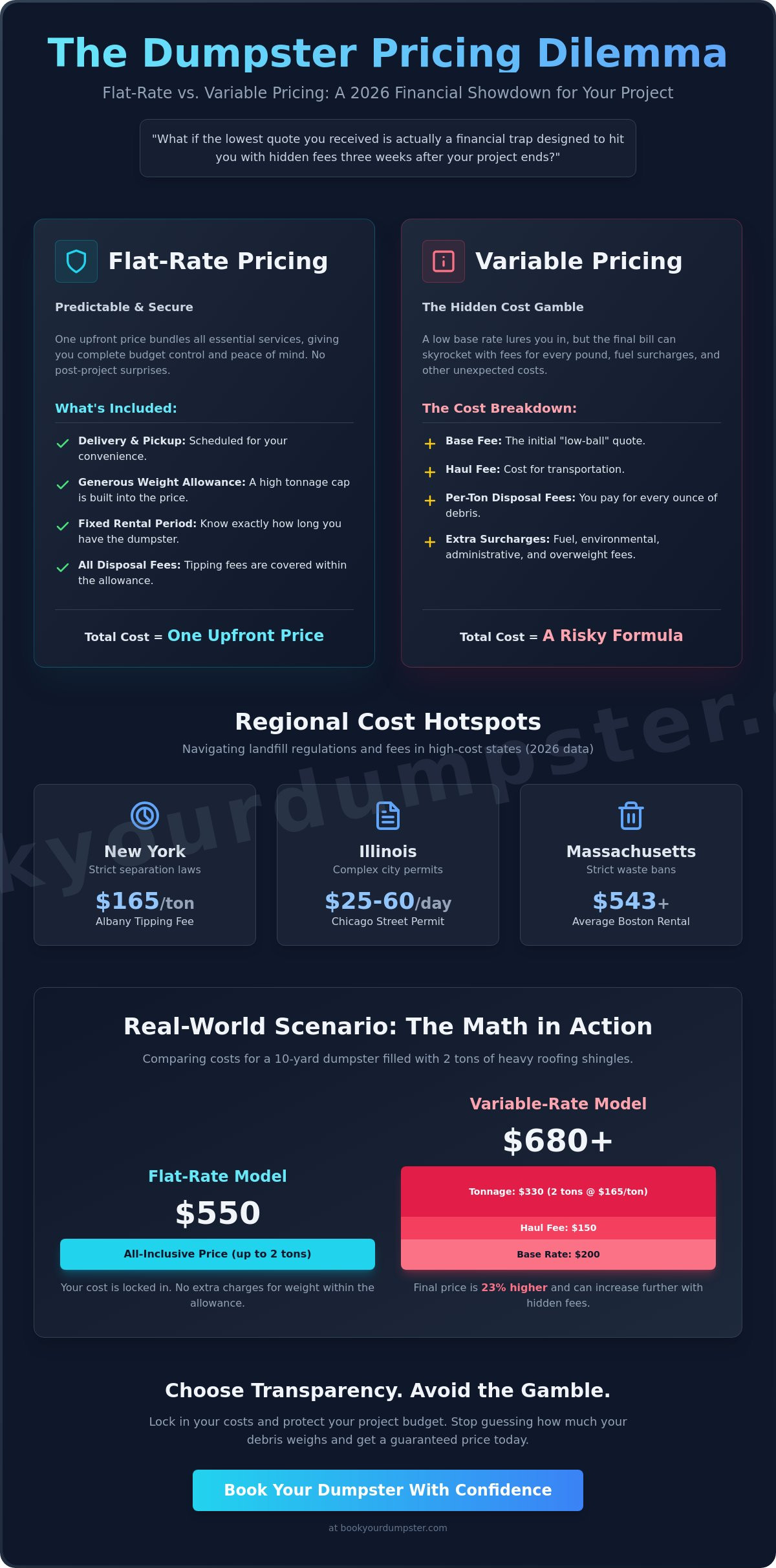
Variable pricing follows a Pay-as-you-throw (PAYT) logic. You pay a low base fee for delivery, but the final cost remains unknown until the truck crosses the landfill scales. When comparing flat rate dumpster rental vs variable pricing, the variable model often exposes you to fluctuating market rates and hidden surcharges. In 2026, landfill scarcity in the Northeast and Midwest has made waste management more complex than ever. Rising fuel costs and environmental compliance fees have pushed average rental costs in Boston to $543 and New York to $600. Without a locked-in rate, these external factors can cause your final bill to skyrocket unexpectedly.
The Reality of Waste Management in High-Regulation States
New York maintains some of the strictest debris separation laws in the country. If you mix prohibited materials, variable pricing models will hit you with massive contamination penalties. In Chicago, navigating the city's grid system requires specific street permits that cost between $25 and $60 per day. You must decide if your property has the space for private placement or if you need to budget for these daily city fees. Massachusetts presents its own challenges with strict "waste bans" on items like mattresses and certain construction materials. These regulations drive up disposal costs, making a flat-rate agreement much safer for your wallet.
Why the Initial Quote is Rarely the Final Price
Don't fall for the "low-ball" trap. Many variable-rate companies lure customers with a base rate that looks like a bargain. Once the project is over, they add fuel surcharges, environmental fees, and daily rental extensions that weren't in the original estimate. Tipping fees are the cost per ton charged by landfills for disposing of your waste. In 2026, Albany tipping fees have reached $165 per ton for construction debris. If you use a variable model and underestimate your weight, those tipping fees will appear as a surprise charge on your credit card weeks later. Book your dumpster with a flat-rate provider to lock in your total cost and avoid these administrative headaches.
Flat Rate vs. Variable Pricing: How the Math Changes for Your Project
Understanding the financial structure of your waste removal is essential for an accurate cost-benefit analysis of waste management. When you evaluate flat rate dumpster rental vs variable pricing, you're essentially choosing between a guaranteed total and a fluctuating invoice. A flat rate provides a clear bundle. It includes the delivery, the pickup, a specific rental window, and a predetermined weight limit. This setup allows you to account for every penny before the project begins.
Variable pricing operates on a different set of gears. You typically pay a lower base fee upfront, but that's just the starting line. Your final bill is calculated using a formula: Base Fee + Haul Fee + Per-Ton Disposal Fee. This model is often marketed as a way to save money on light loads, but it leaves you vulnerable to the "Tonnage Cap." While a flat rate has a generous weight allowance built in, variable models charge you for every pound from the very first ounce. If you fill a container with heavy debris like asphalt shingles or concrete, a variable quote can quickly double or triple. A 10-yard dumpster filled with roofing shingles often weighs over 2 tons; in a variable system, that's a pricing nightmare that hits your wallet hard.
The Mechanics of Flat-Rate Reliability
Flat rates are the gold standard for residential cleanouts in congested areas like Boston or Chicago. These projects often involve mixed household junk where density is hard to calculate. Using a flat rate simplifies your budget because you aren't penalized for the specific weight of an old sofa or a pile of lumber. It provides the "one-and-done" payment structure that homeowners prefer. For smaller projects, check out our 10 Yard Dumpster Rental guide to see how these fixed costs apply to your specific needs.
The Hidden Risks of Variable Billing
The most frustrating part of variable billing is the delay factor. Because the final cost depends on the landfill scale, you might receive a surprise bill three weeks after the dumpster leaves your driveway. Weight estimation is a challenge even for professionals. Debris density changes if it gets rained on, adding hundreds of pounds of water weight you didn't account for. You also risk "dry run" fees. If a driver can't access your site in a tight Chicago alley, a variable-rate company may charge a trip fee that matches their initial base rate. You can avoid these financial traps when you book your dumpster with a transparent, flat-rate provider who handles the logistics without the hidden math.
Which Pricing Model Wins? Comparing Costs for Homeowners and Contractors
Your role in a project dictates which financial model serves you best. For DIY homeowners, simplicity is the priority. You're likely managing a one-time basement cleanout or a kitchen update while balancing a full-time job. You don't have time to study landfill density charts or worry about whether a rainstorm added 500 pounds of water weight to your debris. A flat rate provides a "one-and-done" payment that keeps your credit card statement predictable. You pay once, fill the container, and watch it disappear.
Professional contractors face a different set of pressures. Your profit margins depend on accurate bidding. When you analyze flat rate dumpster rental vs variable pricing, the flat-rate model acts as an insurance policy for your bottom line. If you're quoting a renovation in New York, where 2026 overweight fees range from $200 to $250 per ton, a single heavy load of plaster or tile can wipe out your day's earnings. Using a fixed-cost rental allows you to bake the exact disposal price into your client's contract without fear of back-end surcharges.
The "Weight Trap" is the most common reason variable pricing fails. Heavy materials like dirt, brick, or concrete are nearly impossible for a novice to estimate. A small pile of soil can easily weigh three tons. In a variable system, that weight triggers immediate tonnage fees. In a flat-rate system, you often have a generous allowance that covers these dense materials without extra costs.
Scenario Comparison: The 20-Yard Renovation Project
Imagine a standard 20-yard bathroom gut-job. In a flat-rate scenario, your total cost is locked at the time of booking. Even if 2026 landfill hikes occur mid-project, your price remains unchanged. In a variable scenario, that same heavy debris often leads to $200 or more in overage fees once the truck hits the scale. To see how these sizes work in practice, read our Roll Off Dumpster Rental Guide for a full breakdown of efficient waste management.
When Variable Pricing Actually Makes Sense
Variable pricing is only beneficial in rare, specific cases. If you're disposing of very light, bulky items like empty cardboard boxes or foam insulation, your weight will stay well below any tonnage limits. These "load and go" scenarios are the only time the lower base fee of a variable model might save you money. However, for 95% of residential and construction projects, the risk of hitting a weight limit makes the flat-rate model the superior choice for financial peace of mind.
Navigating Local Landfill Fees and Weight Limits in the Northeast and Midwest
Local landfill fees are not just numbers on a spreadsheet; they're dictated by strict state mandates and geographic constraints. When you weigh the benefits of flat rate dumpster rental vs variable pricing in 2026, you must account for the regulatory environment of your specific region. In New York, the Business Integrity Commission (BIC) oversees "Trade Waste" regulations. These rules ensure haulers follow strict safety and environmental standards, but they also drive up operating costs. If you choose a variable pricing model in NYC, you're on the hook for permit fees that range from $135 to $385 if the container sits on city property. A flat-rate provider often simplifies this by handling the paperwork and bundling known costs into your initial quote.
Illinois presents a different logistical challenge, particularly in Chicago. The city's famous grid system and narrow alleyways require precision delivery. If a driver cannot safely drop a dumpster due to a blocked alley or lack of a $25 to $60 daily street permit, variable-rate companies will charge you for the "dry run" instantly. By booking with a local expert like Book Your Dumpster USA, you avoid the heavy markups charged by national brokers who don't understand the tight clearances of a Midwest job site. We have this under control, ensuring your roll-off fits the first time without extra trip fees.
State-Specific Debris Restrictions
Massachusetts and New York have implemented aggressive "Waste Bans" to preserve limited landfill space. In 2026, disposing of a mattress in Albany carries a $25 surcharge. Massachusetts forbids placing gypsum wallboard, tires, or e-waste in standard municipal loads. If these items end up in a variable-rate dumpster, the landfill will trigger a "contamination fee" that gets passed directly to you. Flat-rate providers often build these common local surcharges into their pricing tiers for specific project types, protecting you from post-haul invoice shocks. Large projects in Illinois must also meet Construction and Demolition (C&D) recycling requirements, which can complicate "pay-as-you-go" billing structures.
The Importance of On-Time Delivery in Local Markets
In high-traffic hubs like Boston or Manhattan, a delivery delay of even two hours can stall a professional crew, costing you more in labor than the entire rental fee. Local expertise is the only way to ensure a truck navigates 2026 traffic patterns effectively. For a detailed look at regional costs, review our guide on Dumpster Rental Prices in NY, IL, and MA. Choosing a partner who knows the local weight limits and street codes is essential for a hassle-free project. Schedule your delivery today to secure a flat-rate container that fits your site and your budget.
Booking Your Dumpster: Why Transparent Pricing Matters for Your Local Project
Deciding between flat rate dumpster rental vs variable pricing comes down to risk management. In the high-regulation markets of New York, Illinois, and Massachusetts, the variable model is a financial gamble you don't need to take. Unexpected costs like the $152.50 per ton tipping fee in Albany or the $90 per ton overage charge in Chicago can turn a bargain into a budget crisis. Choosing a flat-rate model ensures your project stays on track. It protects your credit card from surprise fees that often appear weeks after the job is done. You get the reliability you need to focus on the work, not the waste.
Book Your Dumpster USA removes the uncertainty of traditional hauling. We provide a verbal handshake through our transparent pricing structure. You won't find hidden fuel surcharges or surprise environmental fees on your final invoice. We understand that a 20-yard dumpster is the most common choice for 2026 projects, and we offer a full range of sizes from 10 to 40 yards. Our local expertise means we know the permit requirements for a Boston sidewalk or a Chicago alley before the truck even leaves the yard. We have this under control so you can keep your site moving.
The Book Your Dumpster USA Advantage
Our service is built on utility and honesty. We've modernized the traditional waste industry with a digital-first approach that respects your time. While national brokers often hide behind complex clauses, we provide direct, functional solutions. Our local knowledge of Northeast and Midwest waste regulations means we anticipate the "Waste Bans" and "Trade Waste" rules that trip up other providers. You receive a hassle-free experience with on-time delivery and clear communication. There is no jargon; just the container you need at the price we promised.
Ready to Clear the Clutter?
Our 3-step online booking process is built for speed and efficiency. First, select the container size that matches your debris volume. Use our sizing guide to ensure you have the right capacity for your specific renovation. Second, provide your delivery details and confirm your material type. Third, pick your date and secure your flat rate instantly. Before you book your dumpster, run through this final checklist to ensure a seamless delivery:
- Clear the Path: Ensure a 10-foot wide path and 22 feet of vertical clearance for the truck.
- Check for Obstructions: Look for low-hanging branches, power lines, or parked cars.
- Verify Materials: Confirm your debris is free of prohibited items like hazardous waste, batteries, or tires.
- Permit Check: If placing the container on a public street in Chicago or Boston, verify if you need a $25 to $60 daily permit.
- Surface Prep: Place plywood down if you're worried about protecting a sensitive driveway surface.
Book your dumpster online today and lock in your flat rate to eliminate the administrative headaches of variable billing.
Secure Your Project Budget Today
Managing waste in high-regulation states requires a strategy that eliminates financial surprises. You've seen how the 2026 landfill rates and strict state mandates in New York and Massachusetts make weight estimation a risky game. Choosing a flat rate protects your profit margins and simplifies residential cleanouts by locking in your total cost from day one. Understanding the difference between flat rate dumpster rental vs variable pricing is the only way to avoid post-haul invoice shocks and credit card surprises.
Rely on a partner who understands the local codes in Chicago, Boston, and New York. Benefit from our no hidden fees guarantee and deep local expertise across NY, IL, and MA. We handle the complex logistics and ensure on-time delivery for every residential and commercial project. Take control of your debris removal and get your site cleared without the administrative stress. We have this under control. Book your dumpster with transparent, flat-rate pricing now and focus on finishing your project on time.
Frequently Asked Questions
What is included in a flat rate dumpster rental?
A flat rate includes delivery, pickup, a set rental period, and a specific weight allowance in one upfront price. This model bundles disposal fees and environmental surcharges to prevent surprise costs on your final invoice. It's the most reliable way to manage a project budget in high-cost areas like Boston or New York.
Is flat rate or variable pricing better for a home cleanout in Chicago?
Flat rate pricing is the better choice for Chicago cleanouts because household junk density is difficult to estimate. In a city where alleyway logistics are tight, a flat rate protects you from "dry run" fees and fluctuating landfill charges. It ensures you pay one price regardless of minor weight variations in your furniture or appliances.
What happens if I exceed the weight limit on a flat rate dumpster?
You pay a pro-rated overage fee for the specific tonnage that exceeds your limit. In 2026, New York overweight fees range from $200 to $250 per ton. Your rental agreement clearly states this per-ton rate before you book. This transparency allows you to calculate potential costs if you're disposing of heavy materials like brick or soil.
Are there hidden fees with variable dumpster pricing in New York?
Variable models often exclude fuel surcharges, environmental fees, and administrative costs from the initial quote. When you compare flat rate dumpster rental vs variable pricing, remember that variable bills arrive weeks after pickup with these added expenses. A flat rate eliminates this "variable pricing gamble" by disclosing all costs during the booking process.
How do I estimate the weight of my construction debris?
Estimate your weight using standard density ratios: one cubic yard of concrete weighs approximately 2,000 pounds. For mixed construction waste, expect roughly 1,000 pounds per cubic yard. Most flat-rate plans include a generous tonnage allowance designed to cover these standard ratios for residential and commercial projects. Choose a larger weight limit if you're handling masonry or roofing materials.
Do I need a permit for a dumpster in Massachusetts?
You need a permit if the container sits on a public street or sidewalk. In 2026, Boston permit fees typically range from $30 to $50 per week. If you place the dumpster on private property like a driveway, no permit is required. Check your local municipality rules before scheduling your delivery to avoid city fines.
Can I change my pricing model after the dumpster is delivered?
No, the pricing structure is locked once the rental contract is signed and the unit is dispatched. The logistics and disposal fees are pre-negotiated based on the model you select. Choose the flat-rate option during our 3-step online booking process to ensure your costs remain predictable throughout the entire rental period.
Why are dumpster prices higher in the Northeast compared to other regions?
Limited landfill capacity and strict environmental mandates drive up regional disposal costs. Massachusetts "Waste Bans" and New York tipping fees, which reached $165 per ton for construction debris in 2026, make waste management more expensive in the Northeast. These high base costs make a flat-rate agreement essential for protecting your project from market volatility.


