Is your current waste contract a utility or a hidden drain on your bottom line? Many commercial property managers assume their trash pickup is a fixed cost, but a poorly managed front load waste service often leads to unexpected fees and messy overflows. You want a clean, compliant property and predictable monthly expenses. It's frustrating to deal with missed pickups or to realize you're paying for a bin that's half-empty most of the week.
We've built this guide to give you total control over your facility's logistics. You'll learn exactly how to size your containers and schedule pickups to match your actual waste volume. We also cover critical 2026 compliance standards, including the 20-foot overhead clearance required for modern collection trucks and the 11-foot gate widths necessary for safe access. Stop guessing about your waste needs and start using a system that works for your business. This overview covers container selection, enclosure specifications, and the simple digital tools available to manage your account without the stress.
Key Takeaways
- Apply the "Golden Rule" of waste management by selecting a larger bin size to reduce pickup frequency and lower your monthly costs.
- Identify whether your property requires a permanent front load waste service for daily trash or a temporary roll-off dumpster for short-term projects.
- Avoid costly fines and service delays by meeting specific enclosure requirements, including 20 feet of overhead clearance and 11-foot gate widths.
- Calculate your facility's weekly waste output using our straightforward estimation guide to ensure you never pay for empty air or deal with overflows.
- Streamline your commercial onboarding process with a provider that offers transparent pricing and simple online management tools.
What is Front Load Waste Service and How Does it Work?
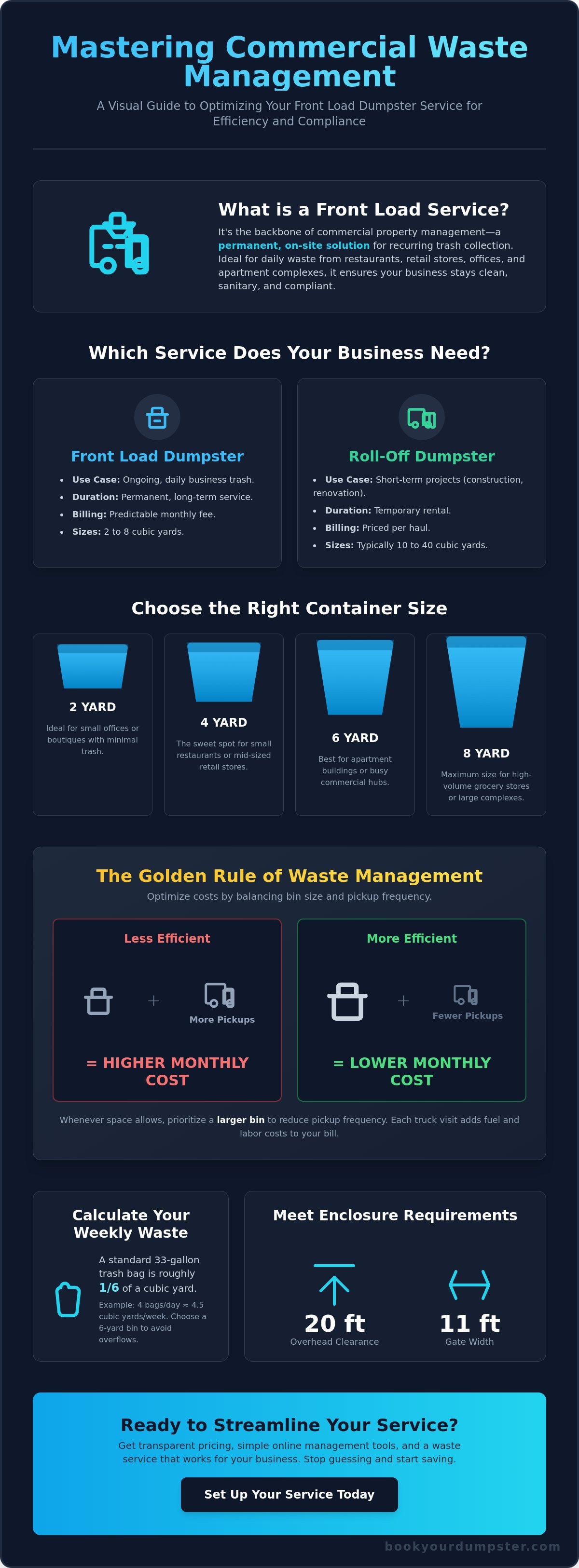
A front load waste service is the backbone of commercial property management. It provides a permanent solution for recurring trash collection using steel containers ranging from 2 to 8 cubic yards. Unlike temporary roll-off dumpsters used for construction, these bins stay on-site indefinitely. They are designed for high-frequency use in retail spaces, restaurants, apartment complexes, and small offices. It's a utility that ensures your business remains sanitary and compliant with local health codes.
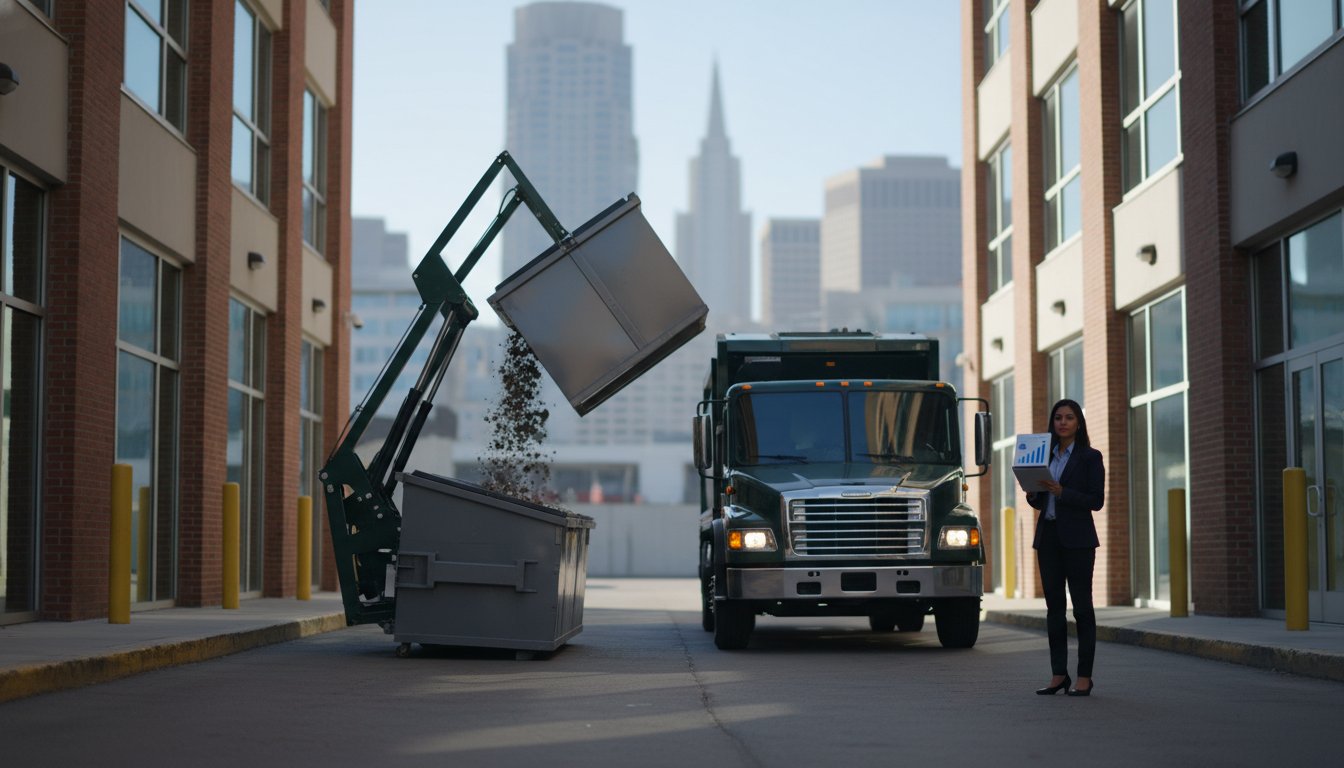
The mechanics are straightforward and efficient. A specialized truck equipped with two hydraulic forks approaches the bin from the front. The driver inserts the forks into the pockets on the sides of the container. The truck then lifts the entire bin over the cab and tips the contents into the hopper. This process takes less than two minutes, ensuring your business operations continue without significant interruption. Understanding what is waste management at this level helps you appreciate the logistics required to keep a city clean and compliant.
Roll-off dumpsters are large, open-top bins delivered for one-time cleanups. They are priced per haul. In contrast, front load service is a reliable utility. You pay a monthly fee for a scheduled routine. This predictability is why front-load units are the industry standard for daily operations. They keep your property clean without the logistical headache of calling for a swap every time the bin is full. It's a system built for consistency and long-term reliability.
The Anatomy of a Front Load Container
Choose the right container based on your enclosure size and waste volume. Standard options include:
- 2 Yard: Ideal for small offices or boutiques with minimal trash production.
- 4 Yard: The sweet spot for small restaurants or mid-sized retail stores.
- 6 Yard: Best for apartment buildings or busy commercial hubs.
- 8 Yard: The maximum size for front-load service, perfect for high-volume grocery stores or large complexes.
Consider the design of the container. Slanted-top bins are easier to load from the front, while flat-top bins often fit better in tight enclosures with low height clearances. Always opt for lockable plastic lids to prevent unauthorized dumping and keep pests out of your waste stream. This simple choice can save you from unexpected overage fees caused by neighbors using your bin.
Common Commercial Waste Streams
Most businesses generate Municipal Solid Waste (MSW), which is your standard daily trash. However, efficient management requires looking closer at what you throw away. If you run a retail shop, single-stream recycling for cardboard and plastic can significantly reduce the weight of your MSW bin. For the restaurant industry, food waste is a heavy component. Since most disposal fees are tied to weight and volume, separating these streams or adjusting your pickup frequency based on the material type is a smart financial move. Identify your primary waste type before signing a contract to ensure your front load waste service is optimized for your specific needs.
Sizing Your Service: Matching Bin Volume to Pickup Frequency
Efficiency in a front load waste service depends on the balance between container size and pickup frequency. Follow the Golden Rule: prioritize a larger bin over more frequent pickups whenever space allows. Every time a truck visits your property, you incur costs for fuel and labor. By doubling your bin size and halving your pickup frequency, you often reduce your monthly bill while maintaining the same total capacity. Don't pay for unnecessary truck visits if you have the room for a larger container.
Calculate your weekly waste output before signing a contract. A standard large trash bag (33 gallons) takes up about one-sixth of a cubic yard. If your staff throws out four bags a day, you generate roughly 4.5 cubic yards of waste per week. A 4-yard bin picked up once a week would likely overflow, but a 6-yard bin provides the necessary buffer for busy weekends. This simple math prevents the logistical stress of overflowing bins and unexpected overage fees.
Assess your physical space constraints. A front load waste service requires a clear approach for the truck. If your parking lot is cramped or has low-hanging wires, a smaller 2-yard bin might be your only option, even if your volume suggests a larger one. Additionally, distinguish between bulky and heavy waste. Cardboard boxes are bulky and fill bins quickly, whereas food waste is heavy and compact. Adhering to Federal guidelines for waste collection ensures your scheduling meets safety and health standards for your specific material type.
2 to 4 Yard Bins: Small Business Essentials
These containers are the standard for small boutiques, professional offices, and low-waste retail. A 2-yard bin holds approximately 12 large trash bags, while a 4-yard bin doubles that capacity to 24 bags. Their footprint is small, roughly the size of a standard parking stall. This makes them ideal for properties with limited alley space or shared enclosures. They offer a professional look while keeping your waste management footprint minimal.
6 to 8 Yard Bins: High-Volume Solutions
Large restaurants, grocery stores, and apartment buildings require 6 to 8 yard bins to handle significant daily output. An 8-yard bin accommodates about 48 large trash bags. For food-service businesses, pair these larger bins with 3 to 5 pickups per week. This prevents odors and pest issues, keeping your property sanitary. If you are unsure which size fits your property, view our commercial service options to compare dimensions and capacity.
Front Load vs. Roll-Off: Which Does Your Project Need?
Select the right equipment for your specific stage of business. Many property managers confuse these two distinct services, which leads to inefficient spending and logistical clutter. A front load waste service is a permanent utility designed for daily refuse. In contrast, roll-off dumpsters are temporary tools for specific projects. Understanding the difference ensures you maintain a clean property without overpaying for equipment you don't need. Front-load systems operate on a predictable monthly fee where you pay for a fixed schedule. Roll-off pricing is usually structured per-haul, including rental periods and specific weight limits.
The loading mechanics also dictate your choice. Front-load bins are lifted overhead by a truck's forks, requiring specific vertical clearance. Roll-off containers are dropped on the ground, allowing your team to walk heavy debris directly into the unit through a rear door. Adhering to waste and recycling industry standards ensures you choose the safest method for your staff and the environment. Switch from a roll-off to a front-load bin once your construction phase ends and you transition to operational status. This move signals that your property is ready for consistent, professional management.
Choosing Roll-Off for Renovations
Use a 10-yard or 20-yard roll-off dumpster for commercial build-outs or major renovations. These heavy-duty units handle materials like concrete, roofing, and structural timber that would damage a standard front-load bin. Learn about 10 Yard Dumpster Rentals to see if a compact unit fits your job site footprint. During a renovation, you'll likely deal with mixed waste that exceeds the weight limits of a standard front load waste service. Rent the roll-off for the mess of construction, then clear it out before your grand opening.
Choosing Front Load for Daily Operations
Transition to a permanent waste solution once your business opens to the public. This provides the predictability needed for a consistent business presentation. For urban storefronts with zero lot lines or no room for a bin enclosure, private curbside trash pickup may be the only viable option. Review our Guide to Efficient Waste Management to map out your long-term logistics. Stop treating your daily trash like a temporary project. Start managing it as a core utility that keeps your property compliant and your expenses controlled.
Local Compliance and Urban Enclosure Requirements
Compliance is a financial safeguard, not a suggestion. Ignoring local ordinances for your front load waste service leads to immediate fines and service interruptions. Most municipalities in hubs like Chicago, Boston, and New York penalize property managers for overflowing bins or illegal placement on public rights-of-way. As the smart waste management market grows to an estimated $3.38 billion in 2026, many cities are implementing more rigorous monitoring for enclosure violations. If your bin is blocked or non-compliant, you often still pay for the service attempt. Avoid these drains on your revenue by adhering to local zoning laws from the start.
Build your enclosure to professional standards to ensure reliable pickups. A 2026-compliant enclosure requires a reinforced concrete pad at least 6 inches thick. This prevents the heavy collection truck from cracking your pavement during the lift. Install steel bollards to protect your gates and walls from impact. Ensure your gates have a minimum width of 11 feet and provide at least 20 feet of vertical clearance for the truck to lift and empty the bin. Provide 60 feet of straight approach for the driver. If the truck can't safely reach the bin, your trash stays on-site and your property's curb appeal drops.
Waste Management in High-Density Areas
Operating in Queens or Manhattan requires navigating strict sidewalk permit laws and narrow access points. You can't simply place a bin on the curb without proper authorization from the city. In San Francisco, compliance means more than just trash removal. You must follow strict mandates for recycling and composting to avoid heavy surcharges on your monthly bill. Review our guide on Dumpster Rental in New York, Illinois, and Massachusetts to understand these regional requirements before you order your equipment.
Safety and Aesthetic Standards
Never over-fill your container. Items sticking out of the top prevent the lid from closing, which attracts pests and creates a safety hazard during the overhead lift. If debris falls during the collection process, it's your responsibility to clean it up. Maintain odor control by scheduling regular wash-outs of your permanent bins. For properties with specialized needs, like those disposing of appliances, check local handling fees for units containing refrigerants. These items often require special processing separate from your standard waste stream. Book your commercial waste service to ensure your enclosure meets these updated 2026 standards.
Setting Up Your Front Load Service with Book Your Dumpster USA
Choosing a front load waste service shouldn't be a logistical burden. We've modernized the process to remove the friction often found with national waste carriers. Instead of complex contracts filled with fine print, we offer a direct partnership built on pricing integrity and operational control. Our system is designed for the property manager who values their time and requires a clean, compliant site every single morning. We treat your waste management as a core utility, not a source of constant administrative stress.
The 3-Step Onboarding Process
- Step 1: Volume Consultation. We analyze your business type and waste output to determine the ideal bin size and pickup frequency. This prevents the common mistake of paying for a container that's too large or pickups that are too frequent for your actual needs.
- Step 2: Transparent Quoting. You receive a clear, no-nonsense quote. We eliminate the surprise environmental fees and administrative surcharges that typically inflate commercial waste bills. You'll know exactly what your monthly expenses look like before the first bin arrives.
- Step 3: Activation. We coordinate the professional placement of your container within your enclosure. Once the bin is set, your scheduled pickup routine begins immediately, ensuring your property stays clean from day one.
We leverage a digital-first approach to manage your account. You can handle scheduling and billing through a streamlined online system, giving you total visibility into your waste expenses. This modernization is paired with deep local expertise. We understand the specific sidewalk permits in New York, the strict composting mandates in San Francisco, and the enclosure requirements in Illinois and Massachusetts. We bring boots-on-the-ground knowledge to every property we serve. This ensures you stay ahead of local inspectors and avoid the costly non-compliance fines discussed in previous sections.
Why Reliability is Our Primary Offering
Reliability in this industry is rare, but we treat punctuality as a verbal handshake. Your business depends on a clear loading dock and a sanitary environment for your customers. When we commit to a schedule, we hit it. If you ever have a question, you get direct access to our support team. You won't waste time navigating endless corporate phone trees or waiting days for a call back. We act as a high-functioning tool for your business, allowing you to focus on your operations while we handle the logistics. Book Your Front Load Waste Service Today to secure a dependable partner for your commercial property.
Optimize Your Commercial Waste Strategy
Your property's cleanliness and compliance are too important to leave to chance. By prioritizing the right bin volume over excessive pickup schedules, you reduce both logistical clutter and monthly overhead. Remember that meeting 2026 enclosure standards is the only way to avoid rising municipal fines and service interruptions. A reliable front load waste service should be a transparent utility that supports your business growth without hidden fees or administrative headaches.
We provide professional-grade waste logistics since 2018, focusing on no-nonsense pricing integrity for our partners. Whether you manage a retail hub in New York, an apartment complex in Illinois, or a storefront in Massachusetts, we bring the local expertise needed to keep your site running smoothly. Take control of your facility's waste management today. Start Your Commercial Waste Service Quote and experience the difference of a pragmatic, digital-first provider. Let's get your property organized and compliant for the year ahead.
Frequently Asked Questions
What is the smallest front load dumpster size available for businesses?
The 2-cubic yard bin is the smallest available option for a permanent front load waste service. It holds approximately 12 large trash bags and fits easily in tight urban alleys or standard parking stalls. This size is ideal for small boutiques or professional offices with low daily waste output. It provides a professional appearance while maintaining a compact footprint on your commercial property.
How often can my front load dumpster be picked up?
You can schedule pickups between one and six times per week based on your specific waste volume. Most businesses find the best value with two or three visits per week to maintain sanitation without paying for unnecessary lifts. If your bin overflows consistently, increase the frequency or move to a larger container size. We coordinate these schedules to match your local route availability and specific business hours.
Do I need a permit for a permanent front load dumpster on my property?
You don't need a permit if the container stays on your private property, such as a parking lot or a reinforced concrete pad. However, if the bin must sit on a public sidewalk or street, city-specific permits are mandatory. These permits often range from $10 to $75 depending on your metropolitan area. Check your local municipal code regarding urban enclosures before finalizing the placement of your permanent bin.
Can I put construction debris in a front load waste container?
Do not put heavy construction debris like concrete, brick, or roofing shingles in a front-load container. These materials exceed the weight limits of the truck's hydraulic forks and can cause structural damage to the bin. Use a 10-yard or 20-yard roll-off dumpster for renovations instead. Reserve your front-load bin for municipal solid waste and daily business refuse to avoid equipment damage fees and service delays.
What happens if my bin is blocked by a car on pickup day?
If a vehicle blocks access on pickup day, the driver cannot empty your container. You'll likely be charged a dry run fee because the truck still burned fuel and used labor to reach your site. Ensure your 60-foot approach is clear at least thirty minutes before your scheduled window. If blocks are a recurring issue, consider installing "No Parking" signs or heavy-duty bollards to protect the truck's access path.
How do I prevent others from using my commercial dumpster?
Install lockable plastic or metal lids to stop passersby from dumping their trash in your bin. You can also secure your enclosure with a heavy-duty gate and a padlock. Unauthorized dumping leads to overage fees and messy overflows that you are financially responsible for. Taking these proactive steps ensures you only pay for the waste your own business generates and keeps your property clean.
Is recycling included in standard front load waste services?
Standard front load waste service focuses on municipal solid waste, but recycling is available as a separate scheduled service. You'll need a dedicated bin for cardboard, plastic, and paper to comply with single-stream standards. Many high-density areas have strict mandates that require businesses to separate these streams to avoid fines. Check your local regulations to see if a second recycling bin is mandatory for your specific business type.
How do I change my pickup frequency if my business grows?
Adjust your service levels through your online management portal or by contacting your account manager directly. As your business grows, your waste output will naturally increase. We recommend reviewing your volume every six months to ensure your bin size and pickup schedule still provide the best value. Scaling your service up or down is a simple administrative change that prevents overflows or wasted spending on empty containers.