
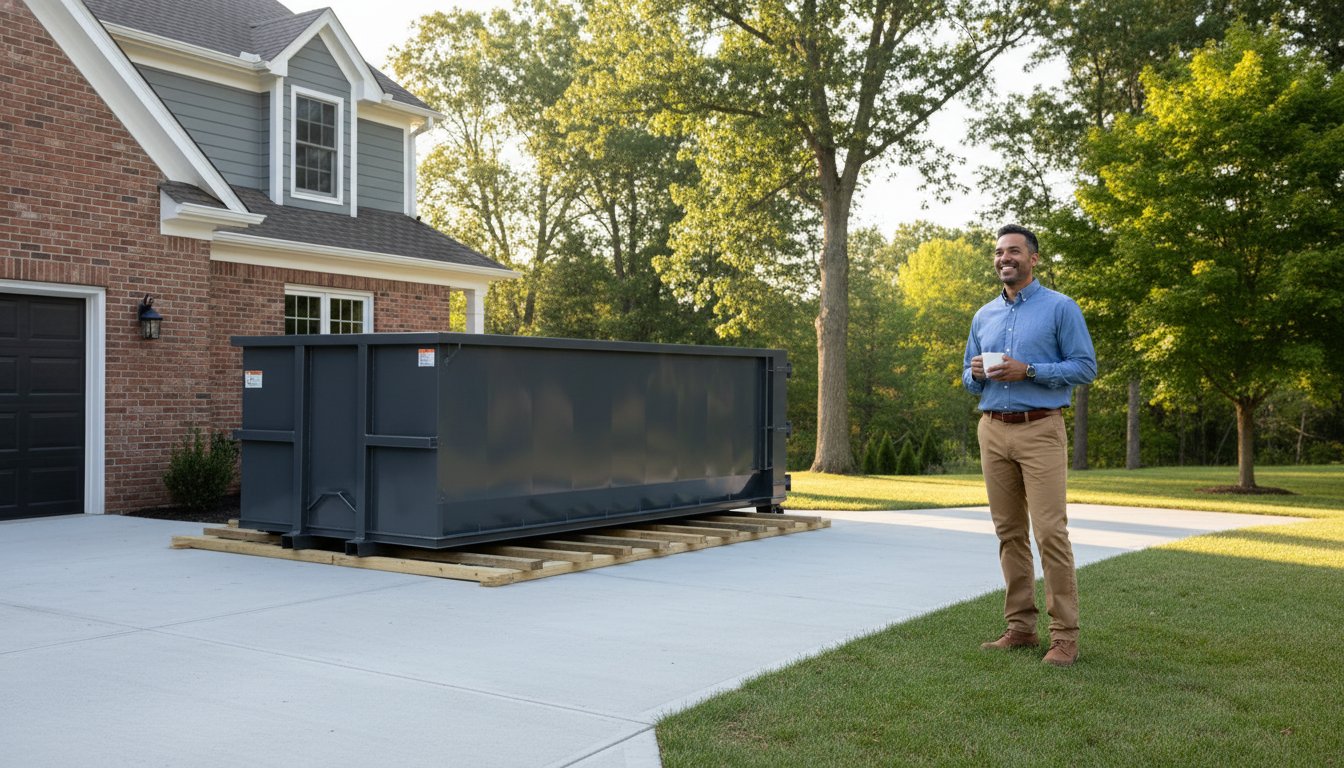
Last Tuesday, a homeowner in Chicago paid $150 in city fines simply because their dumpster lacked the correct local permit. This scenario plays out daily across New York, Illinois, and Massachusetts when logistics are left to chance. You shouldn't have to worry about hidden overweight fees or a heavy bin cracking your driveway. You need a solution that works as hard as you do, arriving on time and leaving without a trace. Managing a renovation is difficult enough; the cleanup should be the easiest part of your day.
This 2026 reference guide ensures your next garbage removal container rental is handled with professional precision. You will learn how to secure the right size on your first attempt and navigate the specific permit laws in your metro area. We provide the localized guidance you need to avoid surprise charges and property damage. We break down the exact steps to achieve transparent pricing and a damage-free delivery process. Follow these instructions to book your dumpster with confidence and get your project back on track today.
Key Takeaways
- Select the ideal roll-off size for your project by mastering the cubic yard measurement system used across NY, IL, and MA.
- Navigate local permit regulations and city ordinances to ensure your container placement is compliant and avoids costly fines.
- Prepare your delivery site effectively by clearing paths and managing overhead obstacles like wires and tree limbs.
- Simplify your cleanup logistics by securing a garbage removal container rental with transparent, upfront pricing and no hidden fees.
- Use the Book Your Dumpster USA online platform to schedule professional, on-time service that removes the stress from waste management.
Understanding Garbage Removal Container Rental in the Northeast and Midwest
Roll-off containers are the industry standard for temporary bulk waste management. They provide a high-capacity solution for projects that generate more debris than standard curbside pickup can handle. Understanding Garbage Removal Container Rental starts with the "cubic yard" measurement system. This system is the universal language for waste volume across New York, Illinois, and Massachusetts. Whether you're hiring a 10-yard or a 40-yard unit, you're paying for the volume of space the container occupies. In 2026, the industry has standardized digital booking to eliminate the back-and-forth of traditional phone quotes. Modern standards prioritize transparent weight limits and real-time delivery tracking to keep your project on schedule.
Primary users of these containers fall into three main categories:
- Residential DIYers: Homeowners tackling kitchen remodels, basement cleanouts, or deck removals.
- Commercial Contractors: Professionals managing construction sites who need reliable debris removal to maintain safety and compliance.
- Estate Managers: Individuals overseeing large property clear-outs or foreclosures who require rapid, high-volume waste solutions.
The 2026 market demands efficiency. You need to know exactly what you're paying for before the container arrives. Transparent pricing models now include the haulage, tonnage, and rental period in one upfront cost. This shift removes the logistical stress typically associated with waste management.
Why Rent a Container Instead of Traditional Junk Removal?
Junk removal services often charge by the item or by how much space you fill in their truck. This pricing gets expensive quickly during long-term projects like attic cleanouts or home renovations. Renting a container is more cost-effective because you pay a flat rate for the unit. You also gain the flexibility of loading on your own schedule. A roll-off dumpster is a heavy-duty, rectangular open-top waste container. It stays on your property until you're ready for pickup. You don't have to rush to meet a crew's timeline.
Regional Demand: Waste Trends in NY, IL, and MA
Demand for garbage removal container rental has surged due to a 15% increase in urban remodeling projects across Chicago, New York City, and Boston. Space is a premium in these areas. You need compact waste solutions that fit into tight driveways or narrow city streets. Seasonal trends also dictate availability. Massachusetts sees a 25% spike in rental volume during spring cleanups. Illinois projects often face winter scheduling shifts due to heavy snowfall. Always book your delivery at least 48 hours in advance during these peak times. For more localized details on permits and regulations, refer to our 2026 Complete Guide.
Choosing the Right Container Size for Your Project
Selecting the wrong size for your garbage removal container rental leads to wasted money or double-booking fees. Book Your Dumpster USA provides four primary capacities to match your specific debris volume. Your choice depends on both the physical space the waste occupies and the total weight of the materials. Dense items like asphalt shingles or concrete reach weight limits faster than household junk. Proper planning ensures the Sustainable Management of C&D Materials by keeping your project compliant and efficient.
Small-Scale Solutions: 10 and 20 Yard Containers
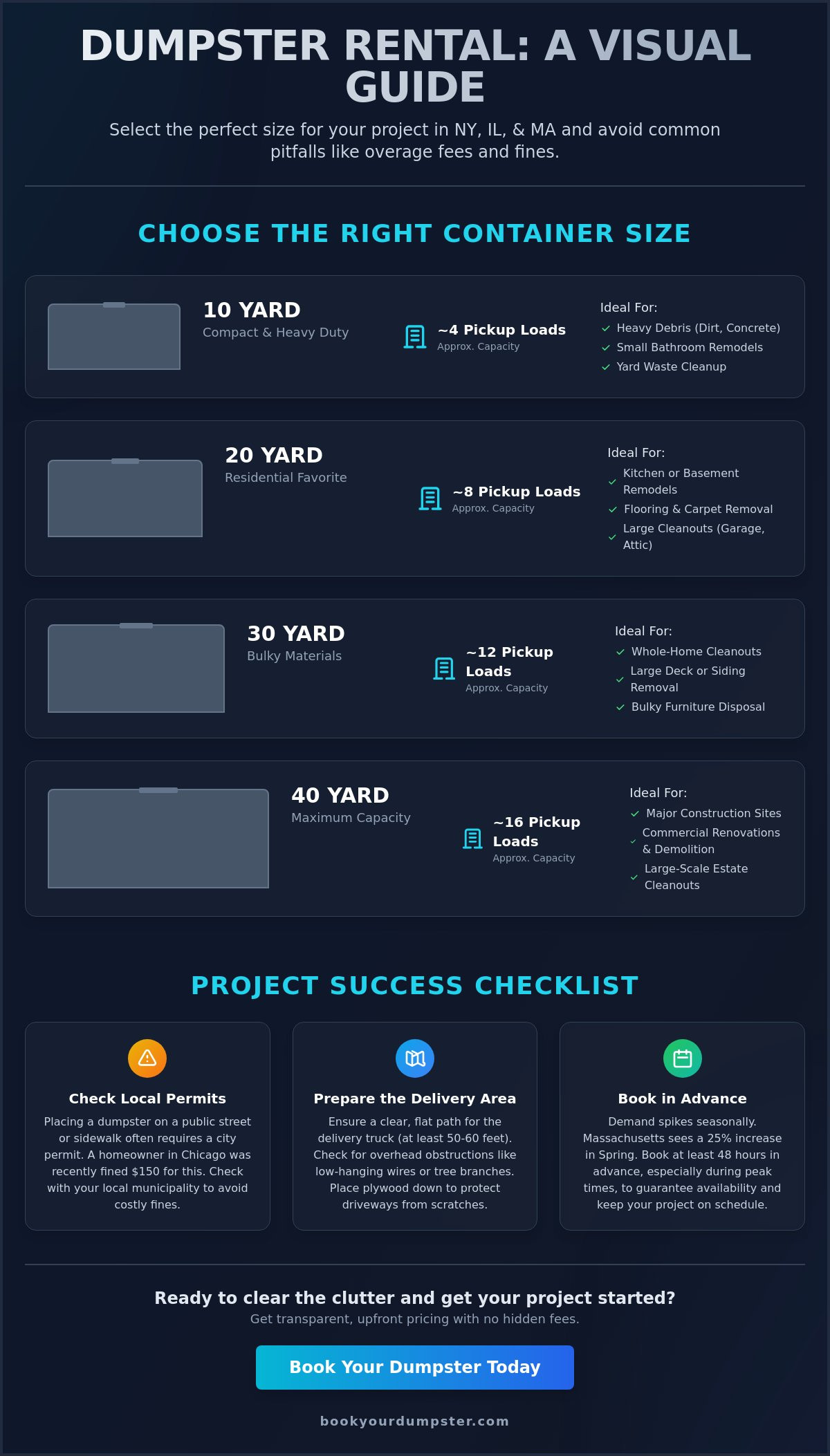
The 10 yard dumpster is the go-to choice for heavy, compact debris. Use this size for dirt, rock, or concrete removal. It holds roughly 4 pickup truck loads. Its small footprint, typically 10 feet long, fits easily in tight driveways without blocking access to your garage. For standard residential kitchen remodels, the 20 yard container is the Goldilocks size. It offers double the capacity, about 8 pickup truck loads, while remaining manageable for suburban properties. This size handles cabinetry, flooring, and appliances without exceeding typical weight restrictions.
Large-Scale Capacity: 30 and 40 Yard Containers
Choose a 30 yard rental for whole-home cleanouts or large deck removals. This container holds about 12 pickup truck loads and accommodates bulky furniture or long pieces of lumber. For major construction sites or commercial renovations, the 40 yard powerhouse is necessary. It manages up to 16 pickup truck loads of debris. Be careful with weight limits on these larger units. Filling a 40 yard container with heavy masonry can exceed legal hauling limits and trigger significant overage charges. These containers require a clear, flat 22 foot space for placement.
Avoid the overfilling trap. In 2026, hauling regulations are stricter than ever. Containers filled above the rim are safety hazards; drivers will refuse pickup. This results in "dry run" fees that stall your progress. Use this breakdown to estimate your needs:
- 10 Yard: 10' x 8' x 3.5' (4 truck loads) - Best for heavy materials.
- 20 Yard: 22' x 8' x 4.5' (8 truck loads) - Best for room renovations.
- 30 Yard: 22' x 8' x 6' (12 truck loads) - Best for estate cleanouts.
- 40 Yard: 22' x 8' x 8' (16 truck loads) - Best for commercial sites.
Analyze your debris type before you click. Roofing projects require smaller, sturdier bins due to the extreme weight of shingles. A single square of shingles weighs approximately 250 pounds. Basement cleanouts often involve lighter but bulkier items that require the height of a 30 yard unit. If you're unsure which capacity fits your driveway, check our sizing guide to secure the right fit today.
Navigating Local Permits and Regulations in NY, IL, and MA
Property owners often worry about city fines when booking a dumpster. You won't face penalties if you follow local placement rules. Fines typically occur when a container obstructs traffic or violates local zoning without a permit. If you place your garbage removal container rental entirely on private property, such as a driveway or a construction site, you usually don't need a permit. Move that container to a public street or sidewalk, and you must secure a right-of-way permit from the city.
State laws in the tri-state and Midwest areas have tightened for 2026. New regulations focus on keeping hazardous materials out of landfills. You cannot mix electronics, lead-acid batteries, or liquid chemicals with general debris. Failure to separate these items leads to immediate rejection at the transfer station and extra handling fees. Use Book Your Dumpster to ensure your project stays compliant with these evolving standards.
Permit Requirements for Urban Centers
In New York, the Department of Transportation (DOT) regulates all street and sidewalk placements. You must obtain a permit through a registered carting company before delivery. Chicago requires a 'Public Way' permit for any container placed on residential streets. These permits usually last for 30 days and require specific reflective markings. Boston uses an 'Occupancy Permit' system. In 2026, certain historic neighborhoods in Boston require a 72-hour notice to neighbors before a container can be dropped at the curb.
Prohibited Materials and Disposal Rules
Standard prohibited items include tires, refrigerators containing Freon, and flammable liquids. Massachusetts has implemented the strictest rules in the region, banning all mattresses and textiles from general waste streams. You must dispose of these at specialized recycling centers. A clean load refers to a container containing only one type of recyclable material, such as pure concrete or dedicated cardboard. Mixing even a small amount of trash into a clean load will result in it being reclassified as general waste, increasing your costs.
- Confirm if your municipality requires a permit for street placement.
- Identify a flat, stable surface on private property to avoid permit fees.
- Separate electronics and hazardous liquids from the main container.
- Check for state-specific bans on mattresses or organic waste.
- Verify weight limits to stay within legal hauling capacities.
Staying compliant isn't difficult when you have the right information. We handle the logistics so you can focus on the job. Book your dumpster today and let our experts guide you through the local requirements for your specific zip code.
Planning Your Delivery: Site Prep and Logistics
Preparing for your garbage removal container rental requires more than just picking a spot on the map. You must ensure the delivery path is functional and safe for heavy machinery. A standard roll-off truck needs at least 60 feet of straight-line approach to drop the bin safely. Follow these steps to prepare your site before the driver arrives:
- Measure 60 feet of linear space to ensure the truck can back in without maneuvering around permanent obstacles.
- Identify any power lines or tree limbs lower than 14 feet; trucks need significant vertical room to tilt the hoist during the drop.
- Clear all personal vehicles from the driveway and the street directly opposite the access point to provide a wide turn radius.
- Sweep the area to remove loose stones or debris that could shift under the weight of the container.
Protecting your property is a priority. Steel rollers and the weight of a full bin can exert over 20,000 pounds of pressure, which risks cracking residential asphalt or pavers. Use wood planks, such as 2x4s or plywood sheets, where the container wheels will rest. This technique distributes the load and prevents the metal from gouging your driveway. In 2026, on-time delivery means arriving within a confirmed 4-hour window. Have your site ready at the start of that block to avoid dry-run fees or scheduling delays.
Placement Logistics for Tight Spaces
Managing a garbage removal container rental in dense urban areas like Chicago or Boston requires precision. Chicago alleys often provide less than 16 feet of width, making a standard drop impossible without expert maneuvering. If you're working in Boston's historic districts, check for local parking permits 72 hours in advance. Communicate with your neighbors before the truck arrives. Ensure they don't park in the turnaround zone during your scheduled window. If the container must sit on a public street, you'll likely need to display a city-issued permit clearly on the bin's exterior.
Scheduling and Timeline Management
Efficient waste management depends on a strict timeline. In 2026, a 48-hour notice is the industry standard for booking. This window ensures the specific size you need is in stock and routed for your location. Most standard contracts cover a 7-to-10-day rental period. If you finish your project early, don't wait for the deadline. Request an early pickup to clear your driveway and finish the job. For more details on optimizing your project flow, read this Roll Off Dumpster Rental guide. If your project runs long, call at least 24 hours before your scheduled pickup to secure an extension. Ready to get started? Book your dumpster today to lock in your delivery time.
Streamlining Your Project with Book Your Dumpster USA
The Book Your Dumpster USA online platform eliminates the logistical friction that typically stalls large-scale cleanups. We've replaced outdated phone tag systems with a streamlined digital interface. You can secure a garbage removal container rental in less than three minutes. This speed is vital for contractors in Chicago or homeowners in Boston who need to keep their projects moving without delay. Our system manages the heavy lifting of coordination so you can focus on the actual work.
Integrity in 2026 waste management starts with our "No Hidden Fees" promise. Many providers bury fuel surcharges or environmental fees in the fine print. We provide total transparency from the start. The price you see during the booking process is the price you pay. This straightforward approach builds immediate trust and allows for accurate project budgeting. We understand that your focus should be on the renovation or cleanout, not on decoding a complex invoice at the end of the month.
Our local expertise across New York, Illinois, and Massachusetts provides a significant advantage. Each of these regions has distinct disposal laws and permit requirements. For instance, Massachusetts expanded its waste disposal bans on November 1, 2022, to include textiles and mattresses. We ensure every load complies with these evolving regional standards. We act as your professional partner, moving you from a state of clutter to a state of resolution with zero guesswork. We know the local streets, the local landfills, and the local laws.
Why Our 2026 Service Model Wins
Our digital-first booking system respects your urgency. We've removed the hurdles of traditional waste management by automating the scheduling process. We provide pragmatic support for regional permit headaches, especially in dense urban areas like New York City where street placement is strictly regulated. Reliability is our core metric. We monitor our fleet constantly to ensure your container arrives exactly when promised. We have the logistical stress under control so you don't have to manage the details yourself.
Ready to Start Your Project?
Selecting the right equipment is the first step toward a clean site. We offer 10, 20, 30, and 40-yard containers to fit any scope. A 10-yard bin works for small garage cleanouts, while our 40-yard units handle major construction debris. Don't let waste pile up and slow your progress. Choose your size and schedule your delivery today to reclaim your space. For a deeper look at the logistics, check out our Trash Dumpster Rental How-To. Book your dumpster now and experience a professional, no-nonsense cleanup.
Take Control of Your Project Cleanup Today
Managing a renovation or cleanout in 2026 requires more than just heavy lifting. You need a solid plan for waste. Choosing the right container size prevents overpaying for empty space or dealing with overflows. Navigating the specific 2026 permit regulations in NY, IL, and MA ensures your project stays on schedule and avoids local fines. Preparing your site for delivery protects your property and keeps the logistics moving forward without delays.
Finding a reliable garbage removal container rental is the final piece of the puzzle. We offer 2026-updated regional permit guidance and guarantee on-time delivery across New York, Illinois, and Massachusetts. You'll get transparent pricing with no hidden fees every time. Our team handles the logistics so you can focus on the actual work. Stop worrying about the debris and start making progress on your site. We've modernized the process to save you time and eliminate the headaches typical of waste management.
Book your dumpster today with Book Your Dumpster USA. We're ready to help you finish the job.
Frequently Asked Questions
Is a permit required for a garbage removal container in my driveway?
You don't need a permit for a garbage removal container rental if it's placed entirely on your private property. Permits are typically only mandatory when the bin sits on a public street or blocks a sidewalk. For instance, the Chicago Department of Transportation requires a Public Right-of-Way permit for any street placement. Always check your local municipal code to ensure your driveway meets specific set-back requirements.
Can I put old appliances in a rented container in New York or Illinois?
You can't place appliances containing refrigerants or hazardous chemicals in a standard container due to strict environmental laws. The NY State Electronic Equipment Recycling and Reuse Act of 2010 prohibits disposing of items like refrigerators and air conditioners in landfills. In Illinois, the EPA requires "white goods" to be processed separately. Book Your Dumpster recommends checking our prohibited items list before you start your project.
How much weight can a 20-yard container actually hold?
A standard 20-yard container typically holds between 3 and 4 tons, which equals 6,000 to 8,000 pounds. This capacity is roughly equivalent to 110 to 130 contractor-grade trash bags. If you're disposing of heavy materials like concrete or brick, you'll reach this weight limit long before the bin is physically full. Exceeding these limits can cause damage to the roll-off truck's hydraulic lifting system during the pickup process.
What happens if I fill the container above the 'Max Fill' line?
We won't haul a container that's filled above the "Max Fill" line because it creates a safety hazard for other drivers. Debris can fly out during transport, leading to DOT violations and potential accidents. If your load is overfilled, you'll need to remove the excess material before we can complete the pickup. This often results in a dry run fee for the wasted trip to your site.
Can the roll-off truck deliver the container over a sidewalk?
Drivers can deliver over a sidewalk if the path is clear and local laws permit it, but it's not ideal for the concrete. The weight of a loaded truck, which can exceed 33,000 pounds, often cracks standard residential sidewalks. In New York City, the Department of Buildings requires specific sidewalk protection like plywood or planks. Always notify us of these obstacles during your garbage removal container rental booking to ensure a safe drop-off.
How long can I keep the container on my property in Massachusetts?
Most standard rental periods in Massachusetts last for 7 to 10 days, though you can extend this for a daily fee. Local ordinances in cities like Boston or Worcester don't set a hard limit for private property, but neighborhood associations often have 14-day restrictions. Schedule your pickup as soon as you finish your project to avoid unnecessary rental extensions. Our online system makes it easy to manage your timeline.
What is the difference between a roll-off container and a junk removal service?
A roll-off container is a DIY solution where we drop the bin and you load it at your own pace. Junk removal is a full-service option where a crew arrives to do the heavy lifting for you. Rental containers are better for long-term projects like a 3-week kitchen remodel. Junk removal works best for quick, one-day cleanouts where you don't want to handle the debris yourself.
Are there extra fees for delivering a container in winter weather?
We don't charge extra for the delivery itself during winter, but snow and ice can lead to weight-related costs. If snow accumulates in your open container, it adds to the total weight at the scale. In Illinois and Massachusetts, sub-zero temperatures can cause debris to freeze to the bottom of the bin. This might require multiple trips to the landfill, which can impact your final disposal invoice.


