You'll spend more time sitting in landfill traffic than actually working if you rely on a standard pickup for a major renovation. Most people underestimate the sheer volume of waste generated during a home cleanout or a commercial demolition project. If you're trying to figure out how many truckloads of debris in a 30 yard dumpster, the reality is that one container replaces roughly 12 to 15 full trips in a standard pickup truck.
It's frustrating to watch your project timeline slip away because of logistical bottlenecks and confusing cubic yard measurements. We understand the pressure to keep costs low and avoid the hidden fees that come with exceeding weight limits. This 2026 capacity guide provides a clear mathematical comparison between roll-off containers and truck beds. You'll learn how to estimate your project's volume accurately, ensuring you select the right size for your specific scope without overpaying for unused space. We'll help you streamline your disposal process and move from a state of clutter to a finished project with minimal stress.
Key Takeaways
- Learn exactly how many truckloads of debris in a 30 yard dumpster to eliminate up to 15 time-consuming trips to the landfill.
- Understand how weight limits between 3 and 5 tons dictate your loading strategy, particularly when handling heavy debris like concrete or roofing.
- Use the "Tetris" packing method to break down bulky items and maximize every inch of the 22-foot container.
- Verify local permit requirements for street placement in major metros like New York or Chicago to avoid unexpected fines and delays.
- Compare standard and long-bed pickup capacities to ensure you select the most cost-effective disposal method for your specific project scope.
Estimating Capacity: How Many Truckloads Fit in a 30 Yard Dumpster?
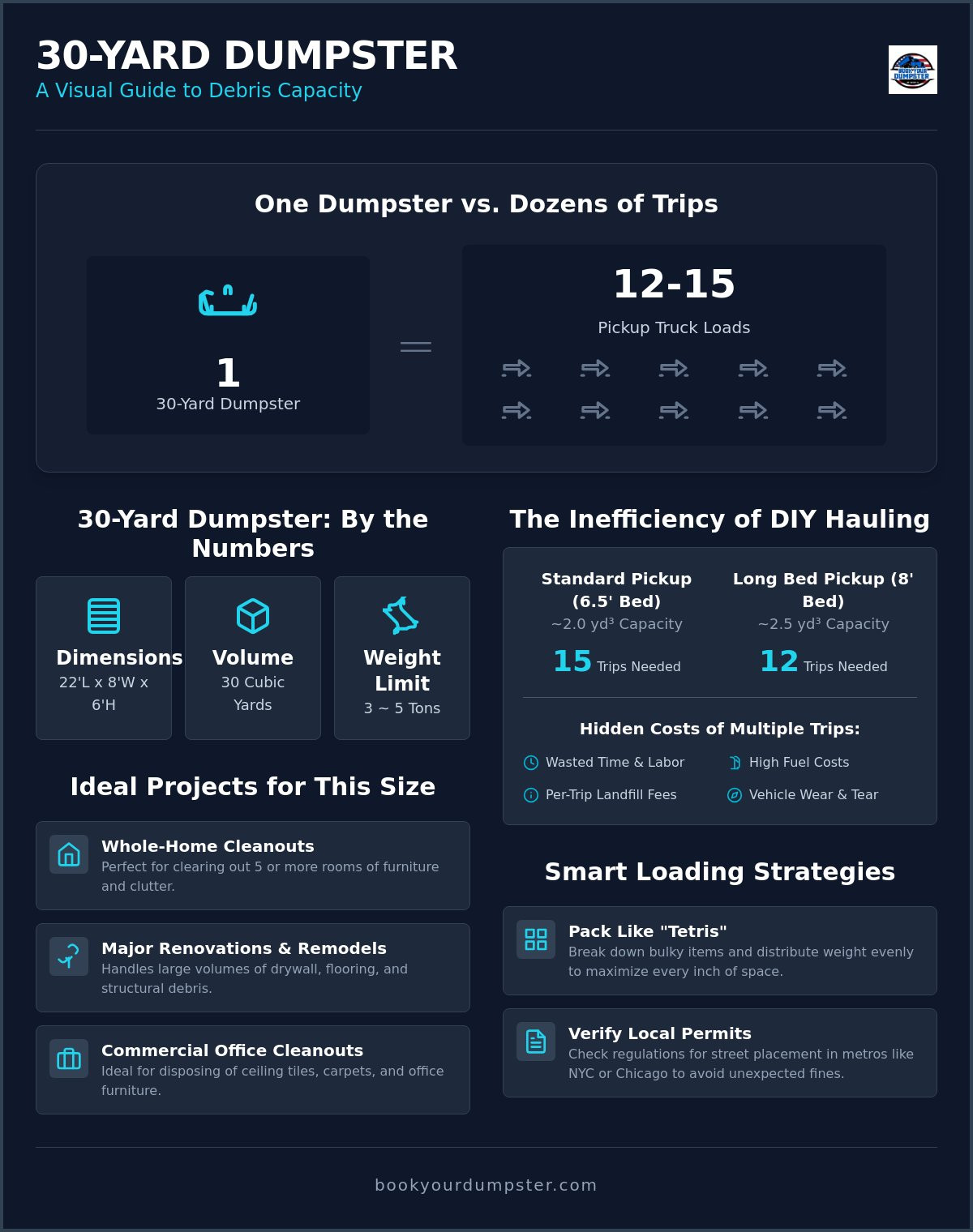
Stop guessing and start measuring. To understand how many truckloads of debris in a 30 yard dumpster, you need to look at the physical dimensions first. A standard 30-yard container measures 22 feet long, 8 feet wide, and 6 feet high. This footprint is roughly the size of a standard parking space, but with walls tall enough to stand in. Roll-off dumpsters of this size provide a massive volume that simply isn't achievable with a personal vehicle.
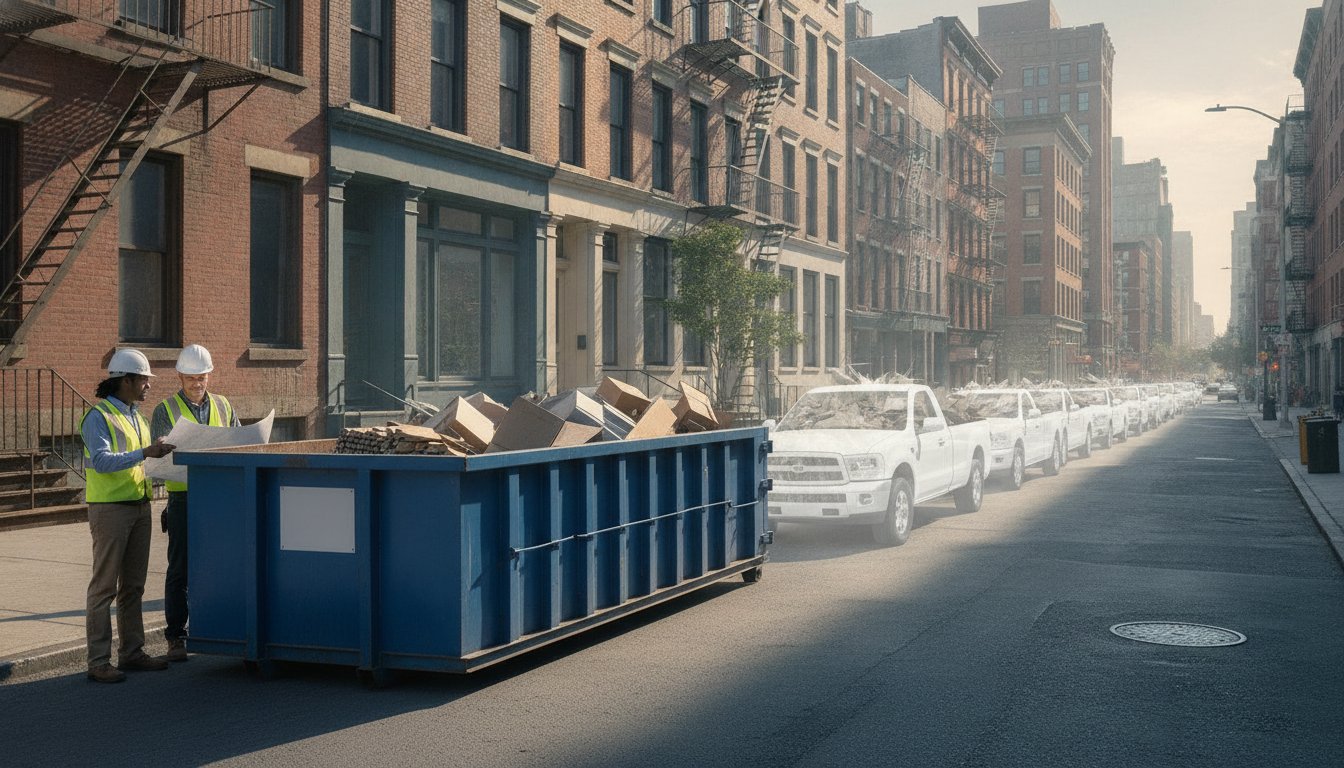
The math is straightforward. A standard pickup truck bed holds approximately 2 cubic yards of material when loaded level with the top. Divide the 30-yard capacity of the container by that 2-yard average, and the result is clear. A 30-yard dumpster typically holds the equivalent of 12 to 15 standard pickup truckloads. This range accounts for air pockets and the reality that you can't always pack a truck bed perfectly. Using this container saves you from making dozens of trips to a disposal site.
Visualizing cubic yards is difficult for most homeowners. It's an abstract unit of measurement that doesn't translate well to the piles of junk sitting in your driveway. Thinking in terms of truckloads provides a tangible logistical tool. If you look at your debris and realize it would take you all weekend to drive 15 loads to the local dump, you know the 30-yard size is the correct choice. It removes the stress of transport and lets you focus on the actual work.
Visualizing 30 Cubic Yards of Waste
Think of a standard one-car garage. If you filled that garage halfway to the ceiling with loose debris, you'd have roughly 30 cubic yards. In terms of household waste, this volume equals about 180 to 200 large, heavy-duty contractor trash bags. The 6-foot wall height is a critical advantage. It allows you to toss in bulky items like sofas, dining tables, or long pieces of lumber without them hanging over the sides. You get more utility out of the vertical space than a flat truck bed could ever offer.
When the 30-Yard Size is the Right Call
Don't rent a smaller container if your project involves significant structural changes. This size is the industry standard for whole-home cleanouts involving five or more rooms. It's also the ideal choice for large-scale deck removals exceeding 600 square feet. For contractors, 30-yard containers are the go-to for major commercial office renovations where drywall, flooring, and ceiling tiles create massive volume quickly. You can book your dumpster online to secure this capacity and keep your job site clear of hazards.
Pickup Bed Comparison: Standard vs. Heavy Duty Trucks
Not all truckloads are created equal. When calculating how many truckloads of debris in a 30 yard dumpster, you must first identify the size of the truck bed you're using. Most consumer pickups feature a 6.5-foot bed, which offers a standard pickup truck bed volume of approximately 2.0 cubic yards when loaded level. If you're driving a heavy-duty work truck with an 8-foot long bed, that capacity increases to roughly 2.5 cubic yards.
These small differences in bed length significantly impact your project logistics. To fill a 30-yard container, you'd need to make 15 full trips with a standard bed. Even with a long bed, you're looking at 12 separate hauls to the landfill. These numbers assume you're loading the bed perfectly level with the rails. In reality, loose debris like drywall or brush is rarely uniform, meaning your actual efficiency often drops below these mathematical ideals.
Many drivers attempt to compensate for low volume by "heaping" the load. Heaping capacity refers to the volume of waste piled above the truck bed rails. While this might seem like a time-saver, it's often dangerous and requires extensive tarping to meet road safety regulations. It also places immense strain on your vehicle's components.
The Problem with DIY Truck Hauling
The true cost of DIY hauling goes beyond fuel. If you're working in New York or Illinois, 15 round trips to a local landfill can easily consume two full workdays. You'll face high fuel costs and cumulative "per-trip" tipping fees that eat into your budget. Don't forget the wear and tear on your personal vehicle. Hauling heavy debris like shingles or flooring can damage your suspension and tires, leading to repairs that cost far more than a rental. Landfill wait times are another hidden drain, as you'll spend hours idling in line instead of finishing your project.
Efficiency Gains with a Roll-Off Container
Choosing a professional container eliminates these logistical headaches. You benefit from one-time delivery and one-time pickup, keeping your site organized and your personal vehicle safe. You can use Book Your Dumpster USA for direct online booking to secure your 30-yard container quickly. This approach replaces the chaos of 15 truck trips with a single, streamlined solution. If you want to simplify your workflow, schedule your rental today and focus on the job at hand.
Weight Limits vs. Volume: Why Material Type Matters
Volume tells you how much space you have, but weight determines if the truck can legally haul it away. When calculating how many truckloads of debris in a 30 yard dumpster, you must account for the density of your waste. A 30-yard container typically carries a weight limit between 3 and 5 tons. If you're clearing out a basement of old clothes and plastic bins, you'll hit the 6-foot fill line long before you hit the weight cap. However, construction materials change the math entirely.
The "Heavy Debris Rule" is non-negotiable. If you load 15 truckloads of concrete or wet dirt into a 30-yard dumpster, you'll exceed the legal weight limit before the container is even a third full. Local regulations in dense urban areas like Queens or San Francisco often impose strict road weight limits to protect aging infrastructure. Exceeding these limits creates safety hazards and logistical delays during pickup. You don't want to deal with the stress of a container that's too heavy to be legally transported.
Common Weight Limits for 30-Yard Rentals
Most 30-yard rentals for standard household debris allow for a 3-ton to 4-ton limit. Construction-specific rentals might push that to 5 tons, or 10,000 pounds. Materials classified as "heavy fill", including brick, asphalt, dirt, and concrete, are exceptionally dense. Just one cubic yard of concrete weighs about 4,000 pounds. If you cross the 10,000lb threshold, expect overage fees. According to 2026 industry standards, these fees typically range from $50 to $100 per additional ton. Always disclose your material type during booking to ensure your weight allowance matches your project needs.
Project Examples: Weight vs. Truckloads
For roofing projects, a 30-yard container is the gold standard. It safely holds between 30 and 50 squares of asphalt shingles, depending on the number of layers being removed. If you're doing a flooring renovation, this size accommodates approximately 1,500 square feet of carpeting and padding without reaching the weight limit. For more complex sites, check out our Ultimate Guide to Construction Debris Removal. Plan your loading carefully. Start with the heaviest items at the bottom and distribute the weight evenly across the 22-foot floor to maintain stability during transport.
Maximizing Your 30 Yard Dumpster Capacity
Packing a large container efficiently is a skill that saves both time and money. Understanding how many truckloads of debris in a 30 yard dumpster you can fit depends heavily on your loading strategy. Don't simply toss items over the side. Use the "Tetris" method by placing large, flat items like old doors, plywood sheets, or sections of drywall at the very bottom. This creates a solid foundation and eliminates "air pockets," which are the empty spaces that waste valuable volume. Break down bulky furniture, cabinets, and bed frames before they go in. If you leave a sofa intact, you're essentially paying to haul air rather than debris.
Maintain a level load to ensure a safe and successful pickup. Federal and local safety regulations require that all debris remains below the 6-foot rim of the container. If items protrude above the top, the driver cannot safely secure the tarp, and they will likely reject the pickup. This results in dry-run fees and project delays. Weight distribution is equally critical. Keep the heaviest materials, such as heavy timber or appliances, in the center of the 22-foot floor. Proper balance prevents the container from tipping or shifting dangerously when the truck's hydraulic system lifts it for transport.
Pro-Tips for Efficient Loading
Take advantage of the walk-in door feature found on most 30-yard containers. Instead of struggling to heave heavy items over the 6-foot walls, open the rear door and carry them directly to the front. This allows you to stack items tightly from the ground up. As you build your layers, fill small gaps with loose debris like drywall scraps, insulation, or carpeting remnants. This "micro-loading" ensures you utilize every available cubic inch. Avoid the temptation to over-fill the container. A "mountain" of trash in the middle might seem efficient, but it's a safety violation that leads to fines.
Prohibited Items That Waste Space
Watch out for items that don't belong in a standard roll-off. Prohibited materials like tires, car batteries, and hazardous waste take up space and create significant logistical headaches. If a landfill discovers these items in your load, they will charge expensive sorting fees or reject the entire container. These costs quickly negate the savings of a large-scale rental. For a full list of what you can and cannot toss, consult our Roll Off Dumpster Rental Guide. Once you have your loading plan ready, book your 30-yard dumpster online to lock in your delivery date and keep your project moving forward.
Booking Your 30 Yard Dumpster in New York, New Jersey, and Illinois
Securing a 30-yard container requires more than just knowing how many truckloads of debris in a 30 yard dumpster will fit inside. You must account for the physical footprint of a 22-foot roll-off on your property or street. In high-density areas like Queens, New York, or Boston, Massachusetts, space is a premium commodity. Navigating narrow residential blocks with a heavy-duty delivery truck takes precision and planning. We specialize in these tight urban environments, ensuring your container arrives exactly where you need it without disrupting the neighborhood. Understanding the logistics of a 15-truckload capacity helps you prepare your site for a successful delivery.
Permit requirements are a critical part of the booking process. If your driveway isn't long enough to accommodate the 22-foot length, you'll likely need to place the container on a public street. Most municipalities, including those in Chicago and Northern New Jersey, require a "Street Permit" for this placement. We maintain pricing integrity by being transparent about these local requirements during the booking phase. Our online system allows for 24/7 scheduling, giving you the flexibility to manage your project on your own time. You can select your size, check availability, and finalize your rental in minutes.
Regional Service Highlights
Navigating the steep hills of San Francisco or the congested lanes of New York City requires experienced drivers and specialized equipment. We provide dedicated support for residential cleanouts and contractor sites across Massachusetts and Illinois, adapting to local waste regulations. For example, Illinois recently implemented strict permitting for construction debris recovery facilities to ensure environmental compliance. We stay ahead of these regulatory shifts so you can focus on your project. For a detailed breakdown of costs in your area, see our guide on Dumpster Rental Prices in New York and Illinois.
Final Checklist Before You Rent
Measure your drop-off site before finalizing your order. You need at least 22 feet for the container itself, plus an additional 10 to 15 feet of clearance for the truck to maneuver. Check for low-hanging utility wires or tree branches. The delivery process requires 14 to 18 feet of vertical space to tilt the container into place. Ensure the surface is flat and stable to support the weight of the debris. Once you've cleared the path, Book your 30-yard dumpster online today to clear your debris in one trip. We'll handle the logistics and punctuality so your site stays on schedule.
Simplify Your Disposal Logistics
Stop wasting time and fuel on repetitive trips to the local landfill. You've seen that understanding how many truckloads of debris in a 30 yard dumpster can fit is the first step toward a more efficient job site. Consolidating 15 truckloads into a single roll-off container protects your personal vehicle and keeps your project on schedule. Whether you're managing a commercial renovation in Chicago or a home cleanout in New York, this size provides the volume you need with the pricing integrity you expect.
Don't let logistical stress or hidden fees slow your progress. Use our transparent online platform to manage your disposal needs with complete confidence. We serve major metros including NY, NJ, IL, MA, and SF with a focus on punctuality and straightforward service. Order Your 30-Yard Dumpster Online Now to secure reliable capacity for your next large project. Our streamlined booking system is available 24/7 to help you move from a state of clutter to a state of resolution. Take control of your project waste today and get the job done right.
Frequently Asked Questions
How many truckloads is a 30 yard dumpster?
A 30-yard container holds the equivalent of 12 to 15 standard pickup truckloads. This estimate assumes you are using a standard 6.5-foot truck bed, which typically offers a 2-cubic-yard capacity when loaded level with the rails. If you use a heavy-duty truck with an 8-foot long bed, the number of trips reduces to approximately 12. Using a single container eliminates the need for a dozen or more time-consuming trips to a disposal site.
Can a 30 yard dumpster hold 10 tons of debris?
No, a standard 30-yard dumpster cannot safely or legally hold 10 tons of debris. Most rental agreements for this size specify a weight limit between 3 and 5 tons. Loading 20,000 pounds of material into one container exceeds the lifting capacity of most roll-off trucks and violates road safety regulations. If your project involves 10 tons of dense material like concrete or brick, you'll need to rent multiple containers to stay within legal limits.
Will a 30 yard dumpster damage my driveway in New Jersey?
Heavy containers can potentially crack or indent asphalt and concrete, but you can prevent this with proper site preparation. We recommend placing large plywood boards or specialized "street pads" under the rollers before delivery. This is a critical step in New Jersey, where fluctuating temperatures can make driveway surfaces more susceptible to damage under the weight of 15 truckloads of waste. Protective barriers distribute the pressure and keep your property intact.
What are the dimensions of a 30 yard dumpster?
A 30-yard dumpster typically measures 22 feet long, 8 feet wide, and 6 feet high. This footprint fits within a standard parking space, but you must ensure there is enough clearance for the delivery truck to maneuver. You'll need at least 15 feet of vertical space to accommodate the tilting of the truck bed during the roll-off process. Always measure your drop-off area to confirm the 22-foot container has enough room to sit flat.
How much weight can I put in a 30 yard dumpster before it is too heavy?
You must stay within the weight allowance specified in your contract, which usually ranges from 6,000 to 10,000 pounds. When calculating how many truckloads of debris in a 30 yard dumpster you can fit, remember that material density is the deciding factor. While you can fill the volume with 15 loads of household junk, you'll hit the weight limit much faster with shingles, soil, or wet debris. Monitor your load height and material types to avoid overage fees.
Is a 30 yard dumpster big enough for a whole house cleanout?
Yes, this size is the professional standard for whole-house cleanouts involving five or more rooms. It provides ample space for large furniture, old appliances, and approximately 180 to 200 contractor-grade trash bags. If you are clearing out a multi-story home, a basement, and a garage, the 30-yard capacity ensures you can finish the job without the logistical stress of ordering a second container or making multiple dump runs.
Do I need a permit for a 30 yard dumpster in New York City?
You need a permit if the container sits on a public street or sidewalk in New York City. If you can fit the 22-foot container entirely on private property, such as a driveway or a commercial lot, a permit is typically not required. Keep in mind that NYC has updated waste containerization laws as of 2026, so always verify current Department of Buildings or DOT requirements before scheduling your delivery to avoid fines.
How much does it cost to rent a 30 yard dumpster compared to 15 truck trips?
Renting a container is generally more cost-effective than making 15 individual trips to a landfill when you factor in total logistics. DIY hauling involves high fuel costs, cumulative per-trip tipping fees, and hours of lost labor sitting in landfill traffic. A 30-yard rental provides a fixed-price solution that includes delivery, pickup, and a generous weight allowance. It simplifies your budget and allows you to focus on completing your project instead of managing transport.