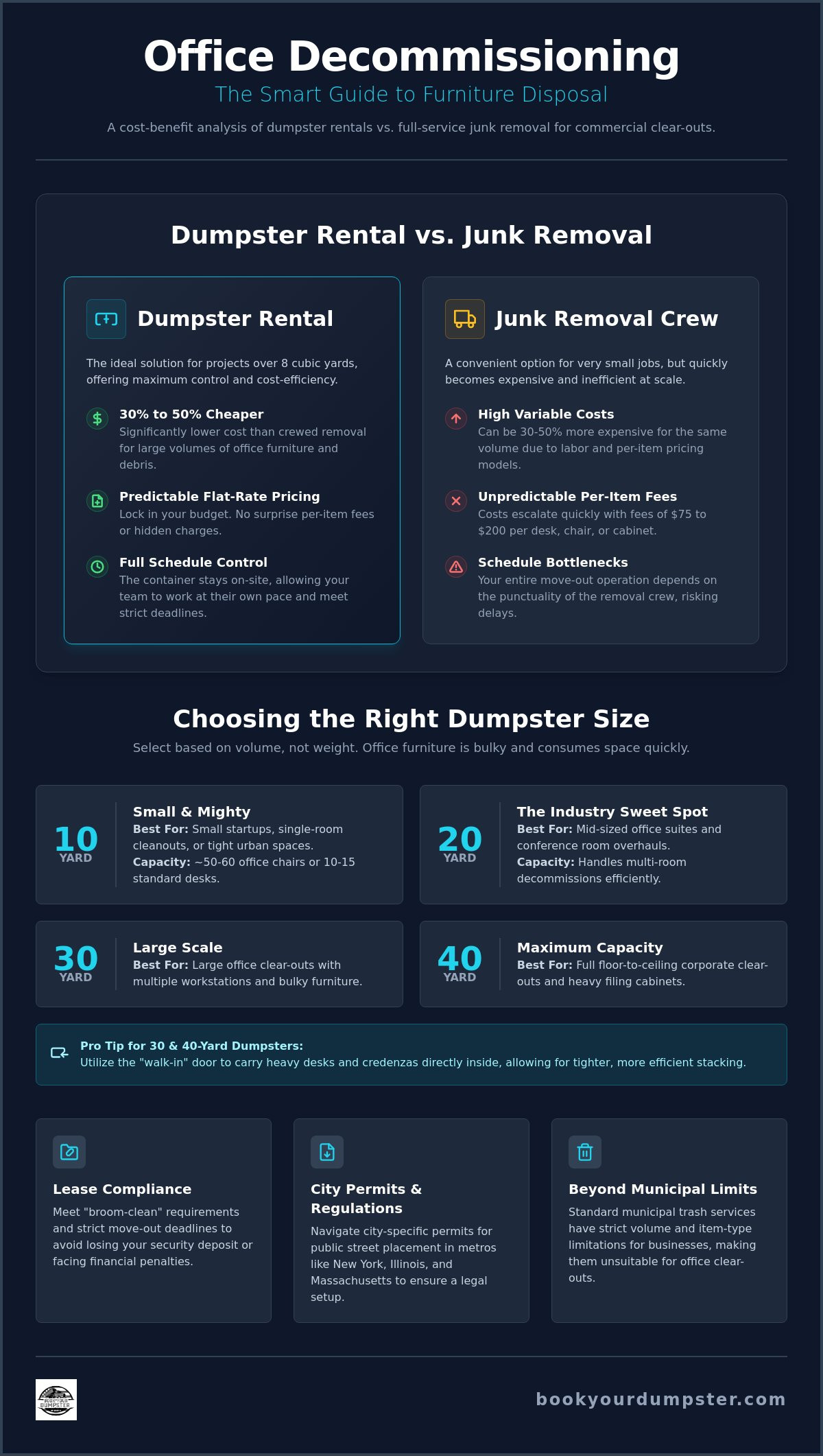
Hiring a full-service junk removal crew for your office decommissioning might feel like the easy path, but it's often the fastest way to blow your relocation budget. For projects involving more than eight cubic yards of debris, renting an office furniture disposal dumpster is typically 30% to 50% cheaper than hiring a crew to haul items away piece by piece. Get a solution that scales with your inventory without the unpredictable per-item fees that plague traditional removal services.
It's understandable that the logistics of a large-scale move feel overwhelming. You're likely facing a strict lease deadline and a broom-clean requirement that mandates every desk, chair, and cubicle be gone before you hand over the keys. Navigating complex city permits in New York or San Francisco while coordinating multiple disposal crews is a distraction your team doesn't need. Learn how to select the right dumpster size and manage the logistics of large-scale office furniture disposal efficiently and cost-effectively. This guide covers everything from choosing between 10-yard and 40-yard containers to creating a decommissioning plan that ensures predictable, flat-rate pricing.
Key Takeaways
- Match your specific inventory to the correct 10-yard or 20-yard container to avoid the logistical headache of multiple pickups.
- Secure flat-rate pricing with an office furniture disposal dumpster to maintain budget integrity and avoid the hidden fees of full-service haulers.
- Meet strict broom-clean lease requirements and avoid financial penalties with punctual delivery and pickup schedules.
- Navigate city-specific permit regulations for public street placement in New York, Illinois, and Massachusetts to ensure a legal setup.
- Transition from a cluttered space to a clean slate quickly using a streamlined online booking system designed for commercial speed.
The Challenges of Large-Scale Office Furniture Disposal
Managing an office move is a high-stakes logistical operation, not a simple cleanup. While a residential move might involve a single sofa, a commercial relocation often involves fifty desks, a hundred task chairs, and miles of cubicle wiring. This volume transforms disposal from a minor task into a critical project path. If your inventory isn't cleared by the lease deadline, you risk heavy financial penalties or the loss of your security deposit. Most commercial leases require the space to be left in a broom-clean condition, meaning every single item must be gone before you hand over the keys.
Attempting to use standard municipal services in major metros like New York or Chicago is a recipe for failure. These cities have strict limitations on the volume and type of material they'll collect from businesses. Office furniture falls under the category of Bulky waste, which requires specific handling and often a scheduled private service. Relying on an office furniture disposal dumpster allows you to maintain control over the timeline and the physical space, keeping the loading dock clear for the movers.
The Problem with Bulk Trash Pickup for Businesses
Municipal trash routes are designed for bags, not boardrooms. In many cities, commercial properties are prohibited from placing large furniture items on the curb. Even if it's allowed, the volume is usually capped. Junk removal companies often exploit this by using per-item pricing models. Paying $75 to $200 per item adds up quickly when you're clearing an entire floor. Waiting for a pickup window also creates a bottleneck. If the hauler is late, your move-out schedule collapses. A roll-off container eliminates these variables by providing a static, high-capacity solution on-site.
Decommissioning vs. Cleaning Out
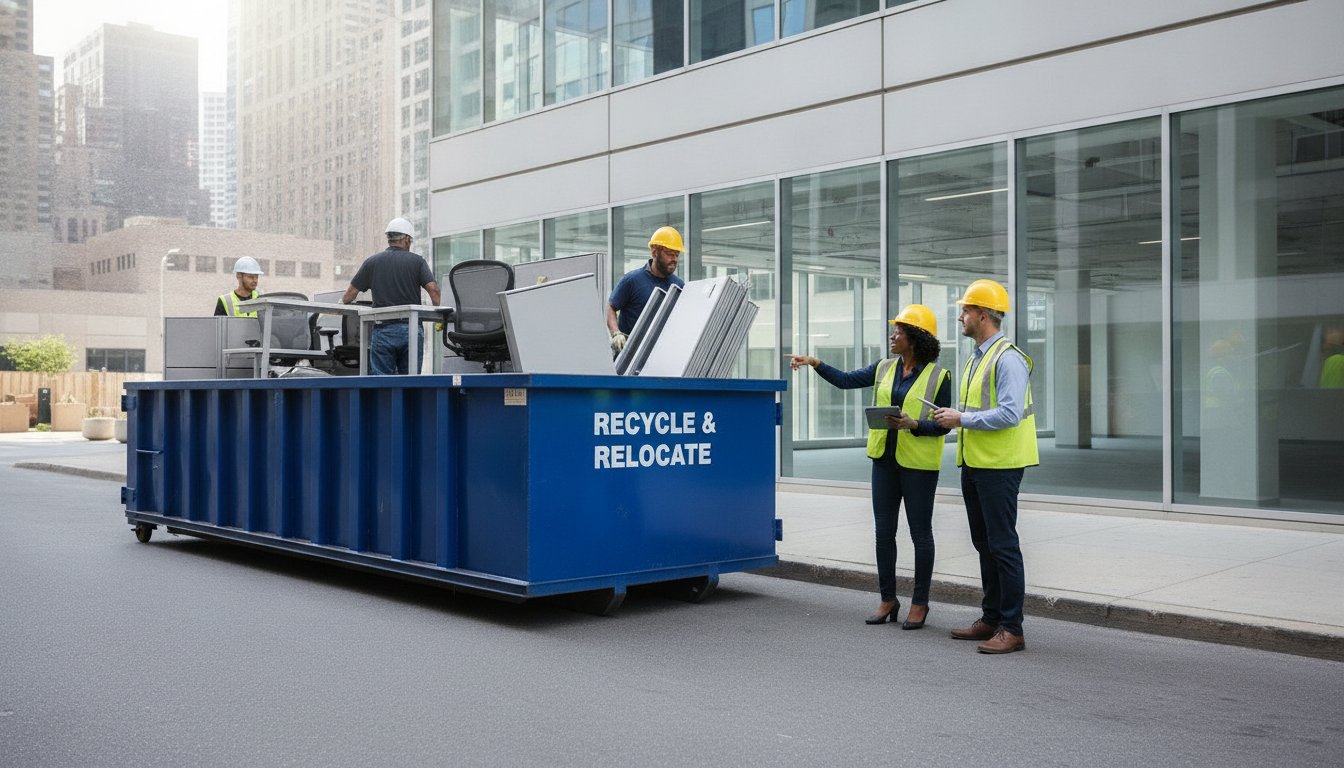
Understand the difference between a minor purge and a full office decommission. A decommission is a systematic teardown of the workspace. You'll encounter items that can't be donated or sold, such as broken laminate, outdated cubicle partitions, and worn-out task chairs. These items need a final destination that doesn't involve multiple trips to a local landfill. An office furniture disposal dumpster acts as the central hub for this entire process. It allows your facility team to work at their own pace, filling the container as they disassemble furniture. This method is safer and faster than coordinating five or six separate junk removal trips. Multiple trips often lead to double-handling of heavy materials and increased labor costs.
Choosing the Right Dumpster Size for Office Furniture
Select your container based on the physical volume of your furniture rather than its weight. Office items are notoriously "airy," meaning they consume significant space even if they aren't heavy. To accurately estimate your volume, assume that ten disassembled cubicle panels will occupy approximately four cubic yards of container space. Choosing an office furniture disposal dumpster that is too small leads to costly mid-project swaps, while a container that's too large wastes your budget on empty air.
The 10-Yard Dumpster: Small but Mighty
This size is the professional choice for small startups or single-room renovations. It holds approximately 50 to 60 office chairs or 10 to 15 standard desks. If you're operating in tight urban environments like Queens or San Francisco, this footprint is often the only viable option for street placement. It fits comfortably in a single parking space without blocking traffic. Read our 10-yard dumpster guide for a deep dive into dimensions and weight limits.
The 20-yard dumpster serves as the industry sweet spot. It's the standard for mid-sized office suites and large conference room overhauls. This size handles the bulk of a multi-room decommission without requiring a massive staging area on your property. It provides enough capacity for bulky items while remaining manageable for smaller loading docks.
Scaling Up: 30 and 40 Yard Containers
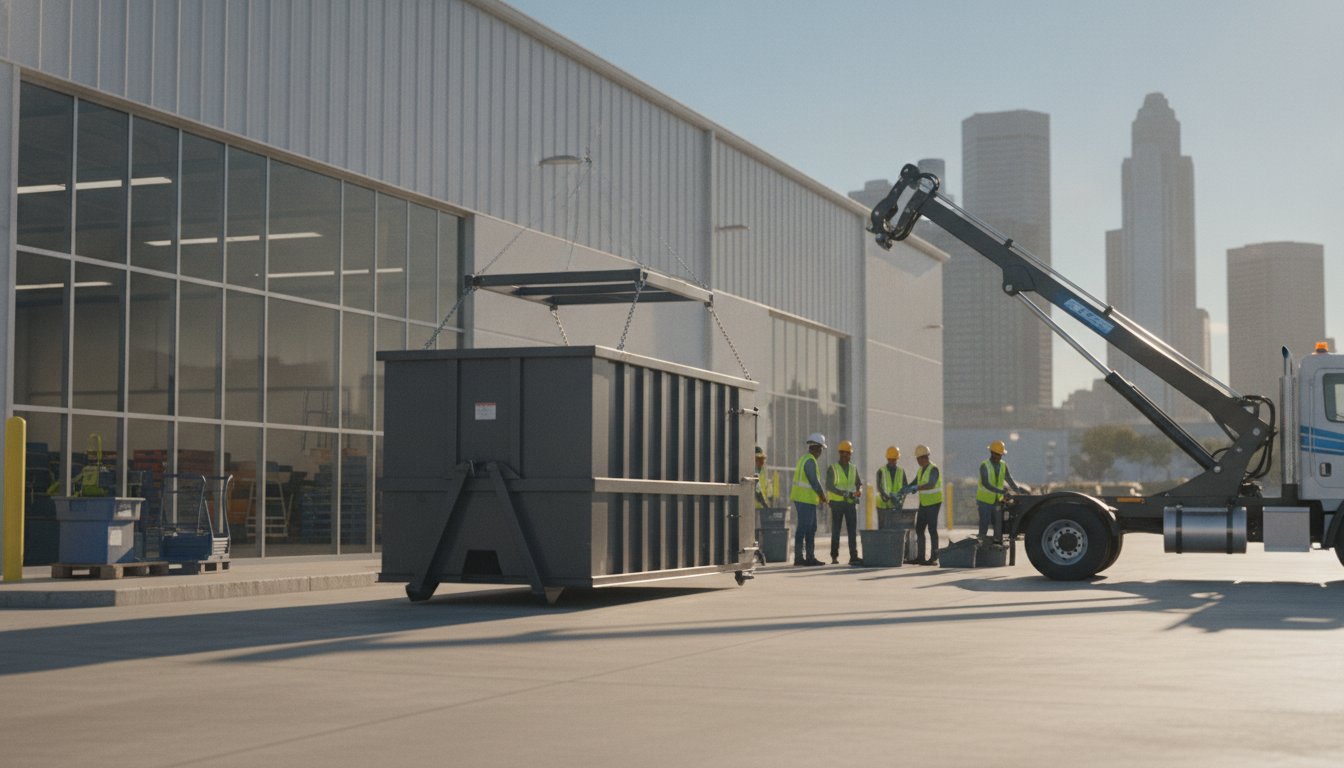
Large corporate floor-to-ceiling clear-outs require the heavyweights of the waste world. The 30 and 40-yard containers are designed for massive workstation removals and rows of heavy filing cabinets. One of the most critical features of these large units is the "walk-in" door. This allows your team to carry heavy desks and credenzas directly into the container, maximizing space by stacking items tightly. Properly sizing your container aligns with the EPA guide for commercial buildings, which emphasizes efficient waste stream management.
For buildings with thousands of square feet to clear, consider a multi-container rotation. We can schedule a "swap-out" where a full 40-yard unit is removed and replaced with an empty one immediately. This keeps your labor crew moving without downtime. You can check real-time availability for these larger units to secure your move-out date.
Dumpster Rental vs. Junk Removal: A Commercial ROI Analysis
Choosing between a roll-off container and a full-service junk crew is a choice between control and convenience. For high-volume projects, an office furniture disposal dumpster typically costs 30% to 50% less than full-service junk removal. This cost gap exists because junk removal companies charge a premium for their labor, insurance, and the logistical complexity of their "per-item" pricing. By utilizing your own facility team to load the container, you eliminate these service markups and keep your project budget predictable.
Timing is the second major factor in your ROI calculation. Junk removal services require a scheduled window, which often conflicts with the operational needs of other tenants in your building. Loading a dumpster at your own pace during off-hours ensures you don't block elevators or loading docks during peak business times. This flexibility allows you to manage the decommission without the stress of a ticking clock or the risk of a crew arriving late to your site.
The Efficiency Factor
Eliminate the inefficiency of multiple-trip fees. Junk removal trucks are often smaller than commercial roll-off containers, requiring several trips to clear a single office floor. Each trip adds time and labor costs to your invoice. Having a container on-site for 7 to 14 days allows for a staggered decommission. Your team can clear one department at a time, keeping the workspace organized and safe throughout the transition. Consult our efficient waste management guide to optimize your loading strategy and maximize your container's physical capacity.
Predictable Budgeting
Flat-fee transparency is the only way to prevent budget creep in a commercial move. Junk haulers often provide "visual estimates" that change once the truck is half-full. In contrast, an office furniture disposal dumpster provides a single invoice with a clear weight limit. Since office furniture is primarily composed of wood, metal, and plastic, it rarely exceeds the standard ton limits of a 20 or 30-yard unit. Review our latest data on dumpster rental prices to see how flat-rate structures compare across major markets. This pragmatic approach ensures your final project cost matches your initial quote, providing a clean financial resolution for your office move.
Logistics and Permits: Preparing for Your Office Dumpster
Securing an office furniture disposal dumpster requires more than just a phone call; it requires a site plan. Your first step is to determine the exact placement of the container. If your building has a private loading dock or a secure parking lot, you can often avoid the bureaucratic hurdle of city permits. However, if the container must sit on a public street or sidewalk, you must account for local "Right of Way" regulations. Clear the path for the delivery truck by checking for low-hanging signs, overhead wires, and narrow alleyway clearances that could obstruct the roll-off mechanism.
Navigating Metropolitan Regulations
Permit requirements vary significantly by state and municipality. In cities like Boston or Chicago, you often need a specific permit for any structure occupying public space. For detailed state-specific rules, review our guide on New York, Illinois, and Massachusetts dumpster rentals. In busy commercial districts like Queens or downtown Chicago, timing is everything. Some zones restrict delivery and pickup to specific off-peak hours to minimize traffic disruption. Always confirm these windows with your building management and local precinct before scheduling your drop-off.
Safety and Sorting
A successful decommission depends on what stays out of the container. While an office furniture disposal dumpster is perfect for desks and chairs, it is not a catch-all for electronics. Computer monitors, lithium-ion batteries, and fluorescent bulbs are prohibited and require specialized e-waste handling. To maximize space and maintain safety, follow a strict loading sequence:
- Place heavy filing cabinets and metal desk frames at the bottom to create a stable base.
- Stack cubicle panels vertically along the sides to leave the center open for smaller items.
- Fill the top layers with lighter task chairs and disassembled laminate tops.
- Never exceed the "fill line" marked on the side of the container.
Overfilled containers are a safety hazard and cannot be transported. If the driver determines the load is unsafe or contains prohibited materials, you'll face delays and dry-run fees. Avoid these logistical setbacks by planning your load ahead of time. Schedule your commercial delivery today to secure your placement before your move-out date begins.
Streamlining Disposal with Book Your Dumpster USA
Execution is the final stage of any successful office decommissioning project. After you calculate your volume and secure your permits, you need a partner that respects your timeline and your budget. We provide the infrastructure to move your project from a state of clutter to a state of resolution without the common friction of traditional waste management. Our service model is built on three pillars: pricing integrity, punctuality, and digital convenience. When you rent an office furniture disposal dumpster through our platform, you receive a high-functioning tool designed for professional efficiency.
The Modern Way to Manage Waste
Ditch the outdated process of playing phone tag with local haulers. Our digital platform removes the logistical stress of office cleanouts by allowing you to manage every detail online. Go from a quote to a scheduled delivery in minutes. Facility managers trust our pragmatic approach because it provides instant clarity in an industry that is often opaque. You can view availability for 10, 20, 30, and 40-yard containers and select the unit that fits your specific site constraints. Use Book Your Dumpster to secure your equipment today and keep your facility team on schedule.
Our national reach combined with local expertise ensures that we understand the specific challenges of your metro area. Whether you are clearing a floor in a downtown high-rise or a suburban office park, we provide the right equipment and the right timing. We eliminate hidden surcharges and unexpected fees, providing a flat-rate structure that keeps your commercial furniture project within its financial guardrails. This transparency acts as a verbal handshake, distinguishing our service from the variable pricing models found elsewhere.
Your Partner in Office Decommissioning
Reliability is our primary promise. We understand that a late delivery or a missed pickup can trigger cascading delays in your relocation or renovation. We support your sustainability goals through efficient debris routing, ensuring that your furniture waste is handled responsibly and in compliance with local regulations. Our commitment to punctuality ensures your loading dock remains clear and your lease obligations are met on time. Secure your timeline and protect your budget with a service that operates as fast as your business does. Ready to clear the floor? Book your office disposal dumpster today and finalize your decommissioning project with confidence.
Secure Your Move-Out Timeline Today
Successful office decommissioning relies on choosing the right tools for the job. You've learned how to match your inventory to the correct container size and why flat-rate pricing beats the unpredictable fees of junk removal crews. Managing your own timeline through an office furniture disposal dumpster ensures you meet strict lease deadlines while keeping your project costs transparent and manageable. Secure your city permits early and plan your loading sequence to maximize every cubic yard of space in your 20 or 40-yard unit.
Don't let logistical clutter stall your business relocation or renovation project. Our digital platform provides the speed and reliability you need to finalize your move with absolute confidence. Experience streamlined online booking, punctual delivery, and pricing integrity on every commercial project. Book Your Office Furniture Disposal Dumpster Now to secure your equipment for your upcoming deadline. Transition your workspace from a state of chaos to a clean slate and focus on your next chapter.
Frequently Asked Questions
Can I put office chairs and desks in a roll-off dumpster?
Yes, you can place standard office furniture like desks, task chairs, and conference tables in the container. Disassemble these items before loading to maximize the physical capacity of your office furniture disposal dumpster. Removing legs from desks and flattening cubicle panels prevents large air pockets, allowing you to fit more inventory into a single unit.
What size dumpster do I need for a 2,000 square foot office?
A 20-yard or 30-yard dumpster is typically the baseline for a 2,000 square foot office decommission. The exact size depends on your furniture density and whether you have high-walled cubicles. If you're clearing out a dense floor with heavy filing cabinets and executive desks, a 30-yard unit provides the extra volume needed to avoid a mid-project swap.
Do I need a permit to put a dumpster in front of my office building?
You need a permit if the container sits on a public street, sidewalk, or right-of-way. If you place the dumpster on a private loading dock or a parking lot owned by your business, no city permit is required. Always check your local municipal regulations in cities like Chicago or Boston, as street placement rules are strictly enforced for commercial projects.
Are there items from an office that cannot be put in the dumpster?
Hazardous materials and electronics are strictly prohibited from standard containers. This includes computer monitors, printers, lithium-ion batteries, and fluorescent light tubes. These items fall under e-waste regulations and require certified recycling. Mixing these materials into your office furniture disposal dumpster can result in environmental fines and refusal of pickup by the transport driver.
How much does it cost to rent a dumpster for office furniture disposal?
Rental costs depend on your specific location, the container size, and the weight of the debris. We use a flat-rate pricing model to ensure your decommissioning budget stays predictable. This single fee covers delivery, pickup, and a specific weight allowance. Use our online booking tool to get an instant, transparent quote for your specific metro area.
Can a dumpster be delivered to a high-rise office building?
Yes, we deliver to high-rise locations provided there is an accessible loading dock or a designated street-side parking zone. Delivery trucks require approximately 22 feet of vertical clearance to roll the container off the hoist. Confirm with your building's facility manager that the loading area can support the weight of a heavy truck and a filled container before scheduling.
How long can I keep the dumpster on my commercial property?
Standard commercial rental periods typically range from 7 to 14 days. This window gives your team enough time to disassemble furniture and load the unit at a steady pace. If you finish your project early, simply use our digital platform to schedule a prompt pickup. If you need more time to meet a lease deadline, contact us to extend your rental period.
What happens if the dumpster is too heavy with filing cabinets?
Exceeding the ton limit of your container results in overage fees, which typically range from $40 to $200 per extra ton depending on local landfill rates. Filing cabinets are dense and add weight quickly. Distribute them evenly across the floor of the dumpster rather than stacking them in one corner. This balances the load for safe transport and helps you stay within your weight allowance.