
Filling your container to the rim doesn't mean your project is over; it might actually mean you're facing a $250 per ton penalty. Most people asking how much does a full 30 yard dumpster weigh assume volume is the only metric that matters, but density determines your final bill and legal compliance. Whether you're a homeowner in Chicago or a contractor in Ann Arbor, exceeding the standard 3.5 to 5 ton limit can stall your project and drain your budget instantly. You need a reliable estimate to avoid the common trap of paying for air or overloading the truck axles.
You want your debris hauled away without the stress of hidden fees or a truck that's physically unable to lift the container. This 2026 guide from Book Your Dumpster USA helps you master weight limits and material densities to avoid overages and stay compliant with local DOT regulations in New Jersey, Illinois, and Michigan. We'll break down how material types like concrete or drywall shift your total weight and provide the specific data you need to estimate your load accurately. Follow these professional insights to ensure a seamless booking and keep your cleanup project on schedule.
Key Takeaways
- Distinguish between volume capacity and weight limits to ensure your container remains safe for transport.
- Calculate how much does a full 30 yard dumpster weigh based on material density to avoid exceeding the 5-ton threshold.
- Identify regional road restrictions in New York, Illinois, and Massachusetts to prevent legal penalties and delivery delays.
- Master the tonnage rule of thumb to estimate your load and eliminate unexpected overage fees.
- Book your 30-yard rental through a local expert to ensure compliance with all DOT safety standards and municipal codes.
The Basics of 30-Yard Dumpster Weight Limits and Capacity
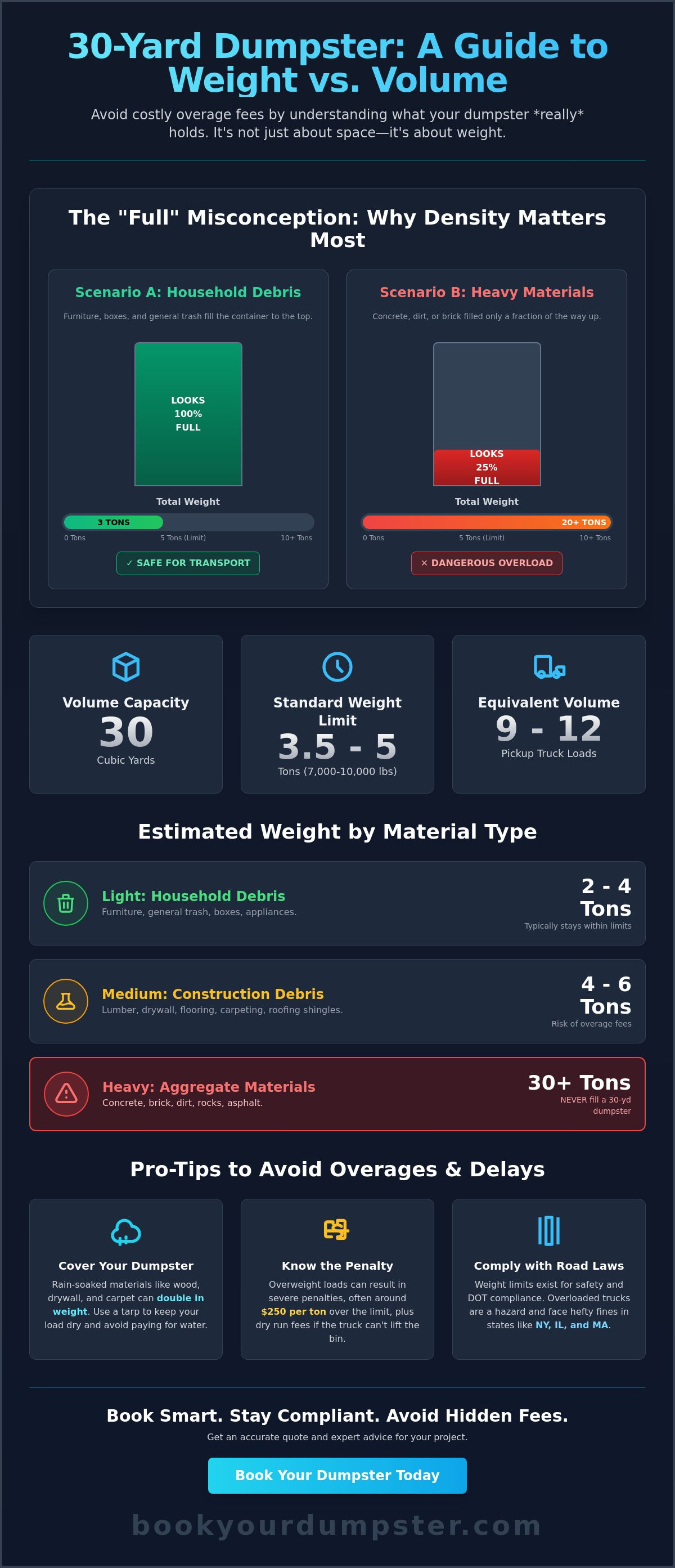
A 30-yard dumpster provides exactly 30 cubic yards of volume capacity. To visualize this, imagine the space of about nine to twelve full pickup truck loads. It is a massive container, typically measuring 22 feet long and 6 feet high. However, there is a sharp distinction between volume and weight. While the box can hold 30 yards of material, the legal and mechanical limits are much tighter. When you ask how much does a full 30 yard dumpster weigh, you are really asking about the payload capacity. Most 30-yard rentals come with a standard weight limit of 3.5 to 5 tons, or 7,000 to 10,000 pounds. This limit is determined by the hydraulic lifting capacity of the roll-off truck. If the load is too heavy, the truck's hoist cannot safely pull the container onto the bed. This results in a dry run fee and a project delay until you remove enough weight to make the bin liftable.
Why Weight Limits Exist in Waste Management
Weight limits are not suggestions; they are safety requirements. Overloaded Roll-off dumpsters put immense strain on the truck's suspension and braking systems. This increases the risk of road accidents, especially in densely populated areas like NYC or Chicago. Beyond safety, weight limits are tied to several operational factors:
- Road Safety: Prevents truck braking failures and tire blowouts on busy highways.
- Landfill Fees: Facilities charge by the ton, not by the container size. If you exceed your tonnage, you pay for the extra weight.
- DOT Compliance: Avoids heavy-load fines on local roads in New York and Massachusetts where axle limits are strictly enforced.
Staying within your limit prevents these logistical and financial headaches. If a truck is caught overweight on a public road, the driver and the company face massive fines. These regulations protect the asphalt and ensure that the vehicle remains under control during transport.
Volume vs. Weight: The 'Full' Misconception
Many first-time renters believe that as long as the debris is below the rim, they're safe. This is a dangerous misconception. A 30-yard dumpster full of household junk might weigh 3 tons, but that same container full of concrete could weigh 20 tons. Density changes everything. If you're disposing of heavy materials like dirt, rock, or shingles, you cannot fill the bin to the top. Instead, use a "water level" fill approach, only loading the container a fraction of the way up. Understanding the nuances of a roll off dumpster rental keeps your project compliant and your site safe. Always remember that how much does a full 30 yard dumpster weigh is a question of material density, not just physical space. Don't let a full-looking bin fool you into a costly overage fee.
Material Weight Breakdown: What a Full 30-Yard Dumpster Weighs
Material density is the primary variable that determines your final disposal cost. When you analyze how much does a full 30 yard dumpster weigh, you must categorize your debris into household, construction, or heavy categories. A container filled with lightweight furniture and general trash typically weighs between 2 and 4 tons. However, the same volume filled with construction materials like drywall and lumber can easily reach 4 to 6 tons. This difference is why we emphasize knowing your inventory before you order. If you're working in New York or Massachusetts, you must also account for the rain factor. Saturated wood, drywall, and carpeting absorb water quickly, which can double the weight of your load during a storm. Always use a tarp to cover your container if the forecast predicts heavy rain, as you don't want to pay overage fees for water weight.
Heavy materials like concrete, dirt, and brick require a different strategy. You should never fill a 30-yard container with these items. Because these materials weigh approximately 2,000 to 3,000 pounds per cubic yard, a full 30-yarder would exceed 30 tons. No standard roll-off truck can lift that much weight. For these projects, we recommend using multiple smaller containers to stay within legal hauling limits and avoid structural damage to your driveway or the truck itself.
Estimating Weight for Residential Cleanouts
Residential projects usually involve a mix of bagged trash and bulky furniture. You can expect to fit roughly 170 to 190 large trash bags into a 30-yard container. For furniture, a standard three-seater sofa weighs about 150 pounds, while a queen mattress averages 90 pounds. Most household cleanouts stay well within the 4-ton range. If your project is limited to a single room or a small garage, a 10 yard dumpster rental might be a more cost-effective choice for your needs.
Contractor Guide: Construction Material Weights
Contractors deal with much higher densities. For roofing projects, remember that 30 bundles of standard shingles weigh approximately one ton. If you are tearing out drywall, half-inch sheets weigh about 1.6 pounds per square foot. This means a large renovation can hit weight limits faster than you expect. The average weight of a full 30-yard construction load is 4.5 tons. To keep your job site moving and avoid delays, book your dumpster through a provider that understands these specific material requirements. Accurate estimation is the only way to ensure how much does a full 30 yard dumpster weigh doesn't become a surprise on your final invoice.
Regional Weight Regulations in New York, Illinois, and Massachusetts
Geography dictates your weight limit as much as your debris does. In New York City, navigating bridge restrictions and narrow borough streets requires precision. NYC overage fees for exceeding your limit can reach between $200 and $250 per ton as of 2026. If you place your container on public property in the city, you must secure a permit costing between $135 and $385. These costs are a direct result of the logistical complexity of hauling heavy loads through the five boroughs. Determining how much does a full 30 yard dumpster weigh before the truck arrives is the only way to avoid these steep municipal penalties.
In Illinois, specifically within Chicago, haulers must respect strict alleyway and residential street weight caps. While the average rental in the state ranges from $450 to $650, Southern Illinois providers often charge overage fees around $105 per ton for exceeding a 3-ton allowance. Massachusetts presents its own challenges, particularly in historic Boston neighborhoods where street weight limits are often capped at 10,000 pounds. Landfill and disposal fees in Massachusetts are among the highest in the country, ranging from $75 to $120 per ton. These regional variations are why dumpster rental prices fluctuate so significantly between states.
DOT Compliance and Overweight Permits
State troopers in all three states actively monitor roll-off trucks for axle weight violations. If your load is too heavy, you risk an overweight ticket that can cost thousands of dollars. You need a special permit if your project requires placing a heavy 30-yard container on a public roadway. Book Your Dumpster USA manages these local permit requirements for you, ensuring your project stays compliant with Department of Transportation safety standards. We handle the paperwork so you can focus on your job site.
Seasonal Weight Factors in the Northeast and Midwest
Weather patterns in 2026 continue to impact hauling logistics. Illinois enforces "frost laws" during winter and early spring to protect roads from damage during thaw cycles. These regulations may temporarily lower the maximum weight a truck can carry on certain routes. Similarly, Massachusetts experiences "mud season," where unpaved or weakened roads cannot support a full 30-yard load. To protect your own property, place plywood under the dumpster's rollers to distribute the weight. This simple step prevents the container from sinking into soft asphalt or soil during these vulnerable seasonal windows. Knowing how much does a full 30 yard dumpster weigh helps you time your delivery to avoid these environmental risks.
Avoiding Overage Fees: How to Estimate Your Load
Stop guessing and start calculating. To avoid overage fees, you must estimate your load before the truck arrives. If you wait until the container is at the landfill scale, it's already too late to adjust your budget. Follow these four steps to ensure your project stays profitable and compliant. First, identify your densest material. If you have a pile of concrete mixed with household trash, the concrete dictates your weight profile. Second, use a tonnage rule of thumb. For mixed residential waste, assume one ton for every five to six cubic yards. This means a container filled with standard household junk rarely exceeds 5 tons. Third, account for moisture and void space. Rain adds thousands of pounds to porous materials like wood or drywall, and large air pockets in your container waste valuable volume. Finally, consult our debris removal guide to see if your specific materials have unique disposal surcharges. Understanding how much does a full 30 yard dumpster weigh is the only way to maintain total control over your project's bottom line.
Understanding the Overage Fee Structure
Landfills operate on a pro-rated tonnage basis. If your 30-yard rental includes a 4-ton limit and the scale shows 4.2 tons, you pay for that extra 0.2 tons at the local rate. This is why flat-rate pricing is rare for large containers; the weight variance is simply too high for a single price point. At Book Your Dumpster, we prioritize transparency. We provide the weight limit upfront and pass through landfill costs without hidden markups. You'll know the exact limits of your rental before you throw the first piece of debris into the bin. This clarity distinguishes us from brokers who hide these costs in fine print.
Pro-Tips for Loading Efficiently
Maximize your space and balance your load with strategic packing. Break down large items like furniture, cabinets, or shipping crates to minimize "air" and fill void spaces. This prevents the load from shifting during transport and keeps the weight concentrated. Always load your heaviest items first and keep them centered in the bin. Centering the weight over the truck's axles ensures the hoist can lift the container safely without straining the hydraulic system. Never fill past the rim. An "overflow" isn't just a volume issue; it's a safety hazard that often signals you've exceeded the legal weight limit. If you're ready to start your project without the stress of hidden costs, book your dumpster online today and get a reliable container delivered to your site.
Book Your Dumpster: Reliable 30-Yard Rentals in NY, IL, and MA
Choosing a local expert is the fastest way to eliminate the logistical stress of waste management. While you now understand how much does a full 30 yard dumpster weigh, you still need a partner capable of hauling that weight safely and legally. We focus on reliability so your project never stalls due to equipment failure or municipal fines. Our team understands the specific bridge clearances in New York, the tight alleyway restrictions in Chicago, and the historic street limits in Boston. We provide more than just a container; we provide a high-functioning tool for your cleanup. Use our updated dumpster rental guide to compare sizes and ensure the 30-yarder is the right fit for your 2026 project goals. We have this under control, from delivery to final disposal.
Why Contractors Choose Book Your Dumpster USA
Professional contractors rely on us because we respect their time and their bottom line. We prioritize on-time delivery and pickup to keep your job site moving without interruption. You'll have direct communication with local drivers who know the exact weight limits of your street and the best placement for the roll-off bin. This local knowledge prevents "dry run" fees where a truck is unable to lift a bin or access a site. Our billing is simplified for commercial projects, offering clear documentation for your records. Whether you are managing a large-scale renovation in NYC or a multi-unit cleanout in Massachusetts, we handle the waste logistics so you can focus on the build. We don't use hidden surcharges or vague pricing; we offer the transparency that modern contractors demand.
Start Your Project Today
Don't let debris pile up and create a safety hazard on your property. Our online booking system is designed for speed and simplicity. You can choose your size, check local availability, and schedule your delivery in minutes. We provide transparent pricing based on your specific material type and geographic location, whether you're in a $500 weekly zone in New York or a $450 zone in Illinois. Knowing how much does a full 30 yard dumpster weigh allows you to book with confidence, but our experts are always available to confirm your estimates. We move you quickly from a state of clutter to a state of resolution with minimal effort on your part. Visit BookYourDumpster.com right now to secure your container. Schedule your 30-yard delivery today and experience a hassle-free rental process from start to finish.
Master Your Waste Logistics Today
Your project deserves a disposal partner that prioritizes precision over guesswork. You now know that a 30-yard container's capacity is defined by material density, typically ranging from 3.5 to 5 tons. Whether you're navigating the bridge restrictions of New York City or the seasonal frost laws in Illinois, compliance is non-negotiable for road safety. Understanding exactly how much does a full 30 yard dumpster weigh isn't just about the scale; it's the difference between a successful project and an expensive headache caused by unexpected overages.
Don't leave your budget to chance. We provide professional DOT-compliant hauling and an on-time delivery guarantee across New York, Illinois, and Massachusetts. Our transparent process ensures you get the right size for your debris without the risk of hidden fees. We have your logistics under control so you can focus on the work that matters. Book your 30-yard dumpster now and clear your site with confidence. Your clean, organized workspace is just a few clicks away.
Frequently Asked Questions
What happens if my 30-yard dumpster is over the weight limit?
If your 30-yard dumpster exceeds its weight limit, you'll face pro-rated overage fees and potential hauling delays. In New York City, these fees can reach $250 per ton as of 2026. If the load is physically too heavy for the truck's hydraulic system to lift, you must remove debris until the container is light enough for safe transport. This results in a dry run fee and stalls your project timeline.
Can I put concrete or dirt in a 30-yard dumpster?
You shouldn't put concrete or dirt in a 30-yard dumpster because these materials are too dense for a container of this size. A full 30-yarder of concrete would weigh over 30 tons, far exceeding the legal and mechanical limit of any roll-off truck. For heavy debris like rock, brick, or soil, use a 10-yard container to stay within safe hauling limits and avoid structural damage.
How many tons are included in a 30-yard dumpster rental?
A standard 30-yard dumpster rental typically includes an allowance of 3.5 to 5 tons, which equals 7,000 to 10,000 pounds. This allowance covers most residential cleanouts and light construction projects. When estimating how much does a full 30 yard dumpster weigh, remember that material density determines if you stay within this pre-paid tonnage. Always confirm your specific weight limit during the booking process.
Is there a weight limit for dumpsters in Chicago or New York City?
Yes, both Chicago and New York City enforce strict weight limits for dumpsters on residential streets and alleyways. NYC has specific bridge and tunnel weight restrictions that haulers must follow to avoid heavy municipal fines. Chicago alleyways often have caps to protect the pavement from cracking under the weight of heavy roll-off trucks. We manage these local permits and compliance details for you automatically.
How do I know if my dumpster is too heavy before it's picked up?
You can determine if your dumpster is too heavy by calculating the density of your materials or checking for visual cues like the container sinking into the asphalt. If you've filled the container more than halfway with heavy items like shingles or wet drywall, it likely exceeds the 5-ton limit. Always load heavy items first and keep them level to help the driver assess the weight during the lift.
Do rain and snow affect the weight of my dumpster load?
Rain and snow significantly increase the weight of your dumpster load by saturating porous materials like wood, drywall, and carpet. Saturated debris can double in weight, leading to unexpected overage fees at the landfill scales. Use a tarp to cover your container during storms to keep your project on budget. This simple step prevents you from paying for hundreds of pounds of water weight.
What is the maximum weight a roll-off truck can legally haul in Massachusetts?
The maximum weight a roll-off truck can legally haul in Massachusetts is governed by axle load ratings and local road regulations. In historic Boston neighborhoods, weight limits are often capped at 10,000 pounds to prevent structural damage to older streets. Our drivers ensure every load meets these 2026 Department of Transportation standards. We provide professional hauling that respects these regional legal limits every time.
Are there extra fees for heavy materials like roofing shingles?
Extra fees often apply to heavy materials like roofing shingles because they reach weight limits much faster than general trash. Since landfills charge by the ton, disposing of 30 bundles of shingles (roughly one ton) costs more than a container of light cardboard. When you calculate how much does a full 30 yard dumpster weigh for a roofing job, expect higher disposal costs. We provide transparent pricing so you know these costs upfront.


